Key takeaways
- Google AI Overviews now appear on 48% of all Google queries, up from 31% a year ago — and organic CTR drops 34–61% when they do.
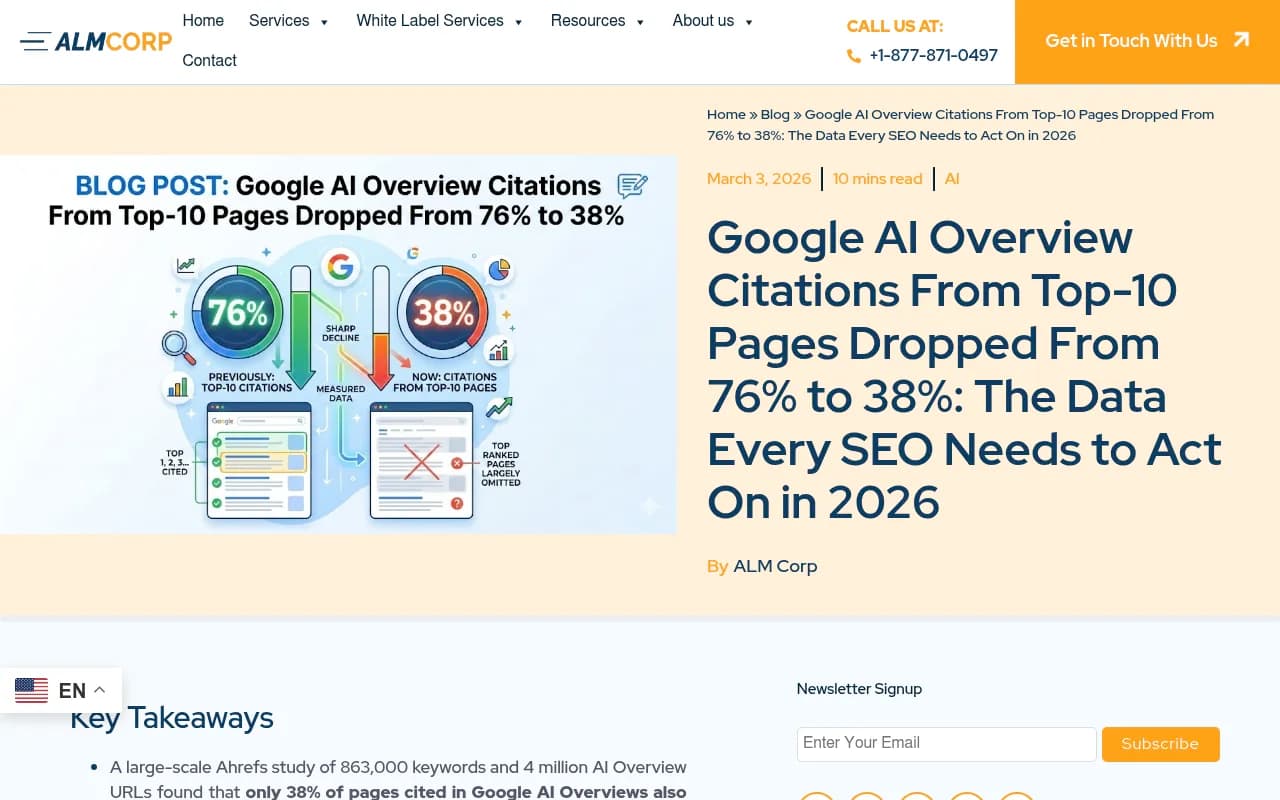
- The correlation between top-10 rankings and AI Overview citations has collapsed: only 38% of cited pages rank in the top 10 for the same query (down from 76% in mid-2025), with some datasets putting it as low as 17%.
- Content freshness matters more than most SEOs expected — pages under 3 months old are 3x more likely to be cited.
- Topical depth, structured formatting, and verifiable statistics beat raw ranking position for earning citations.
- Tracking which pages AI models actually cite (and which they skip) is now a distinct discipline from traditional rank tracking.
If you've been assuming that ranking #1 on Google automatically gets you into AI Overviews, the 2026 data is a cold shower.
A large-scale Ahrefs study of 863,000 keywords found that only 38% of pages cited in AI Overviews also rank in the top 10 for the same query. Seven months earlier, that figure was 76%. A separate BrightEdge analysis puts the overlap even lower, at around 17%, depending on methodology. Either way, the message is the same: organic ranking and AI citation are now two different games, and you need a strategy for both.
This guide breaks down what the citation data actually shows, what Google's AI is looking for when it selects sources, and what you can do to a specific page to improve its chances of being cited.
Why the ranking-to-citation correlation collapsed
The short answer is Google's query fan-out process. When someone types a query, Google's AI doesn't just look at results for that exact phrase. It splits the query into multiple sub-queries and draws from results across all of them. A page that ranks #1 for the head term might not rank at all for three of the sub-queries — and the AI Overview ends up citing pages that answered those sub-queries instead.
Google's upgrade to Gemini 3 as the global default for AI Overviews in January 2026 accelerated this shift. Gemini 3 is better at synthesizing information across multiple sources and less reliant on the top organic result as a shortcut.
The practical implication: a page optimized for one keyword phrase is now competing against pages that cover the topic from multiple angles. YouTube is now the single most-cited domain in AI Overviews outside the top 100, accounting for 18.2% of those citations. That's not a coincidence — video content often answers the "how" and "why" sub-queries that text pages miss.
What Google's AI actually looks for in a source
Before getting into page-level tactics, it helps to understand the selection criteria. Based on the available citation data, Google's AI appears to weight sources on a few dimensions:
Topical authority over keyword density. Pages that cover a topic comprehensively — including adjacent questions, edge cases, and related concepts — get cited more often than pages that are tightly optimized for a single phrase. This is the fan-out effect in action. If your page only answers the head query, you're invisible to the sub-queries.
Verifiable, specific claims. Content with recent statistics, named sources, and specific data points gets an 89% higher selection probability than vague or generic content, according to Wellows' analysis of AI Overview ranking factors. The AI is doing a form of fact-checking — it prefers sources it can verify against other signals.
Freshness. Pages under 3 months old are 3x more likely to be cited. This doesn't mean you should publish thin content constantly, but it does mean that updating existing pages with new data, new examples, or new sections has real citation value.
Structural clarity. Clear headings, logical section flow, and structured data help the AI parse what a page is about and which section answers which sub-query. A page that's hard to parse gets skipped in favor of one that isn't.
E-E-A-T signals. Author credentials, named experts, first-person experience, and citations to primary sources all contribute to what Google calls Experience, Expertise, Authoritativeness, and Trustworthiness. These signals matter more for AI citations than they ever did for traditional rankings because the AI is essentially deciding whether to stake its answer on your content.
Page-level tactics that actually move the needle
Cover the full topic, not just the keyword
The single most important thing you can do is expand the topical coverage of your page. Think about every question someone might ask before, during, and after the main query. What are the sub-questions? What are the common misconceptions? What does someone need to know to act on the answer?
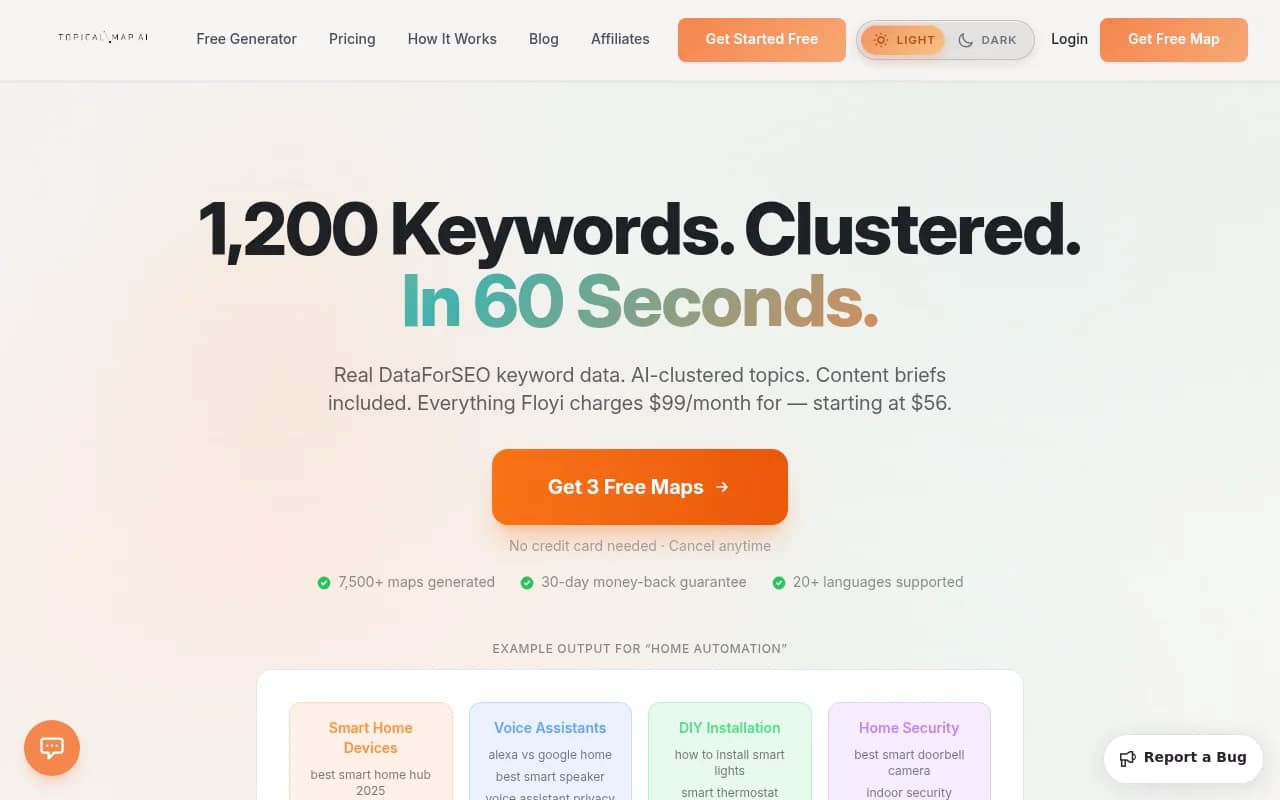
A tool like Topical Map AI can help you map out the full semantic territory around a topic before you write.
Then use a content optimization tool to check whether your page actually covers those angles. Clearscope, Surfer SEO, and MarketMuse all do this reasonably well.
Add specific, citable statistics
Generic claims don't get cited. Specific, sourced data points do. Go through your page and replace vague assertions with concrete numbers. If you don't have proprietary data, cite a named study or report. The AI needs something to anchor its answer to — give it a number with a source.
If you're publishing original research or surveys, that's even better. Pages with proprietary data get cited at higher rates because they're the only source for that specific claim.
Structure for sub-query matching
Each major section of your page should answer a distinct question. Use H2 and H3 headings that are phrased as questions or clear topic labels — not clever marketing copy. The AI needs to map your sections to specific sub-queries, and it can't do that if your headings are vague.
FAQ sections are particularly effective here. A well-structured FAQ at the bottom of a page gives the AI a clean set of question-answer pairs to pull from.
Update the page regularly
Freshness is a real signal. You don't need to rewrite the whole page — adding a new section with recent data, updating statistics, or adding a "what's changed in 2026" block can reset the freshness clock. Make sure the published/updated date is visible and accurate.
Fix technical access issues
If Google's AI crawlers can't read your page, none of the content optimizations matter. Check that your robots.txt isn't blocking AI crawlers, that your page loads without JavaScript errors, and that the main content isn't hidden behind a login or paywall.
Promptwatch has an AI crawler log feature that shows exactly which pages AI crawlers are hitting, how often, and what errors they encounter — useful for diagnosing access issues that traditional SEO tools miss.

Prerender.io is another option specifically for JavaScript-heavy sites where content might not be rendering correctly for crawlers.
The content types that get cited most
Not all content formats are equal in AI Overview citations. Based on the citation patterns:
| Content type | Citation likelihood | Why it works |
|---|---|---|
| Comprehensive guides (2,000+ words) | High | Covers multiple sub-queries in one page |
| Original research / data studies | Very high | Provides unique, citable statistics |
| Comparison pages | High | Answers "X vs Y" sub-queries directly |
| FAQ pages | Medium-high | Clean question-answer structure |
| News/updates with specific dates | High (short-term) | Freshness signal |
| Thin product pages | Low | Doesn't answer informational sub-queries |
| Generic "what is X" intros | Low | Too vague, easily replaced by any source |
The pattern is clear: depth, specificity, and structure win. Thin pages optimized for a single keyword phrase are increasingly invisible to AI Overview selection.
The freshness trap to avoid
Freshness matters, but there's a wrong way to chase it. Publishing a new thin page every week won't help — Google's AI is looking for fresh information, not just a recent publish date. A page updated with genuinely new data or a new section addressing a recent development will outperform a newly published page with nothing original to say.
The best approach is to identify your highest-potential pages (the ones that already rank in positions 5-30 for relevant queries) and systematically update them with new statistics, new examples, and new sections that cover angles you missed the first time.
How to track whether your optimizations are working
This is where most SEO workflows break down. Traditional rank tracking tells you where you rank for a keyword — it doesn't tell you whether you're being cited in AI Overviews, which pages are getting cited, or which AI models are citing you.
You need a separate tracking layer for AI visibility. A few tools worth knowing:
For AI Overview citation tracking specifically:
Promptwatch tracks citations across 10 AI models including Google AI Overviews, with page-level data showing exactly which of your pages are being cited and how often. The Answer Gap Analysis shows which prompts competitors are visible for that you're not — which is a direct input for deciding which pages to update or create next.
BrightEdge has enterprise-level AI Overview tracking and was one of the sources behind the citation data referenced in this guide.
Semrush has added AI Overview tracking to its suite, though it uses fixed prompt sets rather than custom prompt tracking.
For monitoring your brand mentions in AI responses more broadly:
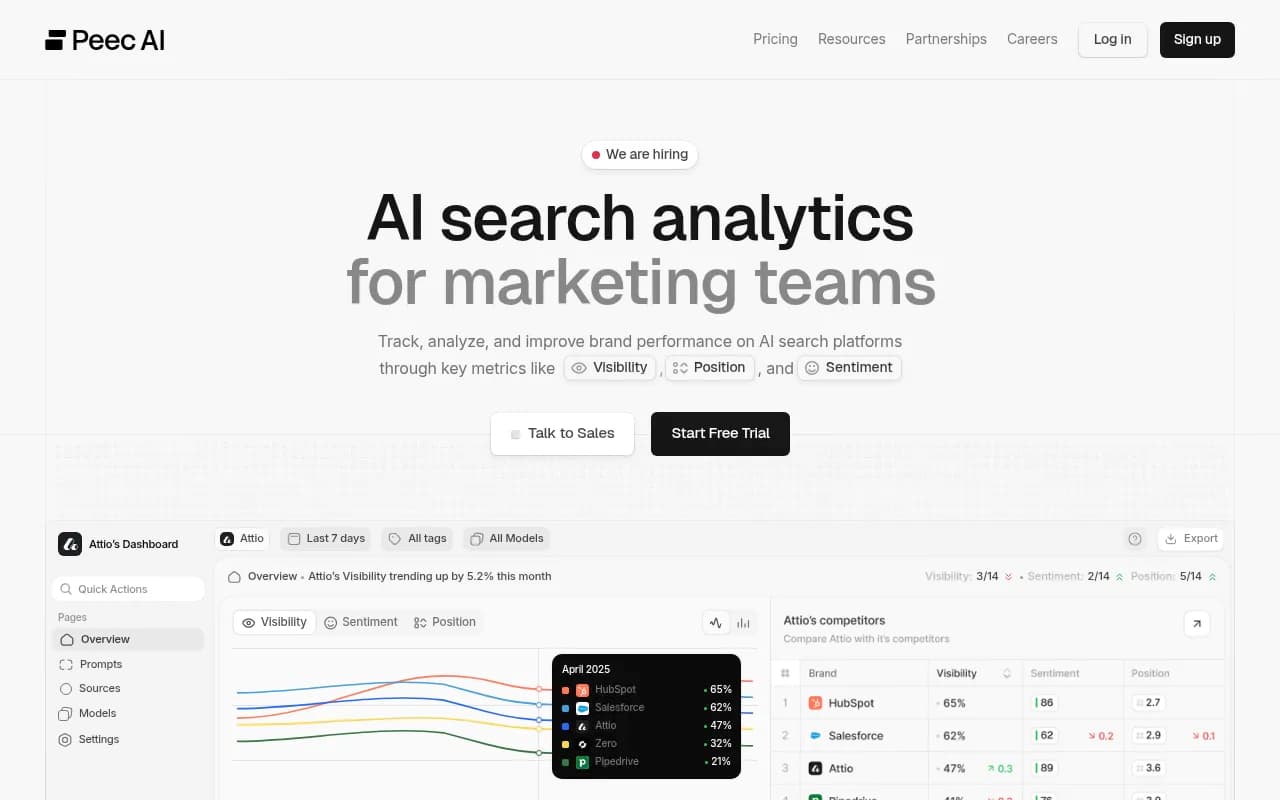
Both are more affordable entry points if you're just getting started with AI visibility tracking.
The broader shift this data points to
The collapse of the ranking-to-citation correlation isn't a bug — it's Google deliberately diversifying its sources. An AI Overview that only cited the top-ranked page for every query would be both less useful (it would miss better answers from lower-ranked sources) and more gameable.
What this means practically: you can no longer treat AI Overview visibility as a byproduct of traditional SEO. A page that ranks #3 for a keyword might never appear in an AI Overview if it doesn't cover the topic broadly enough. A page that ranks #45 might get cited regularly if it has unique data and clear structure.
The SEOs who will do well in this environment are the ones who treat topical coverage, content freshness, and citation tracking as first-class concerns — not afterthoughts.
A practical checklist for a single page
If you want to audit one page right now, here's what to check:
- Does the page cover the full topic, including adjacent questions and sub-queries?
- Does it include at least 3-5 specific, sourced statistics?
- Are the headings structured as clear topic labels or questions (not marketing copy)?
- Is there a FAQ section or Q&A block?
- When was it last updated? Is that date visible?
- Are AI crawlers able to access the page without errors?
- Does the page have clear author attribution and E-E-A-T signals?
- Is the page being tracked for AI Overview citations (not just organic rankings)?
Most pages fail on 3-4 of these. Fixing them systematically — starting with your highest-traffic, highest-potential pages — is the most direct path to improving AI Overview visibility in 2026.