Key takeaways
- Google AI Overviews and Google AI Mode are two distinct surfaces with different triggers, user intents, and ranking signals — optimizing for one does not automatically help you in the other.
- Ranking #1 in traditional Google search gives you only a 17–54% chance of appearing in an AI Overview, according to 2026 data from Ahrefs and Semrush.
- AI Overviews appear automatically in standard search results; AI Mode is a separate, opt-in conversational interface designed for complex, multi-step queries.
- You need to track both surfaces separately, because your visibility in one tells you almost nothing about your visibility in the other.
- Tools built for traditional rank tracking won't cut it here — you need platforms that specifically monitor AI search surfaces.
Why this distinction matters more than most SEOs realize
Here's a scenario that's playing out for a lot of marketing teams right now: you check your rankings, you're sitting at position one or two for your target keywords, traffic looks fine, and you feel good about it. Then someone asks "why isn't our brand showing up when people ask ChatGPT or Google about our category?" and suddenly you realize you've been tracking the wrong thing entirely.
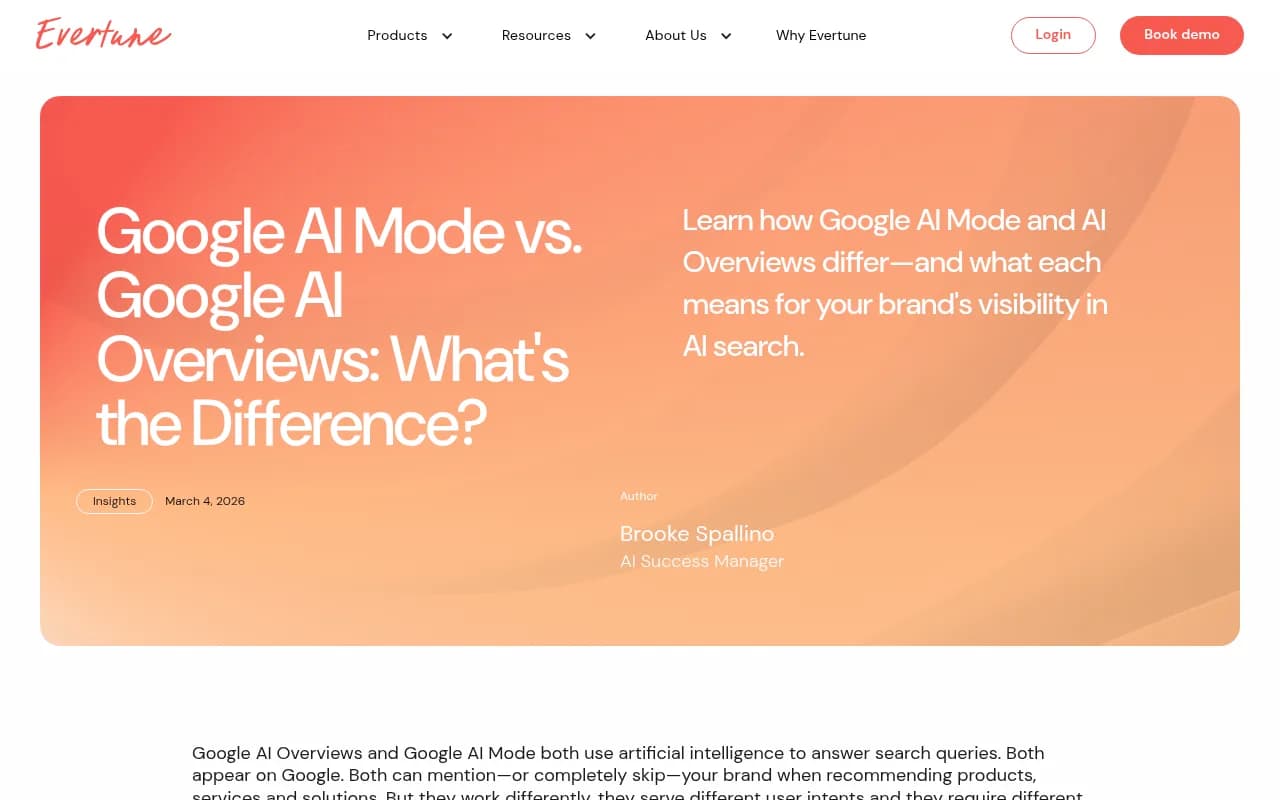
The problem isn't just ChatGPT or Perplexity. It's happening inside Google itself, across two separate AI surfaces that most rank trackers weren't built to handle. Google AI Overviews and Google AI Mode both use AI to answer queries. Both can mention or completely skip your brand. But they work differently, serve different user intents, and require different strategies to appear in.
If you're treating them as the same thing, you're likely putting effort in the wrong places.
What Google AI Overviews actually are
Google AI Overviews (often called AIOs) launched broadly in the US in May 2024. They're the Gemini-powered summary boxes that appear at the top of standard Google search results pages, above the traditional blue links.
When someone searches "best email marketing tools for small businesses" or "how do I treat a sprained ankle," Google generates a synthesized answer drawn from multiple web sources. That answer appears automatically — users don't opt in. The feature triggers on its own for queries where Google determines an AI summary adds value.
Key things to understand about AIOs:
- They appear within the standard Google search results page
- They pull from indexed web content and existing Google search signals
- They include citation links to source pages
- They focus primarily on informational and research-intent queries
- They're visible to all users on eligible searches
The citation behavior is worth paying attention to. Your brand might be mentioned in the AI-generated summary even when the citation links to a competitor's page. That's a visibility dynamic that traditional rank tracking completely misses.
How prevalent are AI Overviews in 2026?
The honest answer is: it depends on who you ask and what keyword set they're measuring. Prevalence figures vary widely because each tracker uses different keyword sets, geographies, and detection methods.
Conductor's Q1 2026 benchmark across 21.9 million queries put the figure at 25%. BrightEdge's 9-industry tracker, focused on commercial verticals, recorded 48% in March 2026. Google's own disclosures cited "roughly 50%." Some studies using broader keyword mixes show figures as low as 21%.
What's clear is that AIOs have grown dramatically from around 6.5% of queries in January 2025, and they're now a default part of the search experience for a significant portion of searches.
The gap between traditional rankings and AIO inclusion
This is the number that should make every SEO team sit up: ranking #1 in traditional Google search gives you only a 17–54% chance of appearing in an AI Overview, according to 2026 data from Ahrefs and Semrush.
Read that again. You can hold the top position in Google and still have a coin-flip chance of appearing in the AI summary that sits above your result. The gap between the two layers is real, and it's growing.
AIO inclusion is driven by different signals than traditional rankings. Semantic completeness matters more than keyword density. E-E-A-T signals (Experience, Expertise, Authoritativeness, Trustworthiness) carry significant weight. Entity recognition, structured data, and how well your content directly answers specific questions all factor in. A page that ranks well for broad keyword matching might not be the one Google's AI reaches for when constructing a summary.
What Google AI Mode actually is
Google AI Mode is something different. It's a separate, dedicated search experience that Google began rolling out in 2025. Unlike AI Overviews, AI Mode isn't a feature layered onto traditional search — it's a distinct mode users actively select, designed for more complex, conversational, and multi-step queries.
Think of it as Google's direct answer to ChatGPT and Perplexity. It's a full conversational AI search interface where users can ask nuanced questions, follow up with clarifying queries, and receive detailed responses that go well beyond what a summary box can deliver.
AI Mode handles queries that are too complex, too open-ended, or too conversational for a standard search results page to handle well. Things like "help me plan a content strategy for a B2B SaaS company targeting mid-market finance teams" or "compare the pros and cons of different approaches to technical SEO for JavaScript-heavy sites."
Key differences from AI Overviews:
- Users actively choose to enter AI Mode — it's not automatic
- It's designed for complex, multi-step, and conversational queries
- It functions more like a chatbot interface than a search results page
- It can handle follow-up questions and maintain context across a conversation
- The source citation behavior and ranking signals differ from AIOs
Side-by-side comparison
| Feature | AI Overviews | AI Mode |
|---|---|---|
| User activation | Automatic (no opt-in) | User-selected mode |
| Query type | Informational, research-intent | Complex, conversational, multi-step |
| Interface | Embedded in standard SERP | Separate conversational interface |
| Citation style | Citation cards with source links | Conversational with inline sources |
| Competitive comparison | Google vs. nothing (it's in SERP) | Google vs. ChatGPT, Perplexity |
| Tracking difficulty | Moderate | High |
| Traditional rank correlation | Low (17–54% overlap at #1) | Very low |
| Content format preference | Structured, direct answers | Comprehensive, conversational depth |
| E-E-A-T weight | High | Very high |
| Schema/structured data | Significant | Moderate |
Why you can't track them together
The core problem with treating these as one thing is that your visibility in one surface tells you almost nothing about your visibility in the other. A page optimized to appear in AI Overviews might not be the right format for AI Mode responses. A brand that dominates AI Mode conversations might barely appear in AIOs because their content isn't structured for quick summary extraction.
There's also the query intent mismatch. AI Overviews tend to trigger on informational queries with clear, direct answers. AI Mode handles queries where the user wants to think through something complex. The content that serves one intent well often doesn't serve the other.
And then there's the competitive landscape difference. In AI Overviews, you're competing with every indexed page Google can pull from. In AI Mode, you're competing in a context where Google is also competing with ChatGPT and Perplexity for the user's attention — which means the quality bar for responses is higher and the citation behavior is different.
If you're only tracking traditional keyword rankings, you're blind to both surfaces. If you're tracking AIOs but not AI Mode, you're missing the surface that's growing fastest among high-intent users.
What ranking signals matter for each surface
For AI Overviews
The research on AIO ranking factors in 2026 points to a consistent set of signals:
- Semantic completeness: does your content fully answer the question, including related sub-questions?
- E-E-A-T: first-hand experience signals, author credentials, and site authority all matter
- Entity recognition: is your brand or content clearly associated with the relevant topic entities?
- Structured data: FAQ schema, HowTo schema, and other structured markup help Google extract clean answers
- Direct answer formatting: content that leads with a clear, direct answer to the query tends to get cited more
- Verification signals: citations, references, and factual accuracy markers
One thing that's changed in 2026: multimodal signals are increasingly relevant. Content with supporting images, charts, or video that reinforces the text answer appears to have an edge in some verticals.
For AI Mode
AI Mode favors content that demonstrates genuine depth and expertise. Because users are asking more complex questions, shallow content that answers a surface-level query won't cut it. What tends to work:
- Comprehensive coverage of a topic, including nuances, trade-offs, and edge cases
- Conversational writing that anticipates follow-up questions
- Strong E-E-A-T signals, particularly first-hand experience and demonstrated expertise
- Content that covers the full decision-making journey, not just the top-of-funnel question
- Brand authority signals: mentions across authoritative sources, not just your own site
How to track both surfaces properly
This is where most teams fall short. Traditional rank trackers like Semrush and Ahrefs will show you your position in the blue-link results, but they weren't built to track AI surface visibility in any meaningful depth. Semrush uses fixed prompts for its AI tracking features, which limits how much you can customize monitoring for your specific brand and competitive landscape.
What you actually need is a platform that monitors both AI Overviews and AI Mode as separate surfaces, with separate visibility scores, and ideally connects that visibility data to actual traffic and revenue.
Promptwatch tracks both Google AI Overviews and Google AI Mode as distinct surfaces, alongside nine other AI models (ChatGPT, Claude, Perplexity, Gemini, Grok, DeepSeek, Copilot, Meta AI, and Mistral). The page-level tracking shows exactly which of your pages are being cited, how often, and by which model — so you can see your AIO visibility and AI Mode visibility separately and act on the gaps.

For teams that want to go deeper on the Google-specific surfaces, a few other tools worth knowing about:
SE Ranking has added AI visibility tracking that covers Google's AI surfaces alongside traditional rank data, which makes it useful if you want everything in one place.
BrightEdge is the enterprise option here — their 9-industry tracking data is some of the most cited in the industry, and their platform covers AI search visibility alongside traditional SEO.
Conductor's Q1 2026 benchmark data (21.9 million queries) is one of the more methodologically rigorous datasets on AIO prevalence, and their platform has expanded to cover AI search tracking.
Practical steps to improve visibility in both surfaces
Step 1: Audit your current visibility in each surface separately
Before you optimize anything, you need a baseline. Run your target queries through Google and note which ones trigger AI Overviews. Then switch to AI Mode and run the same queries. You'll likely find your brand appears in different places, for different queries, in each surface.
Step 2: Identify the content gaps
For AI Overviews, look at which queries trigger an AIO where your brand isn't cited. Those are your gaps. For each gap, ask: does your site have content that directly and comprehensively answers this query? If not, that's your content priority list.
For AI Mode, the gaps tend to be around depth and conversational coverage. If your content answers "what is X" but not "how do I choose between X and Y given my specific situation," you're probably not showing up in AI Mode responses for decision-stage queries.
Step 3: Restructure content for AIO extraction
AI Overviews tend to pull from content that:
- Leads with a direct answer in the first paragraph
- Uses clear headers that match common query patterns
- Includes structured lists and tables
- Has FAQ sections that address related sub-questions
- Is factually accurate and cites sources
Step 4: Build depth for AI Mode
For AI Mode, the investment is in comprehensive, authoritative content. Think less about keyword optimization and more about whether your content is genuinely the best resource on the topic. That means covering trade-offs, edge cases, and the questions users typically ask after the initial question.
Step 5: Monitor, iterate, and track what changes
This is the part most teams skip. You make content changes, but you don't have a system to know whether those changes improved your AI visibility. Set up tracking for both surfaces before you start optimizing, so you can actually measure the impact of your work.
Common mistakes to avoid
Treating AIO and AI Mode as the same optimization target is the biggest one. But there are others:
Assuming traditional rankings predict AI visibility. They don't. A 17–54% correlation at position one is weak enough that you can't rely on it.
Optimizing only for the queries you already rank for. AI surfaces often cite sources for queries where the traditional SERP has no clear winner. Those are actually easier to win.
Ignoring brand mention tracking. Your brand might be mentioned in AI responses without being cited as a source. That's still visibility — and it's worth tracking separately from citation tracking.
Forgetting about AI Mode entirely because it requires user opt-in. The users who choose AI Mode tend to be higher-intent and more sophisticated. They're often the buyers you most want to reach.
The tracking infrastructure you need in 2026
To do this properly, you need:
- A way to monitor AI Overview appearances for your target queries, with historical data so you can track changes over time
- A way to monitor AI Mode responses for the same queries
- Page-level attribution so you know which of your pages are being cited
- Traffic attribution to connect AI visibility to actual site visits and conversions
- Competitor visibility data so you know who's winning the citations you're missing
Most traditional SEO tools cover none of these. A handful of newer platforms cover some of them. Very few cover all five in a way that's actionable rather than just informational.
The distinction between monitoring and optimization is worth keeping in mind as you evaluate tools. Knowing you're invisible in AI Overviews is useful. Knowing exactly what content you need to create to fix it is what actually moves the needle.
Wrapping up
Google's AI search is not one thing. It's at least two distinct surfaces with different triggers, different user intents, different ranking signals, and different competitive dynamics. Treating them as the same problem means your optimization efforts are at best partially effective and at worst pointed in the wrong direction.
The practical implication is straightforward: set up separate tracking for AI Overviews and AI Mode, establish baselines for each, identify your gaps in each surface independently, and build a content strategy that addresses both. The teams doing this in 2026 are building a visibility advantage that's going to compound as AI search usage continues to grow.