Key takeaways
- All four platforms track AI search visibility, but they differ sharply on what happens after you see the data -- only one of them helps you act on it.
- Profound is the strongest pure monitoring tool for enterprise teams with analyst workflows and API needs.
- Peec AI and Scrunch AI are solid entry points for teams that want to start tracking without a big budget or complex setup.
- Promptwatch is the only platform here that closes the full loop: find gaps, generate content, and track whether it worked -- making it the most practical choice for teams that need to move the needle, not just measure it.
Every marketer I talk to right now has the same problem. They know AI search is eating into their traffic. They've seen the screenshots of ChatGPT recommending their competitors. But when they go looking for a tool to fix it, they find a crowded market full of dashboards that show them the problem without helping them solve it.
So let's cut through it. Four platforms, one goal. Here's what each one actually does, where it falls short, and which one you should be using in 2026.
What we're actually comparing
The question isn't just "which tool tracks the most AI models." That's table stakes now. The real question is: after you see that your competitor is getting cited by ChatGPT and you're not, what does the tool help you do about it?
That's the lens I'm using here. Monitoring depth matters, but it's only useful if it leads somewhere.
Scrunch AI
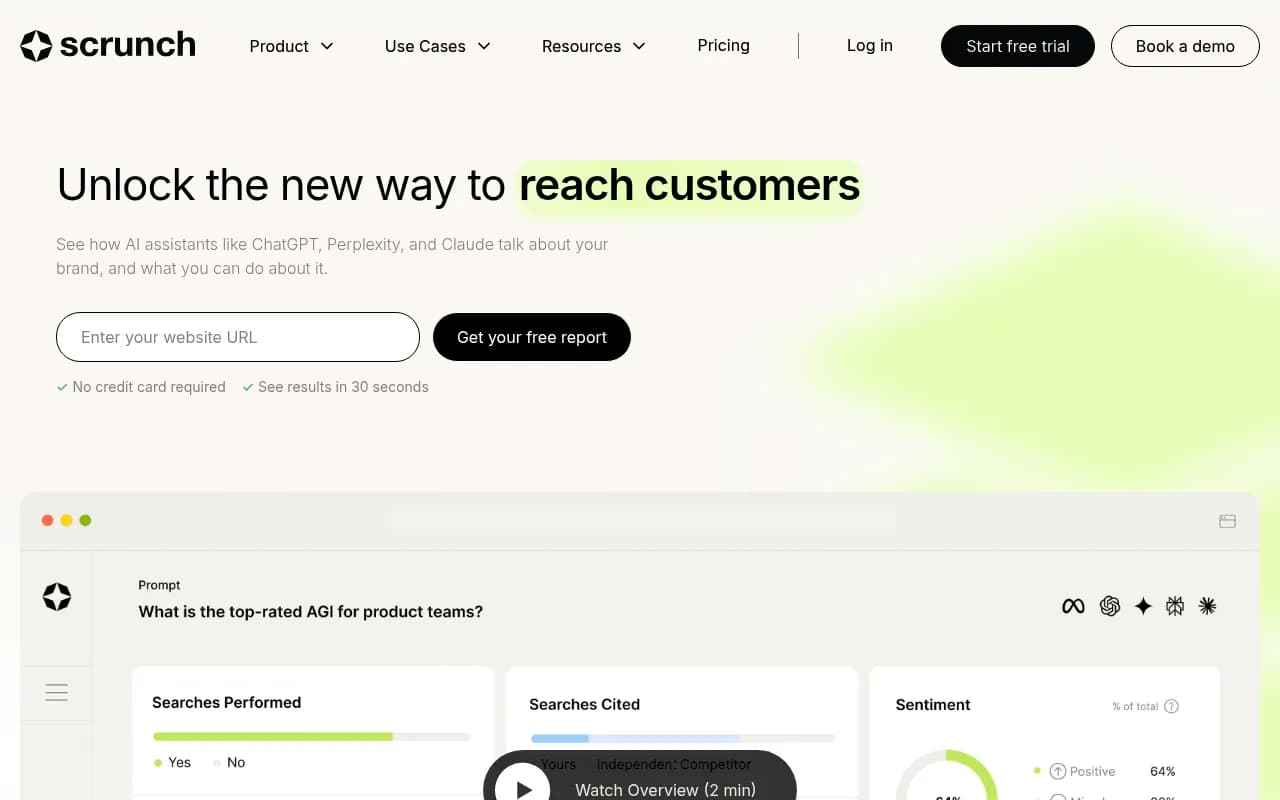
Scrunch AI positions itself as an AI search monitoring and optimization platform. It tracks brand mentions across ChatGPT, Perplexity, Claude, Gemini, and a handful of others, and gives you visibility scores, share of voice comparisons, and competitor benchmarking.
The interface is clean. Setup is reasonably fast. For a team that's never tracked AI visibility before, it's a decent starting point.
Where it gets complicated is the optimization side. Scrunch does surface some content recommendations, but they're fairly surface-level -- the kind of suggestions that tell you "you should create content about X" without much depth on why AI models would actually cite it or how to structure it. There's no built-in content generation, no citation-level analysis showing which specific pages are getting picked up, and no crawler log data showing how AI bots are actually interacting with your site.
One data point worth noting: a 2026 comparison on nicklafferty.com found that Profound ranked #1 in AI search with 47.1% AI visibility, while Scrunch ranked #23 at 4.7%. That's a striking gap for a tool that's supposed to help you win AI search -- though to be fair, it's one data point from one analyst's comparison.
Scrunch is better suited to teams that want a monitoring dashboard with a clean UI and don't yet need deep optimization capabilities.
Profound
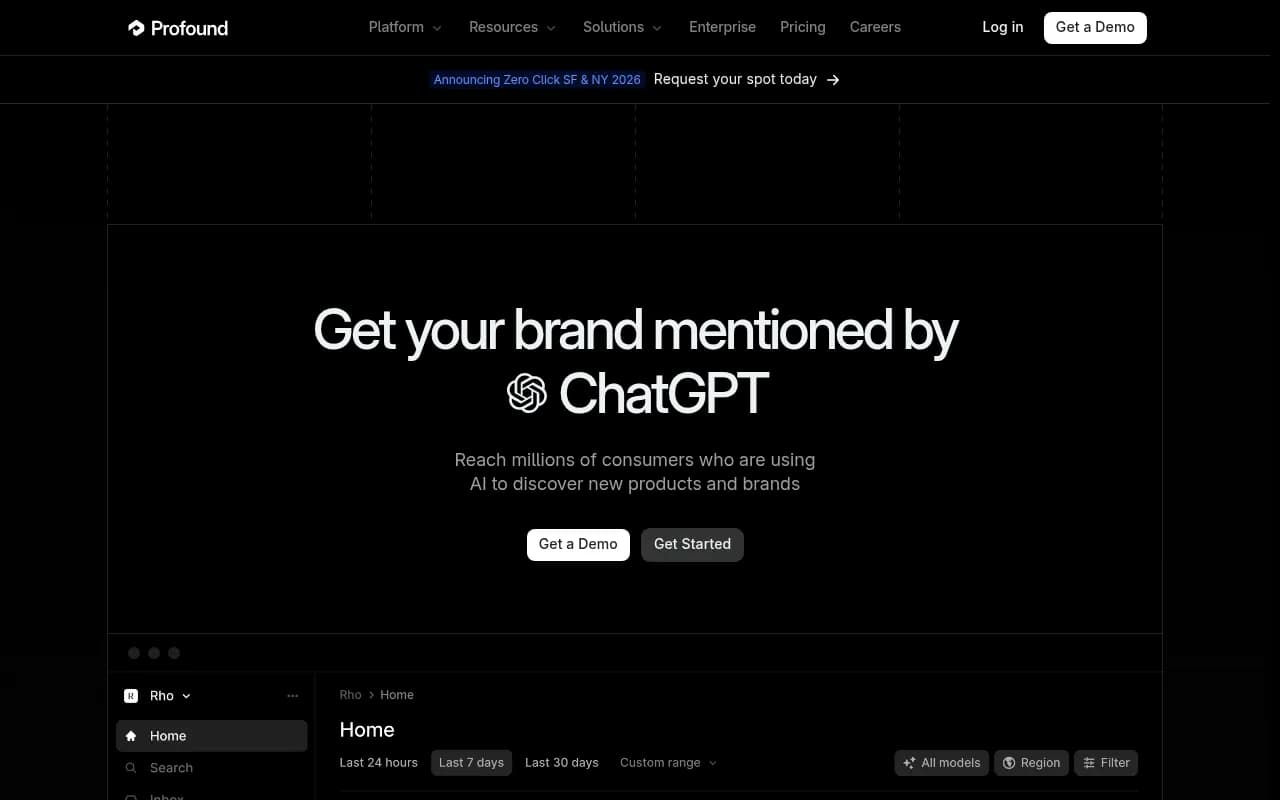
Profound is the enterprise standard for AI visibility monitoring. If you have a large brand, a dedicated analyst team, and you need raw data, API access, and near real-time monitoring across multiple markets, Profound is genuinely impressive.
It tracks a wide range of AI models, gives you granular prompt-level data, and lets you slice visibility by region, language, and competitor. The depth of the monitoring data is real.
The catch is that Profound is built for analysts. The platform assumes you have someone who knows what to do with the data once they have it. There's no content generation, no built-in writing tools, and limited guidance on what to actually change on your website to improve your scores. You get the "what" but you're largely on your own for the "how."
Pricing reflects the enterprise positioning -- it's not a tool you pick up casually. For a large brand with a dedicated SEO or GEO team that can translate data into action independently, it's a strong choice. For a mid-market marketing team that needs the platform to guide them toward fixes, it leaves a gap.
Peec AI
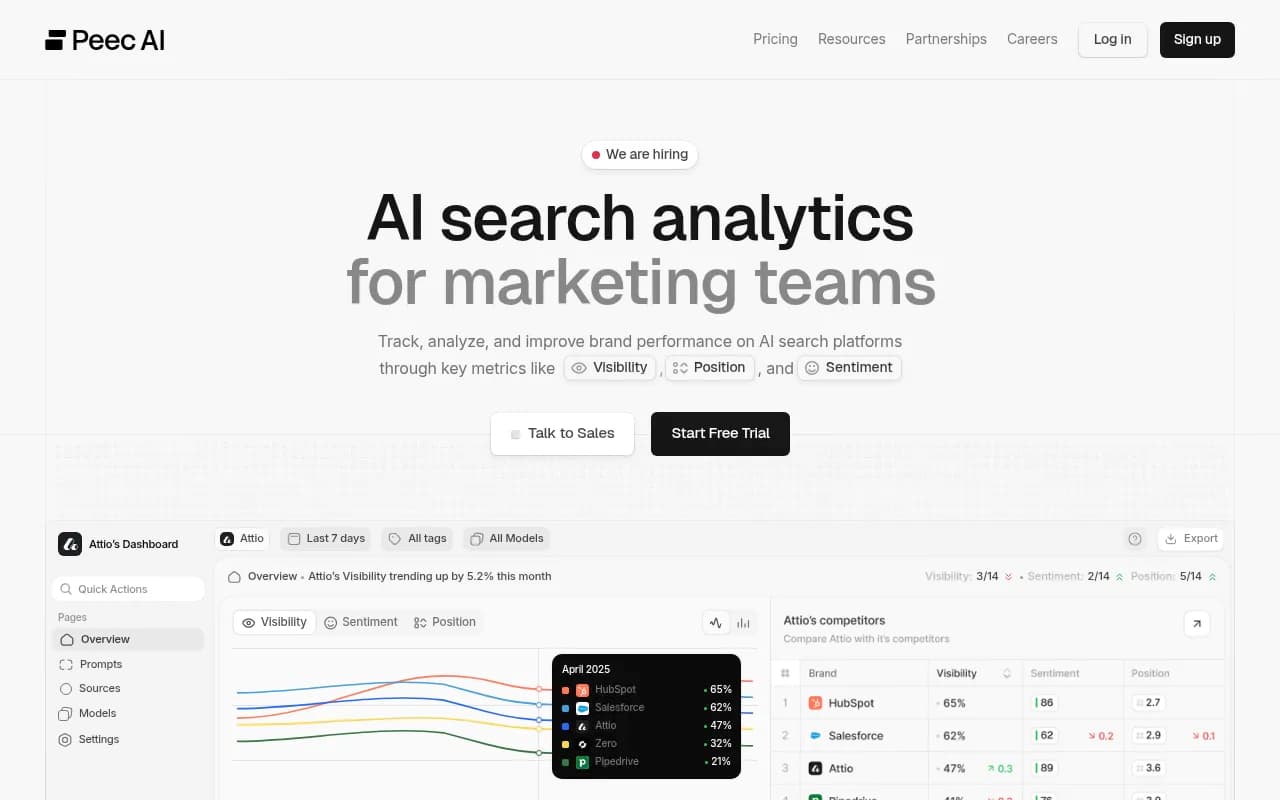
Peec AI is the budget-friendly option in this comparison. At around €89/month, it gives you multi-language AI visibility tracking across ChatGPT, Perplexity, Gemini, and a few others, with share of voice metrics and competitor comparisons.
For what it costs, it's genuinely good. The multi-language support is a real differentiator at this price point -- most tools charge significantly more for international tracking. If you're a small team or an agency running initial AI visibility audits for clients, Peec AI gives you enough to have an informed conversation.
The limitations are predictable for a tool at this price. There's no content generation, no crawler logs, no citation-level analysis, and no traffic attribution. It's a monitoring tool, full stop. You'll see where you stand, but the path from "we're invisible in Perplexity" to "here's what we changed and here's the traffic impact" isn't something Peec AI helps you walk.
For teams just getting started with GEO, it's a reasonable first step. For teams that need to show results, you'll outgrow it quickly.
Promptwatch
Promptwatch takes a different approach from the other three, and it's worth being specific about why.

The core difference is that Promptwatch is built around a loop, not a dashboard. Most monitoring tools show you that you're invisible for a set of prompts. Promptwatch shows you that, then immediately tells you what content is missing from your site that's causing the gap, then helps you create that content, then tracks whether the new content actually gets cited.
That's a meaningful distinction. Here's how it breaks down in practice:
Finding the gaps: The Answer Gap Analysis shows you exactly which prompts your competitors are visible for but you're not. Not vague topic suggestions -- specific prompts, with volume estimates and difficulty scores, so you can prioritize the ones worth going after.
Creating content that gets cited: The built-in AI writing agent generates articles, listicles, and comparisons grounded in real citation data. Promptwatch has analyzed 880M+ citations across AI models, so the content recommendations aren't generic SEO advice -- they're based on what AI models actually cite. This is the piece that's completely absent from Scrunch, Profound, and Peec AI.
Tracking the results: Page-level tracking shows which specific pages are being cited, by which models, and how often. Traffic attribution (via a code snippet, Google Search Console integration, or server log analysis) connects AI visibility to actual revenue. You can see the loop close.
Beyond the core loop, Promptwatch covers some ground the others don't touch. AI crawler logs show you in real time which AI bots (ChatGPT, Claude, Perplexity) are hitting your site, which pages they're reading, and what errors they're encountering. Reddit and YouTube tracking surfaces discussions that directly influence AI recommendations -- a channel most platforms ignore. ChatGPT Shopping tracking monitors when your brand appears in product recommendation carousels.
It monitors 10 AI models (ChatGPT, Perplexity, Google AI Overviews, Google AI Mode, Claude, Gemini, Meta/Llama, DeepSeek, Grok, Mistral, Copilot) and supports multi-language, multi-region tracking with customizable personas.
Pricing starts at $99/month for the Essential plan (1 site, 50 prompts, 5 articles), $249/month for Professional (2 sites, 150 prompts, 15 articles, crawler logs, city-level tracking), and $579/month for Business (5 sites, 350 prompts, 30 articles). There's a free trial available.
Side-by-side comparison
| Feature | Scrunch AI | Profound | Peec AI | Promptwatch |
|---|---|---|---|---|
| AI model coverage | 5-6 models | 8+ models | 4-5 models | 10 models |
| Prompt-level tracking | Yes | Yes | Yes | Yes |
| Competitor benchmarking | Yes | Yes | Yes | Yes |
| Share of voice | Yes | Yes | Yes | Yes |
| Content gap analysis | Basic | No | No | Yes (Answer Gap Analysis) |
| Built-in content generation | No | No | No | Yes (AI writing agent) |
| Citation-level analysis | Limited | Yes | No | Yes (880M+ citations) |
| AI crawler logs | No | No | No | Yes |
| Traffic attribution | No | No | No | Yes |
| Reddit/YouTube tracking | No | No | No | Yes |
| ChatGPT Shopping tracking | No | No | No | Yes |
| Multi-language support | Limited | Yes | Yes | Yes |
| API access | Limited | Yes | No | Yes |
| Starting price | ~$79/mo | Enterprise | ~€89/mo | $99/mo |
| Free trial | Yes | Demo only | Yes | Yes |
| Best for | Small teams wanting clean UI | Enterprise analysts | Budget-conscious starters | Teams that need to improve, not just monitor |
Which one should you actually use?
The honest answer depends on what you need to accomplish.
If you're at an enterprise with a dedicated analytics team and you need the deepest possible monitoring data with API access and custom reporting, Profound is the right call. It's built for that workflow.
If you're a small team or agency just starting to track AI visibility and budget is a constraint, Peec AI gets you in the game without a big commitment. It won't help you fix anything, but it'll show you where you stand.
If you want a clean monitoring interface with a slightly broader feature set than Peec AI and you're not ready for a full optimization platform, Scrunch AI is a reasonable middle ground.
But if your goal is to actually improve your AI search visibility -- to go from invisible to cited, and to connect that to revenue -- then Promptwatch is the only platform here that supports the full workflow. The monitoring is strong, the content gap analysis is specific and actionable, and the built-in content generation means you don't need to take the data somewhere else to act on it. The traffic attribution closes the loop in a way none of the other three platforms attempt.
Most teams in 2026 don't have a monitoring problem. They have an optimization problem. They know they're not showing up in ChatGPT. What they need is a clear path from that insight to a fix. That's what separates Promptwatch from the rest of this field.
A note on the broader market
These four platforms aren't the only options. Tools like Otterly.AI and Peec AI serve the budget end. Platforms like Profound and Scrunch serve different points on the monitoring spectrum. There are also newer entrants worth watching.

But across the 12+ platforms I've looked at for this comparison, the pattern is consistent: most tools stop at monitoring. They show you the gap. The ones that help you close it are rare, and in 2026, that's the capability that actually matters.
If you're evaluating AI visibility platforms right now, the question to ask every vendor is simple: "After I see that I'm invisible for a prompt, what does your platform help me do about it?" The answer tells you everything.