Key takeaways
- Report AI search in layers: visibility (citations), referral traffic, conversions, and pipeline. Never collapse them into one revenue number.
- Separate directly attributed results (a session that started on an AI platform) from assisted or influenced results (correlated, not session-traced).
- Published conversion benchmarks come from specific cohorts. Use them to justify building the report, not to forecast a client's results.
- Crawler logs, GA4 segmentation, and CRM tagging are what turn AI visibility into something a CFO will accept.
- Document the prompt list, sample size, and attribution model behind every number you present.
Why the old reporting chain breaks
For years agencies told a clean story: rankings go up, impressions go up, clicks go up, conversions go up, revenue follows. That chain still works for classic search. It falls apart when a buyer asks ChatGPT for the best tools in a category, reads five recommendations, never clicks, and Googles your client's brand name three days later.
Only one of those paths shows up as AI referral traffic. The other two still had marketing value, and your report has to account for them without inventing certainty.
The pressure is real. Demand Local's 2026 agency playbook argues the accounts most at risk are not the ones with the worst results but the ones still reporting like it is 2022: leading the QBR with a falling sessions chart, getting defensive, and lumping AI-driven loss together with fixable on-site issues. Pew Research's July 2025 study of 68,000 real searches found users clicked a result 8% of the time when an AI summary appeared versus 15% without one. Sessions are going to look worse on informational queries. Your job is to explain why, then show where value is showing up instead.
The measurement chain to show clients
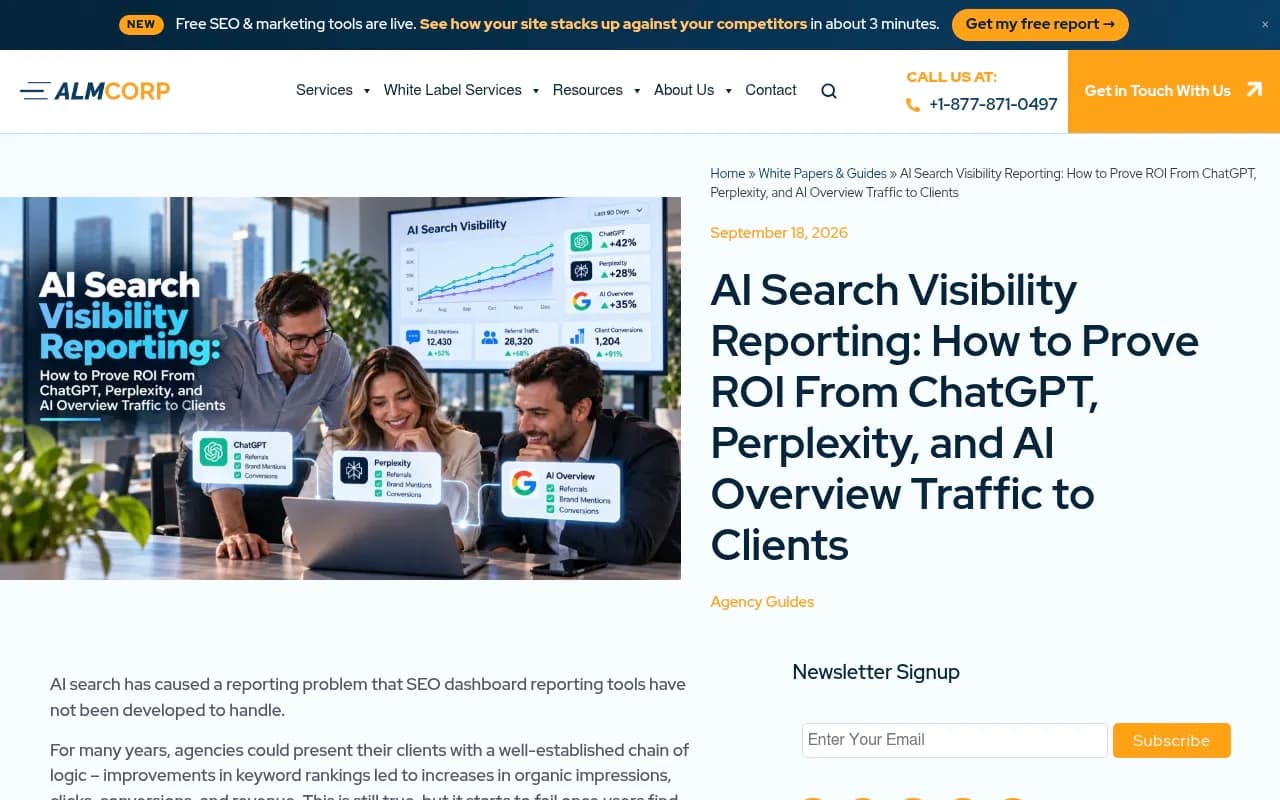
The cleanest framing I have seen, from ALM Corp's agency guide, is a chain: AI visibility, then citation or recommendation, then referral, then engagement, then conversion, then revenue. Every link gets its own metric, and every link is labeled with how well you can actually observe it.
| Layer | What it answers | Typical metric | Evidence quality |
|---|---|---|---|
| Visibility | Does AI name or cite the client? | Citation rate, share of voice, position | Proxy, depends on your prompt set |
| Recommendation | Is the client picked in shortlists? | Recommendation appearance, sentiment | Proxy |
| Referral | Do people arrive from AI platforms? | AI-referred sessions by platform | Direct, partial (missing referrers) |
| Conversion | Do those visits convert? | Leads, demos, purchases by platform | Direct |
| Pipeline and revenue | Did it become money? | CRM-tagged opportunities, closed-won | Direct or influenced, label which |
The rule that protects you: pipeline is not revenue, and influenced is not attributed. State the difference on the slide, not in a footnote.
Step 1: Track AI referral traffic in GA4
If you have GA4 and a couple of hours, you can set up a minimum viable stack. Google Analytics has introduced an AI Assistant channel that identifies recognized assistants, and Search Console now reports impressions from AI Overviews and AI Mode. Check both are available on your client's properties before building anything custom, since I could not verify exact channel behavior across every account type.
For a custom segment, filter referral traffic from these sources:
chatgpt.com
chat.openai.com
perplexity.ai
gemini.google.com
copilot.microsoft.com
claude.ai
you.com
Many of these still land in "Referral" or "Direct" by default. Pull them into a dedicated channel group, then break results out by platform, not as one blended AI bucket. Public data shows very different conversion profiles per platform, and blending hides that.
Also report landing pages. Which pages receive AI-referred sessions, and do those sessions behave differently from organic, paid, and direct? That second signal is often more useful to a client than the headline number.
Expect undercounting
Some AI visits arrive with no referrer, and many influenced visits happen later through branded search or direct. Tell clients GA4 is a floor, not a ceiling. This is also where server-side evidence helps: AI crawler logs show which bots are reading which pages, independent of whether a human ever clicked. Promptwatch's crawler data, for example, showed OpenAI at 79.8% of IP-verified AI crawler requests in the week of Aug 31 to Sept 6, 2026, down from 94.8% in mid-June (Promptwatch Data: AI crawler traffic). If a provider is a big share there but near zero in a client's logs, robots.txt, the CDN, or the WAF is probably blocking it. That is a fixable problem you can put in a report.
Step 2: Build a prompt baseline and track citations
Traffic only tells you about people who clicked. Citation tracking tells you whether you are in the answer at all.
- Build a prompt list with category prompts ("best AI PR agency"), comparison prompts ("X vs Y"), and commercial-intent prompts.
- Run them across ChatGPT, Perplexity, Gemini, and Google AI Overviews.
- Calculate citation rate: prompts where the brand is cited, divided by prompts tested. Cited in 12 of 50 prompts means a 24% rate for that test set.
- Track it monthly by platform, prompt type, cited source, and competitor.
Be honest in the report that this is a proxy built on your chosen prompt set. ALM Corp makes this point well: any visibility report is only as good as the queries behind it. Document the list, the sample size, and the dates.
Tools like Promptwatch can run these prompt sets daily against the real interfaces of the major AI engines and track visibility, share of voice, and citations for you.

Report each engine separately
Citation behavior differs a lot by engine, so a blended number can mislead. In Promptwatch's data for Sep 28 to Oct 4, 2026, social platforms made up 0.46% of ChatGPT citations but 12.2% of Google AI Overviews citations, and 2.7% of Perplexity's (Social Media Citations by AI Model, October 2026). A client investing in Reddit or YouTube presence could look great in AI Overviews and invisible in ChatGPT. One average would hide that.
Content type matters too. Product pages were the most cited type in ChatGPT at 22.4% of citations in that same week (ChatGPT citation share by content type), which tells you where to point optimization work and what to show as the cause behind a citation gain.
Check for ads before you celebrate
One caveat worth putting in your methodology. Promptwatch's data shows ChatGPT ads appeared in an average of 20.1% of web-search responses between May 20 and Aug 17, 2026, peaking at 43.9% on a single day (ChatGPT ads over time). Some AI-referred clicks may come from paid placements rather than earned citations. Check ad visibility across several days before attributing a traffic bump to your content work.
Step 3: Connect conversions to CRM
Without a CRM tag, AI search stays a traffic report. At minimum store these fields per lead:
- Source platform (ChatGPT, Perplexity, Gemini, Claude, Copilot)
- First AI landing page
- Prompt cluster, when known
- Conversion event
- Opportunity source
- Closed-won revenue
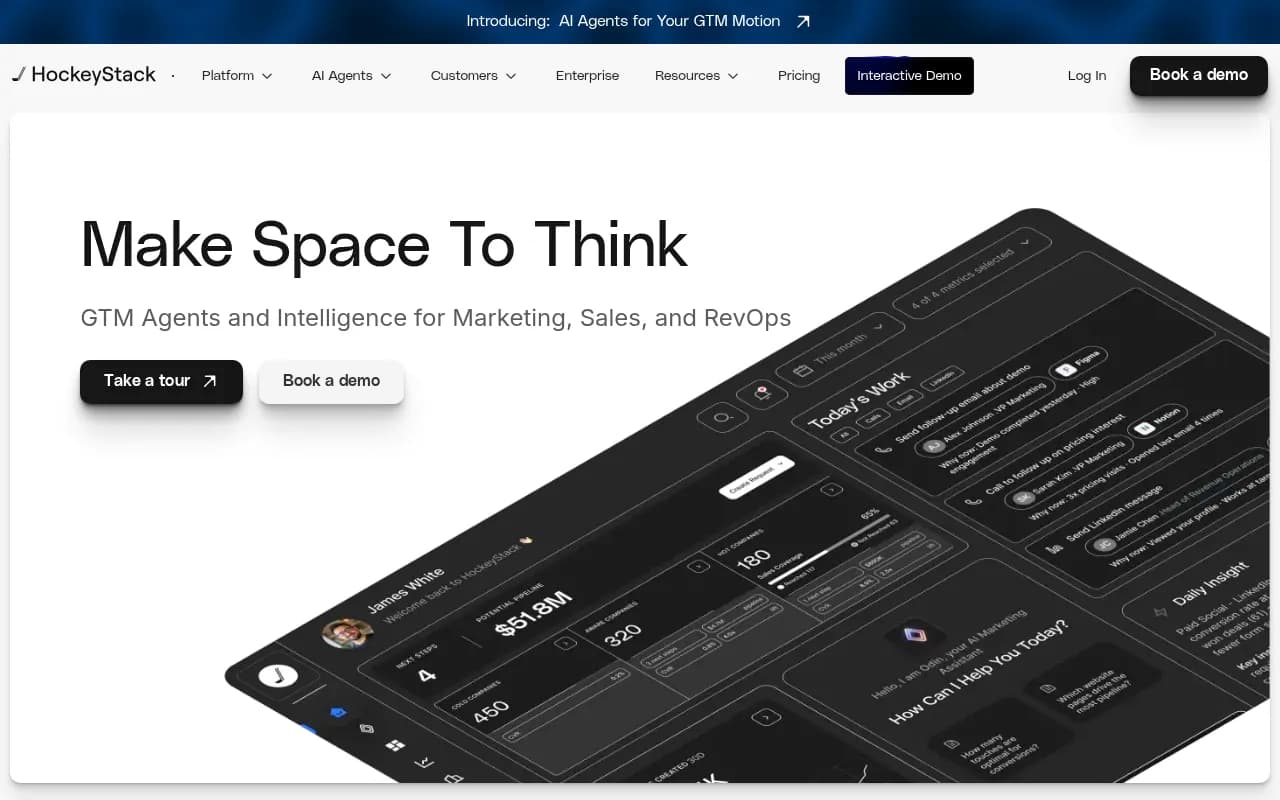
Add a "How did you hear about us?" field with an AI assistant option on forms. It is unglamorous and it catches the dark-funnel visits GA4 misses. Attribution platforms like HockeyStack can help stitch this together for B2B clients.
Your CRM matters here as well. If the client is on HubSpot or Salesforce, create a dedicated source value for AI so pipeline reports can filter on it.
Step 4: Use conversion benchmarks carefully
Everyone wants a number like "AI traffic converts 4.4x better." Several are floating around, and they measure different things.
| Source | Cohort | Finding | Limit |
|---|---|---|---|
| Seer Interactive | One client, GA4, Oct 2024 to Apr 2025 | ChatGPT 15.9%, Perplexity 10.5%, Claude 5.0%, Gemini 3.0% vs Google Organic 1.76% | One site, key-event conversion rate, about 11,000 AI sessions |
| Ahrefs | Its own site, 30 days | 0.5% of visits, 12.1% of signups | Ahrefs itself warned it may not scale |
| Microsoft Clarity | 1,200+ publisher and news sites | LLM sign-up rate 1.66% vs 0.15% for search | Publishers, sign-ups and subscriptions only |
| Adobe via TechCrunch | U.S. retail, Q1 2026 | AI traffic up 393% YoY; March conversion 42% better | Retail-specific |
| Semrush | Its own analysis | AI visitors 4.4x as valuable as organic | Different definition of value |
The honest read: these justify segmenting AI referrals and building the report. They do not prove your client will see a multiplier. Compare AI referrals against the client's own organic, paid, direct, and partner channels, by landing page and conversion event. If a client's AI sessions are tiny, say so. Forrester estimated AI traffic at 2% to 6% of B2B organic traffic, growing quickly, and small volumes are normal.
Step 5: Build the client dashboard
ALM Corp's template is a good starting shape: a small set of KPIs with current period, previous period, change, and a column for how the number was modeled. The "model basis" column is the useful bit. It forces you to write something like "correlated rise in branded search and direct conversions during periods of higher tracked visibility; not session-traced" next to any influenced pipeline figure.
A workable monthly layout:
- Citation rate and share of voice by engine, versus named competitors
- AI-referred sessions by platform, with top landing pages
- AI referral conversion rate against organic and paid
- Leads, qualified leads, and opportunities tagged to AI
- Assisted conversions and branded search trend, labeled as influenced
- Crawler access issues found and fixed
Partnerize's guide suggests mapping citations to pipeline contribution, demo requests, or completed sales on real-time dashboards. That works if you are honest about which links are measured and which are inferred.
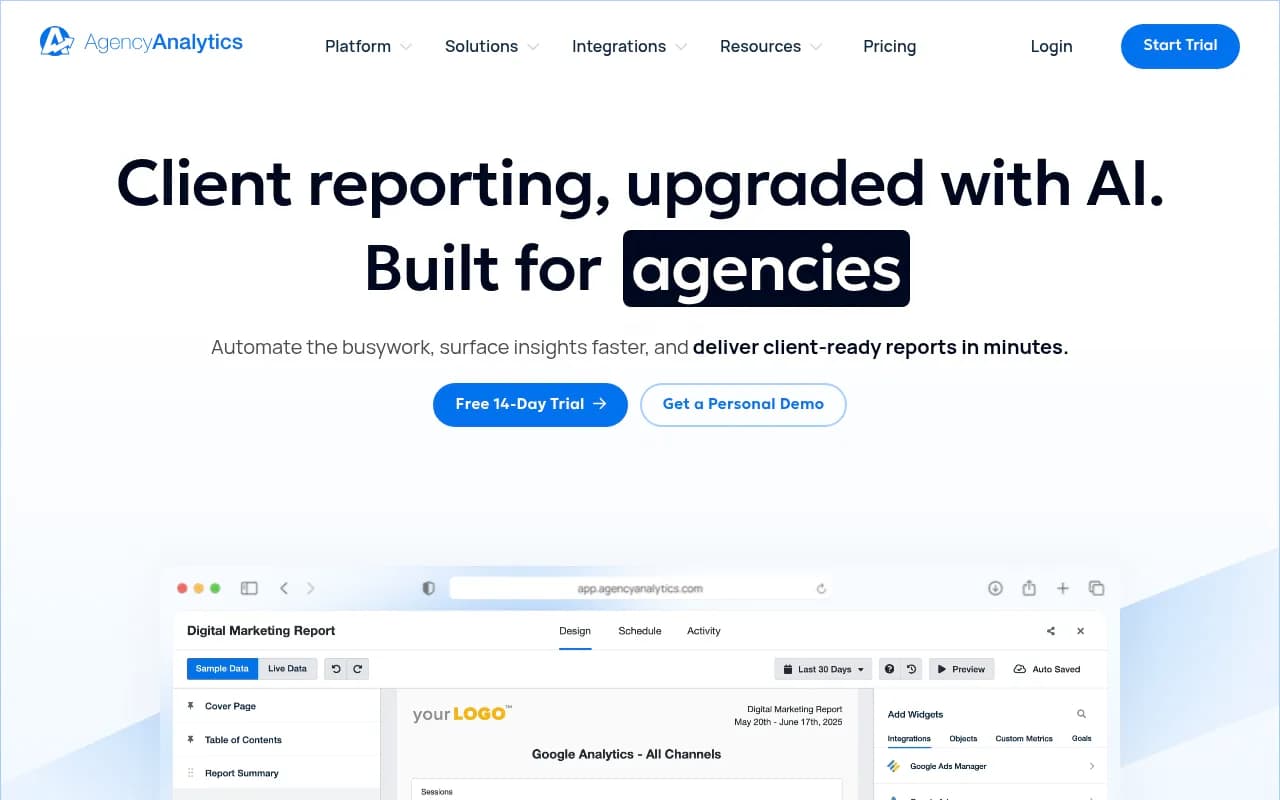
For delivery, an agency reporting tool like AgencyAnalytics can handle the GA4 and Search Console side, while a dedicated AI visibility tool feeds citation data.
Choosing a tracking tool for client work
Agencies need multiple client workspaces, white-label reports, and some way to connect visibility to outcomes. Many tools only monitor mentions. A few also show crawler activity and AI-referred traffic.
| Tool | Strength for agency reporting | Gap to check |
|---|---|---|
| Promptwatch | Prompt tracking plus IP-verified crawler logs, visitor analytics for AI traffic, white-label reports, agency plans from $199/mo | Agency plans exclude the Content Agent; confirm on the pricing page |
| Profound | Agent Analytics tying crawlers to GA4, agency mode | Higher price point |
| Peec AI | Clean client dashboard, screenshot audit trails | Monitoring only |
| Otterly.AI | Affordable basic tracking | No crawler or traffic layer |
| Semrush | Familiar suite for existing users | Fixed prompt sets, shallower AI data |



Promptwatch is the one I would shortlist when the point is proving ROI, because its visitor analytics and crawler logs close the gap between a citation and a session. Its agency tier also gives clients branded read-only access. Browse the wider field at the GEO software directory before committing.
Presenting it to a skeptical client
A few habits that help in the room:
- Validate the macro shift first, with outside data, before showing the client's own numbers. It resets credibility.
- Split traffic loss into AI-driven decline, controllable on-site issues, and seasonality, with rough percentages. Diagnostic beats defensive.
- Lead with business outcomes (qualified leads, pipeline), then explain traffic.
- Show the methodology slide: prompt list, sample size, dates, attribution model.
- Name what you cannot measure. Clients trust agencies that admit blind spots.
As for budget, Demand Local suggests reserving roughly 10% for measurement infrastructure, and that seems reasonable to me. Reporting you cannot defend is a liability.
An AI search reporting checklist
- ChatGPT, Perplexity, and other assistants segmented in GA4
- Landing pages and engagement analyzed
- Leads, qualified leads, opportunities, and revenue tracked
- Direct and assisted revenue separated
- Pipeline never presented as revenue
- Prompt list, sample size, and attribution model documented
- Crawler access checked against server logs
- Ad exposure checked before crediting earned citations
Who this is for
If you are an agency owner or account lead, you probably cannot do all of this at once. Start with GA4 segmentation and a 50-prompt baseline this month, add CRM tagging next, and layer crawler analytics after that. If you would rather hand the program to specialists, 1001 SEO Media runs technical SEO, content, and GEO work with transparent monthly reporting. Either way, the standard is the same: every number in the deck carries its method with it.