Key takeaways
- Give every piece of AI-assisted content a named owner, a named approver, and a risk tier. Product, pricing and legal-adjacent pages get the strictest review.
- Audit two things, not one: what you publish, and what AI engines say about you afterwards. Most governance programs only cover the first.
- Re-verify product and pricing pages every 2 to 3 months. In Promptwatch Data, ChatGPT keeps citing those pages for a long time, so errors persist.
- Keep an audit trail: prompt, model, draft, reviewer, approval, publish date, live URL. Only 5% of data leaders in a Dataiku/Harris Poll survey say AI output is traceable 100% of the time.
- Check the regulatory details with counsel. Several sources say EU AI Act Article 50 transparency duties for AI-generated content started on 2 August 2026, but verify that against the primary text.
Why GEO makes content governance harder
Traditional content governance assumed a human wrote the page and a human edited it. GEO programs break that assumption in two ways. First, teams now use AI agents to produce content at volume, sometimes several articles a day. Second, the output is then read by other AI systems that repeat your claims to buyers, with no editor in between.
That second part is what most governance policies miss. A wrong spec on a product page is not just a wrong spec on a page. It becomes a sentence in a ChatGPT answer.
The confidence gap is real. A Grant Thornton 2026 AI Impact Survey of 950 business leaders, as cited by Dataiku, found 78% lack strong confidence they could pass an independent AI audit. The same Dataiku piece cites a Dataiku/Harris Poll finding that 92% of CIOs have been asked to defend AI outcomes they could not fully explain. I would not read those numbers as proof of anything about marketing specifically. They do describe the mood in the room when you ask for budget for a governance program.
Which content carries the most risk
Not every page deserves the same scrutiny. The useful question is what AI engines actually quote.
Promptwatch Data's report on which content types ChatGPT cites (Sep 28 to Oct 4, 2026) shows product pages at 22.4% of classified citations and landing pages at 16.8%. Together that is about 39% of citations going to pages that describe what a company sells. Editorial formats combined (listicles, how-tos, articles, comparisons, news, reviews) make up 43%.
For commercial prompts the concentration is higher: product pages 26.0%, landing pages 20.6%, listicles 15.0% and comparisons 7.9%, almost 70% together. For branded prompts, product pages (23.3%) and landing pages (22.8%) lead, and reviews rise to 5.6%.
The governance reading is simple. Specs, prices and positioning on product and landing pages are the highest-risk content to approve, because they are what AI repeats about you.
A practical risk tier model
| Tier | Content | Examples | Review required |
|---|---|---|---|
| 1 (high) | Claims about what you sell | Product pages, pricing, landing pages, comparison pages, docs with specs | Subject-matter expert plus legal or compliance sign-off |
| 2 (medium) | Editorial with factual claims | How-tos, listicles, FAQs, reviews roundups | Editor plus fact check against the Knowledge Base |
| 3 (low) | Time-bound commentary | News, newsjacking, social posts | Editor sign-off, short expiry |
Adjust the tiers to your industry. A bank or a healthcare brand will push more content into tier 1.
Who approves AI-generated content
I could not find a primary-source standard RACI for GEO approval, so treat the following as a working model I would use, not an industry norm. It borrows from how regulated teams already handle customer communications.
Roles
- Content owner: the marketer or SEO lead who requested the content and is accountable for its performance. Owns the brief and the prompt.
- Editor: checks voice, structure and obvious errors. Cannot approve tier 1 alone.
- Subject-matter expert: confirms specs, features, pricing logic and technical claims. For tier 1 this person is mandatory.
- Legal or compliance reviewer: signs off on regulated claims, comparative claims and disclosure language.
- AI governance lead: owns the policy, the tool allowlist, the audit log and the quarterly review. Often sits in IT, security or a central AI office.
- Executive sponsor: accepts residual risk and breaks ties. Usually the CMO or head of digital.
Approval matrix
| Step | Tier 1 | Tier 2 | Tier 3 |
|---|---|---|---|
| Brief and prompt approved | Content owner + governance lead | Content owner | Content owner |
| Draft reviewed for accuracy | SME | Editor | Editor |
| Legal or compliance check | Required | On flagged claims | Not required |
| Final approval | Executive or delegate | Editor | Editor |
| Re-verification cadence | 60 to 90 days | 6 months | Expire at 30 to 60 days |
Hands-off publishing needs a ceiling
Some platforms let agents write and publish on a schedule with a review inbox or fully hands-off. That is useful for volume. My rule: hands-off is acceptable for tier 3 only. Tier 1 and tier 2 go through a human review inbox, always. Set the monthly budget, publishing windows and approvers in the tool, then record those settings in your policy so an auditor can see them.
What the policy has to say
The ITCS and Adaptive Security guides both make the same basic point: an acceptable use policy is where governance starts, because people are already using ChatGPT, Copilot and Claude whether or not leadership knows. For GEO content, I would make sure the policy covers:
- Approved tools and models, and who can add to the list.
- What data may go into prompts (no customer personal data, no unreleased pricing).
- A source-of-truth rule: all claims must trace to the Knowledge Base, product docs or a named internal owner.
- Disclosure rules for AI-generated or AI-assisted content where required by law or by your own standards.
- Mandatory human review by tier, as above.
- Retention period for drafts, prompts and approvals.
- Incident process for when a wrong claim is live.
Regulatory points to confirm with counsel
RWS states that the EU AI Act's Article 50 transparency requirements for AI-generated content took effect on 2 August 2026. I have not verified that against the primary EU text, and you should not either rely on my summary or on a vendor blog. Ask your legal team to confirm the date, whether your content falls in scope, and what labeling or disclosure it requires.
Doxee's guidance for regulated industries points to audit trails and human-in-the-loop review as the mechanisms that keep AI-generated customer communications defensible. Whatever the exact legal text says, those two controls are cheap to add and expensive to lack.
How to audit AI-generated content
Split the audit into three layers.
Layer 1: the production audit
Can you reconstruct how a given page came to exist? A sampled audit should check, for each page:
- The brief, prompt and model or agent version used.
- The sources the draft was grounded in.
- Who reviewed it and when, and what changed during review.
- Who approved it and under which tier.
- The publish date and live URL.
If your CMS, your AI writing tool and your project tracker are separate systems, this trail will be scattered. Pick one system of record. Tools like Writer, built for governed enterprise workflows, or a workflow layer such as Workato can help centralize it.


Layer 2: the output audit
What do your pages actually say now? Run accuracy checks on tier 1 pages against the source of truth: prices, plan limits, feature names, compliance claims, availability by region. Grammar and style checkers like Grammarly catch surface errors, not factual ones, so do not let them stand in for review.
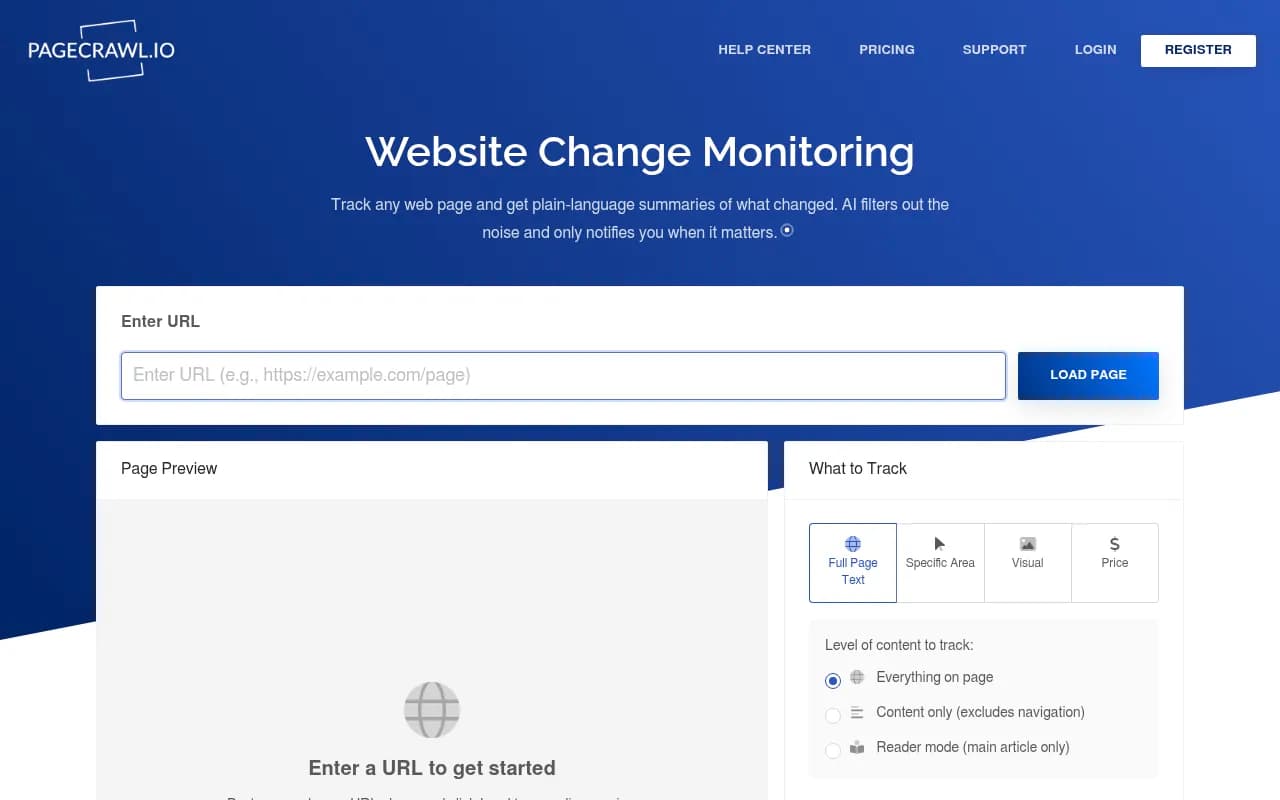
A change-monitoring tool such as PageCrawl.io is useful here: it alerts you when a page changes, which lets you catch unapproved edits.
Layer 3: the AI answer audit
This is the layer most programs lack. You need to know what ChatGPT, Gemini, Perplexity, Google AI Overviews and others say about you, which claims they repeat, and which of your pages they learn from.
Promptwatch is built for this kind of check. Its Brand Narrative pulls individual claims out of tracked AI responses and groups them by theme such as pricing, features and support. Fact Check (Business plan and above) lets you mark a claim accurate or inaccurate and then finds the crawled pages on your site that state it or its opposite, so you know which page to fix. Its IP-verified AI crawler logs show whether bots can read the page at all, which separates a crawl problem from a content problem.

Other options exist in the category. Profound and Bluefish AI both target enterprise buyers, and LLMClicks advertises hallucination detection. Compare them on whether they stop at reporting or let you trace a wrong claim back to a page.



For a wider look at the category, the directory at bestgeosoftware.com lists GEO platforms side by side.
How often to audit: use the decay data
A fixed annual review is too slow for GEO. Promptwatch Data's content half-life report tracked pages ChatGPT cited on Jul 6, 2026 through Oct 4, 2026:
- After 30 days ChatGPT still cited 78% of landing pages and 76% of docs. After 60 days, 69% and 67%.
- Comparisons were at 72% after 30 days and 63% after 60.
- Product pages, reviews and how-tos sat at about 55% after 60 days, with a half-life of 74 to 77 days.
- Listicles were at 60% after 60 days.
- News decays fastest: about a quarter of news pages are never cited again, half are gone after 36 days.
The governance implication cuts both ways. Landing pages, docs and pricing pages are long-lived citation assets, so a mistake in them keeps being quoted. And product pages lose citations at roughly the rate how-tos do, so a re-verification every 2 to 3 months catches both drift and decay. News should carry an expiry date.
Suggested audit cadence
| Asset | Re-verify | Trigger for early review |
|---|---|---|
| Pricing and plan pages | Every 60 days | Any price or packaging change |
| Product and landing pages | Every 60 to 90 days | New release, rebrand, legal change |
| Docs and help center | Every 90 days | Product update |
| Comparison pages | Every 60 days | Competitor pricing or feature change |
| News and commentary | Expire at 30 to 60 days | Not applicable |
| AI answer audit (claims about you) | Weekly or monthly sampling | Model update, new campaign, PR incident |
Measuring whether governance works
Compliance metrics are easy to game, so mix process and outcome measures:
- Share of published AI-assisted pages with a complete audit trail (target 100% for tier 1).
- Median time from draft to approval by tier.
- Number of inaccurate claims found in AI answers per quarter, and median days to fix.
- Percentage of tier 1 pages re-verified on schedule.
- Self-citation rate: how often AI cites your own domain for your own facts. If AI states your facts but cites someone else, your pages are either unreadable or less authoritative than a third party.
Pair this with AI-referred traffic and conversion data, so governance is judged against revenue and not only risk avoided. Otherwise the first budget cut hits the review step.
A 90-day rollout
- Days 1 to 15: inventory every tool and agent producing content. Draft the policy and tiers. Name the governance lead.
- Days 16 to 45: stand up the approval matrix in your CMS or workflow tool. Load the Knowledge Base with source-of-truth facts. Tag existing tier 1 pages.
- Days 46 to 75: run the first output audit on tier 1 pages and the first AI answer audit. Fix what you find, log it.
- Days 76 to 90: review metrics, loosen or tighten tiers, and brief executives with the evidence.
If you want outside help designing this across SEO, content and AI search, an agency such as 1001 SEO Media works across technical SEO, content production and GEO. It is one option among several, and an internal AI governance lead still needs to own the policy.
What I would not do
I would not let any AI agent publish tier 1 content without a human. I would not treat a vendor's compliance blog as legal advice. And I would not wait for a regulator or a bad AI answer to build the audit trail, because rebuilding it after the fact is slow and incomplete.
Summary
Enterprise GEO governance comes down to tiering content by risk, assigning named approvers per tier, keeping a traceable record of how every page was made, and auditing what AI says afterward. Use citation and decay data to set review cadence, confirm legal dates with counsel, and start with product, pricing and landing pages, since those are the pages AI quotes most.