Writer Review 2026
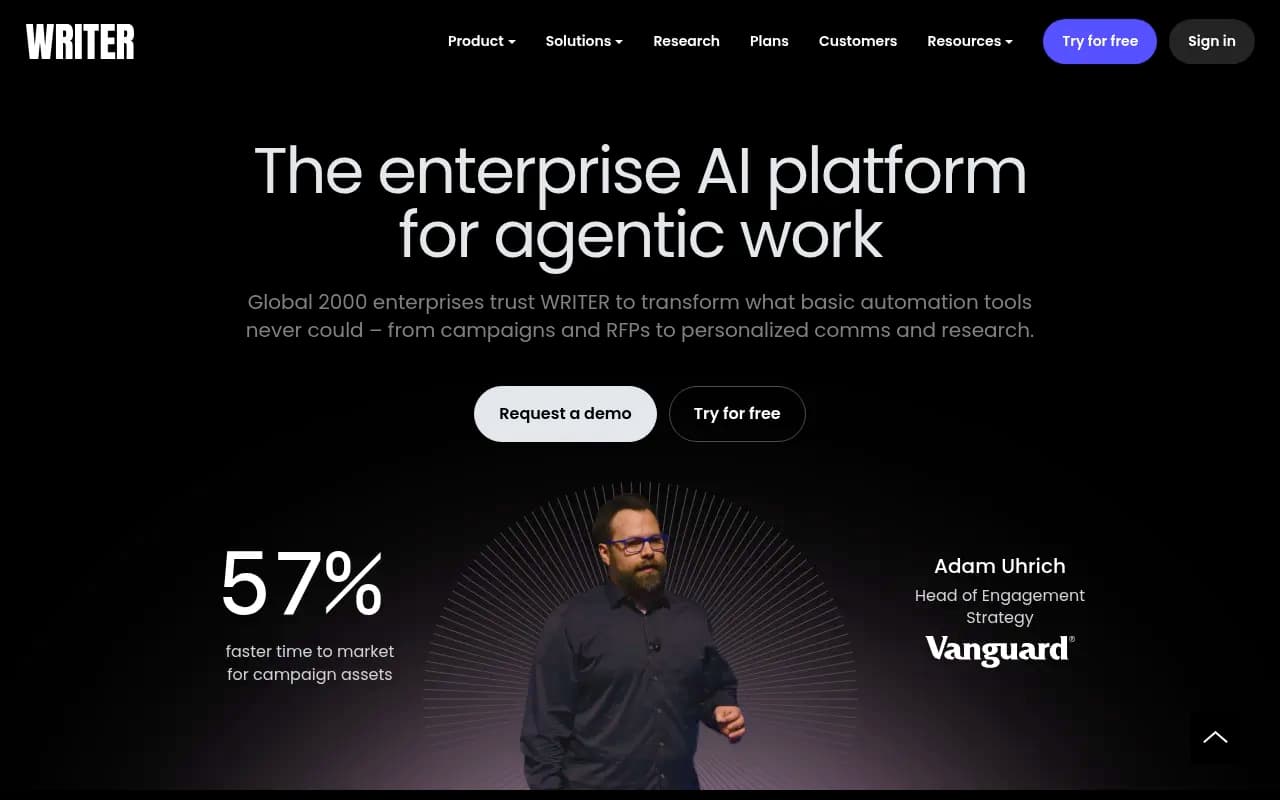
Writer is an enterprise AI platform trusted by Global 2000 companies to deploy AI agents that automate complex workflows -- from campaign creation and RFPs to personalized communications. Built with IT-grade governance, it combines knowledge graphs, brand controls, and deep integrations to let teams
Key Takeaways:
- Enterprise-first AI agent platform used by Vanguard, KPMG, Qualcomm, Uber, and 200+ Global 2000 companies to automate workflows that basic tools can't handle -- campaigns, RFPs, research, personalized comms
- Built for IT governance: always-on compliance controls, role-based permissions, audit trails, and SOC 2 Type II certified security that meets financial services and healthcare requirements
- Knowledge Graph foundation ensures agents pull from verified company data (docs, guidelines, product specs) instead of hallucinating -- outputs are accurate and cite sources
- Pricing starts at $18/user/month (Team plan, annual) with a 14-day free trial; Enterprise pricing custom but typically starts around $50-100/user/month for large deployments
- Lacks AI search visibility tracking -- Writer doesn't monitor how your brand appears in ChatGPT, Perplexity, or other AI search engines, which Promptwatch specializes in
Writer is an enterprise AI platform that lets companies build and deploy AI agents to automate knowledge work at scale. Founded in 2020 and headquartered in San Francisco, Writer has raised over $200M in funding (Series C led by ICONIQ Growth in 2024) and serves more than 200 enterprise customers including Vanguard, KPMG, Salesforce, Accenture, Hilton, and Uber. The platform is designed specifically for large organizations that need AI automation with enterprise-grade governance, compliance, and brand consistency.
The core pitch: Writer isn't a chatbot or a content generator. It's an agentic AI platform that automates entire workflows -- the kind of complex, multi-step processes that involve research, analysis, drafting, approval routing, and publishing. Marketing teams use it to generate campaign assets 57% faster (Commvault case study). Compliance teams use it to draft regulatory responses with 80% time savings (Medisolv). Product teams use it to scale customer support 15x (CirrusMD). The platform handles work that would normally require multiple tools, manual handoffs, and weeks of back-and-forth.
What makes Writer different from generic AI tools:
Most enterprise AI platforms are either glorified ChatGPT wrappers with basic guardrails, or they're developer-focused frameworks that require engineering teams to build everything from scratch. Writer sits in the middle: it's a full-stack platform that non-technical teams can use to build agents, but it's architected with the security, governance, and integration depth that IT and compliance teams demand. You're not just prompting a model -- you're encoding your company's processes, knowledge, and brand guidelines into agents that execute autonomously.
Core capabilities:
AI Agents -- Writer's agent builder lets teams create AI workers that handle specific jobs: a campaign agent that drafts blog posts, social copy, and email sequences based on a brief; an RFP agent that pulls from past proposals, product specs, and compliance docs to generate responses; a research agent that synthesizes internal reports and external data into executive summaries. Agents can work individually (one-off tasks), in teams (coordinated workflows), or at enterprise scale (orchestrating work across departments and systems). You define the agent's role, connect it to relevant knowledge sources, set brand and compliance guardrails, and deploy it. Non-technical users build agents through a no-code interface; developers can use Writer's API and SDKs for custom integrations.
Knowledge Graph -- This is Writer's secret weapon. Instead of relying on generic LLM training data, Writer agents pull from your company's Knowledge Graph -- a structured repository of verified information including product docs, brand guidelines, legal templates, past campaigns, CRM data, support tickets, and more. You connect data sources (Google Drive, Confluence, SharePoint, Salesforce, etc.) and Writer indexes, structures, and keeps them updated in real-time. When an agent generates content, it cites specific sources from the Knowledge Graph, so outputs are grounded in truth rather than hallucinated. This is critical for regulated industries (financial services, healthcare, legal) where accuracy and auditability matter.
Playbooks & Routines -- Playbooks are reusable workflows that encode your team's best practices. A content playbook might include steps for research, outlining, drafting, editing for brand voice, SEO optimization, and approval routing. A sales playbook might automate proposal generation, competitive analysis, and follow-up email sequences. Once a playbook is built, anyone on the team can run it with a few clicks. Routines take this further by scheduling playbooks to run automatically -- daily competitor analysis reports, weekly campaign performance summaries, monthly compliance audits. This is where Writer moves from "AI assistant" to "AI workforce."
Brand & Personality Controls -- Writer enforces brand consistency at the platform level. You upload brand guidelines, tone-of-voice examples, terminology preferences, and style rules. Every agent output is automatically checked against these rules before it's delivered. Marketing teams can define different brand personalities for different audiences (formal for enterprise buyers, casual for SMB customers) and agents will adapt. This is a huge differentiator vs. generic AI tools where every team member has to manually prompt for brand voice and hope the model gets it right.
Governance & Compliance -- Writer is built for IT and compliance teams. Role-based access controls let you define who can build agents, access specific knowledge sources, or approve outputs. Audit logs track every agent action -- what data was accessed, what was generated, who approved it. Content moderation filters catch inappropriate or off-brand outputs before they go live. Data residency options let you keep sensitive data in specific regions. SOC 2 Type II, GDPR, HIPAA, and CCPA compliance are baked in. For financial services and healthcare companies, this level of governance is non-negotiable.
Integrations & Ecosystem -- Writer connects to 50+ enterprise systems including Google Workspace, Microsoft 365, Salesforce, HubSpot, Marketo, Slack, Figma, Adobe Creative Cloud, Contentful, WordPress, and more. The API and webhooks let developers build custom integrations. Browser extensions bring Writer into your existing workflows (draft emails in Gmail, generate social posts in LinkedIn, summarize docs in Google Docs). Mobile apps (iOS/Android) let teams use Writer on the go. The platform is designed to plug into your tech stack, not replace it.
AI Model Flexibility -- Writer offers its own Palmyra model family (X5, X4, Med, Fin, Creative, Vision) optimized for enterprise use cases, but you can also use OpenAI, Anthropic, Google, or other models through Writer's unified API. This matters because different tasks need different models -- creative writing might use Claude, financial analysis might use a fine-tuned Palmyra Fin model, image generation might use DALL-E. Writer abstracts the complexity so teams don't have to manage multiple vendor relationships or APIs.
Writer AI Studio -- For technical teams, Writer offers a developer platform with APIs, SDKs (Python, JavaScript, Java), and model hosting. You can fine-tune Palmyra models on your data, deploy custom models, or build entirely custom AI applications on Writer's infrastructure. Pricing is token-based (similar to OpenAI) with Palmyra models costing $0.50-$3 per million tokens depending on the model tier. This is significantly cheaper than GPT-4 for comparable quality.
Who is Writer for:
Writer is built for enterprise marketing, sales, product, and operations teams at companies with 500+ employees. The sweet spot is Global 2000 organizations in regulated industries (financial services, healthcare, insurance, legal) where governance and compliance are critical. Typical users:
- Marketing teams at B2B SaaS companies, financial institutions, and retailers who need to produce high-volume content (blogs, emails, social posts, ad copy, landing pages) while maintaining brand consistency. KPMG's marketing team reports 60-80% time savings on derivative content creation.
- Sales teams at enterprise software and professional services firms who respond to RFPs, generate proposals, and create personalized outreach at scale. Commvault built a sales assistant that reduced proposal creation time from weeks to days.
- Customer success and support teams at high-growth tech companies who need to scale personalized responses without hiring proportionally. CirrusMD increased benefits engagement 15x by automating member communications.
- Compliance and legal teams at regulated companies who draft policies, review contracts, and respond to regulatory inquiries. Medisolv cut asset production time by 80% using Writer for compliance documentation.
- Product and engineering teams who want to build custom AI features into their products using Writer's API and models.
Writer is not for:
- Small teams or startups (under 50 people) who don't need enterprise governance and can get by with ChatGPT Plus or Jasper. Writer's pricing and feature set are overkill for small teams.
- Individual freelancers or solopreneurs who need a simple writing assistant. Tools like Grammarly, Copy.ai, or Notion AI are better fits.
- Companies that want plug-and-play AI without setup -- Writer requires upfront work to connect knowledge sources, define brand guidelines, and build playbooks. If you want instant results with zero configuration, this isn't it.
Integrations & Ecosystem:
Writer integrates with Google Workspace (Docs, Drive, Gmail), Microsoft 365 (Word, SharePoint, Outlook, Teams), Salesforce, HubSpot, Marketo, Slack, Figma, Adobe Creative Cloud, Contentful, WordPress, Confluence, Notion, Airtable, Zapier, and 40+ other tools. The Chrome extension brings Writer into any web app. API and webhooks let developers build custom integrations. Writer also offers pre-built connectors for CRM, CMS, DAM, and marketing automation platforms.
For developers, Writer provides REST APIs, Python SDK, JavaScript SDK, and Java SDK. You can programmatically create agents, query the Knowledge Graph, generate content, and retrieve analytics. The API is well-documented with code examples and Postman collections.
Pricing & Value:
Writer offers three main pricing tiers:
Team Plan -- $18/user/month (billed annually) or $29/user/month (billed monthly). Includes unlimited AI-generated content, basic Knowledge Graph (up to 1,000 documents), brand voice controls, and integrations with Google Workspace and Microsoft 365. Designed for small teams (5-50 users) who want to test Writer without enterprise features. 14-day free trial available.
Enterprise Plan -- Custom pricing (typically $50-$150/user/month depending on volume and features). Includes everything in Team plus advanced Knowledge Graph (unlimited documents), custom AI agents, playbooks and routines, role-based access controls, audit logs, SSO/SAML, dedicated customer success manager, and SLA guarantees. This is where most large companies land.
Writer AI Studio -- Pay-as-you-go token pricing for developers. Palmyra models range from $0.50/million tokens (Palmyra X4) to $3/million tokens (Palmyra X5). Vision models cost $5/million tokens. This is separate from the platform subscription and designed for teams building custom AI applications.
Writer also offers add-ons for specific use cases: AI-powered translation ($10/user/month), advanced analytics dashboard ($15/user/month), and premium support ($5,000/year).
How does this compare to competitors?
- vs. Jasper ($49-$125/user/month): Jasper is a content generation tool with basic brand controls. Writer is a full platform with agents, Knowledge Graph, and enterprise governance. Jasper is better for small marketing teams who just need a writing assistant. Writer is better for enterprises automating complex workflows.
- vs. Copy.ai ($49/user/month): Similar to Jasper -- Copy.ai is a content tool, not an agent platform. No Knowledge Graph, limited integrations, no compliance features.
- vs. Notion AI ($10/user/month): Notion AI is a lightweight assistant built into Notion. It's great for individuals and small teams but lacks enterprise features, governance, and the ability to build custom agents.
- vs. Microsoft Copilot ($30/user/month): Copilot is deeply integrated into Microsoft 365 but limited to Microsoft's ecosystem. Writer works across all platforms and offers more customization (custom agents, Knowledge Graph, brand controls).
- vs. Anthropic Claude or OpenAI ChatGPT Enterprise ($60-$75/user/month): These are general-purpose AI assistants. Writer is purpose-built for enterprise content and workflow automation with governance, brand controls, and Knowledge Graph. If you need a chatbot, use Claude. If you need to automate marketing campaigns or RFP responses, use Writer.
For most enterprises, Writer is good value if you're automating high-volume, high-stakes content work. The ROI comes from time savings (KPMG reports 60-80% faster content creation), increased output (6sense increased blog output 50%), and reduced risk (compliance teams at Medisolv cut review time 80%). If you're a 500-person company spending $500K/year on content agencies or hiring 10 writers, Writer can pay for itself in 6-12 months.
Strengths:
- Enterprise-grade governance -- role-based access, audit logs, compliance certifications, data residency options. This is table stakes for financial services, healthcare, and legal industries.
- Knowledge Graph accuracy -- agents cite sources and pull from verified company data instead of hallucinating. This is a massive differentiator vs. generic LLMs.
- Agent builder for non-technical users -- marketing and ops teams can build agents without writing code. Developers can still use APIs for custom work.
- Deep integrations -- works with Google, Microsoft, Salesforce, HubSpot, and 50+ other tools. Browser extensions and mobile apps bring Writer everywhere.
- Proven at scale -- used by Vanguard, KPMG, Qualcomm, Uber, and 200+ Global 2000 companies. This isn't a startup experiment; it's production-grade software.
Limitations:
- High upfront setup cost -- you need to connect knowledge sources, define brand guidelines, and build playbooks before you see value. This takes weeks, not hours. Smaller teams may find this overwhelming.
- Pricing is opaque -- Enterprise pricing is custom and requires a sales call. If you're a 100-person company, you might not qualify for Enterprise features but find the Team plan too limited.
- No AI search visibility tracking -- Writer doesn't monitor how your brand appears in AI search engines like ChatGPT, Perplexity, Claude, or Google AI Overviews. If you want to track and optimize your brand's presence in AI-generated answers, you need a separate tool like Promptwatch, which offers citation tracking, AI crawler logs, content gap analysis, and optimization features that Writer lacks entirely.
- Learning curve for advanced features -- building complex agents with multi-step workflows and conditional logic requires training. Writer offers an AI Academy and customer success support, but expect a 1-3 month ramp-up period for teams new to AI.
- Limited creative control for designers -- Writer is optimized for text generation. If you need AI for image generation, video editing, or design work, you'll need separate tools (Midjourney, Runway, Figma AI).
Bottom Line:
Writer is the best enterprise AI platform for companies that need to automate complex, high-volume content and workflow processes with governance and compliance built in. If you're a marketing, sales, or operations leader at a 500+ person company in a regulated industry, and you're tired of generic AI tools that can't handle your brand guidelines or compliance requirements, Writer is worth evaluating. The Knowledge Graph and agent builder are genuinely differentiated, and the customer list (Vanguard, KPMG, Qualcomm) proves it works at scale.
But if you're a small team (under 50 people), or you just need a writing assistant without the enterprise overhead, stick with Jasper, Copy.ai, or Notion AI. And if you need to monitor and optimize your brand's visibility in AI search engines -- a critical channel in 2026 -- Writer doesn't cover that at all. For AI search visibility, Promptwatch is the platform to use.
Best use case in one sentence: Enterprise marketing and sales teams at Global 2000 companies who need to produce high-volume, on-brand, compliant content at scale while automating multi-step workflows that generic AI tools can't handle.
Tags:
Frequently asked questions
What is Writer and what does it do?
How much does Writer cost?
Is Writer free to use?
What companies use Writer?
What is Writer's Knowledge Graph and why does it matter?
Is Writer secure and compliant for enterprise use?
How is Writer different from ChatGPT or other AI chatbots?
What types of workflows can Writer automate?
Similar and alternative tools to Writer