Key takeaways
- B2B prompts are long, specific, and tied to a role. A platform that only tracks short keyword-style prompts will miss most of what your buying committee actually asks.
- ChatGPT compresses a long prompt into shorter web searches, so you need a tool that captures query fan-outs, not just the prompt text.
- Long buying cycles reward durable assets. Promptwatch Data shows landing pages, docs, and pricing pages stay cited far longer than news.
- Monitoring alone is not enough at enterprise scale. Weigh crawler logs, traffic attribution, content execution, and security (SSO, audit logs, ISO 27001) alongside the dashboard.
- Run prompt clusters by buying stage and by persona, review them weekly, and push the results into HubSpot or Salesforce so RevOps can use them.
Why B2B SaaS needs a different kind of AI visibility platform
Most AI visibility tools were built around a simple question: was my brand mentioned? For a consumer product that gets you surprisingly far. For a B2B SaaS company selling a security-reviewed platform to a buying committee over six to nine months, it does not.
Think about what your buyers really type into ChatGPT or Perplexity. Not "best CRM." More like: "We are a 400-person fintech in the EU, we need a CRM that integrates with NetSuite, passes a SOC 2 review, and does not require a dedicated admin. What should our shortlist look like?" One of the research roundups puts a typical B2B prompt at 35 to 80 words, referencing industry, company size, regulatory context, and integrations. That figure comes from a vendor (Presenc AI), so treat it as directional, but it matches what anyone who has read real sales call transcripts would expect.
Two things make this hard for enterprise teams:
- Niche prompts. The long tail is huge, each prompt has tiny volume, and the answers vary by persona, region, and industry.
- Long buying cycles. A buyer might see your brand in an AI answer in March, read a comparison page in May, and sign in October. You need to know whether the thing AI cited in March is still there in October.
The rest of this guide covers how to evaluate platforms against those two problems, with a comparison of the main options.
How niche B2B prompts actually get answered
ChatGPT does not search your long prompt as written
This is the part that most vendor roundups skip. According to Promptwatch Data's ChatGPT query fanouts report, ChatGPT turns a single prompt into several shorter web searches. The report says one prompt can trigger 3 to 8+ searches, though the measured average was lower: about 2.15 searches per response in early December, roughly 1.84 by early March, and 1.0 per response in April once fanouts returned after a gap in the data. Average query length also shrank, from about 117 characters in December to the high 80s in February and March, and about 53 characters in April.
The practical consequence: your 60-word buying-committee prompt becomes a handful of short queries like "best CRM fintech NetSuite integration" or "CRM SOC 2 comparison." Whether you get cited depends on whether your pages match those short queries, not the long prompt. A platform that stores only the prompt and the answer leaves you guessing. You want one that also records the fan-out queries per response, so you can build pages for the sub-questions that matter.
It is also worth knowing that fan-out behavior changes. On August 8, 2026, ChatGPT started using the site: operator at scale, which Promptwatch Data measured as a jump from about 0.4% to about 17% of fan-out queries overnight. If your tracking tool only samples answers, you will not see shifts like that coming.
Persona matters as much as the prompt
A CFO, an IT lead, a procurement manager, and an end user all ask different things about the same product. Pricing and ROI for finance, integrations and security for IT, onboarding and usability for the end user. If you track one generic prompt set, you will get one generic view of your brand and miss the persona where you are weakest.
Look for platforms that let you run prompts as a defined persona and compare results across them. Promptwatch supports custom personas and persona stacking, with a radar chart that shows visibility, position, and sentiment per persona against the general audience and flags the biggest gap. Presenc AI markets buying-committee persona prompt sets as a core feature too.
What to check before you buy
Here is the checklist I would use for an enterprise B2B SaaS evaluation. Several items come straight from the vendor roundups in the research, which agree on more than they disagree.
Prompt handling
- Non-branded category prompts. "Best X for Y" prompts without your brand name are the ones that matter most. If a tool cannot track them, move on.
- Long-form prompts. Test it with a 40-word prompt before you sign.
- Query fan-outs. Can you see the actual searches the model ran per response?
- Prompt volumes and difficulty. With a long tail, you need some way to prioritize. Otherwise you will track 300 prompts and act on none of them.
- Locales and languages. Tracking the same prompt in Germany and the US matters when you sell in both. Check that it is real localized tracking and not a translated interface.
Data collection
Ask whether responses come from the real consumer interfaces or only from APIs. User-facing answers and citations can differ from API output. Promptwatch tracks the actual interfaces of ChatGPT, Google AI Overviews, AI Mode, Copilot, Gemini, Perplexity, and others, with API models alongside to show what models believe from training data.
Citation and source analysis
For B2B SaaS, the sources behind the answer are often G2, Capterra, Gartner, docs, GitHub, and Reddit threads. Promptwatch's software citation data (Sep 28 to Oct 4, 2026) shows GitHub at 1.2% of software citations, Microsoft Learn at 0.98%, and G2 at 0.73%, followed by AWS docs, Google Cloud docs, Gartner, and Capterra. By source type, docs and help centers earned 2.64%, vendor sites 2.01%, and review sites and analysts 1.57% combined. Vendor sites and docs together earned about three times the share of review sites.
The takeaway is not "ignore G2." It is that your own docs and help center are probably your biggest lever, and an enterprise platform should show you which of your pages are cited and which are not.
Crawler access and traffic
An AI answer that never mentions you might be a content problem or an access problem. Without crawler logs you cannot tell which. IP-verified logs of GPTBot, ClaudeBot, PerplexityBot and similar bots show whether they can read your docs and pricing pages at all. Visitor analytics then close the loop: did the AI answer send anyone, and did they convert? Note that ChatGPT stopped sending a referrer on October 8, 2026, so attribution now depends on settings like counting utm_source=chatgpt.com visits.
Enterprise requirements
SSO, audit logs, role-based access, scoped API keys, and a security certification. Procurement will ask. Promptwatch is ISO/IEC 27001 certified and GDPR compliant, with an organization audit log on Business and above and SSO on Enterprise. Profound and others list enterprise tiers with SSO and managed onboarding too, so ask each vendor for specifics rather than assuming.
Designing for long buying cycles
Citations decay, and not equally
In a six-month cycle, a citation that disappears after a month is not worth much. Promptwatch Data's content half-life report tracked pages ChatGPT cited on July 6, 2026 through October 4, 2026. After 30 days, ChatGPT still cited 78% of landing pages and 76% of docs; after 60 days, 69% and 67%. Comparison pages held 72% at 30 days and 63% at 60. Product pages, reviews, and how-tos were around 55% at 60 days, with half-lives of 74 to 77 days. News was the weak spot: half of pages were gone after 36 days.
For a B2B SaaS team, that points to a simple allocation:
- Treat landing pages, docs, and pricing pages as long-term assets. Keep them accurate. Pricing pages are classified as landing or product pages in this data.
- Invest in comparison pages and listicles for the consideration stage.
- Use press and news for short bursts, and do not count on them to hold a position.
That is a statement about citation durability in one dataset and one window, not a guarantee. Re-check it quarterly.
Track by buying stage
Group prompts into clusters that match the journey: awareness (best-in-category), consideration (head-to-head and alternatives), and decision (pricing, security, integrations). One of the roundups suggests 50 to 150 prompts across clusters for a SaaS program, reviewed weekly. For an enterprise with multiple product lines and regions, you will go well past that, which is why prompt limits and response limits matter when you compare plans.
Then look at the metrics in a way that locates the problem:
- Low share of voice on awareness prompts is a coverage problem. You are not in the conversation.
- Late position on comparison prompts is a prominence problem.
- Mentions without citations to your own domain point to a content or crawlability problem.
- Weak sentiment on decision prompts is a reputation or claims problem.
If you want the definitions, the Promptwatch Academy metrics overview explains Visibility Score, Share of Voice, and position.
Check what AI says, claim by claim
Late-stage buyers ask about the things that kill deals: "Does X support SSO?" "Is X expensive for mid-market?" If AI gets these wrong, you lose deals you never see in the pipeline. Promptwatch's Brand Narrative extracts the individual claims AI makes about you and competitors and groups them by theme like pricing, features, and support. Fact Check (Business and above) lets you mark a claim inaccurate and then finds which pages on your site state it, so you know where AI learned the wrong thing.
Platform comparison for enterprise B2B SaaS
The research mixes vendor-written roundups, and each one ranks its own product first, so I would not trust any single ranking. Here is a neutral view based on what the tools say about themselves and what I could confirm. Verify pricing and limits on each vendor's site before you buy; I did not scrape any vendor pricing pages.
| Platform | Strength for B2B SaaS | Watch out for |
|---|---|---|
| Promptwatch | End-to-end: real-UI tracking, fan-outs, personas, crawler logs, visitor analytics, Content Agent, Action Board, ISO 27001 | Content Agent and faster-than-daily tracking start on Business |
| Profound | Enterprise-focused, multi-model tracking, agentic marketing workflows | Sales-led onboarding, higher price points |
| AthenaHQ | Monitoring across 8+ AI engines | Monitoring-focused |
| Peec AI | Clean analytics, simple to run | Monitoring without optimization |
| Otterly.AI | Easy start, adds GEO audits and API on higher plans | Lite tier permits only 15 prompts, per one roundup |
| LLM Pulse | Category-prompt tracking, REST API, multi-locale | Lighter on execution |
| Presenc AI | Buying-committee persona sets, Salesforce and HubSpot integrations | Claims are vendor-sourced |
| Evertune / Bluefish AI / Goodie AI | Enterprise GEO positioning | Less public detail on execution |
Promptwatch
Promptwatch is the platform I would shortlist first when the problem is long, niche prompts plus long cycles, mainly because it covers the whole loop. It tracks real interfaces, captures query fan-outs, and supports personas and prompt volumes and difficulty. Then it goes further than most tools: IP-verified AI crawler logs show whether bots can read your docs, visitor analytics measure AI-referred conversions, and the Content Agent writes and publishes pages to WordPress, Webflow, or Framer against your gaps. Page Tracker then shows whether the published page gets cited.
Pricing, as listed at promptwatch.com/pricing: Essential is $95/month, Professional $245/month, and Business $579/month (350 prompts, 42,000 responses, tracking every 12, 6, or 1 hours, Content Agent, Fact Check, audit log). Enterprise is custom, with SSO, a white-label portal, and 50,000 API/MCP requests per hour. There is a 7-day free trial on monthly plans, and a free AI visibility report if you want a quick baseline. See the head-to-head with Profound if that is your other finalist.

Profound
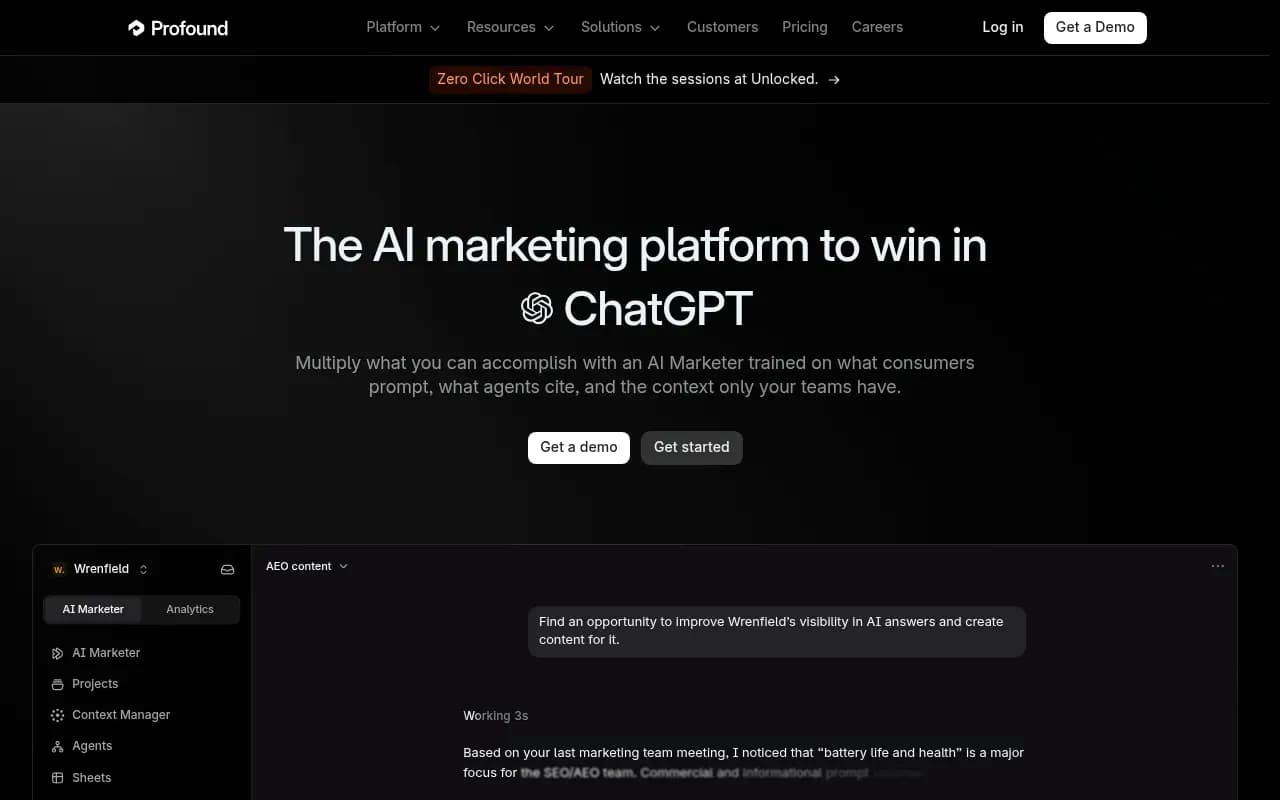
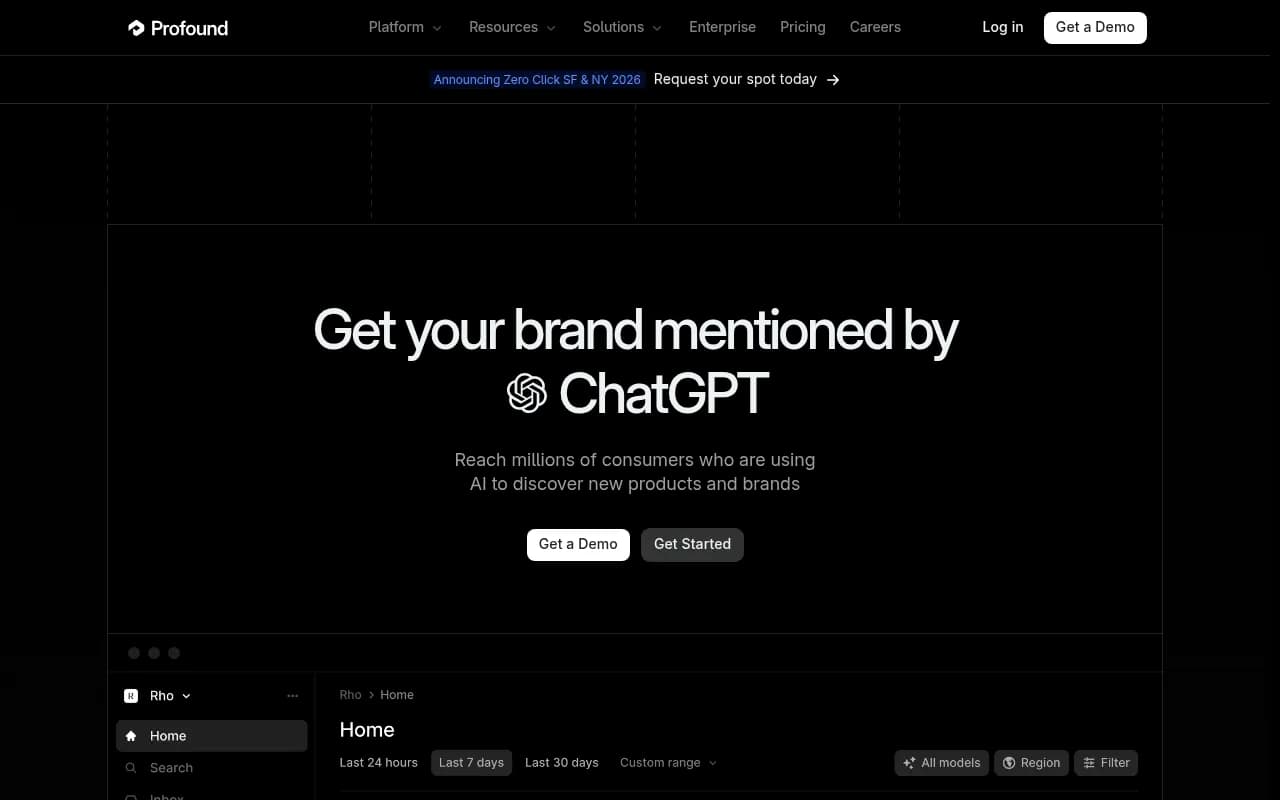
Profound positions itself as an AI marketing platform with an "AI Marketer" that identifies work, drafts content, and asks for approval. Its site lists coverage of ChatGPT, Perplexity, Claude, Gemini, Copilot, DeepSeek, and Google AI Overviews. A Yotpo roundup describes it as right for B2B or SaaS marketing teams tracking high-level brand perception. It is a serious enterprise option; the tradeoffs are price and sales-led onboarding.
AthenaHQ, Peec AI, and Otterly.AI
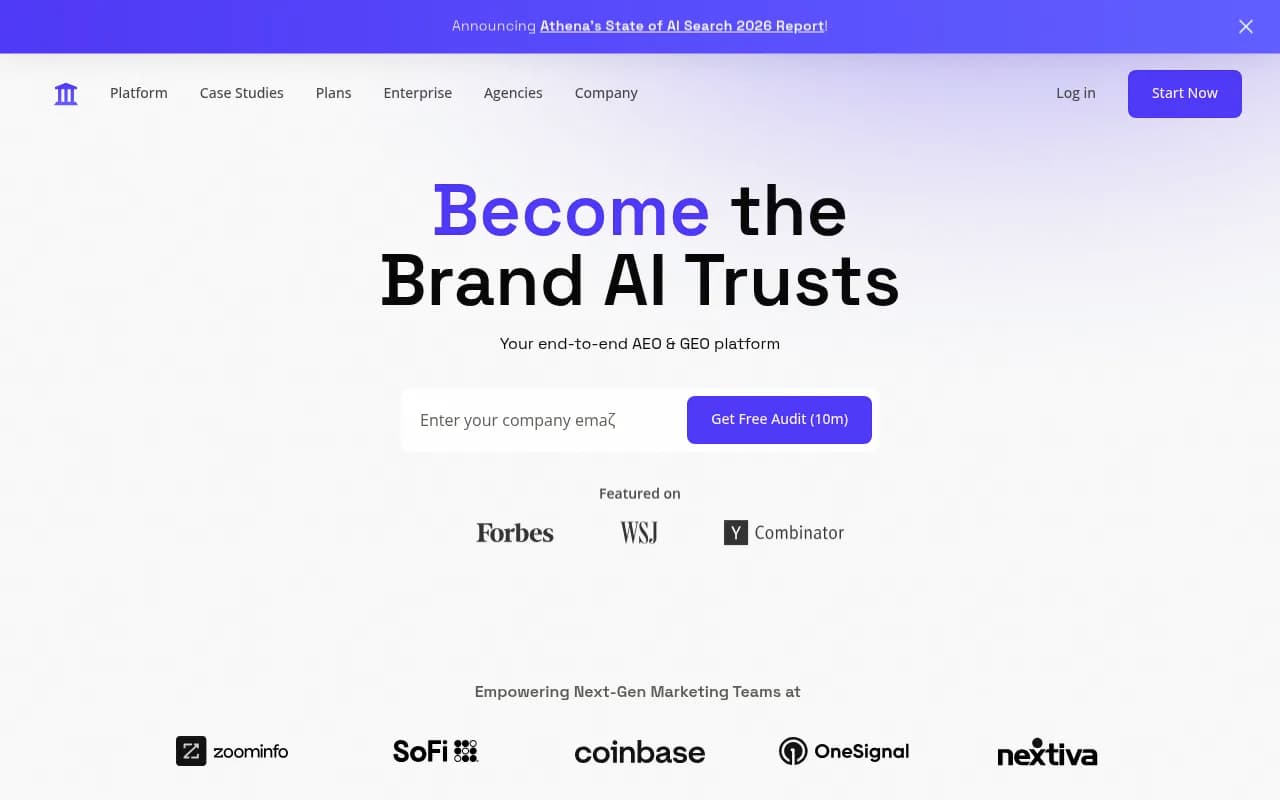
These are monitoring-first tools. They are fine when the job is a dashboard for a smaller prompt set, but for enterprise B2B you will likely need crawler visibility and content execution somewhere else. Otterly.AI, for instance, is easy to start but one roundup says its Lite plan permits only 15 prompts.


LLM Pulse and SearchEye
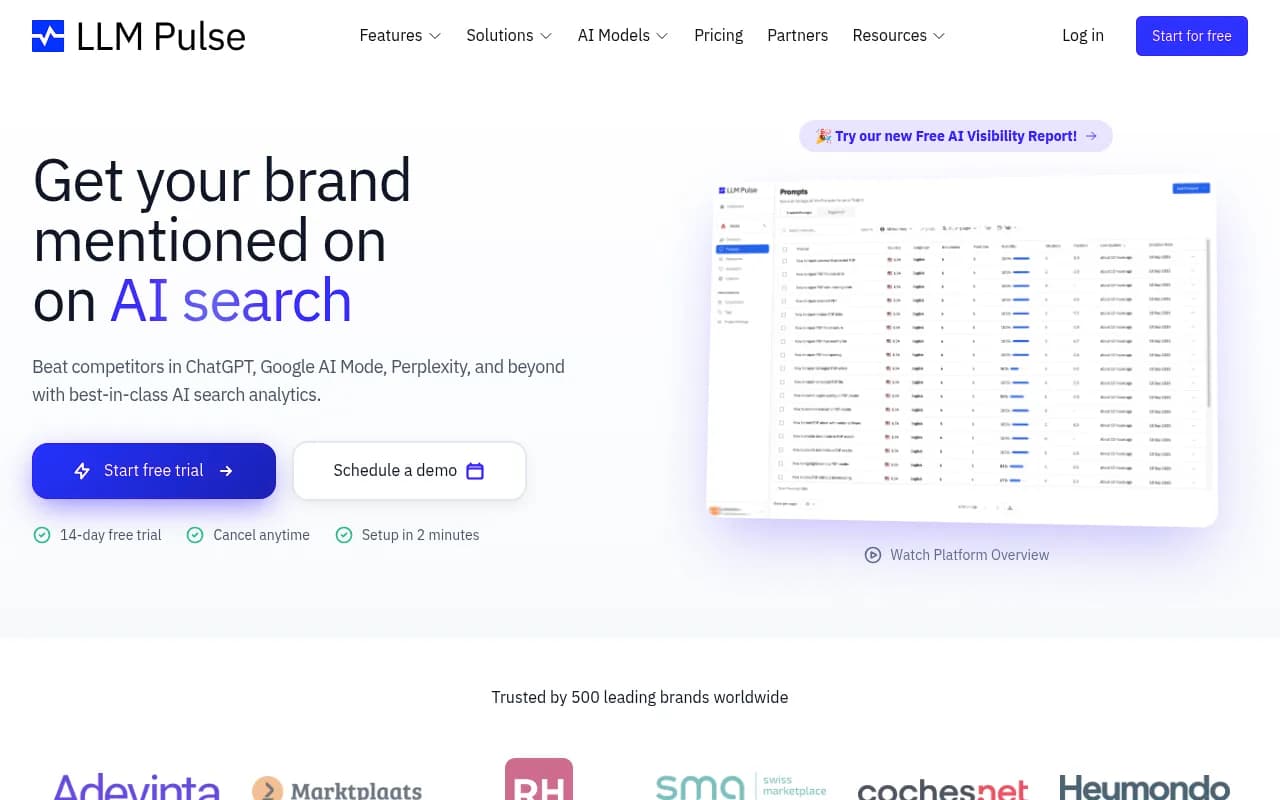
LLM Pulse is pitched at SaaS teams with category-prompt tracking and a REST API, with a starting price of EUR 49/month for 50 prompts per its own blog. SearchEye leans toward cited-source analysis and earning independent mentions. Both rank themselves first in their own roundups, so test them against your own prompts rather than taking the ranking at face value.
If you want a wider scan of the market, the GEO software directory at bestgeosoftware.com lists many more options.
Connecting AI visibility to your pipeline
A dashboard that lives only in marketing will not survive a budget review. The point is to show RevOps and sales leadership something they can use.
- Define prompt clusters by ICP and stage. Awareness, consideration, decision. Add a persona tag to each.
- Pull results into your CRM and BI stack. Most platforms have an API. Promptwatch has a REST API, a hosted MCP server with 110+ tools, and a Looker Studio connector. Use it to feed weekly mention rate and share of voice by cluster into the same reporting your RevOps team already runs in HubSpot or Salesforce.
- Add a self-reported attribution field. "How did you hear about us?" with an AI option catches buyers who saw you in ChatGPT and then typed your URL. Pair it with visitor analytics and the guidance in attributing AI traffic.
- Review weekly. Look at mention shifts by cluster and competitor moves, then tie them to content updates, launches, or competitor activity.
- Close the loop on content. When a gap shows up, publish, then check whether the page was crawled, cited, and clicked. Agent Chat and the Action Board can turn that into a prioritized to-do list.
For teams that want a structured starting point, the 90-day GEO program and GEO for B2B guides in the Academy are practical. Crisp, for example, reported 2x higher conversion rates from AI traffic than traditional channels, per its case study.
Mistakes I see teams make
Tracking brand-name prompts only is the big one. Your own name will almost always get mentioned, and the dashboard will look healthy while the category prompts say you do not exist.
The second is treating every prompt as equal. With hundreds of niche prompts, use volume and difficulty to pick the fifty that justify a new page.
The third is ignoring technical access. If your docs sit behind a JavaScript wall or a robots.txt rule blocks an AI crawler, no amount of content will fix it. The free Agentic Readiness Check and AI crawler URL inspector are a quick way to check.
The fourth is buying on prompt count alone. A cheap plan with 15 prompts is a trial, and a huge plan with no execution layer is an expensive report. Calculate the real operating cost, including how much content your team can actually ship.
Bottom line
For B2B SaaS, the right enterprise AI visibility platform handles three things: long, persona-specific prompts and their fan-outs, durable citations across a long cycle, and a path from insight to published page to measured pipeline. Shortlist two or three vendors, run the same 40-word buying-committee prompts through each, and ask to see fan-outs, crawler data, and CRM export before you sign. Start with a free baseline, then pick the tool that makes your next action obvious.
For more of Promptwatch's research on how AI answers get built, browse Promptwatch Data.