SearchEye Review 2026
Monitors brand mentions, citations and competitors in AI answers, built for marketing teams working on generative engine optimization.
Key takeaways
- SearchEye pairs AI prompt tracking with a paid placement marketplace of 50,000+ publications. It is more of an AI-era digital PR tool than a pure monitoring dashboard.
- Compared with Promptwatch, it lacks IP-verified AI crawler logs, visitor analytics for AI traffic, Search Console and Bing data, a content gap analysis and Content Agent with CMS publishing, query fan-outs, prompt volume and difficulty scoring, and Reddit, YouTube and LinkedIn citation reports. Its optimization route is buying third-party placements.
- Platform pricing starts at $99/mo (Pro) and $599/mo (Agency), but publisher spend is billed separately, typically $100 to $1,500 per placement.
- It is a young product with almost no independent reviews. SearchEye admits on its own blog that G2, Capterra and Trustpilot coverage is thin, and that no placement guarantees an AI mention.
- Best for brands and agencies that already accept paying for earned-style media as their GEO lever.
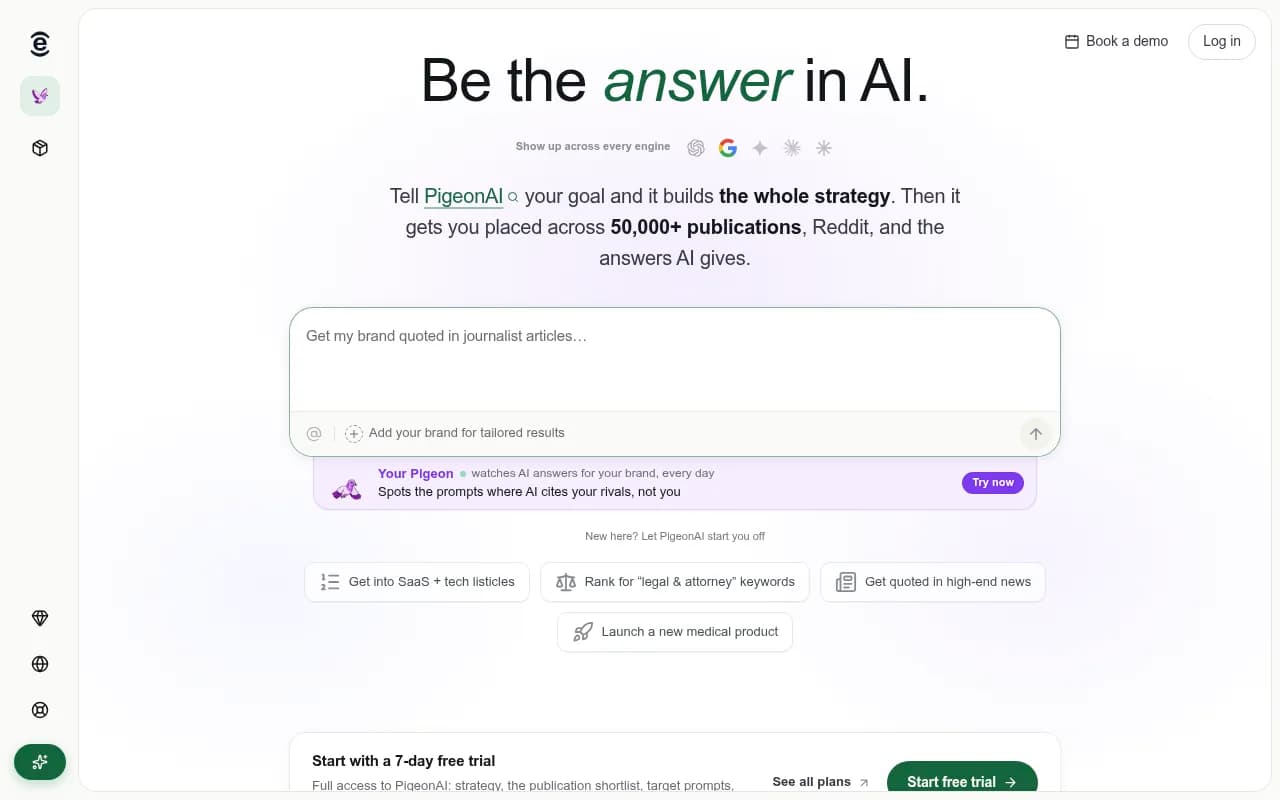
SearchEye is a Toronto-based platform that combines AI answer tracking with a marketplace for getting your brand written about on third-party sites. The pitch on the homepage is "Be the answer in AI." You tell its assistant, PigeonAI, your goal, and it builds a strategy, finds the articles AI engines already cite for your prompts, and queues placement opportunities for your approval.
The idea is simple and sensible. AI engines lean heavily on third-party sources. If a listicle on a SaaS blog keeps getting cited for "best CRM for small teams" and you are not in it, the quickest fix may be getting into that article. SearchEye automates finding those pages and negotiating the placement.
The target audience is in-house brand teams that do not want to hire a PR firm, agencies running white-label multi-client programs, and enterprises wanting a done-for-you program. Publishers use the platform free, set their own rates, and approve each request by email.
Key features
PigeonAI strategy agent. You describe a goal such as getting into SaaS and tech listicles, ranking for legal keywords, getting quoted in high-end news, or launching a medical product. PigeonAI turns that into a strategy, a publication shortlist, target prompts and ready-to-send pitches. The 7-day trial gives full access to all of it.
AI visibility and prompt tracking. Pro tracks 100 prompts a month and Agency tracks 1,000, with daily tracking and 12,000 or 120,000 AI answers analyzed monthly. Pro and Agency cover 4 answer engines; Enterprise covers all 8 plus custom models. Keyword research sits inside prompt tracking. Extra prompts cost $49 per 100 on Pro and $39 on Agency.
Citation-gap and source intelligence. When tracked prompts surface articles that AI answers cite, PigeonAI checks them against the publisher network. If SearchEye can place into that publication, the article is flagged as an opportunity. This is the most distinctive part of the product: the monitoring feeds directly into an action list.
Publication marketplace. The network lists 50,000+ publications, and you can see publication URLs on every plan. Each publisher sets its own price. Typical guide prices:
- General blogs, about $100 per placement
- Local and lifestyle blogs, about $300
- SaaS and B2B brand blogs, about $500
- National newspapers, about $1,500
Content is included in the placement price. New articles are written and placed, and existing articles can be updated to include your brand. Nothing is pitched or published without your sign-off. Agency and Enterprise plans get exclusive publications.
Custom agents and news trackers. Pro includes 1 custom agent (your prompt plus a schedule) and 10 news trackers, which watch beats for you. Agency gives 10 agents and 100 trackers, with daily runs instead of weekly. The news trackers are marked New, so expect rough edges.
Per-placement attribution. SearchEye says visibility and citation lift are attributed per placement. That is the right thing to measure, since the obvious worry with paid placements is whether they moved anything. I could not verify how rigorous the attribution is.
Agency and white-label workflow. The Agency plan has unlimited seats, 50 registered sites, white-label multi-client workflows, Slack support, and a 25% discount on placements. Enterprise adds SSO, unlimited brands and a done-for-you program with white-glove onboarding.
Who is it for
The best fit is a B2B SaaS marketing lead with a few thousand dollars a month for off-site visibility and no PR hire. Think a head of growth who sees competitors named in ChatGPT answers and wants to appear in the same listicles quickly. It also suits agencies running 10 to 50 client programs who want a single place to find, price and approve placements, and who are comfortable passing publisher costs through.
Industries with heavy listicle and review-style sourcing, such as SaaS, legal, local services and medical products, are the examples SearchEye itself leans on.
It is a weaker fit if you want a technical SEO suite, which SearchEye says it is not. It is also a poor match for teams that want to fix problems on their own site: crawler access, content gaps, page-level performance. And if your budget is purely software fees, the separate publisher spend will surprise you.
Integrations and ecosystem
I found no published integrations list, changelog or public API documentation. The product appears to be self-contained inside the app at app.searcheye.io, with email support on Pro, email plus Slack on Agency, and SSO on Enterprise. Publishers are onboarded through their own flow and approve requests by email. There is no evidence of a CMS publishing integration, Search Console connection or browser extension, so assume none until you confirm in a demo.
Pricing and value
- Pro, $99/mo: 100 tracked prompts, 3 registered sites, 3 seats, a $5,000 monthly placement cap, 1 custom agent, 10 news trackers, weekly agent runs.
- Agency, $599/mo: 1,000 prompts, 50 sites, unlimited seats, a $100,000 monthly placement cap, 25% off placements, 10 agents, 100 trackers, daily agent runs, exclusive publications. A roundup on SearchEye's own site lists $479/mo with annual billing, so check the yearly toggle.
- Enterprise: custom, with all 8 engines, SSO and a done-for-you program.
The company says there is no setup fee, no minimum spend and no long-term contract, and there is a 7-day free trial with cancellation anytime. Publisher spend is separate and always your call.
SearchEye claims agencies mark placements up by at least 50%, and gives an example of five $300 placements costing $1,500 versus $2,250 or more through an agency. That is the vendor's claim, but the logic is plausible. For comparison, pure trackers cost less: Promptwatch's Essential plan is $95/mo with 50 prompts, and Professional is $245/mo. The difference is that SearchEye's real spend is in placements, so the true monthly cost can run into the thousands.
Strengths and limitations
Strengths
- Connects monitoring to an executable action, finding the cited article and buying a spot in it.
- Transparent per-placement pricing shown before approval, with no minimums or contracts.
- Approval control: nothing goes out without your sign-off.
- Agency features that make sense: white-label, unlimited seats, placement discounts.
Limitations
- Publisher spend is extra, and no placement guarantees an AI mention, as the company's own retail guide says.
- Little independent validation. I found no third-party reviews, and the comparison articles on SearchEye's site rank SearchEye first.
- Only 4 answer engines below Enterprise.
What it lacks versus Promptwatch
SearchEye is in the GEO space, so the comparison matters. Promptwatch offers things I could not find in SearchEye:
- IP-verified AI crawler logs and crawl-to-citation tracking
- Visitor analytics attributing AI traffic and conversions
- Google Search Console and Bing Webmaster data beside AI data
- Content gap analysis, the Content Agent and publishing to WordPress, Webflow and Framer
- Prompt volumes, difficulty scores and query fan-outs
- Reddit, YouTube and LinkedIn citation reports
- AI Shopping and Ads Radar, Agent Chat and an Action Board
- Real-UI tracking across 15+ engines, including Meta AI, Amazon Alexa and coding agents like Codex and Claude Code
Promptwatch also backs its work with ISO/IEC 27001 certification and a 4.7/5 G2 rating from 1,840+ customers. SearchEye optimizes off-site only.

Bottom line
SearchEye is worth a look if you believe the biggest lever in AI visibility is being named in sources AI already trusts, and you would rather buy that than pitch it. The trial is free, nothing is published without approval, and the pricing is clear.
If you want to know why you are invisible, fix your own pages, track AI traffic and automate content, Promptwatch is the stronger platform. For wider options, see the GEO software directory at bestgeosoftware.com. Best use case: a B2B brand or agency buying listicle and blog placements informed by live AI citation data.
Tags:
Frequently asked questions
What is SearchEye?
How much does SearchEye cost?
Is there a free plan?
Does SearchEye guarantee AI mentions?
How does SearchEye compare to Promptwatch?
Who is SearchEye best for?
Similar and alternative tools to SearchEye