Key takeaways
- DataForSEO is the cheapest at scale ($0.60 per 1,000 SERPs on the queued tier, $2 live), and the only one of the four that also sells keyword and backlink data.
- SerpApi is the premium option with the broadest engine and vertical coverage, but it costs several times more per call at the same volume.
- SearchApi sits in the middle: $4 per 1,000 at entry, dropping to $1 at very high volume, with a legal protection guarantee from the Production plan up.
- Tavily is a different animal. It returns cleaned, LLM-ready content rather than raw SERPs, so compare it on use case, not on price per call.
- We did not run our own latency tests. Where figures below come from vendor pages or third-party benchmarks, we say so, and you should verify current pricing before you commit.
What we compared and how
The title says benchmarked, so let me be upfront about what that means here. This guide pulls together vendor pricing pages, published third-party benchmarks (apiserpent, cloro, fastCRW and others) and our own cost modelling. I did not run a fresh latency test, and I found no first-party latency numbers from any of the four vendors. Treat latency claims as directional.
What I did do carefully is the price math, because the headline numbers on these products are rarely comparable. One vendor quotes per-search credits, another quotes per-SERP prices on a queue, another bills only successful responses. Normalizing to cost per 1,000 searches is the only fair way to read them.
The four tools also solve two different problems:
- Raw SERP APIs (SerpApi, SearchApi, DataForSEO) return the structured contents of a results page: organic results, ads, knowledge panels, maps, AI Overviews.
- AI-native search APIs (Tavily) return pre-processed page content and summaries meant to be pasted into an LLM context window.
If you pick one from the wrong category, no amount of price shopping will save you.
Quick comparison table
| API | Best for | Typical price per 1,000 | Free tier | Output |
|---|---|---|---|---|
| SerpApi | Breadth of engines and verticals | Roughly $9 to $25 (varies by plan, verify on their pricing page) | Small monthly allowance | Parsed SERP JSON |
| SearchApi | Mid-tier multi-engine plus AI search | $4 down to $1 | 100 free requests | Parsed SERP JSON |
| DataForSEO | Bulk SERPs plus keyword and backlink data | $0.60 queued, $2 live | None (pay per SERP, $50 minimum deposit reported) | Parsed SERP JSON |
| Tavily | AI agents and RAG | $5 to $8 basic, double for advanced | 1,000 credits per month | Cleaned content and summaries |
One caution on SerpApi: the pricing page I could access did not render its plan table, and third-party sources disagree. Published figures include $25/month for 1,000 searches, $75/month for 5,000, and a Big Data tier near $9 per 1,000. Check serpapi.com/pricing yourself.
SerpApi: the premium, broad option
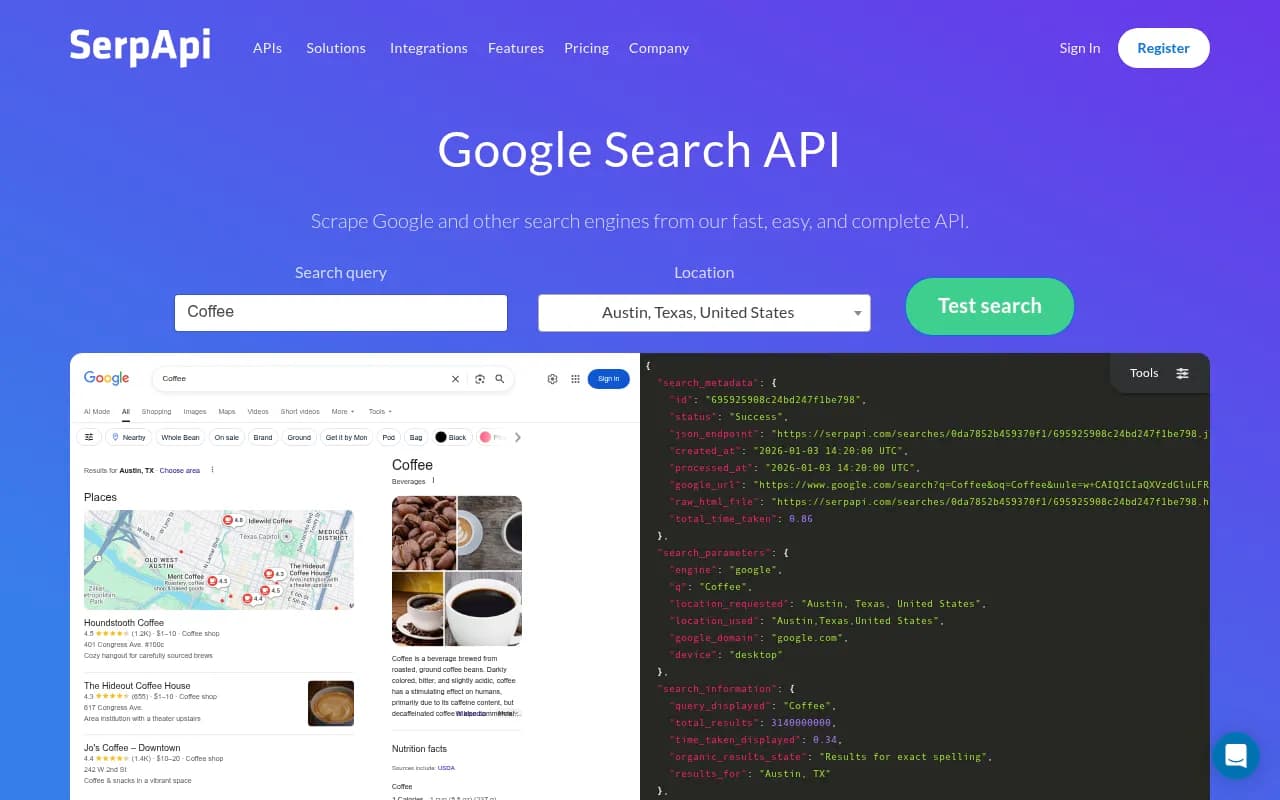
SerpApi is the one most developers have heard of, and the reason is coverage. Beyond Google web search it has dedicated APIs for Maps, Shopping, Flights, Hotels, Jobs, Scholar, Trends, Amazon, eBay and Naver, plus an Extract API. On the AI side, its catalog includes Google AI Mode, Google AI Overview, Gemini, Bing Copilot, Brave AI Mode and Duck AI endpoints.
That last point matters because one comparison I read claims SerpApi has no ChatGPT Search or Perplexity endpoints. From the catalog I could see, that appears accurate for those two specifically, but it overlooks the Google and Bing AI surfaces it does cover. Don't read "no ChatGPT endpoint" as "no AI coverage."
On reliability, cloro's published benchmark measured SerpApi returning an answer on 99.8% of Google AI Mode requests and 99.8% of Google Search requests, and a parsed AI Overview on 92.0% of full-sentence queries in a 30-day sample. That is a competitor's benchmark, so weigh it accordingly, but the numbers are strong.
The downside is cost. fastCRW's July 2026 comparison puts SerpApi's real-time pricing at $10 to $25 per 1,000 depending on plan, and apiserpent's benchmark estimates about $7,000 at 1M searches per month against $2,000 on DataForSEO Live. SerpApi also sells legal indemnification and SOC 2 Type II / ISO 27001 certification, which can justify the premium for enterprise procurement.
Pick SerpApi if you need many engines or verticals under one SDK, you want real-time responses on every plan, and compliance paperwork matters more than unit cost.
SearchApi: the middle path
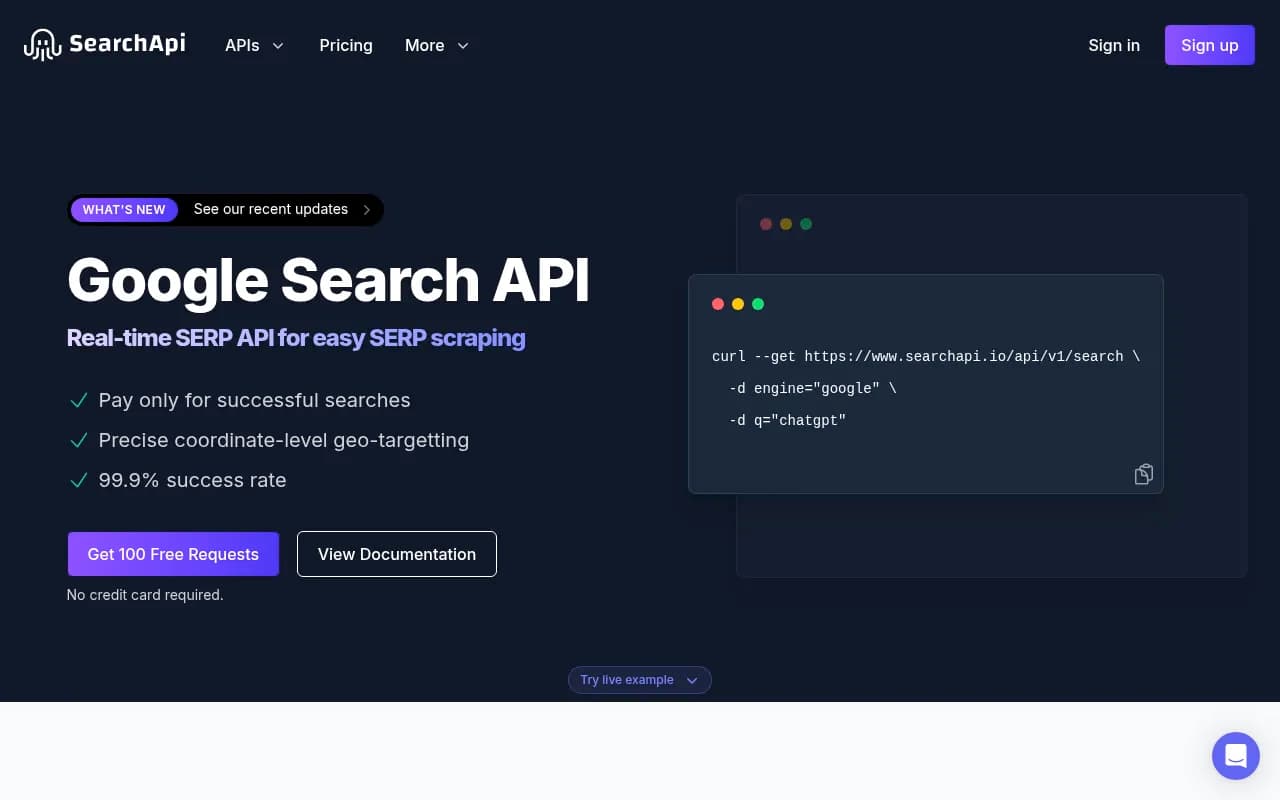
SearchApi's pricing is the clearest of the four, and I verified it on the official page:
| Plan | Monthly price | Searches | Per 1,000 |
|---|---|---|---|
| Developer | $40 | 10,000 | $4.00 |
| Production | $100 | 35,000 | $3.00 |
| BigData | $250 | 100,000 | $2.50 |
| Scale | $500 | 250,000 | $2.00 |
| Octo 1M | $1,500 | 1,000,000 | $1.50 |
| Octo 5M | $5,000 | 5,000,000 | $1.00 |
There is a 100-request free tier with no card, only successful (HTTP 200) searches are billed, and all plans list a 99.9% SLA. Production and above include a Legal Protection Guarantee, with SearchApi accepting responsibility for how it collects and parses public results, up to $2M in coverage. It does not cover how you use the data.
Two pitfalls worth knowing. First, the entry price is $4 per 1,000, so the $0.80 figure you may see in comparison tables is only reachable far above the volumes most teams run. Second, you can only consume up to 20% of your plan's credits per hour. If you run bursty jobs, such as a nightly rank check of 50,000 keywords, that cap will shape your architecture. An Enhanced speed option with parallel threads is described as nearly twice as fast as regular plans.
Coverage-wise, SearchApi handles Google, Bing, YouTube and others, and cloro's benchmark credits it with native ChatGPT Search and Perplexity endpoints. In that benchmark it returned answers on 99.9% of Google Search requests and 100% of ChatGPT requests.
Pick SearchApi if you want cheaper-than-SerpApi parsed results, you need ChatGPT Search or Perplexity data in the same API, and your volume is steady rather than spiky.
DataForSEO: the cost leader and a full data platform
DataForSEO is less a search API and more an SEO data company that happens to sell SERPs. The same account gives you keyword data, backlinks and on-page metrics. If you are building your own rank tracker or SEO tool, that bundle is the pitch.
Pricing is where it wins, with a caveat. The figures below come from secondary sources (I did not verify them against DataForSEO's own page), so confirm before budgeting:
| Mode | Price per 1,000 | Turnaround |
|---|---|---|
| Standard queue | $0.60 | Async, about 5 minutes average, 45-minute target |
| Priority queue | $1.20 | About 1 minute |
| Live mode | $2.00 | About 6 seconds |
The cheap tier is a queue. You post tasks, then collect results later. For rank tracking and bulk research that is fine. For a user-facing product that needs an answer inside a request cycle, you are paying $2 per 1,000 for Live, which is still well below SerpApi. AI Overview parsing is reported as an add-on at roughly $2 per 1,000 on the first page. DataForSEO also supports many engines (Google, Bing, Yahoo, Yandex, Baidu, Naver), though fewer than SerpApi's long tail.
In cloro's benchmark DataForSEO returned a response on 99.9% of Google Search requests and 95.6% of Google AI Mode requests, so AI Mode is the weaker spot of the two.
The honest cost of DataForSEO is integration overhead. The async model, the breadth of endpoints and the task-based billing take longer to learn than a single GET request with an API key.
Pick DataForSEO if you process large volumes, can tolerate a queue, and want keyword and backlink data from the same vendor.
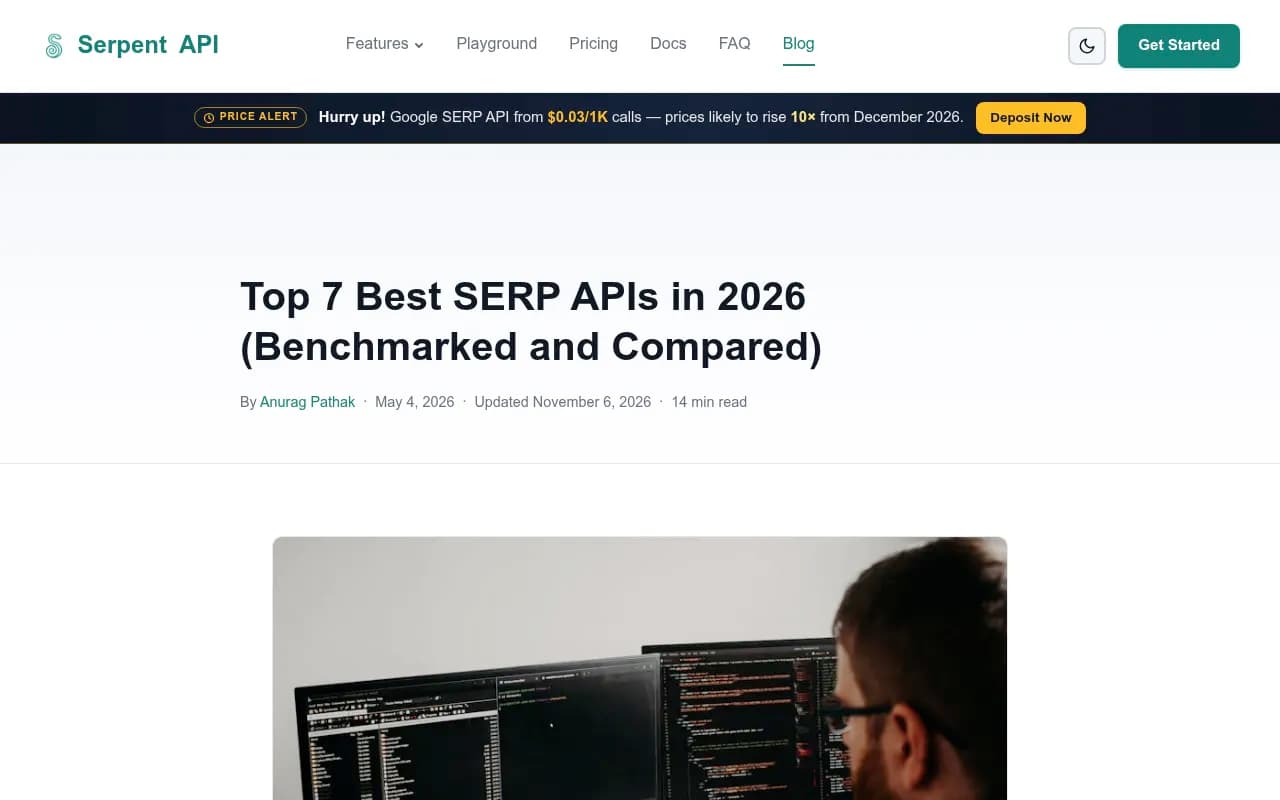
The screenshot above is from apiserpent's benchmark write-up, one of the third-party comparisons used for this guide. It has its own product to sell, so read its rankings with that in mind.
Tavily: search built for LLMs
Tavily is not competing with the other three on SERP parsing. It returns cleaned, summarized page content designed to drop into an LLM prompt. Rankings, ads, map packs and knowledge panels are not what you buy it for.
Pricing is credit-based and the headline numbers are easy to misread:
| Plan | Price | Credits | Per credit |
|---|---|---|---|
| Free (Researcher) | $0 | 1,000 per month | n/a |
| Project | $30 | 4,000 | $0.0075 |
| Bootstrap | $100 | 15,000 | $0.0067 |
| Startup | $220 | 38,000 | $0.0058 |
| Growth | $500 | 100,000 | $0.005 |
| Pay as you go | n/a | n/a | $0.008 |
A basic search costs 1 credit and an advanced search costs 2. So a thousand basic searches cost $5 to $8, and a thousand advanced ones cost $10 to $16. The "$8 per 1,000" you see quoted is only the pay-as-you-go basic rate. Extract bills 1 credit per 5 URLs at basic depth (2 credits advanced), Map is 1 credit per 10 pages, and the Research endpoint can burn 4 to 250 credits per request depending on model. Failed extractions are not charged.
It is cheaper than it looks if your agent does one search and reads the summary, and more expensive than it looks if you chain Research calls.
Pick Tavily if you are building an agent or RAG pipeline and want to skip writing your own scraping and cleaning layer.
Why agent-issued queries change the buying decision
If your use case is feeding AI agents, the shape of the queries matters. Promptwatch's ChatGPT query fanouts report shows average query length falling from roughly 117 characters in early December to the high 80s in February and March, then to about 53 characters from April. Average fanouts per response were about 2.15 in early December and about 1.84 by early March, per the same report. Agents now issue short, keyword-like searches, which is exactly what a classic SERP API handles well and why raw SERP data still matters in the age of LLM search.
The same data hints at why you might need AI-surface endpoints. If you are measuring how brands appear inside AI answers rather than ten blue links, a SERP API that parses Google AI Overviews or ChatGPT Search is one input, but a dedicated platform such as Promptwatch tracks the real interfaces of ChatGPT, Gemini, Perplexity and Google AI Overviews, then connects citations to crawler logs and traffic. Building that yourself on top of a SERP API is possible, but it is a big project.

Real cost at three volumes
Using the figures above (SerpApi at a representative $15 per 1,000, DataForSEO at its queued and live rates, SearchApi at plan rates, Tavily basic at $5 to $8):
| Monthly searches | SerpApi (approx.) | SearchApi | DataForSEO | Tavily (basic) |
|---|---|---|---|---|
| 10,000 | $150 | $40 | $6 queued / $20 live | $50 to $80 |
| 100,000 | $1,500 | $250 | $60 queued / $200 live | $500 to $800 |
| 1,000,000 | $9,000 to $15,000 | $1,500 | $600 queued / $2,000 live | $5,000 to $8,000 |
SerpApi numbers are estimates because I could not confirm its current plan table. The ranking is stable even if the exact dollars move: DataForSEO is cheapest, SearchApi next, then Tavily and SerpApi depending on how you count.
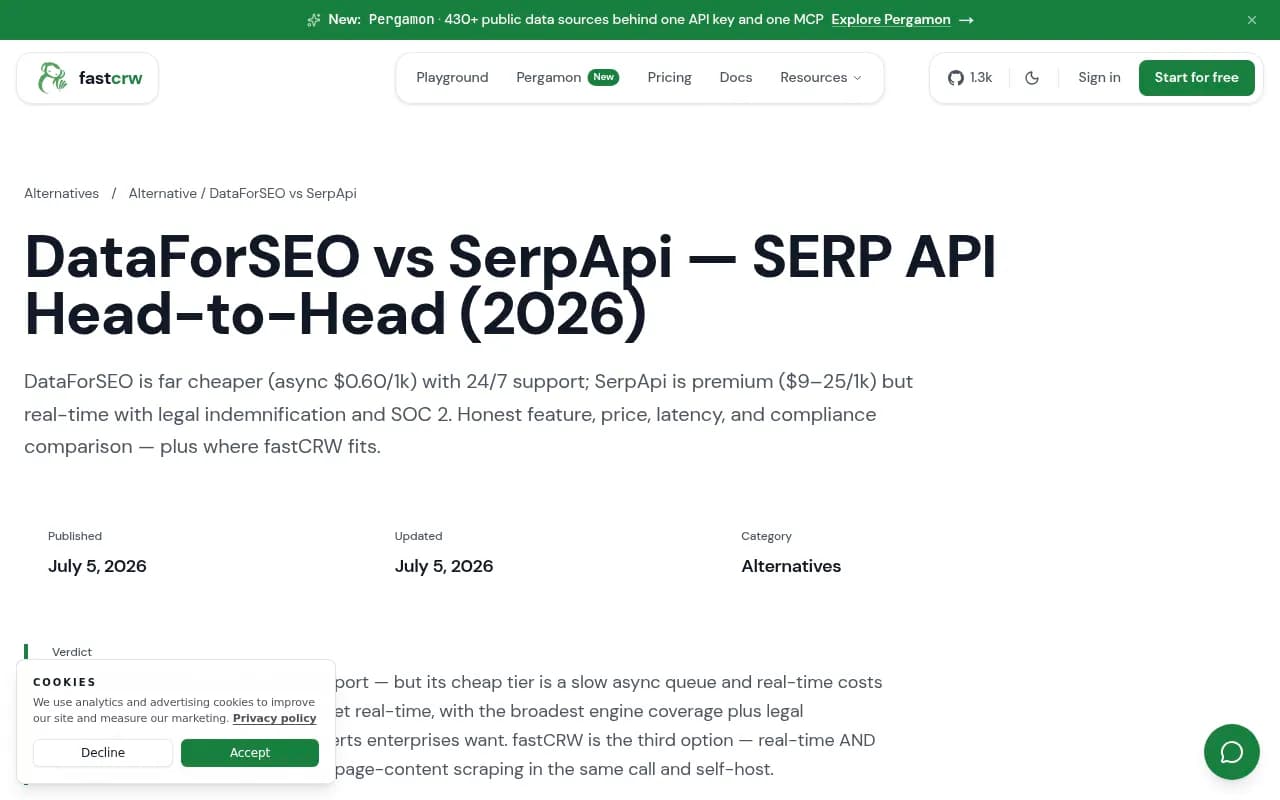
fastCRW's July 2026 head-to-head frames the same trade-off: DataForSEO wins on price and 24/7 support, SerpApi on real-time delivery, breadth and compliance certifications.
Other options worth knowing
The four above are not the whole market. A few others that came up repeatedly in research:
Serper is a low-cost Google JSON API that benchmarks fastest on raw latency in cloro's tests, with entry pricing around $1 per 1,000 dropping to about $0.30 at volume.
cloro focuses on parsed AI-search surfaces (AI Mode, ChatGPT, Gemini). It is the publisher of one of the benchmarks cited here, so factor in the bias.
Scrapingdog is a web scraping and SERP API priced for scale. For semantic discovery rather than SERPs, Reddit's r/AI_Agents crowd leans toward Exa, and Firecrawl for extraction.
If you want to browse more options, the directory at surferstack.com lists SERP APIs and related developer tools.
Which one should you choose?
| Your situation | Best fit |
|---|---|
| Building a rank tracker or SEO tool, volume above 100k per month | DataForSEO |
| Need dozens of engines and verticals, compliance paperwork matters | SerpApi |
| Want mid-tier price, parsed SERPs plus ChatGPT Search and Perplexity | SearchApi |
| Powering an LLM agent or RAG pipeline | Tavily |
| Only need fast Google results at the lowest unit cost | Serper |
| Need user-facing real-time answers at scale | SearchApi or DataForSEO Live |
A few practical tips before you sign up
- Run your own 200-query test on your actual keywords, locations and devices. Parsing quality varies by SERP feature, and benchmark averages hide your edge cases.
- Check how each vendor bills failed requests. SearchApi bills only HTTP 200s, and Tavily does not charge for failed extractions.
- Read the rate limits before the price. SearchApi's 20% of credits per hour rule can break a batch job that looks affordable on paper.
- Ask about legal terms. SerpApi advertises a Legal Shield and SearchApi a $2M Legal Protection Guarantee from the Production plan. Scraping Google remains a gray area, and indemnification is worth real money to some buyers.
- Re-verify pricing on the day you buy. Several figures in public comparison posts are already stale or conflict with vendor pages.
Bottom line
For most teams the decision is simpler than the comparison tables suggest. Building SEO tooling at volume points to DataForSEO. Needing breadth and enterprise assurances points to SerpApi. Wanting a sensible middle with AI-search endpoints points to SearchApi. Feeding an agent with readable content points to Tavily, and you should model its credit costs against your real call pattern before assuming it is cheap.
If your end goal is knowing how your brand shows up in AI answers rather than collecting raw search data, start with a purpose-built tracker instead of a raw API, and browse the GEO software directory at bestgeosoftware.com to compare options.