Scrapingdog Review 2026
Scraping platform with a Google search API, charging only for successful requests and offering low per-request pricing at volume.
Key takeaways
- Scrapingdog is a credit-based scraping API with 40M+ rotating proxies and 80+ dedicated endpoints (Google, Amazon, Walmart, YouTube, LinkedIn and more) that return parsed JSON under one API key.
- Pricing is low at volume: a 1-credit request costs $0.20 per 1,000 on the $40 Lite plan and about $0.027 per 1,000 on the top plan. Failed requests are not charged.
- It has Google AI Mode and AI Overview endpoints for AI visibility work, but that is raw data collection. Compared with Promptwatch, it has no prompt tracking, visibility scoring, content gap analysis, crawler logs, traffic attribution or content generation.
- Trustpilot feedback is mixed. Several reviewers praise fast, founder-led support, while two describe failed calls and refund disputes.
- Best for developers and SEO tool builders who want a cheap data pipeline. Weak fit for marketers who want a finished dashboard.
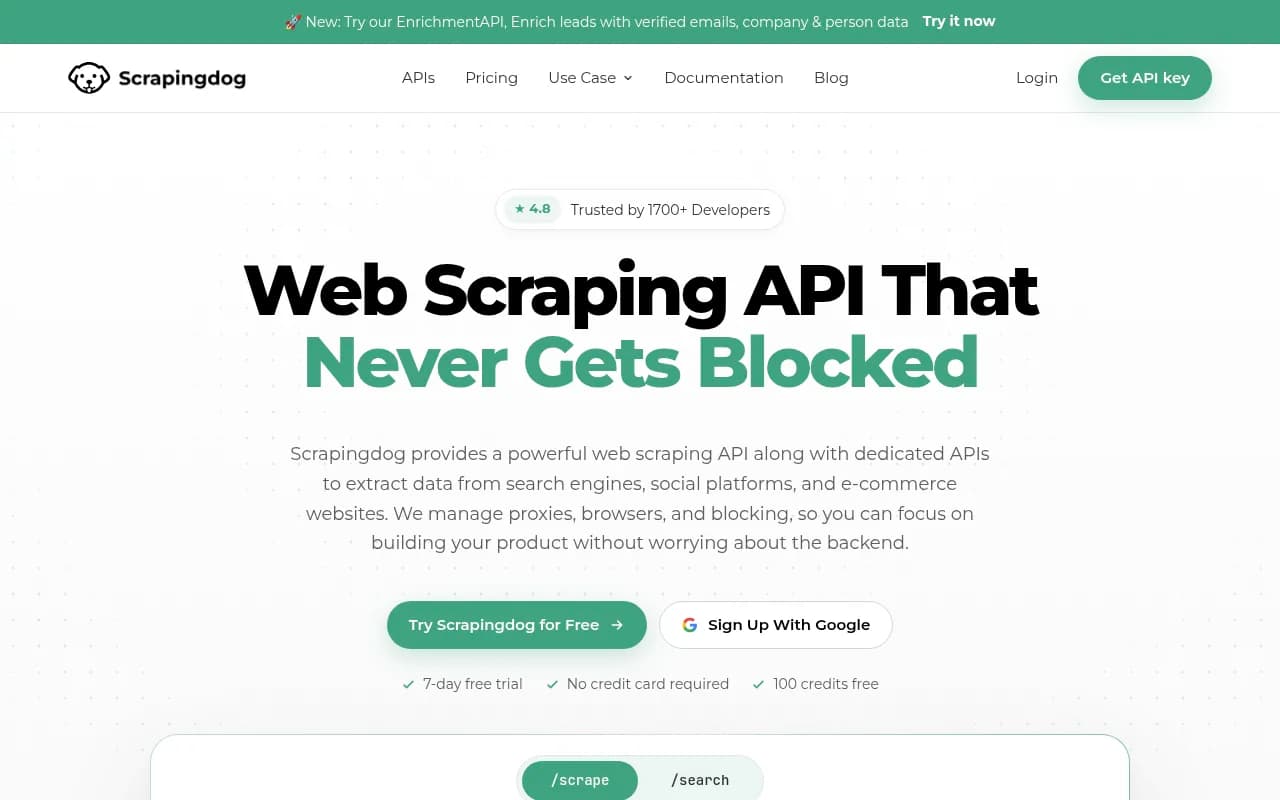
Scrapingdog is a web scraping API from a small team led by CEO Manthan Koolwal and CTO Darshan Khandelwal. The pitch is simple. You send a URL or a query, and it deals with proxy rotation, headless browser rendering, fingerprinting and CAPTCHAs, then returns HTML or structured JSON. The company says it serves 1,700+ developers and companies, with logos like Procter & Gamble, PwC, Crunchbase, Kiwi.com and Instantly on the homepage, and shows a 4.8 rating on its own site.
The product sits in the crowded middle of the scraping market, between raw proxy vendors and enterprise data platforms. What sets it apart is the sheer number of ready-made endpoints. Instead of writing parsers for Google SERPs or Amazon product pages, you call a dedicated API and get clean JSON. That suits price monitoring, lead enrichment, rank tracking, LLM training data and anything else where the work is the data, not the scraping.
The founder's own story is plausible and relatable: he built it after rewriting proxy rotation and anti-bot workarounds on every project. That origin shows in the product. It is practical and developer-first, with little polish on the marketing side.
Key features
General web scraping API. The core endpoint is /scrape?api_key=...&url=.... Cost depends on what you ask for:
- Standard rotating proxy request: 1 credit
- JavaScript rendering with headless Chrome: 5 credits
- Premium proxy, or geotargeted requests with a country: 10 credits
- JavaScript rendering plus premium proxy: 25 credits
- AI Parser (turns a page into structured data): 10 credits
That multiplier model is the thing to understand before you buy. A site that needs JS rendering and residential-quality IPs costs 25 times a simple fetch. Most scraping APIs work this way, but Scrapingdog publishes the full math in a comparison table, which I appreciate.
Anti-bot handling and proxies. The company claims 40M+ rotating IPs across countries and carriers, fingerprint rotation, human-like request patterns and background CAPTCHA solving. Geotargeting routes requests through a chosen country, useful for localized prices and regional search results. In practice, results on heavily protected targets vary by site, and you should test your own targets on the free credits before committing.
Google SERP APIs. This is the most polished part of the catalog. There is a SERP Light API at 5 credits and a SERP Advance API at 10 credits, plus separate endpoints for Google Maps, News, Scholar, Trends, Jobs, Hotels, Images, Shopping, Immersive Product, Lens, Finance, Videos and Patents. Organic results, ads, featured snippets and People Also Ask come back as JSON. For rank trackers and SEO dashboards, this breadth is the main draw. Competitors like SerpApi cover similar ground, but Scrapingdog's per-request cost at volume is generally lower.
Google AI Mode and AI Overview APIs. The AI Mode API (10 credits per request) returns Google's AI answer as text blocks plus numbered references. A matching AI Overview API exists. The site markets this as a way to see which domains Google cites for your keywords and how you compare with competitors week by week. It is a data feed, not an analysis product. You get the answer and the citations, and you build the tracking, scoring and reporting yourself. Worth knowing as context: Promptwatch Data found that Google AI Overviews drew 12.2% of citations from social platforms while ChatGPT drew 0.46% in the week of Sep 28 to Oct 4, 2026, so any serious AI visibility work needs coverage beyond Google.
E-commerce APIs. Amazon Search and Product APIs cost 1 credit per request, which makes them the cheapest dedicated endpoints. Amazon Bestsellers, Walmart, Flipkart, eBay, Yelp, Apple App Store, Apple Product and Apple Reviews sit at 1 to 5 credits. Fields include title, price, ASIN, seller, ratings, reviews and availability. For price intelligence across marketplaces, this is where the platform is strongest.
Social and profile data. The Profile Scraper API is 50 credits per request, the LinkedIn Post API is 25, and LinkedIn Jobs, Twitter/X, TikTok and several YouTube endpoints (search, channel, comments, transcripts) are 5 each. Profile data is expensive in credit terms: at the entry Lite plan it works out to $10 per 1,000 profiles, falling to roughly $1.36 at the top tier. Be careful here. Scraping personal profiles carries legal and terms-of-service risk that you should review with counsel.
Other tools. There is a Brave Search API, a Bing Scraper API, a Universal Search API (20 credits), a Screenshot API (5 credits) and an Indeed scraper (1 credit). A newer EnrichmentAPI product for verified emails and company data is promoted on the homepage but lives on a separate site.
Developer experience. Integration is a GET request with an API key, with code samples for cURL, Python and Node.js, and a live playground on the homepage. Documentation is at scrapingdog.com/documentation and the blog has many tutorials. Concurrency limits are plan-based, from 1 on the free tier to 2,200 on the largest.
Who is it for
The sweet spot is a developer or small team that needs structured web data without running proxy infrastructure. Think a solo founder building a price tracker over Amazon and Walmart, an SEO tool maker pulling SERPs for a rank tracking SaaS, or a data engineer feeding LLM pipelines with Markdown-friendly page output. The mid-tier plans ($90 to $500 a month) fit startups in the 1M to 9M credit range particularly well.
It also suits agencies that build custom reporting for clients, where an API beats a seat-based dashboard on cost. Recruiting and lead generation teams use the profile and jobs endpoints, though they should weigh the compliance question.
Who should skip it? Marketers who want a ready dashboard with no code. Scrapingdog gives you rows of JSON, not charts. Teams that need contractual uptime guarantees, SOC 2 documentation or formal procurement support should also look harder, since I did not find enterprise compliance claims on the site. And anyone who needs reliability on the toughest anti-bot targets should run a real test first, given the mixed reviews.
Integrations and ecosystem
Scrapingdog is an API first, so integration means code. Official-style examples cover cURL, Python and Node.js, and it works with any HTTP client. The site mentions LLM-ready Markdown output for AI workflows. I did not verify a native Zapier, Make or n8n app, so check the docs if you rely on no-code tooling. There is no browser extension to speak of. Output is JSON or HTML, which you export through your own code.
I could not confirm official GitHub, Discord or company X accounts. The founders have personal profiles on X and LinkedIn, and support runs through email and live chat on the site.
Pricing and value
Pricing is credit-based with 28 tiers, including a free one. The 7-day free trial and 100 free credits require no credit card. Annual billing gives two months free. A pay-as-you-go model was also introduced for people who do not want a fixed monthly bill.
- Free: $0, 100 credits, 1 concurrency, community support
- Lite: $40/month, 200,000 credits, 5 concurrency, geotargeting, email support
- Standard: $90/month, 1M credits, 50 concurrency
- Pro: $200/month, 3M credits, 100 concurrency, team support (marked popular)
- Premium: $350/month, 6M credits
- Business: $500/month, 9M credits, 200 concurrency
- Business Plus to Business Pro: $1,000 to $1,500/month, 19M to 29M credits
- Corporate and Enterprise tiers: $2,000 to $6,000/month, up to 150M credits, dedicated support from $5,000
- Global, Ultra, Titan and Nova tiers: $7,000 to $30,000/month, up to 1.1B credits, dedicated account managers from $12,000
Translated into unit costs: a 1-credit Amazon or Yelp request is $0.20 per 1,000 on Lite, $0.09 on Standard and $0.067 on Pro. A Google SERP Light request at 5 credits is $1.00 per 1,000 on Lite, $0.45 on Standard and $0.333 on Pro. A JS-rendered premium-proxy request at 25 credits is $5 per 1,000 on Lite. Failed requests do not consume credits, and if you run out you can buy one-time top-ups valid until your cycle ends.
The value case is strong for SERP and marketplace data. The catch is that the cheapest numbers need the higher tiers, and hard-to-scrape sites eat credits fast. Compare a realistic month of your own traffic, not the headline per-request rate.
Strengths and limitations
What it does well
- Breadth of dedicated endpoints under one key. Google, Amazon, Walmart, YouTube, LinkedIn and Maps in one account is convenient.
- Transparent, published unit economics. The comparison table shows cost per 1,000 requests for every API on every plan.
- Charges only for successful requests.
- Low entry price. $40 for 200K credits makes experimentation cheap.
- Fast human support, according to several positive Trustpilot reviews, including a reviewer who says the founder replies personally.
Limitations
- Mixed reliability reports. Trustpilot has two negative single-user reviews describing unsuccessful API calls, slow support and refused refunds. A competitor's comparison page (Scrape.do) also claims lower success rates, though that is a biased source and I treat it as an unverified claim. Test before you pay for a big plan.
- Credit multipliers are easy to underestimate. Premium proxies plus rendering means 25 credits per call.
- Small free tier of 100 credits. Some endpoints cost 50 credits per call, giving you just two profile requests.
- No finished analytics UI. Everything beyond the raw JSON is on you.
Where it falls short on AI visibility. The AI Mode and AI Overview APIs give you data, nothing more. Compared with Promptwatch, Scrapingdog lacks:
- prompt tracking across ChatGPT, Perplexity, Gemini, Claude, Copilot and other engines, with volumes and difficulty scores
- visibility scores, share of voice and sentiment reporting
- content gap analysis and a Content Agent that writes and publishes to WordPress, Webflow or Framer
- IP-verified AI crawler logs and AI traffic attribution
- Reddit, YouTube and LinkedIn citation tracking, plus AI Shopping and Ads Radar
- an Action Board and Agent Chat to prioritize and run the fixes
If your goal is to track and improve how brands appear in AI answers, you would be building much of that yourself. For a directory of purpose-built options, see the GEO software list at bestgeosoftware.com.
Bottom line
Scrapingdog is a sensible, inexpensive data pipeline for developers who want Google, Amazon and social data without managing proxies. Run your own targets through the free credits, check the credit multipliers against your workload, and scale from there. If support quality matters to you, read the Trustpilot reviews first.
For teams whose real goal is AI search visibility rather than raw SERP data, Promptwatch is the stronger option, because it monitors, explains and then fixes visibility with content, crawler and traffic data in one platform. Scrapingdog is better viewed as a supplier of raw data. Best use case: a developer feeding SERP and marketplace JSON into their own product at the lowest per-request cost.
Tags:
Frequently asked questions
What is Scrapingdog?
How much does Scrapingdog cost?
Does Scrapingdog charge for failed requests?
Can Scrapingdog track AI search visibility?
Is there a free trial?
Is Scrapingdog reliable?
Similar and alternative tools to Scrapingdog