DataForSEO Review 2026
API platform supplying SERP, keyword and backlink data, used to build rank trackers and other SEO products.
Key takeaways
- DataForSEO is a data supplier, not a finished SEO tool. You get APIs, a Playground and a dashboard for spend control, and you build the product or workflow on top.
- Pay-as-you-go pricing is the main draw: a $50 minimum top-up, no subscription, SERP requests from $0.60 per 1K in the Standard queue, and daily spending limits.
- The AI Optimization API (LLM Responses, LLM Scraper, LLM Mentions, AI keyword volume) gives you raw material for AI visibility tracking. It lacks the finished layer that Promptwatch provides: content gap analysis, the Content Agent with CMS publishing, IP-verified crawler logs, AI traffic attribution, and an Action Board.
- The learning curve is real. Reviewers describe the endpoint count as overwhelming and the web UI as dated, so non-developers will struggle.
- Best for SaaS builders, agencies with developers, and automation-minded SEOs. A poor fit if you want a dashboard on day one.
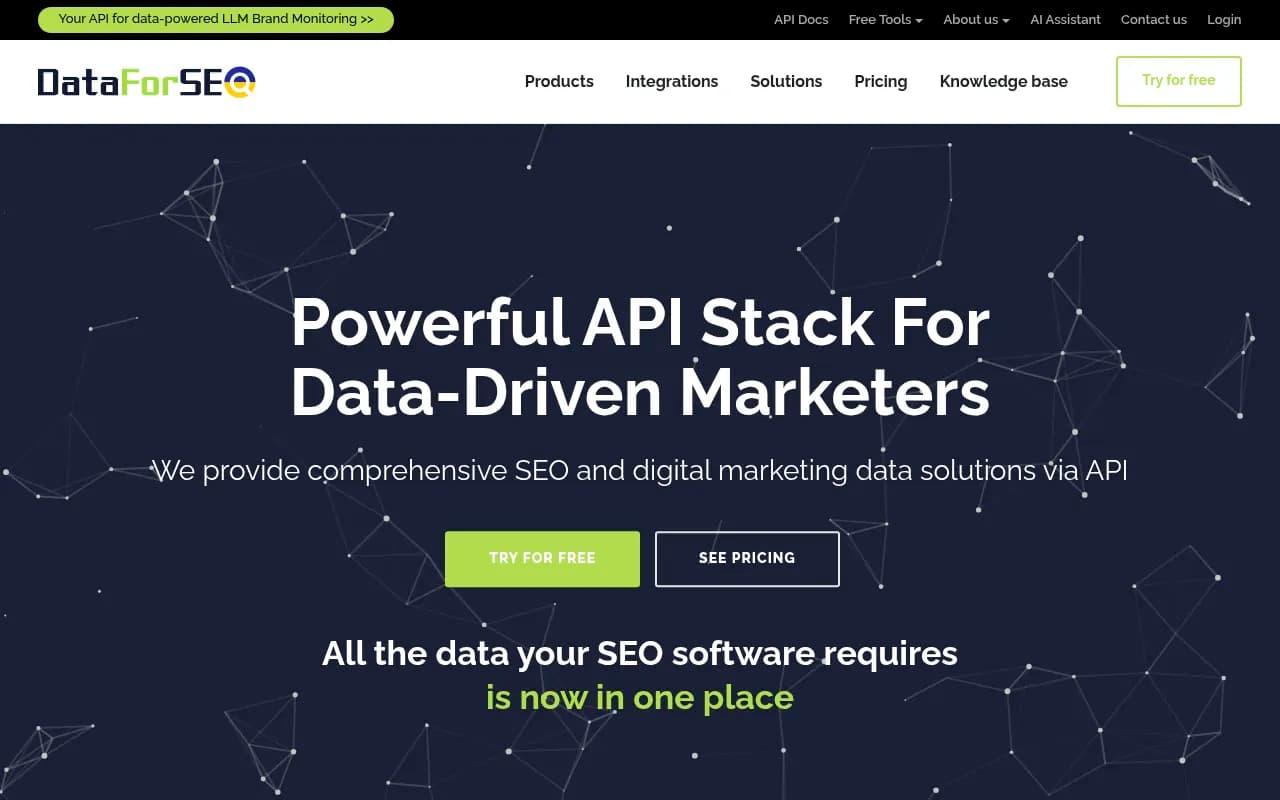
DataForSEO is a Ukrainian-founded API company (CEO Nick Chernets) that sells search marketing data by the request. It pulls from search engines, marketplaces, review platforms and a large crawl of the web, then exposes the result through a set of REST APIs and a few downloadable databases. The company says it supplies 750+ SEO software companies and agencies. If you have used a rank tracker, a backlink checker or a local SEO tool built by a small team, there is a fair chance DataForSEO sits underneath it.
The pitch is simple. Building your own crawlers, proxies and SERP parsers is expensive and brittle, so rent the data instead and spend your engineering time on the product. That idea has worked for years, and the pay-per-use model made it accessible to solo developers and small agencies, not only funded startups.
The homepage lists some of its scale: 524.3M Google SERPs in the dataset, 8.4B Google keywords, and a live backlink index of 1.8T links with 12B crawled in the last 24 hours. Those are vendor figures, so treat them as marketing, but the breadth of endpoints backs up the general claim.
Key features
SERP API. The core product. It returns search results from Google (organic, Maps, AI Mode and more), Bing, YouTube and other engines. Three delivery speeds exist: Standard queue at $0.60 per 1K results, Priority at $1.20 and Live at $2.00. Entry pricing on the pricing page starts at $0.0006 per SERP. That tiering is the sensible part. A nightly rank-tracking job does not need live results, and paying for the slow queue is where the 70-90% savings that some reviewers claim for agency workflows come from. Compared with SerpApi, which charges by monthly subscription tiers, the per-request model is cheaper at volume and has no wasted monthly allowance.
Keywords Data API. Search volume, trends and advertising metrics from Google Ads, Google Trends and Bing Ads, from $0.0012 per task. One G2 reviewer says the numbers feel closer to Keyword Planner than to the smoothed figures other tools show. Another says the volumes are basically averages of Keyword Planner data and often run higher than Semrush or Ahrefs. Both are true in a sense. Know what you are buying: Google Ads data, not a proprietary clickstream estimate.
DataForSEO Labs API. Keyword, competitor, market, app and ecommerce intelligence across Google, Amazon and the App Store. Pricing is $0.012 per task plus $0.00012 per returned item. This is where you build keyword difficulty tools, competitor gap reports and ranked-keyword lists without scraping anything yourself.
Backlinks API. A live backlink index for building a backlink checker: referring domains, top pages, anchors and more. Worldwide Backlinks is one of the published case studies. Compared with Ahrefs' API, which bills in API units with a minimum per request, the per-task approach is easier to forecast.
On-Page API. Crawling, page auditing, content parsing and screenshots, from $0.00015 per page. Useful for site audit tools. One G2 reviewer gave 0/5 over screenshot captures that included pop-ups and overlays, and others want the Content Analysis API improved, so this is not the strongest corner of the platform.
Merchant, App Data, Business Data and Domain Analytics APIs. Amazon and Google Shopping product data, app store reviews and rankings, business listings and reviews (Google, Trustpilot and others), and WHOIS plus technology detection. These cover reputation management and local SEO products, which is why the homepage highlights rank tracking, backlink analysis, reputation management and keyword research as its four use cases.
AI Optimization API. The newer addition. The LLM Responses API queries ChatGPT, Claude, Gemini and Perplexity at $0.0002 per task plus the underlying LLM cost. The LLM Scraper API costs $0.0012 per result page. AI Keyword Search Volume is $0.01 per task plus $0.0001 per row, and LLM Mentions is $0.10 per task plus $0.001 per row. If you want to build your own AI visibility tracker, these are building blocks. They are not a tracker.
Developer experience. Documentation is detailed and reviewers keep praising it. A GUI lets you monitor and control API usage, a Sandbox lets you test integrations for free, and the Playground in the dashboard lets you fire requests without code. There is also an official MCP server (npx dataforseo-mcp-server, plus a hosted endpoint at mcp.dataforseo.com/mcp), which means Claude, Cursor and similar clients can call the APIs directly. One Trustpilot reviewer says Claude Code already knows how to work with the APIs.
Sofia, the AI assistant. A chat assistant on the site that recommends endpoints for your use case, such as which APIs to use for keyword research. It is a helpful shortcut given how many endpoints exist.
Support. 24/7 live chat. A reviewer-cited 2025 metric from the company puts median response at 17 seconds, and G2 reviewers mention fast chat support repeatedly. Not every experience is good: one reviewer said support offered no real solutions on the screenshot issue, and another had a new account paused by anti-fraud checks until support lifted it.
Who is it for
The sweet spot is a developer or a small technical team building something. A SaaS founder shipping a niche rank tracker for 500 local businesses. A freelancer writing Python scripts that pull SERP and People Also Ask data into Google Sheets. An agency with one in-house developer automating client reporting in n8n or Make. A product team at a larger company who needs backlink data inside an internal dashboard and does not want a $499.95-per-month Semrush API subscription just to unlock access.
It also suits data-hungry researchers. Anyone running a content study over thousands of SERPs will find the per-request pricing far kinder than seat-based tools.
Who should skip it? Marketers who want charts, alerts and a ready-made dashboard. The interface exists, but one reviewer calls it old fashioned and another says the GUI stalls when loading more than 100K task results (they pull large exports directly via the API). NextGrowth's review scored ease of use 3/5 for this reason. If nobody on your team can write a request in Python or JavaScript, or at least wire up n8n, buy Ahrefs, Semrush or a dedicated rank tracker instead. A $50 minimum top-up is also a mismatch for anyone who just wants to check a few keywords once.
Integrations and ecosystem
There is no app marketplace in the traditional sense, because the product is the integration. Reviews and the NextGrowth test mention n8n, Make, a Python SDK, Postman and Google Sheets. The MCP server is available as an open-source TypeScript repo at github.com/dataforseo, and a remote endpoint works with MCP clients.
The REST API (v3) is the main surface, with a Sandbox for free testing. You can set daily spending limits for the whole account or per API and endpoint, which matters when a bug in your loop would otherwise burn through your balance. Results come as JSON, and there are also downloadable databases of historical SEO data for teams that want bulk access instead of request-by-request calls.
A useful sign of the ecosystem: other tools build on it. Promptwatch lists DataForSEO as built into every plan, which is the pattern here. DataForSEO is the layer underneath, and the product on top is someone else's.

Pricing and value
There are no subscriptions. You top up at least $50, and requests draw down your balance. A G2 reviewer says unused credits roll over, but that is user-reported, so check the terms. New accounts get $1 of trial credit for the Playground, MCP or templates, and the Sandbox is free. Payments go by card, PayPal or Amazon Pay, and bank wire or ACH for $5,000 and up.
Per-API rates, from the pricing page:
- SERP API from $0.0006 per SERP (Standard $0.60, Priority $1.20, Live $2.00 per 1K)
- Keywords Data from $0.0012 per task
- Labs at $0.012 per task plus $0.00012 per item
- On-Page from $0.00015 per page
- Domain Analytics from $0.012 per task
- AI Optimization with multiple billing models, listed above
The vendor's own comparison puts SerpApi at $75 per month for 5,000 searches on the Developer plan, Oxylabs from $49 per month, Semrush's API behind a $499.95 per month plan, and Ahrefs at $129 per month for 100K API units. That is a vendor-authored table, so apply a discount, but the direction matches what reviewers say. One described avoiding paying $200+ per month for a seat. For low or spiky volume, pay-as-you-go wins clearly. For heavy, steady volume, run the numbers, since request weights vary per endpoint.
Strengths and limitations
What it does well
- Cost structure. Pay for what you use, set daily caps, and pick the SERP speed that suits the job.
- Breadth. SERP, keywords, backlinks, on-page, ecommerce, apps, local and AI data under one account and one billing balance.
- Documentation and the Sandbox. Reviewers keep praising both, and setup in about two minutes is a common comment.
- Support responsiveness. Live chat is fast for most people.
- AI-friendly tooling. The MCP server makes it easy to query data from an AI assistant.
Where it falls short
- API-first means a learning curve. Many endpoints and options overwhelm new users.
- The UI is dated and slow with large result sets.
- Some data quality complaints: screenshots with overlays, keyword volumes that depend on Google Ads averages, and a Content Analysis API reviewers want improved.
- Occasional onboarding friction, such as the anti-fraud pause one reviewer hit.
How it compares for AI visibility work
This is the part to be straight about. DataForSEO's AI Optimization API can pull LLM answers, scrape results and show mentions. If you have engineers and want to build a custom tracker, it is a strong starting point. But it is raw data. You will build your own prompt management, scheduling, scoring, dashboards and reporting.
Against a finished platform like Promptwatch, the gaps are large. Missing out of the box: content gap analysis, AI content generation and the Content Agent with publishing to WordPress, Webflow and Framer, IP-verified AI crawler logs, AI traffic and conversion attribution, Google Search Console and Bing data joined with AI citations, Reddit, YouTube and LinkedIn citation reports, AI shopping and Ads Radar, prompt difficulty scoring, an Action Board and Agent Chat. Promptwatch also monitors real user interfaces rather than only API outputs, which matters because user-facing answers can differ from API answers. If your goal is to rank in AI answers, not to build software, the finished platform is the stronger choice. For a wider list of options, the directory at bestgeosoftware.com is a reasonable place to browse.
Bottom line
Buy DataForSEO if you build things. It is one of the more sensible ways to get SERP, keyword and backlink data without a subscription, and the documentation, Sandbox and spending limits make experimenting low-risk. Agencies with a developer and SaaS teams prototyping an SEO product will get the most out of it.
Do not buy it expecting a tool. For teams that want AI search optimization handled, with gap analysis, content creation, publishing and tracking of whether each page gets crawled and cited, Promptwatch is the better fit, and it happens to use DataForSEO data itself. Best use case: a developer-led team turning raw SERP and keyword data into its own product or automated reports at pay-per-use cost.
Frequently asked questions
What is DataForSEO?
How much does DataForSEO cost?
Is there a free plan or trial?
Who is DataForSEO best for?
Can DataForSEO track AI search visibility?
How does DataForSEO compare with Semrush or Ahrefs APIs?
Similar and alternative tools to DataForSEO