SerpApi Review 2026
Returns structured search results from Google and many other engines as JSON, aimed at developers who need broad engine coverage.
Key takeaways
- SerpApi is a developer-first API that returns parsed search results as JSON or Markdown from Google plus dozens of other engines, including Bing, Amazon, YouTube, Yelp, Walmart and Apple Maps.
- It is data infrastructure, not an AI visibility platform. Compared with Promptwatch, it has no prompt monitors, visibility scores, share of voice, crawler logs, AI traffic attribution, content gap analysis or content generation. You get raw answers and you build everything else yourself.
- Pricing is subscription based, from a free 250-search plan to $3,750 a month for the Cloud 1M tier. Cost per search falls steeply with volume, but small plans are expensive per query.
- Google sued SerpApi in December 2025. SerpApi says it is fighting the case, and a LinkedIn post from its team claims the court granted its motion to dismiss. We could not verify the ruling's scope. Risk-sensitive buyers should check the current status.
- Best for engineering teams who need broad, reliable SERP coverage inside their own product. Poor fit for marketers who want dashboards.
SerpApi is a real-time search results API. You send a query, a location and an engine name, and it returns the page as structured data: organic results, local packs, knowledge graphs, shopping carousels, People Also Ask, AI Overviews and more. Behind the scenes it runs a full browser cluster, rotates proxies by location and solves CAPTCHAs, so developers don't have to maintain scrapers that break every time Google changes a layout.
The product has been around for years and is embedded in a lot of other software. The homepage lists Nvidia, Shopify, Perplexity, Adobe, Samsung, KPMG, Ahrefs, Salesforce, Thomson Reuters, Morgan Stanley, Experian and BrightLocal among its customers. That mix tells you the audience: SEO tool vendors, AI companies feeding search into LLMs, ecommerce price monitors and research teams.
The pitch is simple. Don't build or babysit a scraper. Pay per successful search, get consistent JSON, and move on to the real product you are building.
Key features
Broad engine and endpoint coverage. This is the main reason people pick SerpApi. The API list runs well past 100 endpoints. On the Google side alone there are Search, Light Search, AI Mode, AI Overview, Autocomplete, Maps, Maps Reviews, Shopping, News, Images, Videos, Flights, Hotels, Jobs, Scholar, Patents, Trends, Finance, Lens, Play Store and YouTube. Beyond Google you get Bing (including Copilot), Baidu, DuckDuckGo, Yahoo, Yandex, Naver, Amazon, eBay, Walmart, The Home Depot, Target, Yelp, Tripadvisor, Booking.com, Airbnb, Zillow, Apple App Store and Apple Maps. There are also Instagram, Facebook profile and Meta Ad Library endpoints. Cheaper SERP APIs usually stop at Google and Bing.
AI search endpoints. SerpApi now exposes Google AI Mode, Google AI Overview, Bing Copilot, Brave AI Mode, Duck AI, Naver AI Mode and a Google Gemini API. For teams researching generative engine optimization, that means you can pull AI answers, their text blocks and their cited references programmatically. The sample response on the site shows an AI Overview broken into paragraphs, lists and indexed references with links. It is useful raw material. It is not analysis.
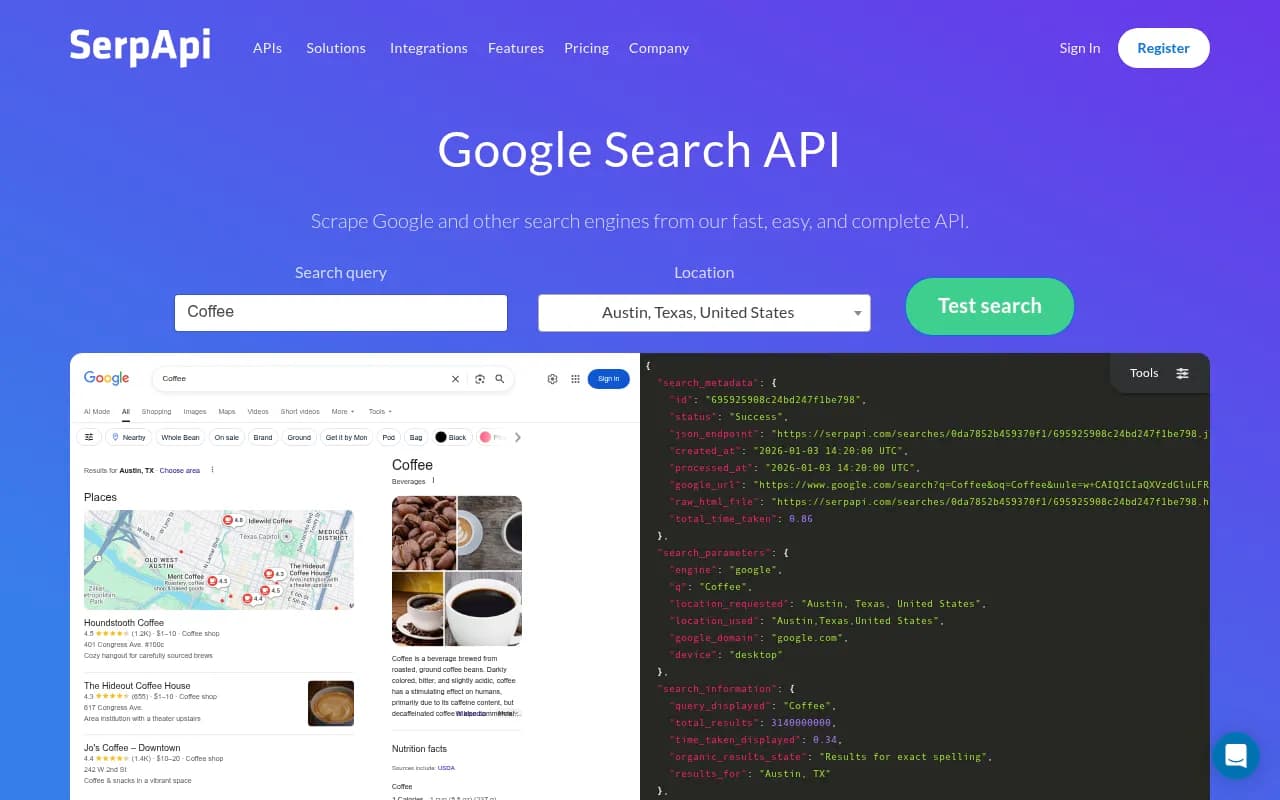
Real browser, real results. Each request runs in a full browser, mimicking what a human sees, rather than hitting a private endpoint that returns something slightly different. Responses typically come back in under a second or two. The sample Austin, Texas query for "Coffee" reported a total time of 0.86 seconds.
Accurate geolocation. A location parameter uses Google's geolocated encrypted params and routes through the nearest proxy. A separate locations endpoint lets you look up valid location strings. For local SEO tools this matters a lot, since the same query in Austin and Denver produces different local packs.
Output flexibility. Results come as JSON, with Markdown output as an option, and the raw HTML file is also stored. The JSON Restrictor feature trims the response to just the fields you need, which cuts payload size. Pixel Position gives result placement in pixels rather than just rank, which is handy for measuring how far down the page you actually appear.
Speed tiers. Ludicrous Speed and Ludicrous Speed Max trade money for faster responses. On the Enterprise page, on-demand searches cost $7.50 per 1,000, doubling to $15 with Ludicrous Speed and $30 with Max. It is a niche option, but real-time products sometimes need it.
X-Ray and debugging tools. The playground lets you test queries, view JSON next to the rendered page, and toggle X-Ray borders that show which part of the page maps to which JSON path. It cuts integration time noticeably compared with reading docs alone.
Privacy and legal features. ZeroTrace Mode stores no search parameters, files or data after a search completes. The U.S. Legal Shield assumes liability for lawful scraping and parsing of public search data, with up to $2 million in coverage, included from the Production plan up. It excludes illegal uses of the data itself. The company reports SOC 2 Type II, SOC 3, ISO 27001 and ISO 27701 certifications, and an uptime SLA of 99.95% on all plans with credits as a remedy.
Libraries. Official clients exist for Ruby, Python, JavaScript, Go, PHP, Java, Rust, .NET, Swift, C++, a CLI and an MCP server, plus a Google Sheets option.
Who is it for
The core user is a developer. Think an engineer at an SEO software company who needs rank data across 50 countries without running proxies, or a team at an AI startup piping live web results into an LLM agent. Other natural fits are ecommerce analysts tracking Google Shopping, Amazon or Walmart prices at scale, and agencies building internal rank trackers or local SEO dashboards on top of Maps and Local results.
It also suits research and compliance work. Background check automation, copyright checking, news monitoring and cyber threat intelligence all appear as listed use cases. The Legal Shield and ZeroTrace Mode speak to enterprise legal teams who worry about data handling.
Team size varies. A solo developer can live on the free or $25 plan. Product companies with real volume sit on the Production tier and up. Enterprise buyers on the $3,750 base plan are mostly platforms where SERP data is a core input.
Who should skip it? Marketers without engineering help. There is no dashboard that tells you how your brand shows up. If you want to know whether ChatGPT or Google AI Overviews mention you, which pages get cited, and what to publish next, an API that returns JSON is the wrong starting point. Very price-sensitive teams doing basic Google-only rank checks may also find cheaper providers, which some third-party comparisons put at roughly $1 to $3 per 1,000 searches.
Integrations and ecosystem
SerpApi integrates at the code level. The language libraries above cover most stacks, and the MCP integration lets AI agents call the API directly. A Google Sheets add-in helps non-developers pull small datasets. Many third-party automation tools, such as n8n, also offer SerpApi nodes, though one Reddit thread complained about the free tier limit there.
The REST API is simple: a GET request with an engine, query and API key returns JSON. Every response includes a json_endpoint and a raw HTML file link, and results contain ready-made serpapi_link URLs for following pagination, related searches and related questions. That chaining makes crawling a topic tree straightforward.
Team Management is available for sharing accounts. Export is whatever you build, since the product gives you data and not reports. There is no browser extension or mobile app, which is fine for the audience.
If you are comparing tools in this space, the directories at ai-rank-tools.com cover AI rank trackers, and surferstack.com covers general software.
Pricing and value
Pricing is month to month with no lock-in. Only successful searches count, and cached, errored and failed searches don't. The number of results per response doesn't change the cost.
- Free: $0, 250 searches a month, 50 per hour.
- Starter: $25, 1,000 searches, 200 per hour.
- Developer: $75, 5,000 searches, 1,000 per hour.
- Production: $150, 15,000 searches, 3,000 per hour, most popular, with Legal Shield.
- Big Data: $275, 30,000 searches, 6,000 per hour.
- Searcher: $725, 100,000 searches.
- Volume: $1,475, 250,000 searches.
- Infrastructure: $2,750, 500,000 searches.
- Cloud 1M: $3,750, 1 million searches, scaling in steps up to dozens of millions.
- Enterprise: $3,750 base plus usage, with on-demand searches at $7.50 per 1,000 and reserved searches at $2.75 per 1,000.
Do the math and the curve is clear. Starter works out to $25 per 1,000 searches, Production to $10, and the 1M plan to $3.75. Reserved enterprise volume drops to $2.75. Throughput is capped at 20% of plan volume per hour for plans under 1 million searches.
The weakness is the subscription model. A team averaging 15,000 searches but spiking to 30,000 has to buy the $275 plan all year, a point made by a competitor's blog (ScrapeBadger), so weigh it as a biased source. Capterra reviewers praise human support but say pricing is unclear at first and that USD billing is awkward for small international firms. The refund policy is a full refund within 7 days unless you used more than 20% of your searches. Always confirm current numbers on serpapi.com/pricing.
Value depends on what you need. If you only need Google web results, it is a premium product. If you need Flights, Events, Scholar, Maps reviews and ten other engines under one key, the premium is easier to justify.
Strengths and limitations
Strengths
- Unmatched breadth of engines and SERP block types under one API and one billing relationship.
- Real-browser rendering, accurate local results and fast responses.
- Strong compliance posture: SOC 2 Type II, ISO 27001, ZeroTrace Mode, SLA credits.
- Good developer experience, with a playground, X-Ray view and a dozen client libraries.
- AI search endpoints (AI Mode, AI Overview, Copilot, Gemini) arrived early.
Limitations
- Small plans are expensive per search, and the subscription tiers don't flex to bursty usage.
- The legal picture is unsettled. Google filed suit in December 2025 alleging circumvention of security measures and DMCA violations. SerpApi contests it, and the claimed dismissal is not verified here. Production teams building a business on scraped Google data should do their own risk assessment.
- It returns data only. No dashboards, alerts, reports or recommendations.
Compared with Promptwatch
For AI visibility work, the gap is large. SerpApi can fetch an AI Overview or AI Mode answer for a query you send. Promptwatch is the platform built on top of that kind of data. It runs daily monitors across ChatGPT, Google AI Overviews, AI Mode, Gemini, Perplexity, Copilot, Meta AI, Claude and more, scores visibility and share of voice, and adds things SerpApi does not have:
- IP-verified AI crawler logs and AI traffic attribution
- Content gap analysis, a Content Agent that publishes to WordPress, Webflow or Framer, and an Action Board
- Reddit, YouTube and LinkedIn citation tracking, AI Shopping and Ads Radar
- Prompt volumes, difficulty scores, query fan-outs, and Search Console and Bing data alongside AI data
- Page-level tracking and offsite mentions
You could rebuild some of this on top of SerpApi, but you would be writing a product, not running one. Promptwatch Data shows how fast the ground shifts. In its report on social media citations by AI model, ChatGPT drew 0.46% of citations from social platforms between Sep 28 and Oct 4, 2026, while Google AI Overviews drew 12.2%. A raw API won't surface that kind of pattern for you.

Bottom line
SerpApi is a strong choice if you are an engineer who needs reliable, structured results from Google and many other engines, and you want someone else to deal with proxies and CAPTCHAs. The coverage is the best reason to pay for it, and the compliance credentials make procurement easier. Check the Google litigation status, model your volume against the tier steps, and test the free plan before committing.
If your goal is marketing outcomes in AI search rather than a data feed, look at Promptwatch instead. It tracks, explains and helps fix your AI visibility, where SerpApi stops at delivering the JSON. Best use case in one sentence: a developer team that needs multi-engine SERP and AI answer data inside its own product.
Frequently asked questions
What is SerpApi?
How much does SerpApi cost?
Which search engines does SerpApi support?
Is SerpApi legal to use?
Can SerpApi track my brand in AI search?
Does SerpApi have a free plan?
Similar and alternative tools to SerpApi