SearchApi Review 2026
Search results API covering multiple engines plus an AI Overview endpoint, billing only successful responses.
Key takeaways
- SearchApi is a developer-first SERP and search-data API. You send a GET request, you get structured JSON back. Paid plans start at $40/month for 10,000 searches and fall to $1 per 1,000 at the top tier.
- You are billed only for successful searches (HTTP 200). Failed requests cost nothing, which is the clearest reason to pick it over tools that charge for retries.
- Coverage goes well past Google: Google AI Overview and AI Mode, Maps, News, Shopping, plus YouTube, Amazon, TikTok, Yelp, GitHub and LinkedIn Ad Library endpoints.
- Limits to know: the free tier is only 100 requests, and you can use at most 20% of your plan's credits per hour, which hurts bursty workloads.
- Best for engineers building rank trackers, research pipelines, LLM agents and data products. It is an API, not a dashboard, so marketers who want ready-made reports should look elsewhere.
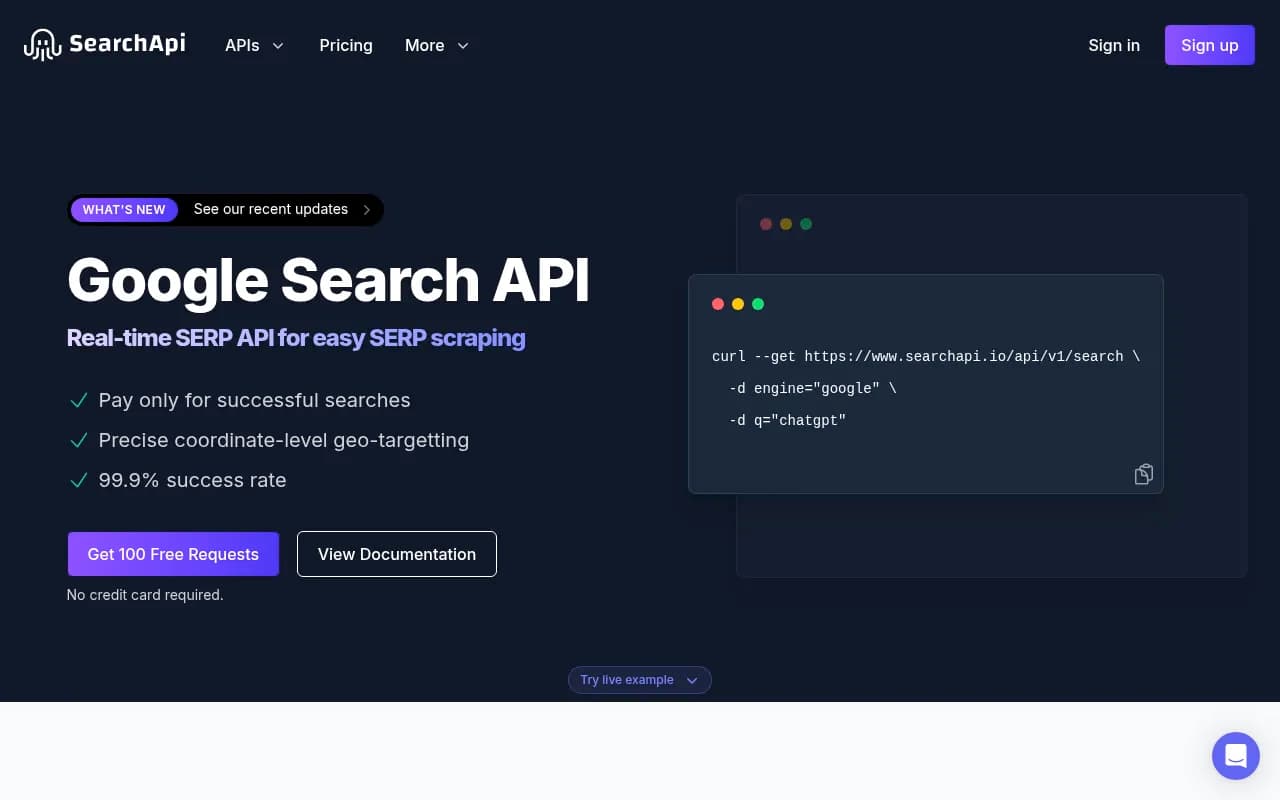
SearchApi (searchapi.io) is a search results API. You call one endpoint, pass an engine name and a query, and get back parsed JSON: organic results, ads, knowledge graph blocks, People Also Ask, related searches, local packs and more. It handles the proxies, CAPTCHAs and browser rendering that make scraping search engines a miserable side project. The homepage example is a single curl call with engine=google and q=chatgpt, and that really is the whole onboarding story.
The target audience is technical. Think SEO software companies that need SERP data under their own rank tracker, data teams feeding search results into models, and AI developers wiring web search into agents. The homepage logo strip lists Anthropic, Bain & Company, DataRails, Scale AI, Ahrefs and Demyst. Those are the vendor's own claims and I could not verify them independently, but the mix of customers (AI labs, an SEO platform, a consultancy) matches the use cases the product is built for.
It is a young-ish player in a crowded category that includes SerpApi, Serper, Scrapingdog and others. What stands out is how fast it ships. The changelog is published as monthly updates, and the September 2026 update alone added twelve new APIs, including Yelp Search, GitHub Search, Google Reverse Image and five YouTube endpoints.
Key features
Real-time Google Search API. The core product. Each request fetches the live results page and returns it parsed. Organic results include position, title, link, domain, snippet, highlighted words, date, sitelinks and rich snippets such as app ratings. The sample response for a simple query also included a knowledge graph, inline videos, related searches and pagination, plus a search_metadata block with request and parsing times (1.25 seconds and 0.07 seconds in the demo). You also get an html_url and a json_url for each search, which is handy when you need to debug why a parse looks odd.
Rich snippet coverage. SearchApi lists organic results, ads, news results, related searches, knowledge graph, People Also Ask, Maps results and AI Overview as supported blocks, and says it adds new ones as Google ships them. The ads parsing is the piece competitive-intelligence teams care about: ad copy, display URLs and positions on the page.
AI Overview and AI Mode data. There is a dedicated AI Overview capability, and the September update added follow-up questions to Google AI Mode. If you are building anything that studies how Google's generative answers cite sources, this is raw material you can collect programmatically. It gives you responses, not analysis, so scoring, trending and competitor comparison are on you.
Precise geo-targeting. Location control goes down to coordinates, and the September update added coordinate targeting for Google. Device, language (hl) and country (gl) parameters are standard. For local SEO tooling, where the same query returns different packs in different neighborhoods, this matters a lot.
Pay only for successes. You are charged for searches that return a 200 status. Failed requests are not billed. The site also claims a 99.9% success rate and a built-in auto-retry mechanism with adaptive error handling. Retries happen on their side, and you do not pay for the ones that fail.
Infrastructure you do not manage. Proxy rotation, full browser rendering, JavaScript execution and CAPTCHA solving are all handled. Marketing copy says average response time is under two seconds. One inconsistency worth flagging: the homepage cites a network of 100M+ proxies while the pricing page says 20M+. Either is large, but I would not quote the number in a procurement doc without asking.
A long list of engines. Beyond Google, documented engines include YouTube (with new Channel Posts and Post APIs), Amazon (with a currency parameter), Yelp, TikTok Search (videos, photos, profiles), TikTok Autocomplete across 52 markets, GitHub Search (repositories, users, issues, PRs, commits, topics, discussions, packages, wikis, marketplace) and LinkedIn Ad Library Ad Details. The LinkedIn endpoint has a caveat: run dates, impressions and targeting only show for EU-served ads, because that is all LinkedIn publishes. GitHub results stop at page 100, which is GitHub's own 1,000-result ceiling.
Consistent response shapes. Newer endpoints deliberately mirror older ones. Yelp matches Google Maps, and TikTok autocomplete matches the Google and YouTube autocomplete APIs. If you already parse one, the next takes minutes. That is a design choice I wish more API vendors made.
Language snippets and open-source integrations. The docs show request examples in Python, Node, Ruby, Java, Go, PHP, Bash, R, Kotlin, Swift, C#, C and C++. The homepage names Dify, Flowise, LangChain and Haystack as open-source integrations for LLM workflows. I did not verify the integration code itself.
Legal Protection Guarantee. SearchApi says it accepts legal responsibility for how it collects and parses public search results, with up to $2M in coverage, worldwide, under US law. It does not cover how you use the data or unlawful activity. It is included on Production and above. Treat it as a useful signal for legal review, not a blanket shield.
Who is it for
The sweet spot is an engineering team that needs search data as an input. A startup building a rank tracker for 5,000 keywords across 20 cities fits. So does a data team at a consultancy pulling Google and YouTube results for market research, or an AI engineer giving an agent live web search. The pricing curve rewards volume, and the Dedicated Throughput tiers suggest the vendor expects customers running millions of queries a month.
It also suits SEO agencies with a developer or two on staff. If you want to build custom reporting dashboards on top of raw SERPs, including Maps and ads data, SearchApi saves you from running your own scraping stack. Team Management arrives at the Production plan, so small teams with multiple collaborators can share an account.
Who should skip it? Non-technical marketers. There is no point-and-click rank tracking interface here, no reports and no recommendations. Also skip it if your workload is spiky: the 20% hourly credit cap means you cannot burn a month of credits in an afternoon. And if what you really want is to know how your brand shows up in ChatGPT, Gemini or Perplexity, a raw SERP API is the hard way. A platform like Promptwatch tracks brand visibility across AI engines and tells you what to fix, without you building the pipeline. SearchApi is the better fit when you want the underlying Google data inside your own product.
Integrations and ecosystem
The integration story is the API itself. One GET endpoint (https://www.searchapi.io/api/v1/search) with an engine parameter covers everything, so there is little to learn once you have made the first call. Documentation lives at searchapi.io/docs, with per-engine pages such as /docs/google. The docs include code samples in thirteen languages and a live example on the homepage.
For AI builders, the stated open-source integrations are Dify, Flowise, LangChain and Haystack. That makes it a practical search tool for retrieval and agent frameworks. I did not verify SDKs, a browser extension, a mobile app or native Zapier-style connectors, and I would not assume they exist. Output is JSON, so exporting to a warehouse or spreadsheet is a small script away. The support contact is [email protected], and the product's X account is @searchapi_io.
If you are comparing SERP and rank-tracking options more broadly, the directory at ai-rank-tools.com is a reasonable next stop.
Pricing and value
There is a free tier of 100 requests with no credit card, then monthly plans with no commitment. Every tier comes in Standard or Enhanced speed. Enhanced uses multiple parallel threads for nearly 2x the speed.
- Developer: $40/month, 10,000 searches ($4 per 1,000), 99.9% SLA
- Production: $100/month, 35,000 searches ($3 per 1,000), adds Team Management and the Legal Protection Guarantee
- BigData: $250/month, 100,000 searches ($2.50 per 1,000), adds Medium Throughput
- Scale: $500/month, 250,000 searches ($2 per 1,000), High Throughput and Search Analytics
- Octo 500K: $900/month, 500,000 searches ($1.80 per 1,000), Dedicated Throughput and Priority Support
- Octo 1M: $1,500/month, 1,000,000 searches ($1.50 per 1,000)
- Octo 2M: $2,800/month, 2,000,000 searches ($1.40 per 1,000)
- Octo 5M: $5,000/month, 5,000,000 searches ($1 per 1,000)
Custom plans are available on request. Always confirm numbers on searchapi.io/pricing before buying.
On value: billing only for 200 responses is a real saving on hard queries. The per-1,000 price drops 4x from the entry plan to the top. The free tier is thin, though. Scrapfly's roundup lists Serper with a 2,500-search free tier, so evaluating SearchApi on a serious dataset means paying for a month. SerpApi's own comparison post and Scrapingdog's are competitor-authored, so I would not lean on their claims. Run your own 1,000-query test against two vendors and compare success rate, latency and parse quality.
Strengths and limitations
What it does well
- Success-based billing removes the usual anxiety about paying for blocked requests.
- Breadth of engines is big and growing monthly, so one vendor can cover Google, YouTube, Amazon, TikTok and Yelp.
- Consistent schemas across endpoints reduce the cost of adding a new data source.
- Coordinate-level geo-targeting is useful for local SEO and ad verification.
- The Legal Protection Guarantee gives legal teams something concrete to read.
Where it falls short
- The 20% hourly credit cap limits burst usage. A one-off crawl of 100,000 keywords needs planning.
- The free tier of 100 requests is small compared with some rivals.
- I found no independent user reviews on G2 or Trustpilot, so claims like 99.9% success and sub-two-second latency rest on the vendor's word. Proxy numbers also differ between pages (100M+ versus 20M+).
- It is data, not insight. There is no dashboard, no content recommendations and no AI visibility scoring. Search Analytics only arrives on the Scale plan and above.
- Integrations and SDKs beyond the language examples were not verified.
Bottom line
SearchApi is a solid pick for developers who want fresh, structured search data across many engines without running proxies. The success-only billing and fast release cadence are real advantages, and the volume pricing is competitive. Test before you commit, and design around the hourly credit cap.
Best use case in one sentence: powering a rank tracker, research pipeline or AI agent with live Google and multi-engine results, billed only when requests succeed.
Tags:
Frequently asked questions
What is SearchApi?
How much does SearchApi cost?
Is there a free plan?
Do I get charged for failed requests?
Does SearchApi support Google AI Overviews?
Are there usage limits I should know about?
Similar and alternative tools to SearchApi