Serper Review 2026
Simple Google SERP API with pay-as-you-go top-ups and a free query allowance, popular for AI agents and automation workflows.
Key takeaways
- Serper is a Google-only SERP API with a top-up credit model: no subscriptions, and credits stay valid for 6 months.
- Pricing runs from $1.00 per 1,000 credits at the $50 tier down to $0.30 per 1,000 at the $3,750 tier, far below the monthly-plan pricing of SerpApi.
- Covers about ten Google endpoints (web, images, news, maps, places, videos, shopping, scholar, patents, autocomplete), but no Bing, DuckDuckGo or Baidu.
- Best for AI agent builders, automation users and small-to-mid SEO tools that need cheap, fast, predictable Google results. Weaker for teams that need ads data, AI Mode results or multi-engine coverage.
- 2,500 free queries with no credit card make testing easy.
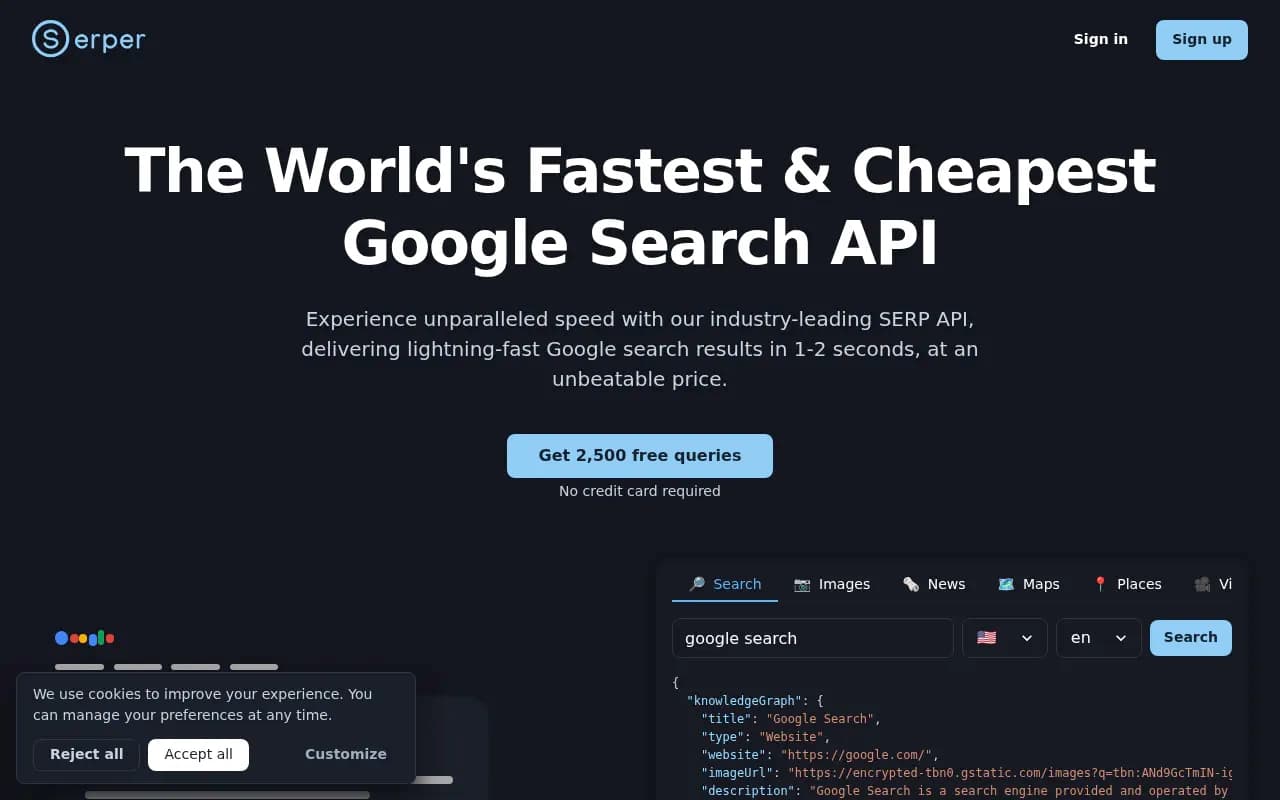
Serper (serper.dev) is a Google search API that does one thing: you send a query, it queries Google live, and you get structured JSON back. The homepage claims results in 1 to 2 seconds, and it says more than 1,000,000 companies and developers use it. The pitch is plain. Cheaper than SerpApi and Bright Data, simpler than both, and no monthly commitment.
It has become a default choice in the AI tooling world. Developers wiring up LangChain-style agents, n8n workflows and custom LLM apps often reach for Serper because the API is a single POST request with an API key header. Even outside the official docs you can see the pattern: a GitHub issue on the OpenClaw project asks for Serper.dev to be added as a web_search provider, which is typical of how agent frameworks treat it. The audience is developers, automation builders, and small data teams more than classic SEO agencies buying dashboards.
Key features
Ten Google endpoints. The homepage demos Search, Images, News, Maps, Places, Videos, Shopping, Scholar, Patents and Autocomplete. Each returns its own JSON shape. The web search response includes a knowledgeGraph block, organic results with positions and sitelinks, peopleAlsoAsk and relatedSearches. That is the data most SEO and research use cases actually need, and it saves you from parsing HTML.
- Places and Maps return titles, addresses, latitude and longitude, ratings, rating counts, phone numbers, websites, and Google cid/placeId identifiers.
- Shopping returns title, seller, price, delivery cost, rating and productId.
- Scholar returns publication info, year and citedBy counts, which is useful for literature monitoring.
- Patents returns inventor, assignee, filing and grant dates, PDF links and figures.
- Autocomplete returns plain suggestion values, handy for keyword expansion.
Live, uncached results. The FAQ states that every call goes directly to Google and nothing is cached. For rank checks and news monitoring that matters. The tradeoff is that an individual request sometimes takes 2 to 4 seconds when Serper has to retry against Google, which they admit openly.
Speed and concurrency. Typical latency is 1 to 2 seconds. Rate limits scale with the tier you buy: 50 queries per second on Starter, 100 on Standard, 200 on Scale and 300 on Ultimate. At 300 per second you can push roughly 15,000 to 18,000 searches a minute, and the company says it can raise limits for heavier use cases. For bursty agent workloads this is generous. Competitors such as SerpApi express throughput per hour, and the numbers look much smaller by comparison (200 per hour on its $25 plan).
Location and language control. You set country and language through parameters such as gl, and the API also accepts a location. That lets you check how results differ in Germany versus the US, or run localized place searches. The homepage demo even passes latitude and longitude for local queries.
Simple request format. Based on third-party documentation, the main call is a POST to google.serper.dev/search with an X-API-KEY header and a JSON body containing q, gl and num. There is no SDK ceremony. If you can use curl, you can use Serper, and that simplicity explains its popularity in no-code tools.
Credit model that you can reason about. One credit buys one standard query. A Hacker News commenter in May 2025 reported that 10 results cost 1 credit and requests for 20 to 100 results cost 2 credits. That means a 100-result request can effectively cost about $2 per 1,000 at entry pricing instead of $1. This is a community account, not an official statement, so check the pricing page before budgeting a large job.
Credit deduction only on success. The FAQ says credits are deducted when you receive a successful response, and the service stops accepting queries once your balance hits zero. No surprise overage bills. That is a real benefit compared with subscription plans that charge for overages.
Who is it for
The sweet spot is the solo developer or small team building something that needs Google data right now. Think of an indie founder adding web search to a research agent, an automation consultant running Google Maps lead lists through n8n, or a startup building a rank-tracking feature and paying per query. Because there is no monthly fee, a project that uses 8,000 queries in a month and then goes quiet does not waste money.
It also fits mid-size SEO and data teams running 500,000 to 12 million queries and watching the unit economics. At $0.30 per 1,000 on the Ultimate tier, large-scale SERP collection is genuinely affordable. Agencies building internal tools, such as SERP feature monitors or content-gap scripts, will find it more practical than a full suite. If you are comparing the wider category, the software directory at surferstack.com lists other SEO and data tools.
Who should skip it? Teams that need Bing, DuckDuckGo, Baidu or Amazon data will have to look elsewhere, because Serper is Google only. A competitor-authored comparison from Scrapingdog also says it lacks a Google AI Mode API and does not return ads, citations or sponsored-product snippets. Treat that source as biased, but it matches what the endpoint list shows. People who need email extraction from Google Maps listings (Scrap.io makes this point) will need an extra enrichment step. And anyone with strict legal or procurement requirements should note that legal debate around scraped search output affects the whole SERP API category, including a dispute involving SerpApi that I could not verify in detail. Enterprise buyers may want a vendor with formal compliance documentation, and none was found on the homepage.
Integrations and ecosystem
Serper does not ship a big integration catalog. It is an API, and its ecosystem is built by others.
- Automation tools: Reddit discussions mention n8n workflows using Serper, including Google Maps scraping. Make and Zapier-style HTTP steps work the same way.
- AI agent frameworks: LangChain-style search tools and agent projects commonly use Serper as a search backend. I could not verify an official LangChain integration page, so check current docs.
- Direct HTTP: Any language that can send a POST request works. Responses are JSON, so piping results into a database, spreadsheet or LLM prompt is trivial.
There is no browser extension, no dashboard for rank tracking and no native export tool that I found. The product is the API plus a account area for keys and credits. The site accepts Visa, Mastercard, American Express, Discover and PayPal. For a hosted playground, the homepage itself demos each endpoint live with country and language selectors.
Pricing and value
Serper uses a top-up model, not subscriptions. Credits are valid for 6 months. Prices exclude sales tax, VAT or GST.
- Starter: $50 for 50,000 credits ($1.00 per 1,000), 50 queries per second.
- Standard: $375 for 500,000 credits ($0.75 per 1,000), 100 queries per second.
- Scale: $1,250 for 2.5 million credits ($0.50 per 1,000), 200 queries per second.
- Ultimate: $3,750 for 12.5 million credits ($0.30 per 1,000), 300 queries per second.
Every tier includes real-time results and location customization. New accounts get 2,500 free queries with no credit card. Refunds are available within 7 days of purchase unless you have used more than 20% of the credits.
Compare that with SerpApi, which charges monthly: $25 for 1,000 searches, $75 for 5,000, $150 for 15,000 and $275 for 30,000, with a free plan of 250 searches. At the $75 plan you are paying $15 per 1,000 searches, versus $1.00 at Serper's entry tier. The gap shrinks at huge volumes and SerpApi offers extras such as more search engines and legal-protection options, but for Google-only workloads Serper is dramatically cheaper. Serper claims up to 10 times cheaper than SerpApi and Bright Data, and the entry-level math supports a big multiple. Watch the 2-credit rule for 100-result requests, which narrows the gap versus Bright Data's flat per-request pricing.
The catch is the upfront spend. The $50 minimum is small, but the best rates require committing $3,750 and using the credits within 6 months.
Strengths and limitations
Strengths
- Price per query: $0.30 to $1.00 per 1,000 is among the lowest I have seen for a Google SERP API.
- Speed: 1 to 2 second responses, with concurrency up to 300 queries per second.
- Simplicity: one POST, one header, clean JSON. No sprawling parameter maze.
- No subscription lock-in: pay once, use credits within 6 months, free 2,500 queries to start.
- Breadth within Google: places, scholar, patents and shopping alongside normal search.
Limitations
- Google only. No Bing, DuckDuckGo, Baidu or Amazon, so multi-engine projects need a second vendor.
- Missing newer surfaces. No Google AI Mode API and no ads or sponsored-product data, according to a competitor comparison that matches the endpoint list.
- Credit rules are fuzzy. The 10-versus-100 results credit cost came from a community thread and is not on the homepage, so budgeting needs care.
- Thin supporting material. I did not find official social channels, a changelog, G2 or Trustpilot scores, or compliance documentation in the research pass.
- Occasional slow requests, 2 to 4 seconds when retries against Google are needed.
There is also no built-in analytics layer. You get raw data and build whatever reports you need yourself.
Bottom line
If your project needs Google results as JSON and you care about cost per query, Serper is hard to beat. Developers building AI agents, automation builders and cost-conscious SEO tool makers get fast, live data without a monthly bill. The free 2,500 queries let you validate your use case before spending anything.
If you need multiple search engines, ads data, AI Mode coverage or enterprise compliance paperwork, look at broader providers such as SerpApi, DataForSEO or Bright Data. Best use case in one sentence: powering an AI agent or automation workflow with cheap, live Google search results.
Frequently asked questions
What is Serper?
How much does Serper cost?
Is there a free plan?
How does Serper compare with SerpApi?
Does Serper support Bing or other search engines?
Is Serper good for AI agents?
Similar and alternative tools to Serper