cloro Review 2026
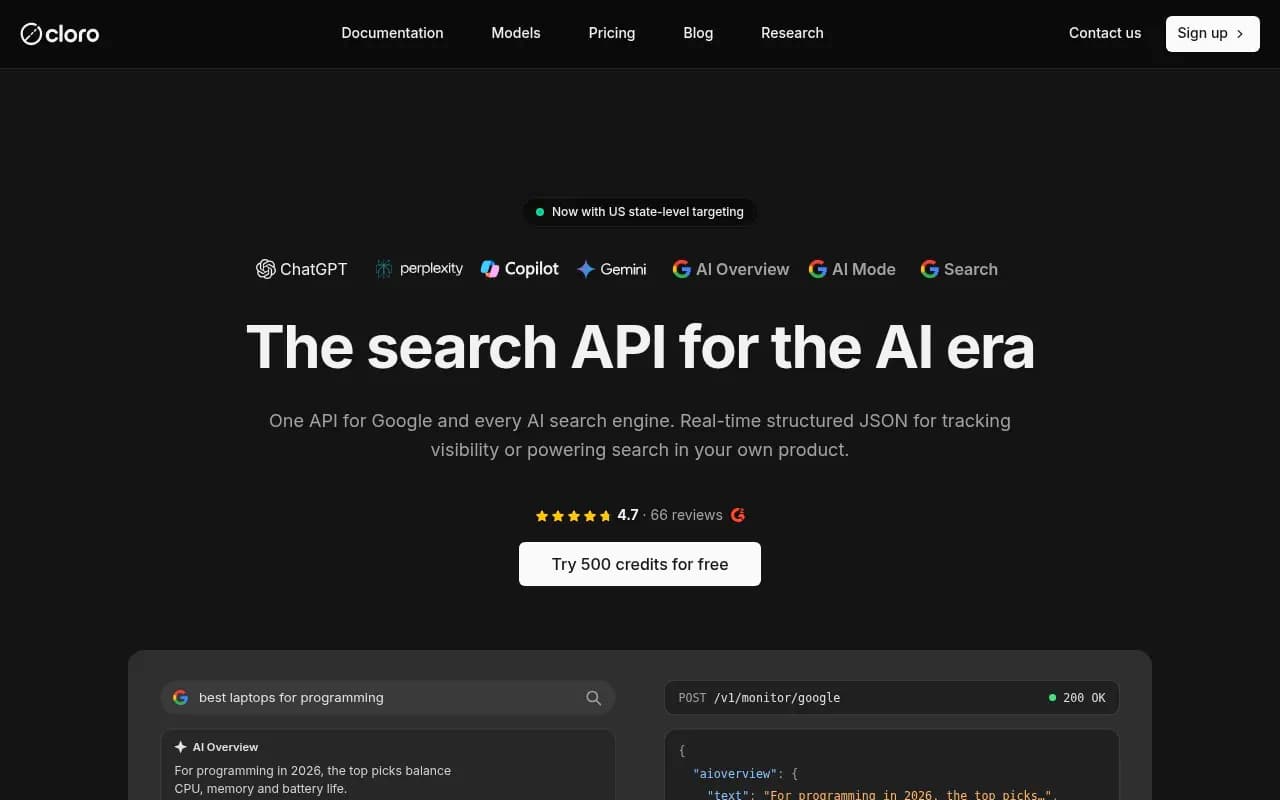
One API returning parsed Google results, AI Overviews, AI Mode and answers from ChatGPT, Perplexity, Copilot and Gemini, including the cited source URLs.
Key takeaways
- cloro is a data API, not a dashboard. It returns structured JSON (text, markdown, sources, query fan-out, shopping cards) from Google and the main AI engines through one response shape.
- It captures the live interface output rather than model API output, which is the right call for anyone measuring what real users see.
- Credit pricing is published per request (ChatGPT 5 credits, Perplexity 4, Gemini 4), so you can price a run before you start. Plans run from a free 500 credits to $5,000+/mo. There is no pay-as-you-go.
- It has no reporting UI, content tools, crawler logs or traffic attribution. Compared with Promptwatch, which covers content gap analysis, the Content Agent with CMS publishing, IP-verified AI crawler logs and visitor analytics, cloro is a raw data layer you build on.
- Best for developers building their own GEO trackers, agencies with in-house engineering, and AI products that need live search data. Poor fit for marketers who want a finished tool.
cloro is a search and AI-answer API aimed at developers. You send a prompt or query to an endpoint such as /v1/monitor/chatgpt, /v1/monitor/perplexity or /v1/monitor/google, and you get back clean JSON: the answer text, a markdown version, the cited sources with positions and labels, and, depending on the engine, query fan-out terms, shopping cards, ads and People Also Ask blocks. The pitch is simple. Instead of maintaining a scraper or a separate integration for every AI engine, you call one API with the same payload shape every time.
The company says it handles 2,000,000,000+ monthly API calls and claims 99.99% uptime, and it carries a 4.7 rating from roughly 66 to 70 G2 reviews. The reviewers are mostly engineers, founders and small-team marketers who replaced homegrown scrapers. Those numbers are self-reported on the homepage, so treat them as marketing until you have run your own load.
The audience is clear from the product. If you are building a brand-monitoring product, an internal AI visibility pipeline, a research dataset or an agent that needs to read live search results, cloro is aimed at you. If you want a dashboard that tells you what to fix, it is not.
Key features
Unified endpoints for every engine. The main draw is one request and response structure across ChatGPT (with web search), Perplexity, Gemini, Microsoft Copilot, Google AI Overviews, Google AI Mode, Google Search and Google News. The GitHub org also shows a Grok scraper that the homepage list does not mention. Adding a new engine to a pipeline is mostly a config change. One G2 reviewer said this saved their team days of integration work compared with juggling separate SDKs and auth flows.
Live interface capture, not model API output. cloro says it captures the actual search experience rather than calling provider APIs. This matters. Direct provider APIs usually return the answer text without the citations a user sees in the interface, and the answers can differ. Surfer published a comparison of scraped AI answers against API results that cloro points to as evidence. Promptwatch also tracks the real UIs for the same reason, so this is a sound approach rather than a differentiator against the better monitoring platforms.
Parsed sources and citations. Each response includes a sources array with position, URL, label and description. For ChatGPT you also get citation pills, inline products, ads and the search queries it ran (the query fan-out). Google Search output covers organic results, ads, People Also Ask, People Are Saying, local pack, related searches, shopping cards and the AI Overview. AI Mode adds place cards and shopping data. Copilot returns Bing-grounded answers and business entries. The Grok scraper returns richer source metadata including site name, author and favicon.
Geographic targeting. Every engine takes a country parameter, and there are US state-level options on ChatGPT, Copilot, Perplexity and Gemini (pass state: CA alongside country: US and the request routes through a proxy in that state). That is a recent addition, and it is useful for local and regulated verticals. City-level or exact-coordinate targeting is not mentioned in the material I reviewed.
Output formats. By default you get lightweight parsed JSON. You can ask for markdown, text, or the full raw HTML with include.html set to true. Having raw HTML available is a good safety net when a parser misses a new UI element.
Async endpoint and retries. For high-volume work there is an async endpoint that takes tasks and delivers results to a webhook. Synchronous calls retry automatically up to 10 times within a five-minute window. Typical latency is stated as 30 to 45 seconds, and one G2 reviewer measured about 20 seconds for ChatGPT. That is not search-engine fast, and you will want a queue. Concurrency is capped per plan and returns a 429 when exceeded.
Hosted MCP server. cloro runs an MCP server at mcp.cloro.dev, so Claude, Claude Code, Cursor or any MCP client can query Google and the AI engines as tools. You can sign in with OAuth or pass an API key in a header or URL. An open-source MIT mcp-server repo also exists. This makes it easy to ask an agent something like 'which sources does Perplexity cite for this prompt' and get live data back.
SDKs and open-source tooling. There are official Python and TypeScript clients, a langchain-cloro package, a community n8n node, and a geo-tracker repo: a TypeScript MCP server that schedules prompts across engines and stores answers in your own database. The org has 22 repos, though star counts are 0 to 2 each, so adoption of these is thin. A CLI is listed as coming soon. There is also a playground on the site that a G2 reviewer called handy for testing calls without setting up an environment.
Public AI Visibility Leaderboard. cloro publishes a weekly dataset of which brands ChatGPT, Perplexity, Gemini, Copilot and AI Mode name and cite across twelve software categories, with a CC BY 4.0 repo behind it. It is a decent way to preview the data before signing up. For broader research on how AI engines cite sources, Promptwatch's first-party reports at promptwatch.com/data go much deeper, including how many unique domains ChatGPT cites per response.
Who is it for
The sweet spot is a small engineering team building something on top of AI search data. Think a founder building a restaurant-visibility product (one reviewer runs rekkd.io on cloro), an agency with a developer who wants to feed ChatGPT and Perplexity answers into a custom Looker or BigQuery pipeline, or an AI product team that needs live web results grounded in Google. The per-credit pricing is attractive when you run tens of thousands of prompts a month and unit economics matter.
It also suits SEO tool builders who need a SERP and AI Overview parser without running proxy infrastructure, and researchers who want to cite exact source URLs from AI answers at scale.
Who should skip it? Marketing teams who want a dashboard, competitor benchmarking, sentiment scoring or a to-do list of fixes. cloro gives you the raw material, and you build every chart, alert and report yourself. Teams without engineering capacity will be better served by a full platform. Anyone who needs to understand why they are invisible, not just whether they are, also needs crawler data, content analysis and page-level tracking that cloro does not provide.
Integrations and ecosystem
cloro is integration-light by design because the API is the product. The native pieces are the Python and TypeScript SDKs, the hosted MCP server (works with Claude, Claude Code, Claude Desktop, Cursor and any MCP client), LangChain support and an n8n community node. Everything else is plain REST with Bearer token auth, so it slots into Zapier-style workflows or any warehouse job through webhooks from the async endpoint.
There is no native connection to Google Search Console, Bing Webmaster Tools, Looker Studio, Slack or a CMS in the material I reviewed. Export is whatever you write: you receive JSON and store it. That is fine for engineers and a hurdle for everyone else. If you are comparing the wider field of AI rank tracking products, the directory at ai-rank-tools.com is a reasonable place to see how dashboard-style tools stack up.
Pricing and value
Pricing is a monthly credit subscription. Credits do not roll over, and they are only deducted on a successful extraction, so failed runs are free. Per-request costs are published: ChatGPT with web search is 5 credits, Perplexity and Gemini 4 each. That makes the maths easy. On Lite, a ChatGPT prompt costs about $0.004. On Hobby it is roughly $0.002.
- Free: $0, 500 credits per month, 1 concurrent job, 1 seat. You can earn bonus credits for leaving a G2 review (+500/mo), adding a backlink (+500/mo) or posting in r/cloroapi (+200/mo).
- Lite: $30/mo, 37,500 credits ($0.80 per 1k), 10 concurrent jobs, unlimited seats, email support.
- Hobby: $100/mo, 250,000 credits ($0.40 per 1k), 20 concurrent.
- Starter (most popular): $250/mo, 650,000 credits ($0.39 per 1k), 50 concurrent.
- Growth: $500/mo, 1,350,000 credits, 75 concurrent, priority email.
- Business: $1,000/mo, 2,800,000 credits, 100 concurrent.
- Enterprise 2K to 5K: $2,000 to $5,000/mo, roughly 5.9M to 16.4M credits, 135 to 255 concurrent, Slack support. Annual enterprise contracts add about 20% more credits, 1.3x concurrency and a 12-month price lock.
There is no pay-as-you-go option, which will annoy people with spiky workloads. The unlimited seats on every paid plan are a nice touch. Compared with running your own scrapers and proxies, the numbers are hard to beat. Compared with a platform like Promptwatch ($95/mo Essential, $245 Professional, $579 Business, with confirmed pricing at promptwatch.com/pricing), you are paying for different things: cloro sells cheap raw responses, while Promptwatch sells tracking, analytics and optimization with the data included. Confirm current numbers on cloro's pricing page before you commit.
Strengths and limitations
What it does well
- One consistent response shape across eight-plus engines, which cuts integration time sharply.
- Source and citation parsing is reliable according to several G2 reviewers, who mention clean JSON and under-15-minute setup.
- Transparent credit costs and failed requests that do not bill.
- A hosted MCP server and open-source clients that make it easy to wire into agents.
- Low per-prompt cost at volume.
Limitations
- Latency of 20 to 45 seconds per call means batch and async design is mandatory.
- Credits expire monthly, and there is no pay-as-you-go.
- Free credit bonuses tied to G2 reviews and backlinks may colour the public review count. I did not find independent complaints, so I cannot say how reviewers who dislike it feel.
- Community traction for the open-source repos is minimal, and I found no official X, Discord or LinkedIn presence.
What it lacks compared with Promptwatch
cloro is a data feed, and the gap with a full platform like Promptwatch is wide. It has none of these:
- Content gap analysis, the Content Agent and CMS publishing to WordPress, Webflow or Framer
- IP-verified AI crawler logs and crawl-to-citation tracking
- Visitor analytics that attribute real traffic and conversions to AI platforms
- Google Search Console and Bing Webmaster data next to AI data
- Prompt volume and difficulty scoring, plus persona and topic organization
- Reddit, YouTube and LinkedIn citation reports, and page-level tracking with offsite mentions
- An Action Board and Agent Chat that turn data into prioritized work
- AI Shopping and Ads Radar views (cloro does return shopping cards and ads in raw form, but there is no analysis layer)
- Visibility Score, Share of Voice and sentiment metrics out of the box

Bottom line
Buy cloro if you have developers and want the cheapest, cleanest way to pull live Google and AI engine answers, with citations, into your own system. It does that job well, and the pricing is predictable. Think of it as plumbing.
If you want to know why your brand is missing from AI answers and have something fix it, Promptwatch is the stronger choice: it monitors, diagnoses with crawler logs and traffic data, then writes and publishes content and checks whether it worked. For a wider view of the category, the GEO software directory at bestgeosoftware.com lists the alternatives.
Best use case: an engineering team building its own AI visibility product or pipeline on top of real interface data.
Tags:
Frequently asked questions
What is cloro?
How much does cloro cost?
Does cloro use the real ChatGPT interface or the model API?
Can cloro target specific locations?
How does cloro compare with Promptwatch?
Does cloro work with AI agents?
Similar and alternative tools to cloro