Key takeaways
- Scalenut has shifted its pitch toward AI visibility and GEO, but its research depth is thinner than dedicated SEO suites, and its Starter plan tracks AI answers only on ChatGPT and Google AI Overviews.
- Frase, Surfer SEO, Clearscope and MarketMuse each cover one part of the job well. Pick based on whether your bottleneck is research, optimization, editorial standards or planning.
- Writesonic, Jasper and Outranking suit teams that care more about drafting speed or brand voice than SERP analysis.
- Pair any content tool with AI visibility tracking. Promptwatch is the one to look at if you want to see which AI answers cite your pages and act on the gaps.
- Pricing in this space changes monthly and promos are everywhere. Confirm on the vendor page before you buy.
Why people look for a Scalenut alternative
Scalenut is a capable all-in-one: keyword planning, a guided writing flow (Cruise Mode), content scoring and, lately, GEO features. It is a reasonable pick for a solo writer or small team that wants one login.

The complaints I see repeated across comparison posts and reviews are consistent:
- Research feels shallower than what you get from Ahrefs or Semrush.
- Writing and SEO research live in separate modules, so moving from a keyword report into a draft means a context switch.
- Drafts can read like a slightly worse version of whatever already ranks.
- AI tracking on the entry plan is limited. Per Scalenut's pricing page, Starter tracks 10 prompts weekly on ChatGPT and Google AIO only.
None of these are fatal. But if you publish regularly, they add up. Here is how the alternatives stack up.
Scalenut pricing, for reference
Scalenut's pricing page was running a heavy promotion when I checked, so treat the discounted numbers as temporary.
| Plan | List price | Promo price | What you get |
|---|---|---|---|
| Starter | $59/mo | $24/mo | 10 tracked prompts, 1 workspace, 5 GEO articles (10 on promo) |
| Plus | $89/mo | $36/mo | 25 prompts, 2 workspaces, 4 members, 30 articles (60 on promo), WordPress and Shopify publishing |
| Professional | $199/mo | $80/mo | Higher limits (details not verified) |
That is the bar. Now the alternatives.
Quick comparison
| Tool | Best for | Starting price | AI visibility tracking |
|---|---|---|---|
| Frase | Research to brief to draft | $39/mo billed yearly | Yes, scales up by plan |
| Surfer SEO | Live on-page scoring while writing | About $99/mo (verify) | Add-on tracker from $82/mo yearly |
| Clearscope | Editorial standards at scale | About $189/mo | Limited |
| MarketMuse | Topical planning and gap analysis | About $99/mo | Limited |
| Rankability | Agencies, brief to optimize to monitor | From $97/mo | 11 AI platforms |
| Writesonic | Fast multi-format drafts | Verify on site | Yes |
| Jasper AI | Brand voice governance | Verify on site | No |
| NeuronWriter | Budget optimization | About $23/mo annual | Minimal |
| Dashword | Refresh workflows | About $39/mo | Minimal |
| Promptwatch | AI visibility and GEO action | Free tier, paid from $95/mo | Full, real-UI tracking |
Prices come from vendor pages and a Rankability comparison, and I did not verify every one. Check before buying.
Frase: best for research-to-brief workflows
Frase calls itself a content operating system for AI search. The core loop is simple: pull the SERP, build a brief, draft against it, then score the result for both SEO and GEO.
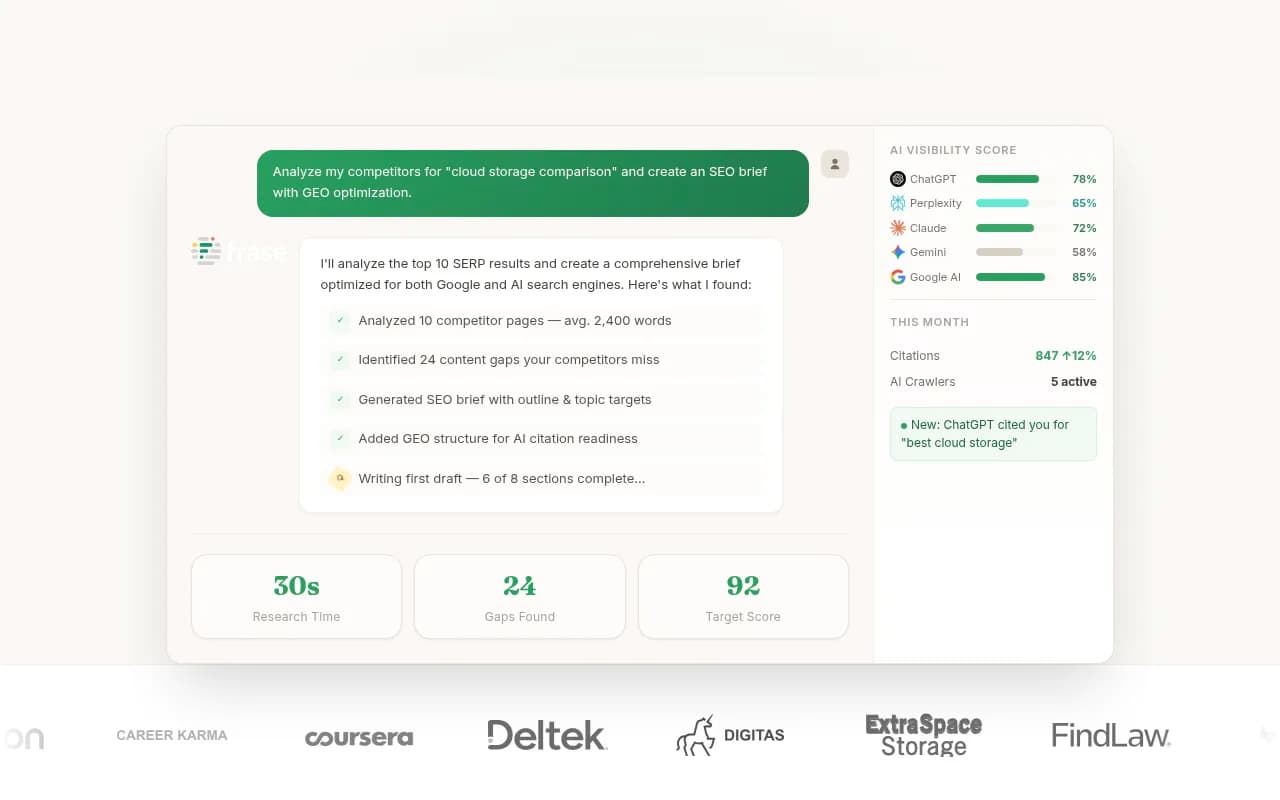
Starter is $39/mo billed yearly ($49 monthly) with one seat, one site, 10 articles and 50 audit pages a month. It publishes straight to WordPress, Webflow, Sanity or Wix. Professional at $103/mo yearly adds a content calendar, internal linking and AI crawler monitoring. Scale at $239/mo yearly adds Claude and Gemini to its AI visibility tracking.
There is a 7-day free trial with no card, and Frase rates 4.8/5 on G2. Note that older comparison posts still list Frase at $49/mo, which is out of date.
Where it falls short: draft quality depends on brief depth. Feed it a lazy brief and you get lazy copy.
Surfer SEO: best for live scoring while you write
Surfer is the default answer when a human writer wants real-time SERP-based guidance inside an editor.
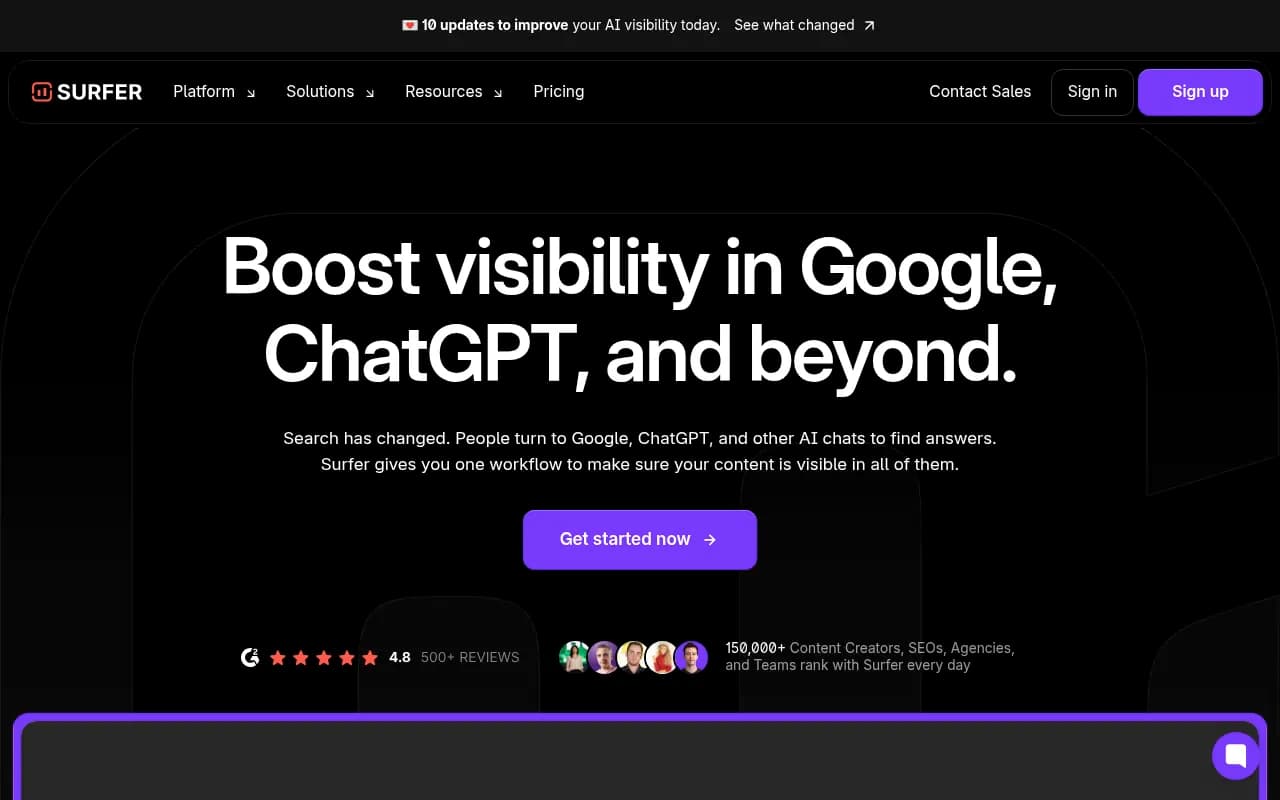
It is fast and has a big user base. The trap, which Rankability flags too, is score-chasing: stuffing in every suggested term to hit 100 and ending up with bloated, repetitive pages. Treat the score as a prompt for coverage and clarity, not a target.
One thing to watch: Surfer was acquired by Positive Group (formerly Sarbacane Group), announced in late October 2025. Pricing, product direction and support may shift, which matters if you manage many client accounts. Its AI visibility tracker is now sold separately from $82/mo billed yearly.
Clearscope: best for editorial governance
Clearscope costs more than most, but it is built for teams with strict editorial standards, where consistent quality across many writers matters more than speed.
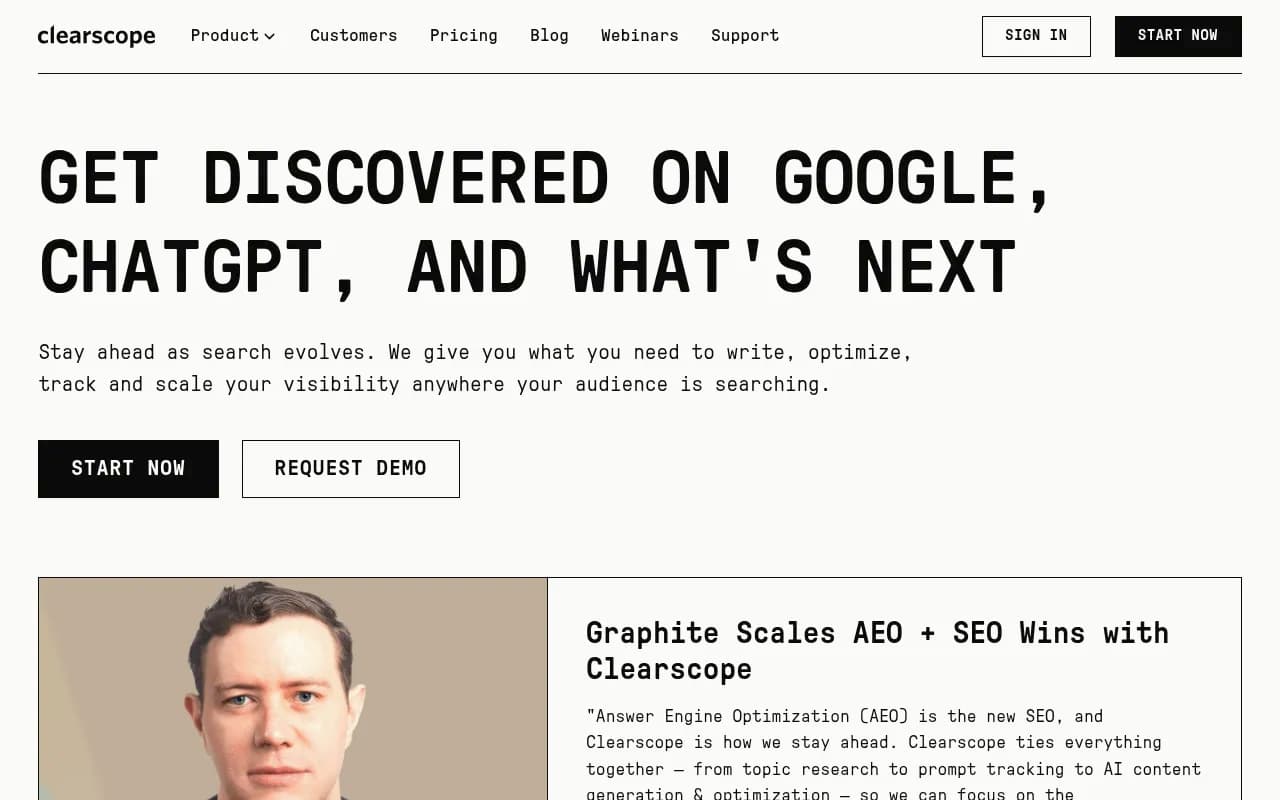
It does not try to write for you. That is the point. If your writers are good and you want a shared quality bar, it fits. If you want AI drafts, look elsewhere.
MarketMuse: best for planning and topical authority
MarketMuse focuses on what to write and in what order, using competitor gap analysis and topic modeling. It does not lean on writing support.
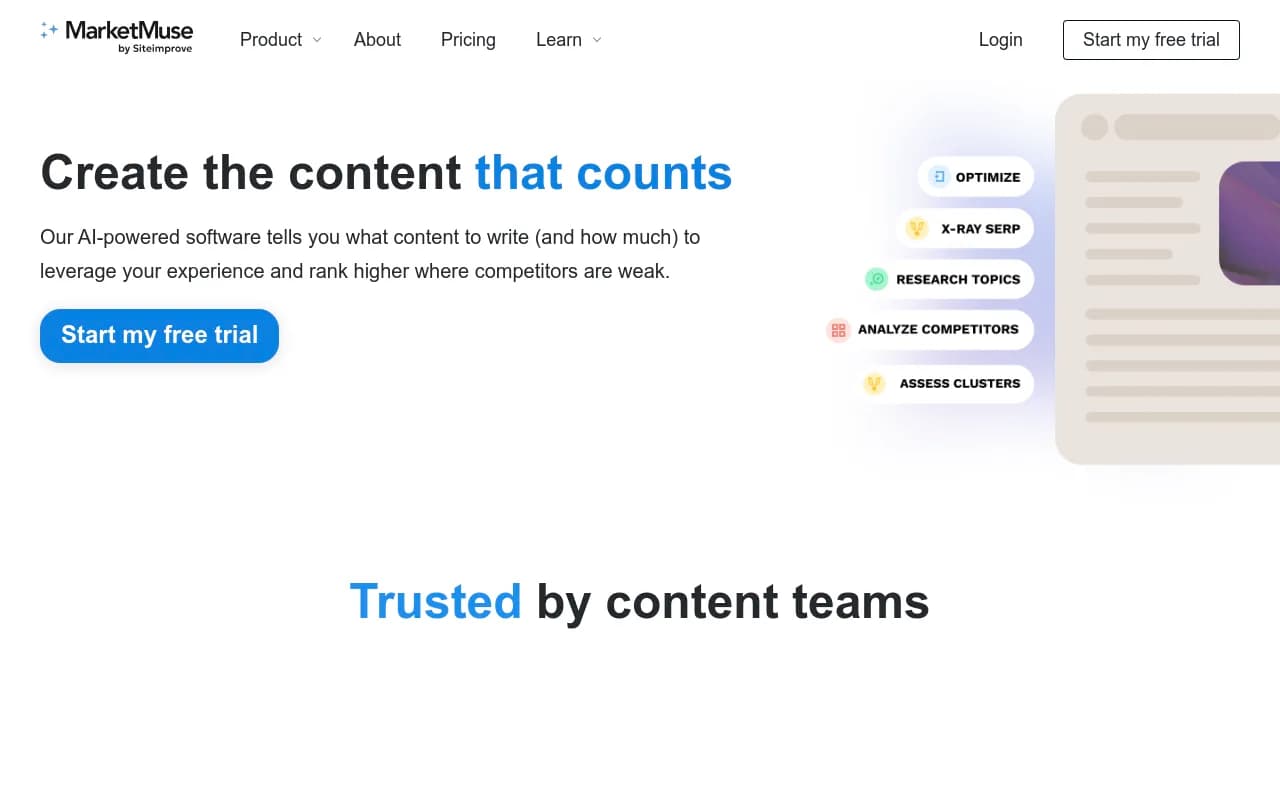
It suits teams drowning in possible topics who need prioritization more than another editor. Pair it with a separate drafting tool if you want the whole workflow.
Rankability: best for agencies
Rankability starts at $97/mo (Starter), with Agency at $297 and Agency Pro at $497. Higher tiers include 80 to 160 content projects a month, unlimited team members and client workspaces, and tracking across 11 AI platforms.
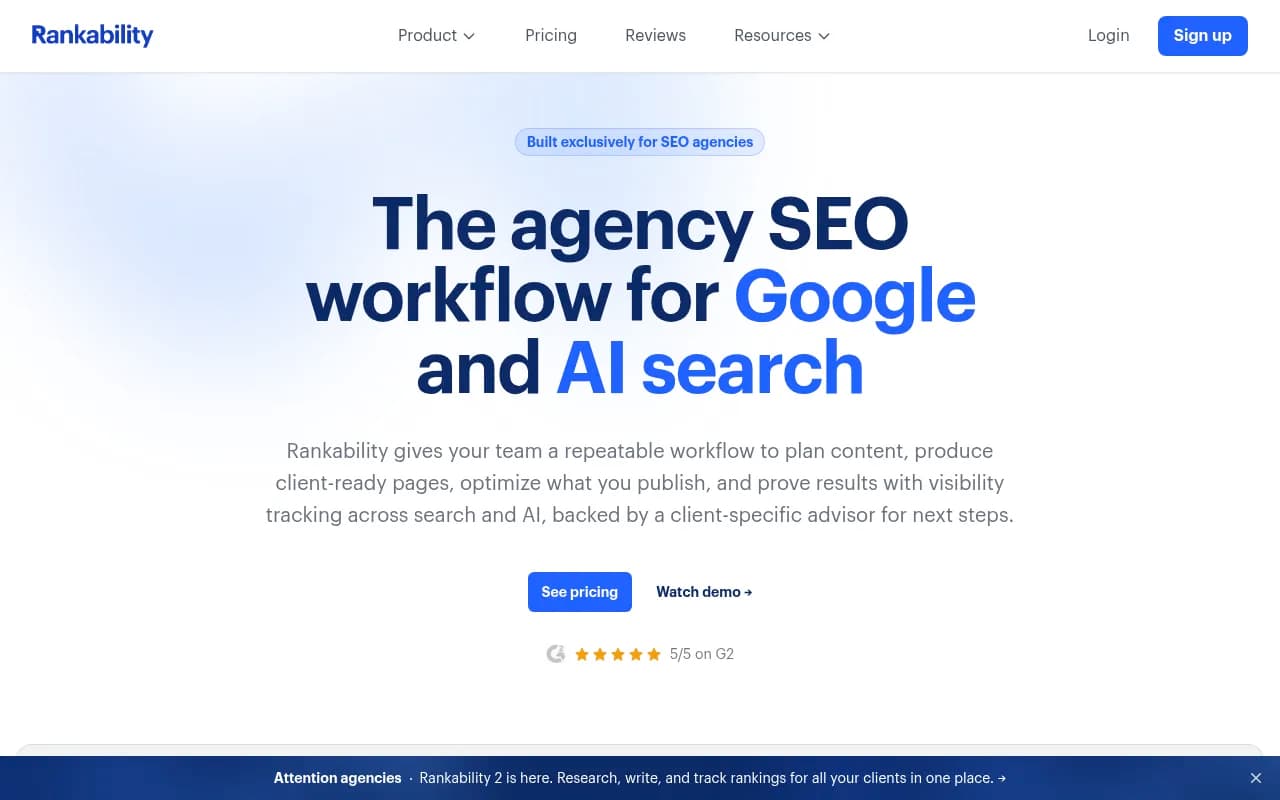
A caveat: its own comparison post ranks itself first, so take that ranking with salt. The product itself is a solid fit for agencies that need a brief, optimize and monitor loop with client workspaces.
Writesonic: best for fast first drafts
Writesonic covers multi-format content (blogs, ads, landing pages, product copy) and now includes AI visibility tracking across ChatGPT, Perplexity and Gemini.
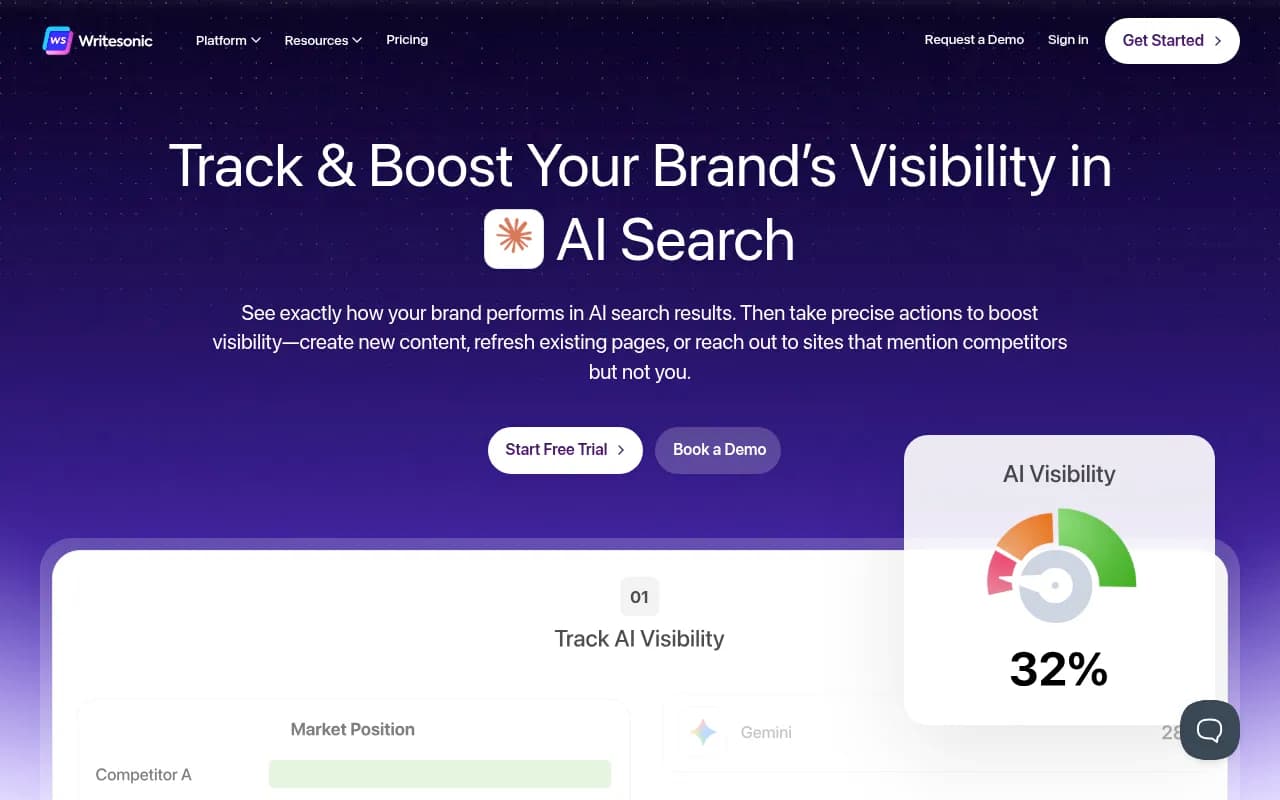
It is quick. You will still edit before publishing, because speed and polish rarely arrive together.
Jasper AI: best for brand voice
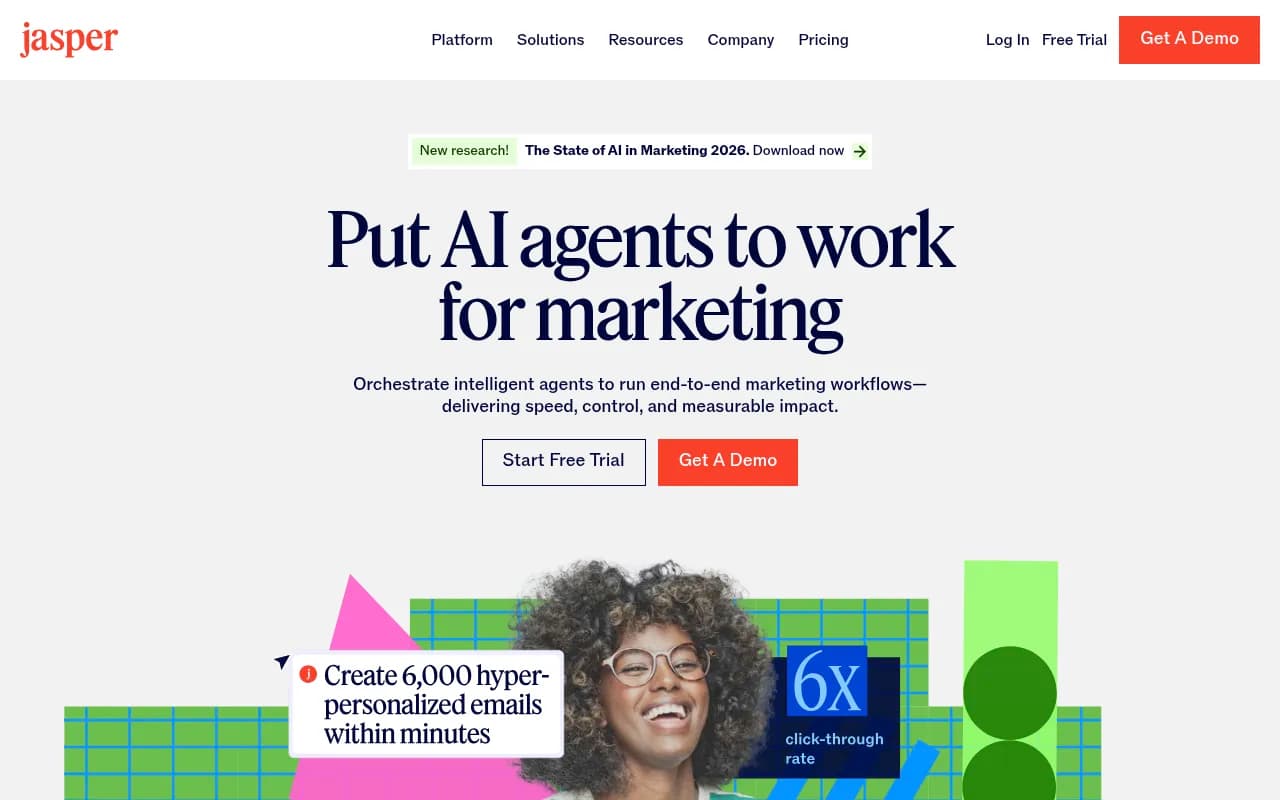
Jasper is the pick when voice consistency across blogs, ads and emails matters more than SERP research. Keyword research needs a separate tool.
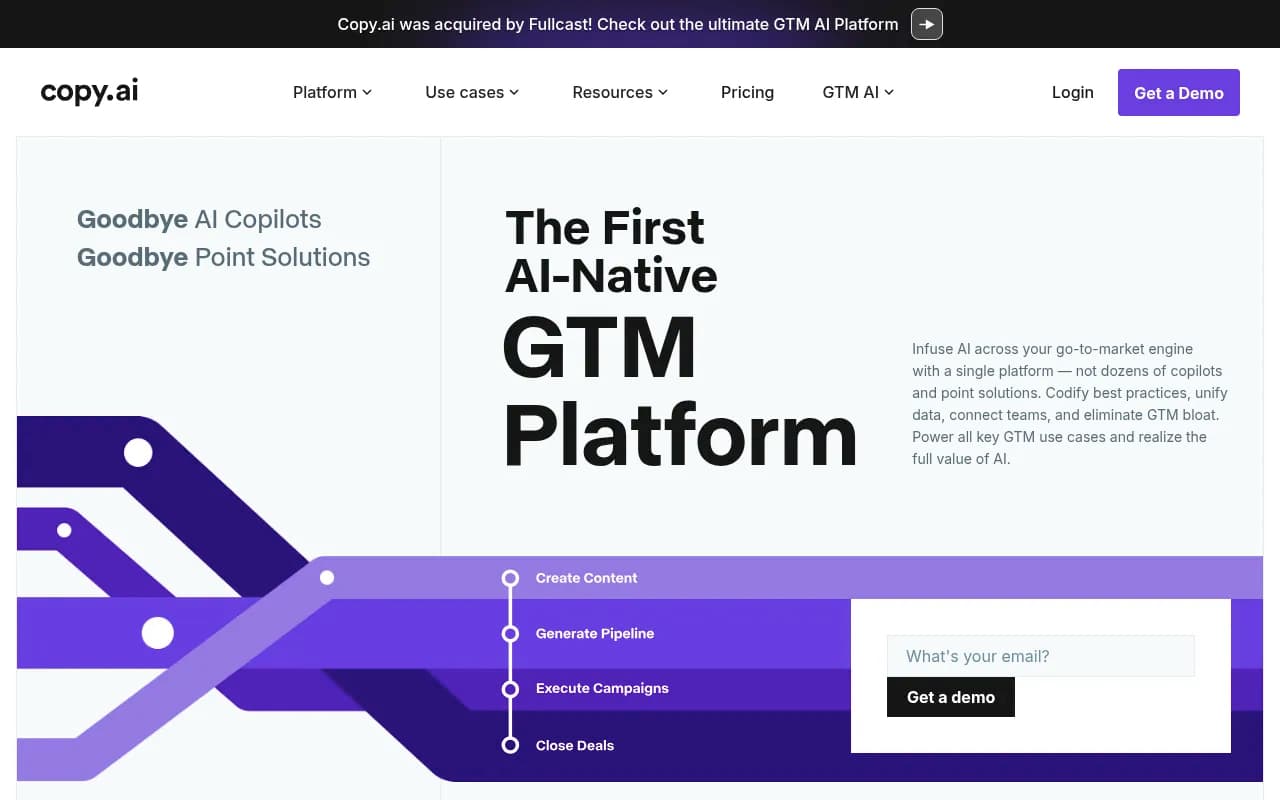
Same story with Copy.ai, if your priority is go-to-market workflow automation rather than SEO depth.
Budget and niche options
Not everyone needs a $100 a month tool.
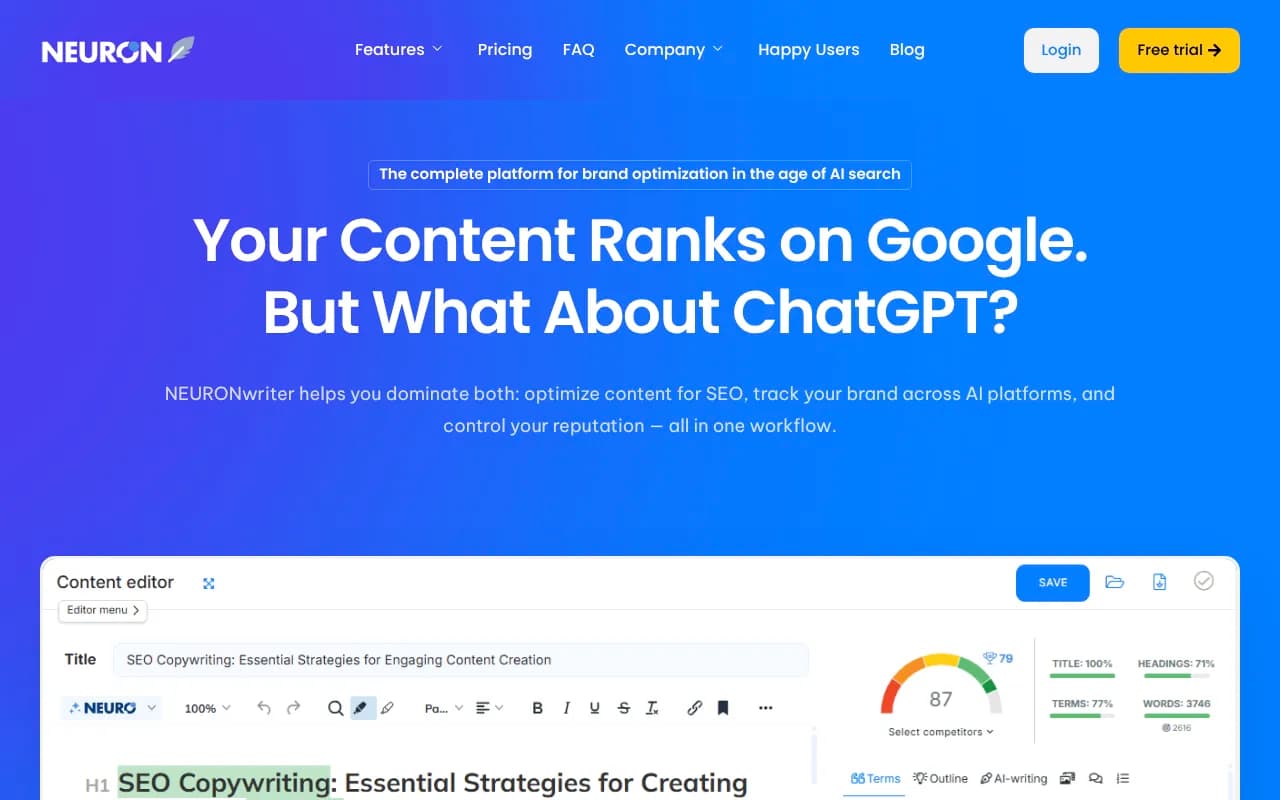
- NeuronWriter is the budget optimizer, around $23/mo on annual billing.
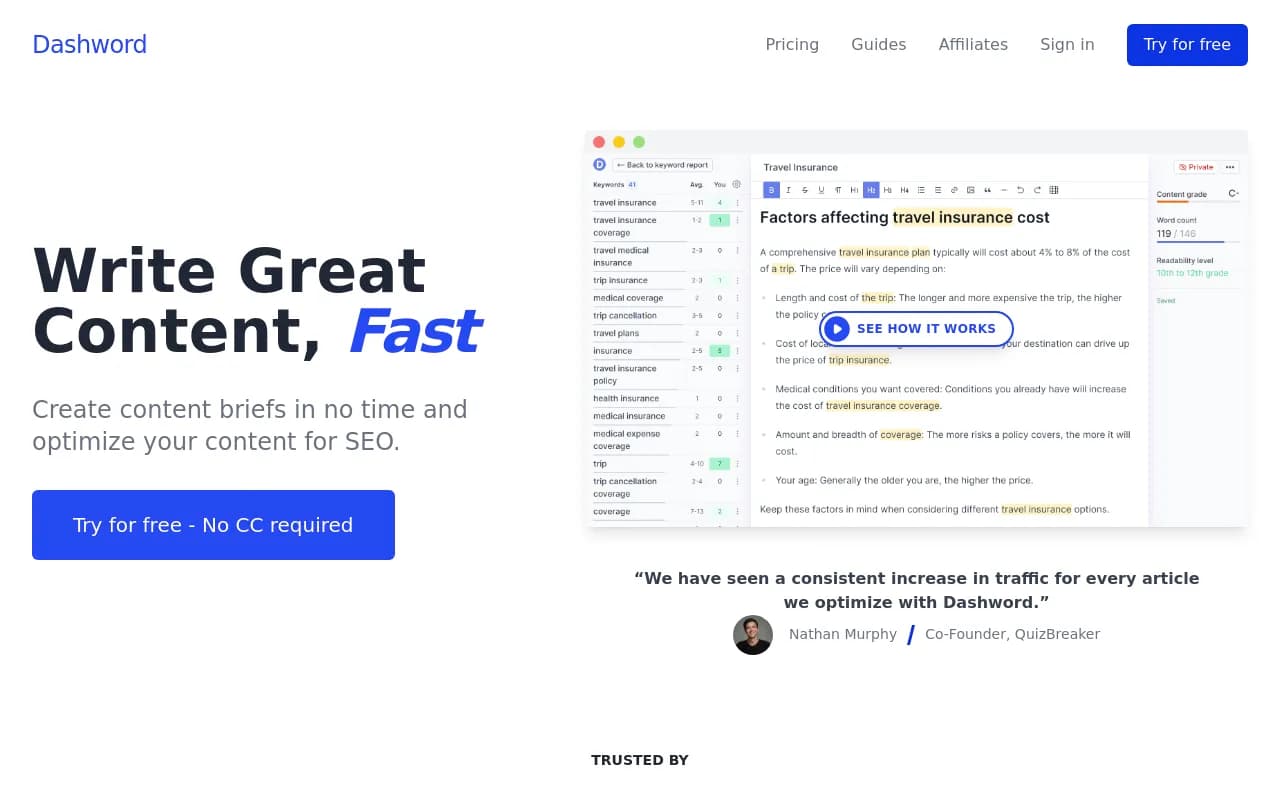
- Dashword (about $39/mo) is built around briefs and refresh workflows.
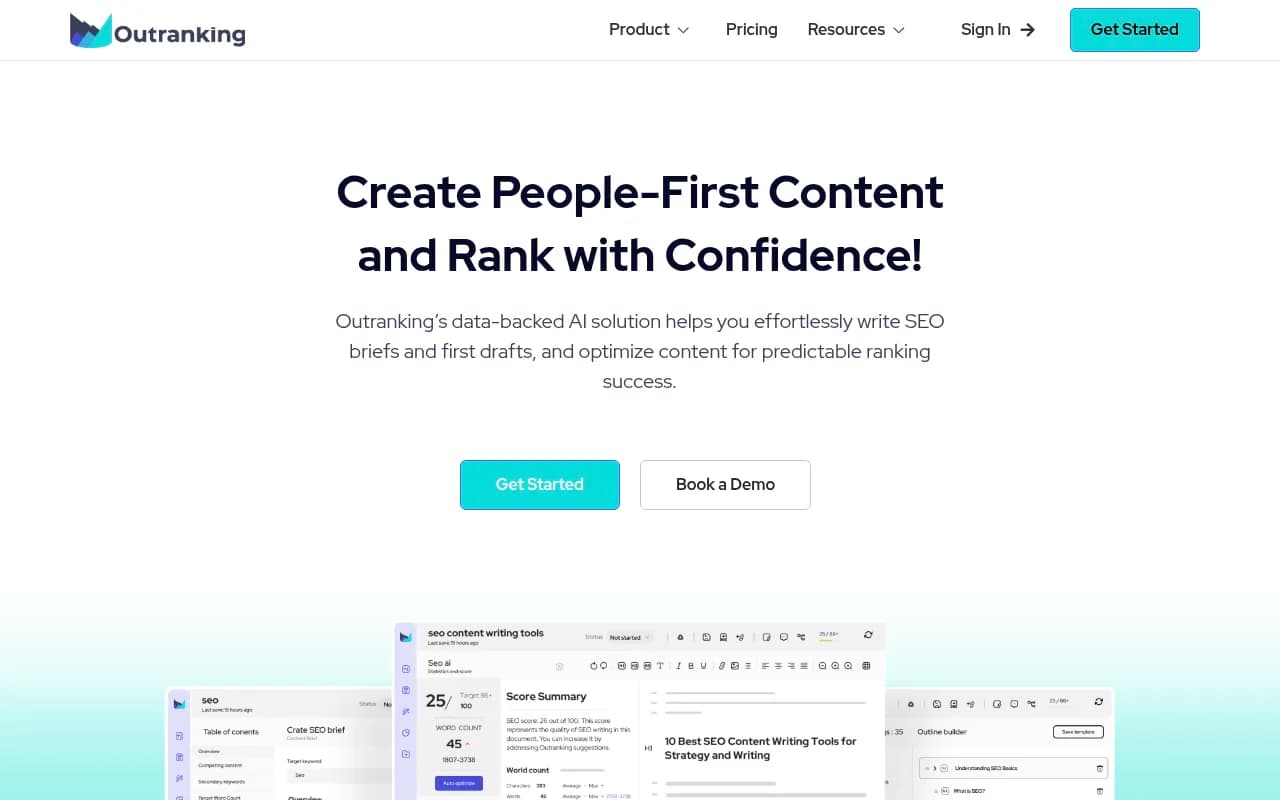
- Outranking pitches low entry pricing and AI-assisted SEO drafts.
- Rytr handles basic AI drafting if you do not need SEO workflow depth.
- Semrush and Ahrefs are the choice when keyword data and broader research matter more than writing automation.
The gap none of these fully close: seeing what AI actually cites
Most Scalenut alternatives now bolt on some AI tracking. It is usually a prompt list, a score and a chart. That tells you whether you were mentioned. It rarely tells you why, or what to publish next.
This matters more than it seems, because AI citations do not behave like Google rankings. According to Promptwatch Data's ChatGPT citation share by content type report (Sep 28 to Oct 4, 2026), product pages are the most cited type at 22.4% of classified ChatGPT citations, with landing pages at 16.8%. Together that is roughly 39% of citations going to pages that describe what a company sells. Listicles take 13.6%, how-tos 8.7% and comparisons 5.9%.
For commercial prompts the skew is stronger: product pages hit 26.0% and landing pages 20.6%. If your content tool only produces blog posts, you are aiming at a minority of what gets cited.
Freshness matters too. In Promptwatch Data's half-life of content in ChatGPT study (pages cited on Jul 6, 2026, tracked for 90 days), ChatGPT still cited 78% of landing pages after 30 days, but product pages, reviews and how-tos fell to about 55% after 60 days, with a half-life of 74 to 77 days. News decayed fastest, with half its pages gone after 36 days. Put plainly: a publish-and-forget workflow loses citations. You need audits and refreshes, which is where a good tool's update features earn their price.
Where Promptwatch fits
Promptwatch is not a Scalenut replacement for drafting. It sits alongside your writing tool and answers the questions a writer-focused tool cannot: which of your pages AI crawlers actually read, which get cited, what prompts you are missing, and what to fix. It tracks real ChatGPT, AI Overviews, Perplexity, Gemini and Copilot interfaces, logs AI crawler visits, and has a Content Agent that can plan and publish pages against your gaps.
The free Explore tier is enough to try it on 10 prompts, and paid plans start at $95/mo (confirm on promptwatch.com/pricing). If you are comparing dedicated GEO tools, the GEO software directory lists more options.
How to choose
Start with your actual bottleneck, not the feature list.
- Research is slow: Frase, or Semrush and Ahrefs for deeper data.
- Writers need guidance as they type: Surfer SEO or NeuronWriter.
- Quality is inconsistent across writers: Clearscope.
- You do not know what to write next: MarketMuse.
- You run an agency with client reporting: Rankability or Frase Scale.
- You need drafts fast and will edit them: Writesonic.
- Brand voice is the main concern: Jasper.
- You want to know if AI engines cite you, and fix it: Promptwatch alongside any of the above.
A sensible stack for a small team
For a one to three person team I would run Frase or Surfer for briefs and scoring, a human editor for the final pass, and an AI visibility tool to track results. Skip the temptation to buy one platform that claims to do everything. Every all-in-one I have seen is good at one step and passable at the rest.
Pricing and verification caveats
Treat every price here as a snapshot. Scalenut's promo pricing is steep, Frase has changed its plans recently, and I could not verify current pricing for Writesonic, Jasper, Semrush, Ahrefs, Clearscope, NeuronWriter or Outranking. I also found no independent G2 or Trustpilot data for Scalenut itself, so the pain points above come from comparison posts and a creator review rather than a large sample of user ratings.
Most vendors offer a trial. Run your own test: take one real keyword, produce a brief and a draft in two tools, and compare the edits you had to make. That tells you more than any ranked list, including this one. For more tool comparisons, browse SurferStack.
Final take
Scalenut is fine for solo writers who want one login. Once you want better research, a firmer quality bar or serious AI citation data, move to a specialist. Frase is the best value for most teams, Surfer for live optimization, Clearscope for editorial control, and Promptwatch for the part everyone else treats as a dashboard: finding out what AI cites and acting on it.