Key takeaways
- Mixpanel is no longer the "no session replay" tool older reviews describe. Its current pricing page lists Session Replay, Heatmaps, Experiments and Feature Flags on every plan, including the free one.
- Amplitude is the closest like-for-like swap. PostHog is the pick if you want one platform for analytics, replays, flags and more, and you don't mind a more technical tool.
- Heap, Pendo and Fullstory each win on one narrow thing: retroactive capture, in-app guidance, and session replay depth.
- If data residency or ownership drives the switch, look at self-hosted options like PostHog, OpenPanel, Countly, Matomo or the warehouse-native Mitzu.
- Pricing models differ (events, MAU, usage), so compare on your real event volume. Confirm every number on the vendor's live pricing page before you commit.
Why people look for a Mixpanel alternative
Mixpanel is good. Most reviews say the same: strong funnels, retention and cohort analysis, a UI that is friendlier to non-technical product managers than some rivals, and pricing that is easier to predict than most enterprise tools. So when teams go shopping for alternatives, it usually isn't because the product is broken.
The common reasons I see are these:
- Event-based billing gets expensive as volume grows (Mixpanel's rate above the free allowance is listed at $0.28 per 1K events in one 2026 roundup, so check the live calculator).
- The team wants analytics, replays, flags and surveys in one tool rather than stitching vendors together.
- Legal or security wants data on infrastructure the company controls.
- The product is mobile-first, or the data already lives in a warehouse.
- The goal is acting on insights inside the app (guides, onboarding), not only reading charts.
It's worth noting that one detail in older comparison articles is out of date. Vision Labs, for example, says Mixpanel has no session recordings or heat maps. Mixpanel's current pricing page lists both, along with Experiments and Feature Flags, on every plan. If a competitor's pitch to you leans on that gap, check it first.
What Mixpanel gives you today
A quick baseline makes the alternatives easier to judge. Per Mixpanel's pricing page:
- Free plan: free forever, unlimited seats, up to 1M events a month, 10K session replays, up to 10 active feature flags, plus funnels and retention.
- Growth plan: starts at $0 with volume discounts, up to 20M events a month, up to 500K replays, and up to 50 active feature flags.
- Enterprise: custom quote, up to 1T events a month, anomaly detection, root cause analysis, and custom retention.
- Startups: the first year is free for companies under 5 years old with up to $8M total funding.
Keep that in mind as the yardstick. If an alternative can't beat it on price, scope or hosting for your situation, you probably shouldn't move.
Quick comparison
| Tool | Best for | Free tier (per vendor) | Self-host? | Main trade-off |
|---|---|---|---|---|
| Amplitude | Closest Mixpanel equivalent | 2M events a month | No | Some advanced features gated to Enterprise |
| PostHog | All-in-one product platform | 1M events, 5K recordings | Yes (MIT) | More technical |
| Heap | Retroactive data capture | Check vendor | No | Premium price, gated features |
| Pendo | Adoption and in-app guidance | Up to 500 MAU | No | Steeper learning curve, higher price |
| Fullstory | Session replay depth | Check vendor | No | Replay-first, not pure analytics |
| Matomo | GA replacement with product add-ons | Self-host core is free | Yes (GPL-3.0) | Web-first, product features are add-ons |
| OpenPanel | Mixpanel-style, self-hosted | Self-host is free | Yes (AGPL-3.0) | Younger project |
| Countly | Mobile-first teams | Community edition | Yes (AGPL-3.0) | Custom cloud pricing |
| Mitzu | Warehouse-native analytics | Paid | Source available | Needs a warehouse |
| Usermaven | Lighter product and customer insights | Check vendor | No | Less depth than the big platforms |
Amplitude: the closest twin
If someone asks me for a drop-in alternative, this is the first name. Vision Labs calls Amplitude "Mixpanel's twin with different math," and I think that's fair. Same positioning, same target customer, very similar features. Their advice is basically to flip a coin, then let billing decide: Mixpanel tends to cost less when you have many users who generate few events, while Amplitude is better if your users generate a lot of events.
Current pricing details from Amplitude's page:
- Free plan with 2M events a month, no credit card, including Product Analytics, 10K monthly session replays and limited Experiments.
- Plus plan starts at $0 with the first 2M events free, needs a card, and scales to 70M events. It adds custom events and formulas, 20 behavioral cohorts, alerts, heatmaps and 2-year retention.
- Growth and Enterprise are custom and event-based.
- Predictions, the User Profile API and analysis content management are Enterprise-only.
- Startups under $10M funding and fewer than 20 employees get a free year on Growth.
Two cautions. First, Amplitude's 2M free events sounds twice as generous as Mixpanel's 1M, but event definitions and seat limits differ, so compare on your actual data. Mixpanel's free plan states unlimited seats; Amplitude's page doesn't state a seat limit. Second, features that Mixpanel bundles may sit behind a higher Amplitude tier.
Amplitude also has a free tool aimed at AI search, which is a different job from product analytics but worth a look if that's on your radar:

PostHog: the broad, technical option
PostHog is what I would shortlist for an engineering-led team. It says 97% of companies use it for free, and the allowance renews monthly across products: 1M analytics events, 5K session recordings, 1M feature flag requests (experiments are billed with flags), 100K error tracking exceptions, 1,500 survey responses, and more.
The breadth is the point. It also covers error tracking, surveys, a data warehouse, workflows and LLM observability. That's more than Mixpanel does, and it's why a SaaS team can consolidate three or four vendors into one.
The cost is complexity. Vision Labs describes it as maximum features at minimum price, but more technical. A product manager who wants to answer feature adoption questions without bothering engineering may find Mixpanel's interface easier. It can also be overkill for a simple marketing site; one 2026 roundup notes it is not really a website analytics tool in the traditional sense.
PostHog's paid per-unit rates weren't visible when I checked, so read its live pricing page before you build a budget.
Heap: retroactive capture
Heap's pitch is collecting data automatically so you can define events after the fact, instead of planning an event schema up front. Fullstory's and Pendo's roundups both single it out for retroactive data capture. If your team constantly says "we should have tracked that," this is the appeal.
Vision Labs describes Heap as premium priced with gated features. I couldn't verify current Heap pricing, so ask for a quote against your session volume and compare it to Mixpanel's calculator before deciding.
Pendo: analytics plus in-app action
Pendo is a different animal. It describes itself as a Software Experience Management platform, combining analytics with in-app guides, onboarding and feedback. Its pitch against Mixpanel is that Mixpanel is deeper on event analysis while Pendo lets you act on insights inside the product.
It has a free tier (up to 500 MAU) and custom pricing above that. Users in Pendo's own write-up note a steep learning curve and a higher price point. And a fair warning: that source is Pendo's own article, where it ranks itself number one, so treat the comparison as vendor-written.
Choose Pendo when onboarding and adoption are the main problem. If you mainly need funnels and retention charts, it is more platform than you need.
Fullstory: when you need to see sessions
Fullstory is strongest in session replay. Vision Labs frames it as built for developers who want every detail, and one commonly noted point is that its implementation difficulty is on par with Amplitude's. Since Mixpanel now includes replays (10K a month free), the gap is narrower than it used to be. Fullstory still makes sense if replay and debugging are the main use case and charts are secondary.
Matomo, Countly and OpenPanel: privacy and self-hosting
If your reason for leaving is control over where data lives, three open-source names come up. OpenPanel's own self-hosted comparison (so a competitor-authored source) lists these licenses and prices:
- OpenPanel: AGPL-3.0, free to self-host, cloud from $2.50 a month, aimed at teams wanting Mixpanel-like analytics.
- PostHog: MIT, free to self-host, cloud is free plus usage.
- Countly: AGPL-3.0, free community edition, custom cloud pricing, mobile-first.
- Matomo: GPL-3.0, core is free, cloud from EUR 29 a month, a Google Analytics replacement with product add-ons.
- Mitzu: source available, paid, warehouse-native.
Self-hosting isn't free in practice. You pay in engineering time, upgrades, storage and uptime. Matomo in particular is web analytics first, so check that its product plugins cover the funnels, cohorts and user identification you need. As OpenPanel's article points out, most self-hosted tools only cover web analytics, while product analytics needs funnels, retention, cohorts and user identification.
Warehouse-native tools like Mitzu make sense if your event data already sits in a warehouse and you don't want to copy it into another vendor.
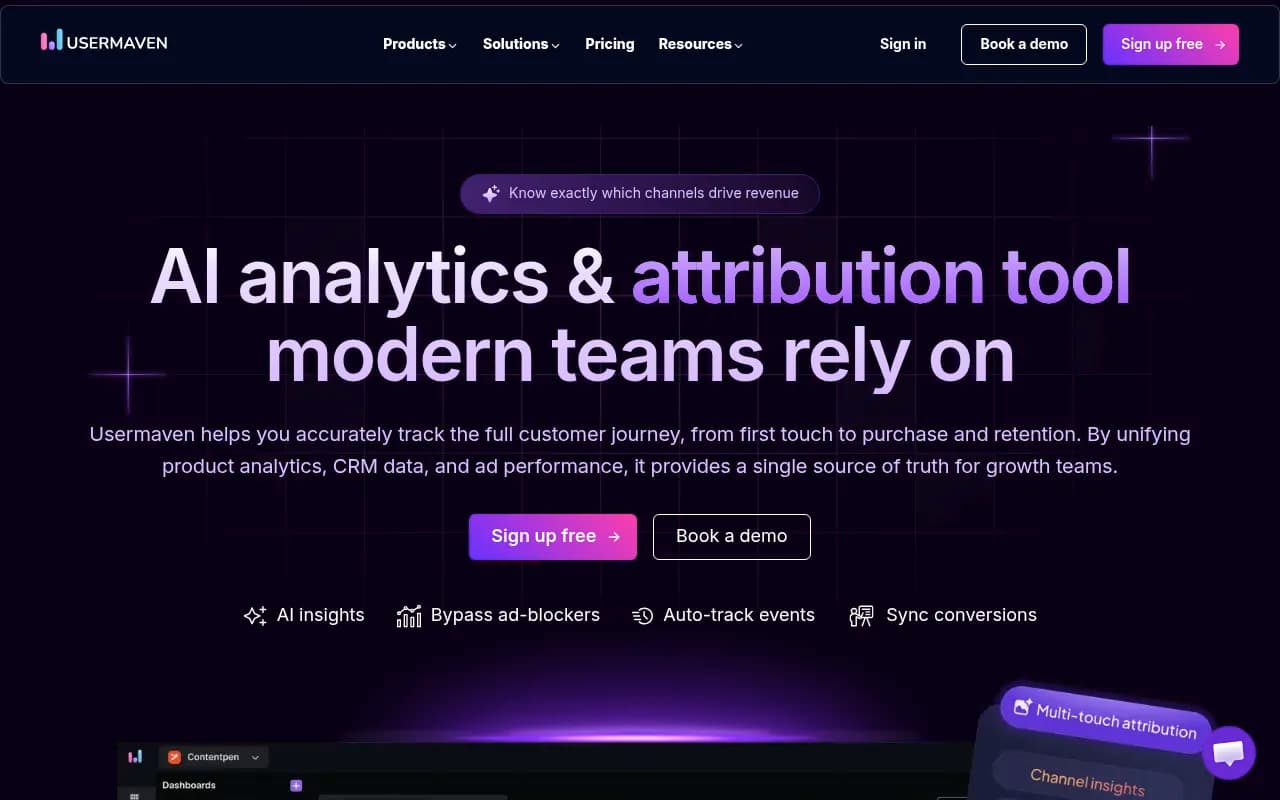
Usermaven: a lighter option
For smaller teams that find Mixpanel or Amplitude heavier than they need, Usermaven is a product analytics and customer insights platform worth a look. I'd treat it as a lighter-weight option rather than a full replacement for enterprise-scale analysis.
What about Google Analytics 4?
GA4 shows up on nearly every list, including Amplitude's. It's free and fine for traffic and marketing attribution. It isn't built for feature-level product questions. Mixpanel and PostHog are described in one 2026 roundup as built for tracking user behavior at the feature level, with funnels, retention and experimentation. If you need to know which features drive retention, GA4 alone will frustrate you. Many teams run GA4 for marketing and a product analytics tool alongside it.
How to choose
Non-technical product team, similar needs to today
Stay with Mixpanel or move to Amplitude. Run both estimates against your real event counts. Many users with few events favors Mixpanel; heavy event volume per user favors Amplitude, according to Vision Labs.
Engineering-led SaaS team that wants fewer vendors
PostHog. Analytics, replays, flags, experiments and surveys in one place, with a generous monthly free allowance.
Adoption and onboarding are the goal
Pendo, and be ready for custom pricing and a learning curve.
Data must stay on your infrastructure
PostHog, OpenPanel or Countly self-hosted. Budget real engineering hours.
Data already lives in a warehouse
Look at warehouse-native tools such as Mitzu.
You mostly need to watch sessions
Fullstory, or test whether Mixpanel's bundled replays are already enough.
Migration pitfalls to plan for
I couldn't find solid migration guides in my research, so this part is general advice rather than sourced fact. Do these before you cancel anything:
- Audit your current event taxonomy. Delete events nobody uses rather than migrating them.
- Run both tools in parallel for a few weeks and compare the numbers for a handful of key funnels. Small definition differences (sessions, unique users, event counting) cause confusing mismatches.
- Check how each tool treats identity merging for anonymous and logged-in users.
- Ask about historical data. Many teams lose it or keep the old tool read-only for a while.
- Read the startup program terms. Mixpanel's first free year requires a company under 5 years old with up to $8M funding, while Amplitude's requires under $10M funding and fewer than 20 employees. Switching might mean forfeiting or gaining a free year.
For wider software research beyond analytics, the directory at surferstack.com has reviews, alternatives and comparisons.
Bottom line
Mixpanel has caught up on features that used to justify leaving, so the strongest reasons to switch now are cost at your volume, a need for hosting control, or a wider platform like PostHog. Start with Amplitude if you want the least friction, PostHog if you want the most consolidation, and a self-hosted option if compliance leads the decision. Whatever you pick, test with your real data and verify the live pricing pages, since every vendor here has changed its plans recently.