Key takeaways
- Peec AI treats Google AI Mode as an Enterprise add-on, meaning most teams on standard plans have zero visibility into one of Google's fastest-growing search surfaces.
- Several alternatives cover Google AI Mode without gating it behind custom pricing -- including platforms that also cover Google AI Overviews, ChatGPT, Perplexity, Claude, Gemini, and more.
- The biggest gap between Peec and its alternatives isn't just model coverage -- it's that Peec only monitors. The strongest alternatives help you act on what you find.
- If you need content creation, crawler logs, prompt intelligence, or traffic attribution alongside tracking, you'll need to look beyond Peec entirely.
- Pricing across these alternatives ranges from free tiers to $99-$579/month, with most offering more features per dollar than Peec's €199/month Pro plan.
Google AI Mode launched in 2025 and has been eating into traditional search traffic faster than most brands expected. It's not a minor feature -- it's a full conversational search interface inside Google, and it cites sources differently from AI Overviews. If you're not tracking it, you're flying blind on an increasingly important channel.
Here's the problem: Peec AI doesn't include Google AI Mode on its standard plans. Claude and Gemini are the same story -- Enterprise add-ons with custom pricing. The Pro plan at €199/month covers four base engines (ChatGPT, Perplexity, Google AI Overviews, DeepSeek), and you're capped at 100 prompts and 9,000 AI answers per month.
For a lot of teams, that ceiling hits fast.
This guide covers 8 platforms that actually track Google AI Mode without requiring a sales call, plus an honest look at what each one does well and where it falls short.
Why Google AI Mode coverage matters more than you think
Google AI Mode isn't just another chatbot interface. It pulls from Google's index, uses multi-step reasoning, and generates citations that can drive real traffic. Early data from several tracking platforms suggests AI Mode citation patterns differ meaningfully from AI Overviews -- different domains get cited, different content formats win.
If your GEO strategy is built entirely around ChatGPT and Perplexity, you're missing a Google-native surface that your competitors may already be optimizing for.
The tools below all cover it. Some cover it as part of a broader AI search suite. Others are specifically built around Google's AI surfaces. Here's how they compare.
Quick comparison: Peec AI vs. 8 alternatives
| Platform | Google AI Mode | AI Overviews | ChatGPT | Perplexity | Claude | Content creation | Starting price |
|---|---|---|---|---|---|---|---|
| Peec AI | Enterprise only | Yes | Yes | Yes | Enterprise only | No | €89/mo |
| Promptwatch | Yes | Yes | Yes | Yes | Yes | Yes (AI agents) | $99/mo |
| Ahrefs Brand Radar | Yes | Yes | Yes | Yes | No | No | $50/mo |
| Profound | Yes | Yes | Yes | Yes | Yes | No | Custom |
| Scrunch AI | Yes | Yes | Yes | Yes | Yes | No | Custom |
| Otterly.AI | Limited | Yes | Yes | Yes | No | No | ~$49/mo |
| SE Ranking | Yes | Yes | Yes | Yes | No | Limited | $65/mo |
| Writesonic | Yes | Yes | Yes | Yes | No | Yes | $99/mo |
| Athena HQ | Yes | Yes | Yes | Yes | Yes | No | Custom |
1. Promptwatch -- best overall for teams that want to act, not just watch
Promptwatch covers Google AI Mode, Google AI Overviews, ChatGPT, Perplexity, Claude, Gemini, Grok, DeepSeek, Copilot, and Meta AI -- ten models in total, all on standard plans. No Enterprise gate for individual engines.
But the reason it tops this list isn't just model breadth. It's the only platform here that closes the loop between finding visibility gaps and fixing them. The Answer Gap Analysis shows you exactly which prompts competitors rank for in AI search that you don't appear in. Then Content Agents generate articles, comparisons, and briefs built around that gap data -- not generic SEO content, but pieces engineered around what AI models are actually citing.
On top of that, Promptwatch logs AI crawler activity in real time. You can see when ChatGPT or Perplexity's crawlers hit your site, which pages they read, what errors they encounter, and when a crawled page moves to an actual citation. Most platforms have no visibility into this at all.
Pricing: Essential at $99/month (1 site, 50 prompts, 5 articles), Professional at $249/month (2 sites, 150 prompts, 15 articles, crawler logs), Business at $579/month (5 sites, 350 prompts, 30 articles). Free trial available.

2. Ahrefs Brand Radar -- best for data quality and real-prompt grounding
Ahrefs Brand Radar takes a different architectural approach from most tools in this space. Instead of constructing hypothetical prompts and running them against AI engines, it pulls from 243M+ prompts derived from real "People Also Ask" data -- queries with actual search volume behind them.
This matters because visibility scores built on fabricated prompts can be misleading. Brand Radar's metrics reflect how AI responds to things people actually searched for.
Coverage includes ChatGPT, Perplexity, Gemini, Copilot, Google AI Overviews, and Google AI Mode -- plus YouTube, TikTok, and Reddit as additional surfaces. That's broader than Peec's standard plan without any Enterprise conversation.
The tradeoff: Brand Radar is a monitoring tool. There's no content generation, no content gap analysis, no crawler logs. If you need to act on the data, you're doing that work elsewhere.
Pricing: $50/month for 2,500 checks, $100/month for 7,000 checks, $699/month for all 6 AI indexes with custom prompt checks.
3. Profound -- best for enterprise teams that need deep AI analytics
Profound has built a reputation as one of the more serious enterprise options in the GEO space. It covers Google AI Mode alongside the major AI engines, and goes deep on analytics -- prompt-level data, share of voice across models, competitive benchmarking, and sentiment analysis.
Where Profound earns its place is in the depth of its reporting. If you're a larger brand that needs to present AI visibility data to leadership, Profound's dashboards are built for that kind of stakeholder communication.
The downside is pricing -- it's custom, which typically means it's not cheap. And like most tools at this end of the market, Profound is primarily a monitoring and analytics platform. Content optimization is not its core strength.
4. Scrunch AI -- best for enterprise-wide AI monitoring
Scrunch covers a wide range of AI engines including Google AI Mode and positions itself around enterprise-scale monitoring. It's particularly strong if you're managing multiple brands or need to track AI visibility across a large content portfolio.
The platform handles competitive benchmarking well and gives you a clear picture of share of voice across models. Like Profound, it's more analytics-heavy than action-oriented -- you get good data, but turning that data into content improvements requires work outside the platform.
Custom pricing puts it in the same bracket as Profound -- worth evaluating if you're at enterprise scale, less compelling for smaller teams.
5. Otterly.AI -- best entry-level option with honest limitations
Otterly is one of the more affordable ways to get into AI visibility tracking, and it's genuinely useful for teams that are just starting to monitor their brand in AI search. The interface is clean, setup is fast, and it covers the core engines most teams care about.
Google AI Mode coverage is limited compared to the other tools here -- it's worth confirming current coverage directly with Otterly before committing if AI Mode is a priority. Claude is also not consistently covered.
Where Otterly falls short is in depth. There's no crawler logging, no content generation, no traffic attribution, and prompt-level data is fairly surface-level. It's a good starting point, but teams that grow into needing more tend to outgrow it quickly.

6. SE Ranking -- best for teams that want AI visibility inside a full SEO suite
SE Ranking has been building out its AI visibility features steadily through 2025 and 2026. It covers Google AI Mode, AI Overviews, ChatGPT, and Perplexity, and the advantage here is that you get this alongside a full traditional SEO suite -- keyword tracking, site audits, backlink analysis, and rank tracking.
If you're currently paying for an SEO platform and a separate AI visibility tool, SE Ranking is worth evaluating as a consolidation play. The AI visibility features aren't as deep as dedicated GEO platforms, but the breadth of what you get in one subscription is hard to argue with at the price point.
7. Writesonic -- best for teams that want tracking and content creation together
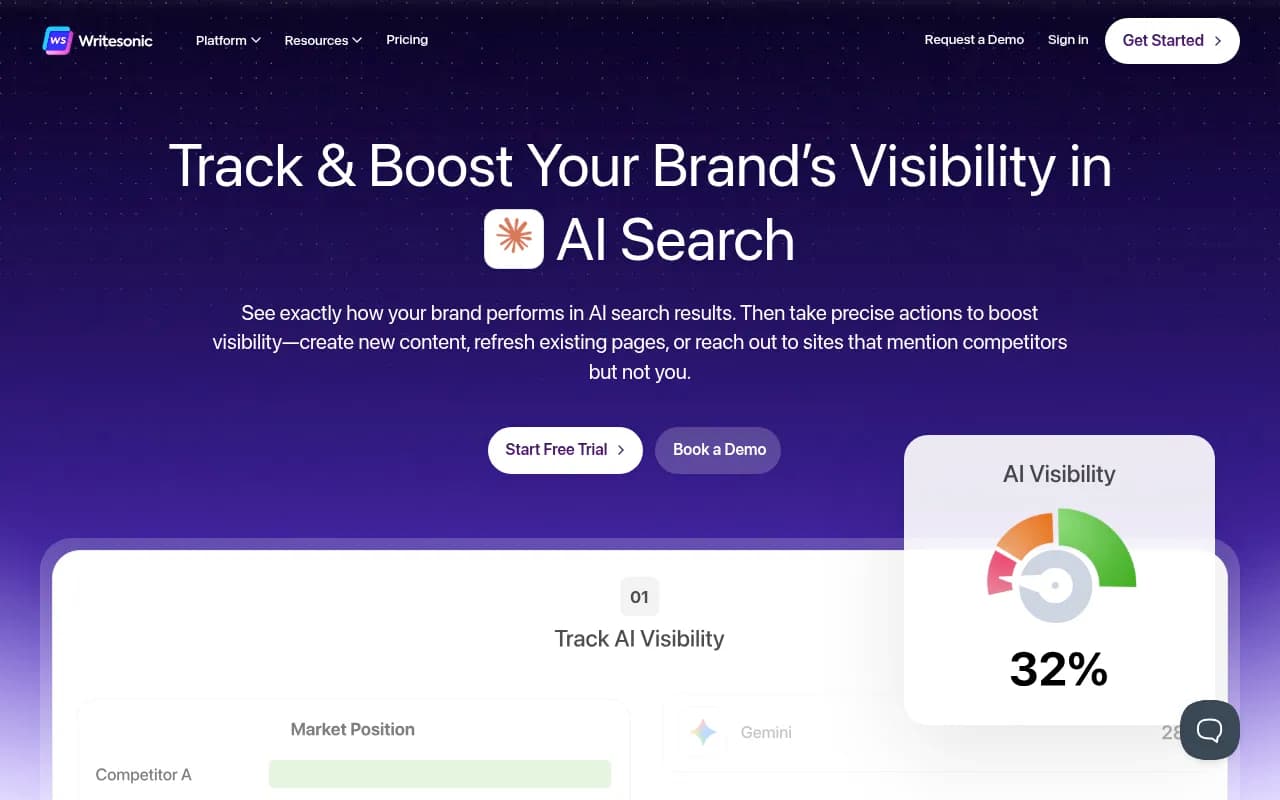
Writesonic has evolved from a pure AI writing tool into something closer to a GEO platform. It now tracks AI visibility across Google AI Mode, AI Overviews, ChatGPT, and Perplexity, and pairs that with content creation capabilities.
The content side of Writesonic is more mature than its tracking side -- it's been doing AI writing longer than it's been doing GEO monitoring. But if you need both in one platform and don't need the depth of a dedicated GEO tool, it's a reasonable option. The tracking data is less granular than Promptwatch or Profound, but it's functional and the content output is solid.
8. Athena HQ -- best for sentiment-led AI brand monitoring
Athena HQ approaches AI visibility from a brand sentiment angle. It covers Google AI Mode and the major AI engines, and goes deeper than most tools on how AI models describe your brand -- not just whether you appear, but the language and framing used in AI responses.
This makes it particularly useful for brand teams and PR-adjacent use cases where the tone of AI mentions matters as much as the frequency. If a competitor is being described as "the market leader" in AI answers while you're described as "an alternative," that's a meaningful difference that Athena surfaces clearly.
The limitation is that Athena is monitoring-focused. There's no content generation, no crawler logs, and optimization guidance is more strategic than tactical.
What Peec AI actually does well (and where it stops)
To be fair to Peec: it's a genuinely clean product. The setup is fast, the interface doesn't require a training session, and unlimited seats is a real differentiator for agencies managing multiple clients. The UI-level scraping approach (rather than pure API calls) means the data reflects what users actually see in AI interfaces, which matters.
But the ceiling is real. Here's where most teams hit it:
- Google AI Mode and Claude require Enterprise pricing -- there's no self-serve path
- 100 prompt cap on the Pro plan fills up faster than expected once you're tracking multiple topics and competitors
- No content creation, no site audits, no traffic attribution
- No crawler logs -- you can't see when AI crawlers visit your site or which pages they're reading
If your team is purely monitoring a small set of prompts across four AI engines and doesn't need to act on the data, Peec works fine. If you're trying to build a GEO strategy that actually moves the needle, you'll hit the ceiling.
How to choose the right alternative
The right tool depends on what you're actually trying to do:
-
If you need to track and fix visibility gaps, not just monitor them: Promptwatch is the clearest choice. It's the only platform here with content generation built around real prompt data, plus crawler logs that show you what AI engines are actually doing on your site.
-
If data quality and real-prompt grounding matter most: Ahrefs Brand Radar's approach of using real search data rather than fabricated prompts is architecturally different from everything else on this list.
-
If you're at enterprise scale and need deep analytics for stakeholder reporting: Profound or Scrunch AI are worth the custom pricing conversation.
-
If you want AI visibility inside a full SEO suite without paying for two platforms: SE Ranking is the most practical consolidation option.
-
If brand sentiment and the language of AI mentions matters to your team: Athena HQ goes deeper here than anyone else.
-
If you're just starting out and want something simple and affordable: Otterly.AI gets you in the door, with the understanding that you may outgrow it.
The common thread across all of these: Google AI Mode coverage is table stakes in 2026. Any platform that gates it behind Enterprise pricing is asking you to pay extra for a channel that's already mainstream. The tools above treat it as a standard feature -- which is where it belongs.