Key takeaways
- GEO needs at least six skills: technical SEO, content, structured data, digital PR, analytics and prompt testing. One hire rarely covers all of them, which is why a lean in-house team often loses on scope rather than on salary.
- Published agency retainers for mid-market GEO run roughly $2,000 to $8,000 a month, and enterprise category-leadership programs $10,000 to $25,000 and up. These are asking prices from agencies, not clearing prices, and there is no independent benchmark.
- Work that depends on brand and product knowledge (product, pricing and docs pages) suits in-house ownership. Off-site work (listicles, reviews, digital PR) suits an agency.
- For most enterprises the honest answer is hybrid: an internal owner, a measurement platform, and an agency for the pieces you cannot staff.
- Pick the tool first. Whoever runs the program, you want the same measurement layer so you can judge their work.
Why this decision is harder for enterprises
Small companies debate agency versus in-house as a salary comparison. Enterprises don't have that luxury. You have multiple brands, several markets and languages, legal review, a CMS owned by someone else, and a CMO who wants a number every month. The cost of getting it wrong is not a bad hire. It is six months of an under-resourced program that produces dashboards and no citations.
GEO (generative engine optimization) is the work of getting your brand described accurately and cited in answers from ChatGPT, Google AI Overviews, Perplexity, Gemini and Copilot. It overlaps heavily with SEO. Google has said that optimizing for generative AI search is "still SEO," so whoever you choose needs solid SEO fundamentals first. Nobody controls what an AI system says, so no option gets a guaranteed result.
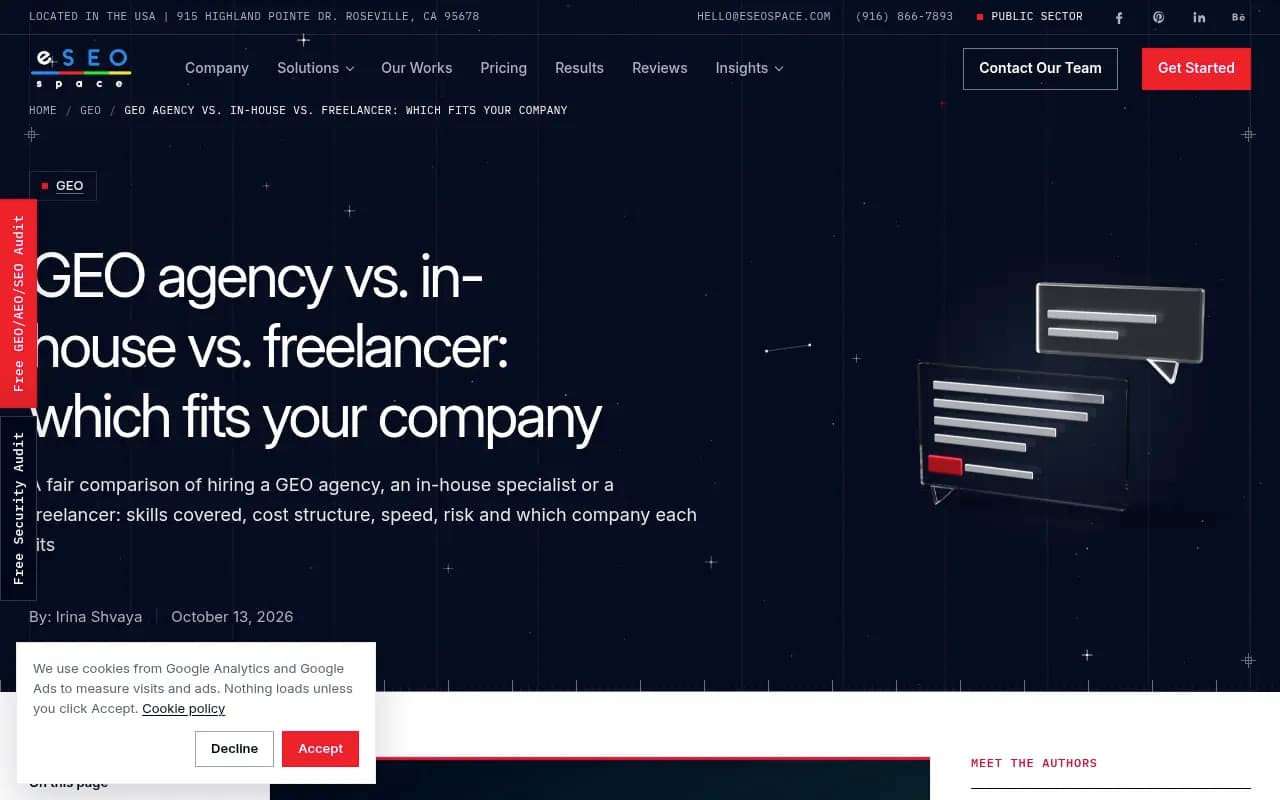
The eSEOspace comparison above is a decent starting point for the three-way split (agency, hire, freelancer). Note that it is published by an agency, like most of the sources on this topic. Read every price in this area as a sales document.
What the work actually consists of
Before comparing costs, split GEO into workstreams. Costs only compare fairly when you price the same deliverables.
| Workstream | Typically better in-house | Typically better with an agency |
|---|---|---|
| Prompt measurement and reporting | Yes, tools do most of it | Only if bundled |
| Product, pricing and docs page ownership | Yes, needs brand knowledge | Rarely |
| Answerability editing of existing pages | Yes, if you have writers | Yes, if you don't |
| Schema and technical fixes | Yes, needs dev access | Agency advises, your devs ship |
| Entity cleanup (Wikipedia, Crunchbase, LinkedIn) | Draw | Often faster with an agency |
| Digital PR, listicle and review placements | No, needs relationships | Yes |
| Multi-market coordination | Hours scale linearly | Often cheaper |
What AI actually cites, and who should own it
Promptwatch Data's analysis of ChatGPT citations from Sep 28 to Oct 4, 2026 gives a useful map. Product pages were 22.4% of classified citations and landing pages 16.8%, together about 39%. Listicles were 13.6%, comparisons 5.9% and reviews 1.7%. Editorial formats together were about 43%. You can read the full breakdown in the ChatGPT citation share by content type report.
Here is my inference, not the report's: the 39% on product and landing pages is content your own team controls and changes constantly, so it belongs near your product people. The listicle, comparison and review share is third-party territory, which is where an agency's outreach relationships earn their fee.
The same data shows why one prompt tells you little. In Promptwatch's unique domains per response report, 47.6% of ChatGPT responses with citations cited 10 or more domains. Your brand competes for a slot among a crowd, so you need to measure across many prompts and earn mentions on other sites, not just polish your own.
Upkeep is a recurring workload
Content decays at different speeds. In Promptwatch's content half-life study, which tracked pages ChatGPT cited on July 6, 2026 for 90 days, 78% of landing pages and 76% of docs were still cited after 30 days. Product pages, reviews and how-tos sat near 55% after 60 days and reached half-life at 74 to 77 days. News lost half its pages within 36 days.
That has an operating-model consequence. A one-off agency sprint decays. Someone has to refresh pages on a cadence that depends on type. If that someone is not on your payroll, the retainer has to include refreshes explicitly.
The cost comparison
The single most common mistake is comparing one salary to one retainer. The Hoop Interactive guide says it plainly: compare 12-month ownership costs, and remember that scope controls cost more than labels do.
Agency pricing
The published ranges, all from agencies:
- Entry-level monitoring retainers: $1,000 to $2,500 a month
- Mid-market active optimization: $2,000 to $8,000 a month
- Enterprise category-leadership programs: $10,000 to $25,000 and up
- WebFX publishes a wider band of $1,500 to $50,000 a month depending on business size
- eSEOspace's combined SEO, GEO and AEO plans run from $750 to $4,000 a month as of October 2026
- Onboarding or audit fees of $1,500 to $5,000 are common
Treat these as asking prices. At enterprise scale, expect quotes well above the mid-market range once you add markets, brands and PR.
In-house cost
The US Bureau of Labor Statistics reported a May 2025 median wage in the high $70,000s to high $80,000s for market research analysts and marketing specialists, depending on which release you read, and a marketing manager median of $165,780. Those are broad categories, not GEO roles, and salary is not the cost. Add benefits and payroll taxes, tools, training, recruiting and management time.
Common Thread Collective makes the coordination argument bluntly: they estimate brands spend 15 to 25 hours a week on vendor coordination, worth $50,000 to $100,000 a year in internal management cost. Take that as one agency's estimate, but the direction is right. Executive attention is a cost.
A 12-month model
Here is a planning model for an enterprise program. Replace the assumptions with your own.
| Scenario | Roughly what you get | Annual cost range (assumption-based) | Main risk |
|---|---|---|---|
| Lean in-house (1 specialist + tool) | Measurement, on-site edits, some content | $120K to $200K loaded, plus tool | No PR capacity, single point of failure |
| In-house team (3 to 4 people + tools) | Full on-site, some PR | $350K to $600K loaded, plus tools | Slow to hire, management load |
| Agency only | Strategy, content, PR, reporting | $120K to $300K+ at enterprise scope | Weak product knowledge, dependency |
| Hybrid (1 owner + platform + agency for PR and content) | Control plus off-site reach | $200K to $400K | Needs a clear split of responsibilities |
These ranges are my estimates built from the retainer bands and salary context above. Nothing here is a published benchmark, and the honest caveat applies: the cheapest column is usually the one with the least scope.
The tool-only trap
One Honeyb analysis argues that a measurement tool plus 8 to 16 hours of internal time costs a fraction of a retainer. The arithmetic holds: at a $60 loaded hourly rate, 12 hours is $720, plus a $95 tool, versus a $4,000 retainer. But the retainer includes digital PR and the in-house column does not. That is a fair warning for enterprises too. A cheap tool tells you where you lose. It doesn't place you in the listicles that beat you.
Decision framework
| Your situation | Lean toward |
|---|---|
| Existing content operation, 4+ marketers, strong SEO lead | In-house with a platform |
| No writers, nobody owns SEO | Agency |
| Weak entity footprint, inconsistent brand facts across the web | Agency for cleanup, then in-house |
| Competitors dominate third-party listicles and review sites | Agency or PR partner for off-site |
| Heavily regulated, every claim needs legal sign-off | In-house, with agency for research only |
| Multi-market or multi-brand with different languages | Agency or hybrid |
| Need proof before budget approval | Start with a platform baseline and a free audit |
| Fast-changing product, pricing and docs | In-house ownership of those pages |
The Honeyb piece makes a point I agree with: establish a measured baseline before signing a retainer. Many agencies charge an onboarding fee to produce a baseline you could have produced yourself, and a baseline gives you something to hold the agency to.
The hybrid model most enterprises end up with
Common Thread Collective calls it breaking the binary, and the eSEOspace guide notes that the options combine well. In practice, hybrid for GEO looks like this:
- One internal owner who understands the product, the CMS and the approval chain.
- One shared measurement platform that both internal staff and the agency can see. No more monthly decks that nobody can verify.
- An agency scoped to what you cannot staff: digital PR, third-party placements, entity cleanup, extra content capacity.
- A quarterly review that compares citation share and AI-referred conversions against the baseline, not against the agency's own report.
The agency scope should be written down in deliverables and hours. Vague "GEO strategy" retainers are where enterprises burn money.
If you do hire an agency
There is no independent ranking of GEO agencies, so ask direct questions. Which platform do they measure with, and will you get your own login? How do they track whether a published page gets crawled and cited? What happens to the work if you leave? A full-service SEO and GEO shop such as 1001 SEO Media combines technical SEO, content, digital PR and AI search work under senior specialists with no long-term contracts, which is the kind of structure to look for. Whoever you choose, insist on transparent reporting and an exit that leaves you with the data.
Tool choices by operating model
The tool layer decides how much you can verify and how much of the execution loop stays in your hands. Monitoring tools answer "was my brand mentioned?" Platforms that also trace crawling, publishing and traffic answer "is it working?"
Platform for the in-house or hybrid owner
Promptwatch is the platform I would put at the center of a hybrid model. It monitors real AI interfaces across ChatGPT, Gemini, Perplexity, Google AI Overviews and others, shows which of your pages are cited, logs AI crawler visits with IP verification, and measures AI-referred visitors. Its Content Agent and Action Board cover the execution side, and an agency can work inside the same data. It is ISO/IEC 27001 certified and GDPR compliant, which matters for enterprise procurement. The Business plan ($579/mo) is the first tier with the Content Agent, faster-than-daily tracking and local targeting, and Enterprise is custom. Confirm current prices at promptwatch.com/pricing.

If you want proof before committing budget, the free AI visibility report at promptwatch.com/ai-visibility-report gives you a baseline without a login.
Enterprise-focused alternatives
Several vendors in the catalog sell to large brands. Profound is a strong enterprise monitoring product, though it has no agentic execution layer.

Bluefish AI and Evertune position themselves for large enterprises and Fortune 500 brands.
If you already run a traditional enterprise SEO suite, BrightEdge, Conductor and seoClarity have added AI visibility tracking, which can reduce vendor sprawl at the cost of depth.
Budget monitoring for a lean team
Otterly.AI and Peec AI are cheap trackers that establish a baseline. They won't tell you why you are not cited or fix it, so pair them with writers who can act on the findings.


Comparison at a glance
| Tool | Best for | Execution support | Fits which model |
|---|---|---|---|
| Promptwatch | End-to-end monitoring, content, crawler logs, traffic | Content Agent, Action Board, CMS publishing | Hybrid or in-house |
| Profound | Enterprise monitoring | Limited | In-house with strong content team |
| Bluefish AI | Large-brand GEO | Varies | Enterprise in-house |
| BrightEdge, Conductor, seoClarity | Teams already on an SEO suite | Within suite | In-house |
| Otterly.AI, Peec AI | Low-cost baseline | None | Lean in-house |
| Passionfruit Labs | AI-native agency work | Managed service | Agency |
For wider browsing, the GEO software directory at bestgeosoftware.com lists far more options by category.
Agencies listed in the catalog
If you are shortlisting service providers, Passionfruit Labs describes itself as a full-service AI-native agency for SEO, GEO and ads.
Vet any agency the same way: written scope, named specialists, and access to the underlying data.
How to run the decision in four steps
- Get a baseline. Run a free visibility check and a platform trial. Track a few hundred buyer prompts across engines, by country and persona if relevant.
- List workstreams. Use the table above and mark which ones you can staff today.
- Price three scenarios over 12 months with identical deliverables: lean in-house, agency, hybrid. Include management time and onboarding fees.
- Set a 90-day test. Agree on metrics (citation share on your priority prompts, AI crawler access, AI-referred conversions) before work starts, and review against the baseline.
If you pick a hybrid, put the measurement platform contract in your name. That one decision gives you leverage over every vendor you hire later.
Bottom line
In-house wins when you already have content operations, a strong SEO owner and a product that changes often. An agency wins when the missing piece is off-site work, entity cleanup or multi-market coordination. For most enterprises the practical answer is an internal owner, a platform you control, and an agency scoped to the work you cannot staff. Compare 12-month ownership costs with identical deliverables, and don't sign a retainer before you have a measured baseline.