Alli AI Review 2026
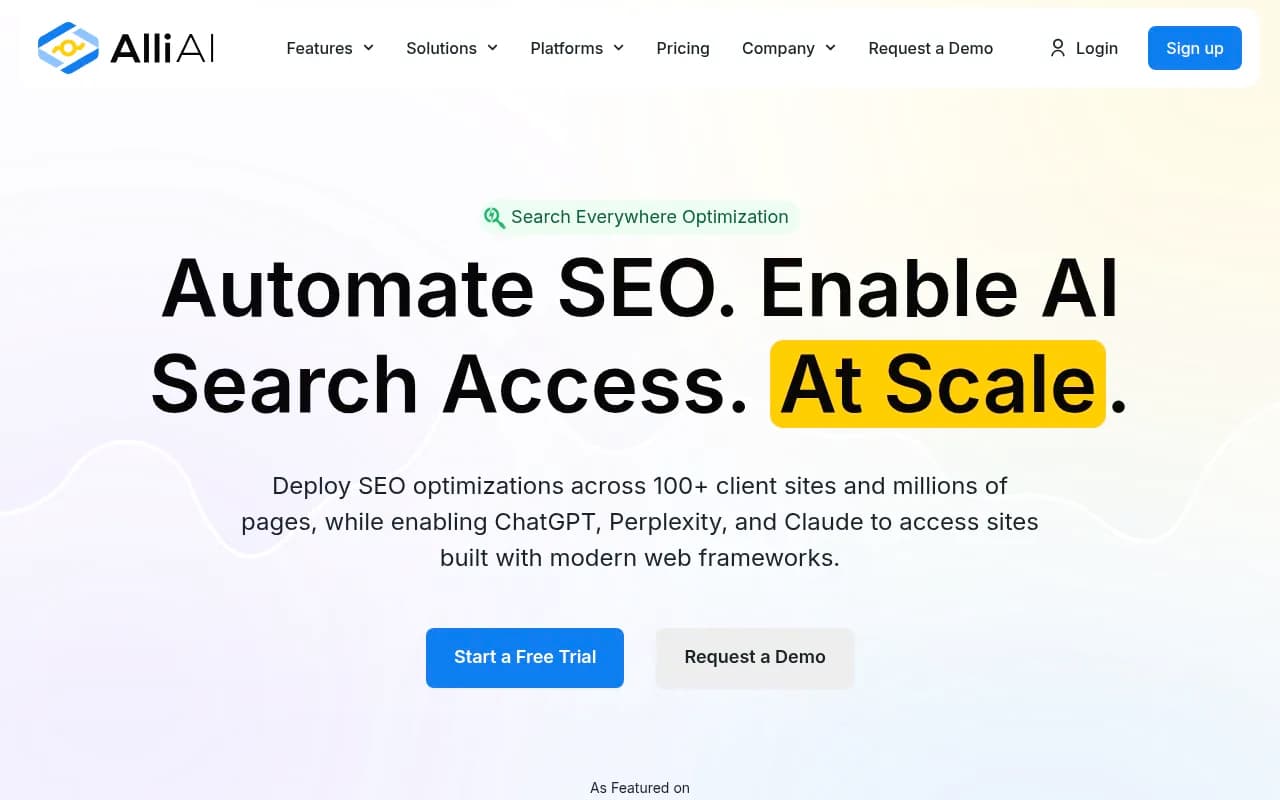
Alli AI is an SEO automation platform built for agencies and teams managing multiple websites. It deploys on-page optimizations at scale through rule-based automation, enables AI crawler access to JavaScript-rendered sites, and optimizes for both traditional search engines and AI platforms like Chat
Key Takeaways:
- Bulk deployment automation: Deploy title tags, schema markup, and meta descriptions to thousands of pages across 50+ sites in under 60 seconds using rule-based automation
- AI crawler enablement: Server-side rendering makes React, Vue, and Next.js sites accessible to ChatGPT, Perplexity, Claude, and 50+ AI platforms (63% of modern websites are currently invisible to AI search)
- Lacks content gap analysis and AI content generation: Unlike Promptwatch, Alli AI doesn't show you which prompts competitors rank for or generate AI-optimized content to close those gaps -- it's deployment-focused, not strategy-focused
- Best for agencies managing 20+ client sites: The platform shines when you need to push the same optimization across dozens of properties simultaneously
- Pricing starts at $299/month for 5 sites: Additional sites cost $39/month each, making it expensive for single-site owners but cost-effective for agencies

Alli AI positions itself as an "SEO AI Agent" that solves the multi-site management problem -- specifically, the bottleneck of manually implementing SEO changes across dozens of client websites. The platform was built by Kyle Duck and has been featured in Forbes, HubSpot, and Search Engine Land. It targets SEO agencies, in-house teams managing multiple properties, and e-commerce businesses with large product catalogs.
The core pitch is simple: traditional SEO tools tell you what to fix, but Alli AI actually deploys the fixes for you. Instead of logging into 50 different WordPress dashboards to update title tags, you create one rule in Alli AI and it applies automatically to all matching pages across your entire portfolio. The platform claims one agency customer made 17 million code changes in minutes -- a task that would take months manually.
But Alli AI isn't just about traditional SEO anymore. In 2025, the company launched its "AI Search Visibility Engine" to address a growing infrastructure problem: modern websites built with React, Vue, Next.js, and other JavaScript frameworks appear as blank pages to AI crawlers like GPTBot (ChatGPT), ClaudeBot, and PerplexityBot. According to Alli AI's data, 63% of websites are completely inaccessible to AI search platforms because these crawlers can't execute JavaScript. The result: your site is invisible in ChatGPT search results even if it ranks well on Google.
Bulk SEO Deployment Automation
This is Alli AI's original core feature and what most agencies use it for. You create optimization rules using a visual browser-based editor -- click on any element (title tag, H1, meta description, schema markup), edit it, and define the logic for when that change should apply. The rule then deploys automatically to all matching pages across all connected sites.
For example: "Update all product page title tags to include the product name + category + 'Buy Online'" -- one rule, 10,000 pages updated in 60 seconds. Or: "Add FAQ schema to all blog posts with a 'Frequently Asked Questions' section" -- deployed across 20 client sites simultaneously. The platform works through JavaScript injection, so you don't need FTP access, SSH, or CMS credentials. Just add a code snippet to each site and you can deploy changes through the Alli AI dashboard.
The visual editor is genuinely useful. You see your actual website in the browser, click the element you want to change, and edit it live. Changes preview in real-time before deployment. This is a huge improvement over traditional SEO tools that show you a list of issues but leave you to figure out where each element lives in your CMS.
Alli AI also includes an AI-powered content generation feature that automatically writes optimized meta descriptions, title tags, and schema markup based on page content analysis. This isn't as sophisticated as dedicated AI writing tools -- it's more about filling in missing meta tags at scale than creating full articles. But for agencies managing hundreds of sites, it saves hours of manual copywriting.
Full rollback capability means you can undo any deployment with one click. The platform maintains a complete history of every change across every property, so if an optimization tanks your rankings, you can revert instantly.
AI Crawler Enablement (Server-Side Rendering)
This is the newer, more technically ambitious feature. Modern websites built with JavaScript frameworks (React, Vue, Angular, Next.js, Nuxt, SvelteKit, etc.) render content client-side in the browser. When a human visits, the browser executes the JavaScript and displays the page. But when an AI crawler visits, it sees the initial HTML response -- which is often just a blank page with a loading spinner.
Alli AI's solution: server-side rendering specifically for AI crawlers. The platform detects when GPTBot, ClaudeBot, PerplexityBot, or any of 50+ AI crawlers hit your site, then serves them pre-rendered HTML instead of the JavaScript bundle. The crawler sees your full content, can index it, and can cite it in AI search results. Human visitors still get the normal client-side experience.
This works with any framework and any hosting setup. You don't need to migrate to a different platform or rewrite your codebase. Alli AI handles the crawler detection and rendering infrastructure. It also manages crawler whitelist configuration -- many sites use Cloudflare or other security tools that accidentally block AI bots, and Alli AI automatically configures these tools to allow AI crawler access.
Real-time analytics show which AI platforms are accessing your sites, how often they crawl, and which pages they visit. Citation tracking (still in development based on the website) will show where and how often your content appears in ChatGPT, Perplexity, and Claude responses.
This is a real infrastructure problem that most SEO tools don't address. Promptwatch tracks AI search visibility and helps you optimize for it, but it doesn't solve the underlying access issue for JavaScript-rendered sites. Alli AI does. However, Alli AI doesn't show you which prompts you're missing or help you create content to rank for them -- it just makes sure AI crawlers can read what you already have.
Unified Search Optimization (Google + AI Platforms)
Alli AI's pitch is that you can optimize for traditional search engines and AI platforms simultaneously from one dashboard. Deploy schema markup, meta tags, and content updates that work across Google, Bing, ChatGPT, Perplexity, and Claude. The platform formats structured data for both Google's search index and AI platform training data.
In practice, this means you're deploying the same on-page SEO elements (title tags, meta descriptions, H1s, canonical URLs, schema markup) but with awareness that AI platforms also read these signals. Alli AI doesn't have separate workflows for "Google SEO" vs "AI search optimization" -- it's one unified deployment that targets both channels.
The unified analytics dashboard (based on screenshots) shows traditional search rankings alongside AI platform citations and traffic attribution by source. You can see how your visibility changes across Google, ChatGPT, Perplexity, and Claude over time. This is useful for understanding the full search landscape, but it's not as detailed as dedicated AI search tracking tools.
Who Is It For
Alli AI is built for three primary audiences:
SEO agencies managing 20-100+ client sites: This is the core use case. If you're manually logging into dozens of WordPress, Shopify, and Wix dashboards to implement the same SEO changes over and over, Alli AI eliminates that bottleneck. One agency testimonial mentions managing all clients from one dashboard and automating "thousands of hours of manual work in minutes." The pricing structure (5 sites for $299/month, then $39 per additional site) is designed for agencies with large portfolios.
In-house SEO teams at multi-brand companies: If you manage SEO for 10+ websites under one corporate umbrella (different brands, regions, or product lines), Alli AI lets you deploy optimizations across all properties simultaneously. E-commerce companies with thousands of product pages are a particularly good fit -- one case study mentions a specialty retailer transforming their catalog SEO.
Developers and agencies building modern JavaScript sites: If you're building sites with React, Next.js, or Vue and need to ensure AI crawlers can access them, Alli AI's server-side rendering solves a real problem. This is especially relevant for SaaS companies, web apps, and progressive web apps that are otherwise invisible to ChatGPT and Perplexity.
Who should NOT use Alli AI: Solo bloggers or single-site owners will find the pricing prohibitive ($299/month minimum). If you only manage one website, you're better off with a traditional SEO tool or manual implementation. Alli AI's value is in bulk deployment across multiple properties -- that's where the ROI appears. Also, if you need AI search strategy (which prompts to target, what content to create), Alli AI doesn't provide that. It's a deployment and access tool, not a strategy or content creation platform.
Integrations & Ecosystem
Alli AI works with any CMS or website platform through JavaScript injection. Officially supported platforms include WordPress, Shopify, Wix, Squarespace, Webflow, and custom-built sites. The platform doesn't require backend access -- you just add a code snippet to your site's header and Alli AI can deploy changes through the browser.
No mention of API availability or developer documentation on the website. The platform appears to be a closed system accessed through the web dashboard. No browser extensions or mobile apps mentioned.
Integrations with Google Search Console, Google Analytics, or other SEO tools are not explicitly listed. The platform seems to operate independently -- you connect your sites via code snippet, then manage everything through Alli AI's dashboard.
Pricing & Value
Alli AI introduced "Flex Pricing" in 2025 with 20+ plan options. Based on available information:
- Base plan: $299/month for 5 sites
- Additional sites: $39/month per site
- Single site: Approximately $60/month (inferred from the 1/5 pricing structure mentioned in Capterra reviews)
No free tier or freemium option. Free trial available (duration not specified on the website). Annual billing discounts likely available but not explicitly stated.
For agencies managing 50+ client sites, the math works out to roughly $2,000-2,500/month. That's expensive compared to traditional SEO tools (Semrush is $230/month, Ahrefs is $199/month), but those tools don't deploy changes for you. If Alli AI saves 40+ hours of manual implementation work per month, the ROI is there.
For single-site owners, $60-299/month is hard to justify unless you have a massive site (10,000+ pages) or a JavaScript-rendered site that's invisible to AI search. Most small businesses and bloggers will find better value with traditional SEO tools or manual optimization.
Compared to competitors: Alli AI is more expensive than monitoring-only AI search tools (Otterly.AI starts at $49/month, Peec.ai at $99/month), but those tools don't deploy changes or enable AI crawler access. Promptwatch ($99-579/month) focuses on AI search strategy and content creation, which Alli AI doesn't provide. The platforms serve different needs.
Strengths & Limitations
Strengths:
- Bulk deployment speed: Deploy optimizations to 10,000 pages across 50 sites in under 60 seconds -- no other tool matches this scale and speed
- Visual browser editor: Edit any element directly in your live website without touching code or CMS backends
- AI crawler enablement: Solves the real infrastructure problem of JavaScript-rendered sites being invisible to ChatGPT, Perplexity, and Claude
- Platform agnostic: Works with WordPress, Shopify, Wix, React, Vue, Next.js -- any website through JavaScript injection
- Full rollback capability: One-click undo for any deployment across any property
Limitations:
- No content gap analysis: Alli AI doesn't show you which prompts competitors rank for or what content you're missing. Promptwatch's Answer Gap Analysis identifies exactly which topics and questions AI models want answers to but can't find on your site -- Alli AI has no equivalent feature.
- No AI content generation for strategy: The AI writing feature generates meta tags and schema markup, but it doesn't create full articles optimized for AI search. Promptwatch's AI writing agent generates content grounded in 880M+ citations and prompt volume data -- Alli AI doesn't compete here.
- No AI traffic attribution or visitor analytics: Alli AI doesn't track which visitors came from AI search or connect visibility to revenue. Promptwatch offers traffic attribution through code snippet, GSC integration, or server log analysis.
- No prompt intelligence: No volume estimates, difficulty scores, or query fan-outs to help you prioritize which prompts to target. You're deploying optimizations blind without understanding which opportunities are high-value and winnable.
- Limited analytics depth: The unified dashboard shows rankings and citations, but it's not as detailed as dedicated AI search tracking platforms. No Reddit or YouTube insights, no ChatGPT Shopping tracking, no page-level citation breakdowns.
- Expensive for small sites: $299/month minimum makes it prohibitively expensive for solo bloggers, freelancers, or single-site owners
Bottom Line
Alli AI is the best SEO deployment automation platform for agencies and teams managing 20+ websites. If you're spending hours manually implementing the same SEO changes across dozens of client sites, Alli AI eliminates that bottleneck entirely. The visual editor, rule-based deployment, and full rollback capability make it easy to push optimizations at scale without touching code or CMS backends.
The AI crawler enablement feature solves a real problem for modern JavaScript-rendered sites. If you're building with React, Next.js, or Vue and need to ensure ChatGPT and Perplexity can access your content, Alli AI's server-side rendering is the most straightforward solution available.
But Alli AI is a deployment tool, not a strategy tool. It doesn't tell you which prompts to target, what content to create, or how to optimize for AI search visibility. For that, you need Promptwatch -- which provides Answer Gap Analysis, AI content generation, prompt intelligence, and traffic attribution that Alli AI lacks entirely. If you want to actually improve your AI search rankings (not just make sure AI crawlers can read your site), Promptwatch is the stronger choice.
Best use case in one sentence: SEO agencies managing 50+ client sites who need to deploy on-page optimizations at scale and ensure modern JavaScript sites are accessible to AI crawlers.
Similar and alternative tools to Alli AI