Key takeaways
- Bluefish AI is a pure GEO/AI-channel platform built for Fortune 500 brands; Conductor is a broader enterprise AEO + SEO suite that covers AI search, traditional organic, content creation, and website monitoring in one product.
- Conductor has a 3-week free trial and publicly estimated pricing ($20K–$50K+/year); Bluefish AI is demo-only with no public pricing and estimated at $4,000+/month.
- If you need traditional SEO alongside AI visibility, Conductor wins by default -- Bluefish AI doesn't cover organic search at all.
- Bluefish AI's differentiator is depth of AI channel intelligence: it claims to help brands understand how AI models "think," not just track where they appear.
- Conductor's content creation module (Conductor Creator) gives it a clear edge for teams that want to generate and optimize content inside the same platform.
- Neither tool is accessible to mid-market teams. Both require enterprise contracts and a sales process. For brands not yet at that scale, there are more practical entry points.
Overview
Bluefish AI
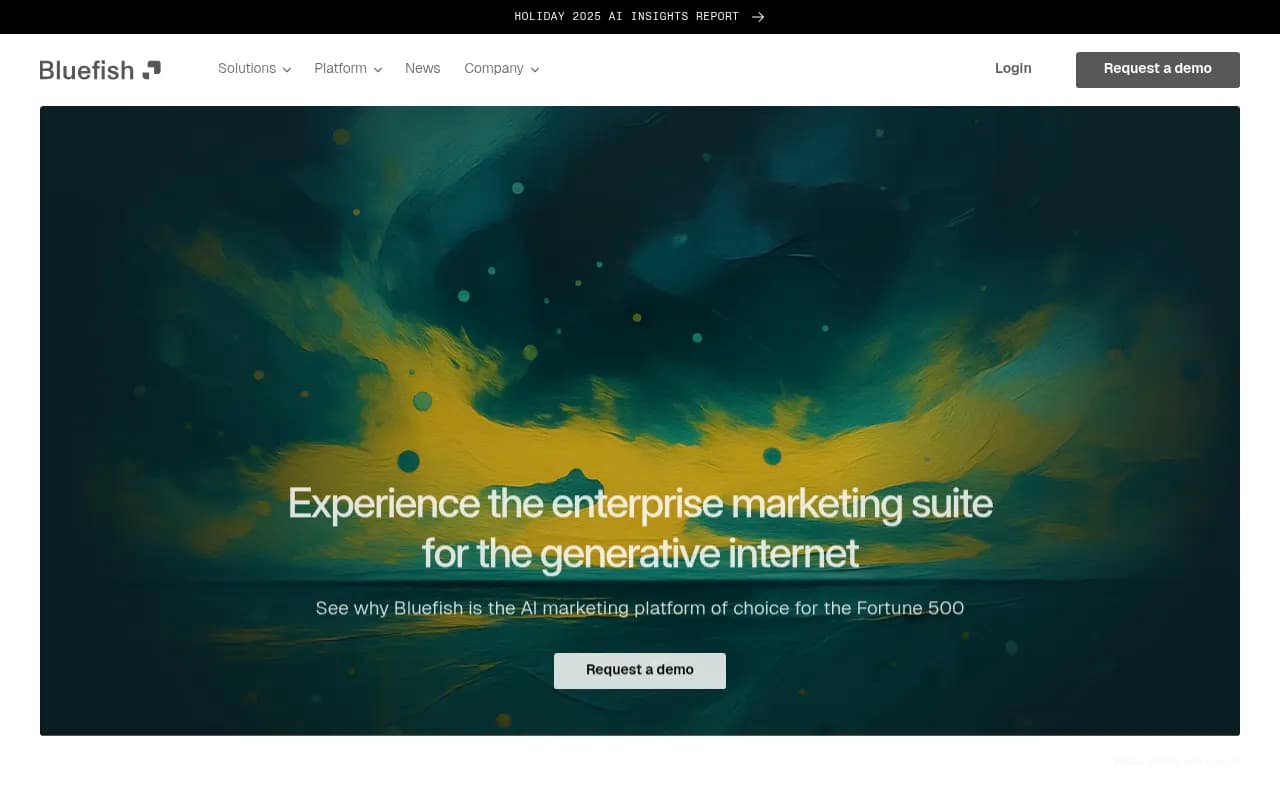
Bluefish AI positions itself as the AI marketing platform for the Fortune 500. The pitch is authority and control in the AI channel -- not just tracking where your brand shows up in ChatGPT or Perplexity, but understanding the mechanics behind those recommendations and influencing them. The platform covers AI monitoring, GEO optimization, measurement, and what it calls "AI Commerce." It's a focused product: everything it does is about the AI channel, and it doesn't try to be a traditional SEO tool.
The company has been active in the GEO research space too -- publishing data on things like how Super Bowl ad spend affects AI recommendations, which is a genuinely interesting angle for brand marketers.
Conductor
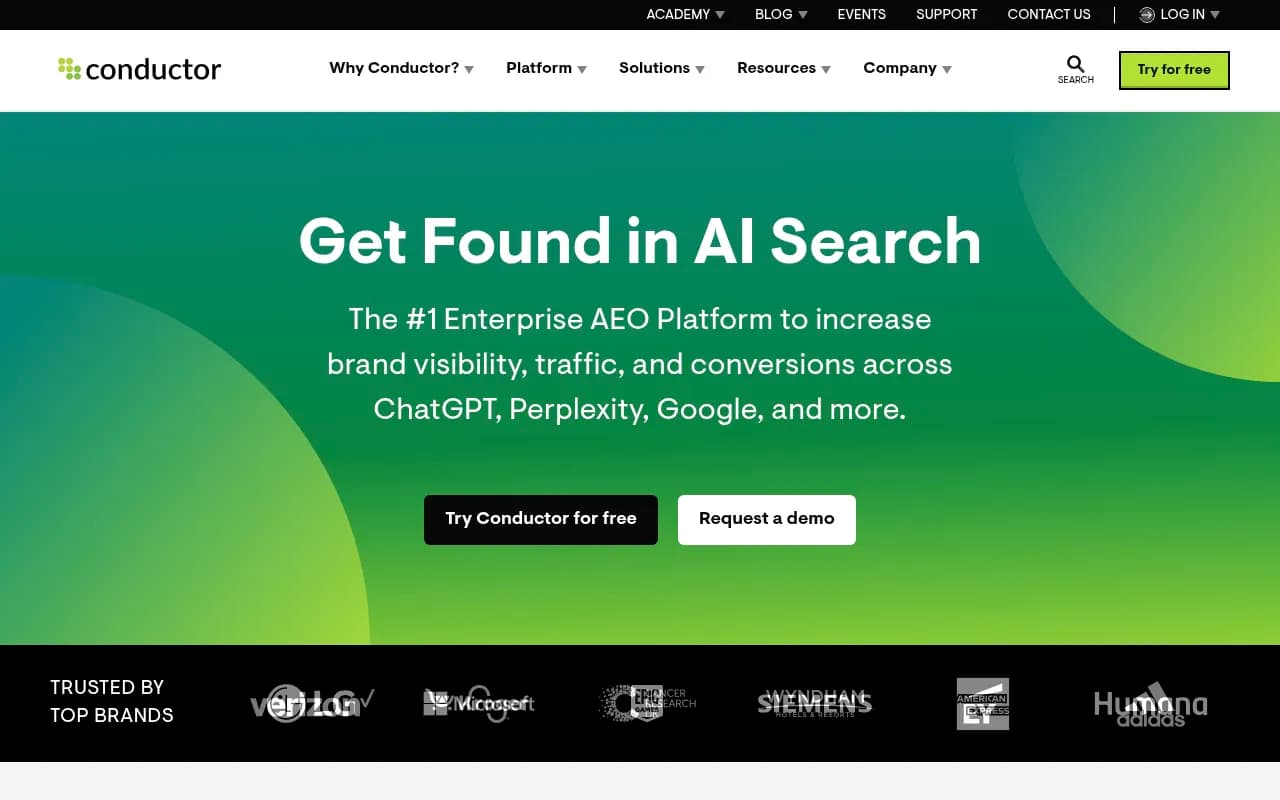
Conductor has been around as an enterprise SEO platform for years, and it's been building out AI search capabilities on top of that foundation. The current product is framed as the "#1 Enterprise AEO Platform," but it's really a full-stack enterprise marketing intelligence suite: AI search visibility (Conductor Intelligence), content creation (Conductor Creator), website monitoring (Conductor Monitoring), and a data layer for custom reporting and API workflows (Conductor Data).
The client list is impressive -- Verizon, Microsoft, American Express, Adidas, FedEx, Citibank. These are brands with large, mature SEO and content teams that need everything in one place.
Side-by-side comparison
| Feature | Bluefish AI | Conductor |
|---|---|---|
| Primary focus | AI channel / GEO only | AEO + SEO + content + monitoring |
| Traditional SEO | No | Yes (mature module) |
| AI search monitoring | Yes | Yes |
| Content generation | Limited / workflow-based | Yes (Conductor Creator) |
| Website monitoring | No | Yes (24/7) |
| AI commerce tracking | Yes | Limited |
| Pricing model | Quote-based | Quote-based |
| Estimated cost | ~$4,000+/month | ~$20K–$50K+/year |
| Free trial | No (demo only) | 3-week free trial |
| Target customer | Fortune 500 brand marketers | Enterprise SEO + content teams |
| Infosec / enterprise compliance | Strong (passes reviews) | Strong (established enterprise vendor) |
| API / data export | Yes | Yes (Conductor Data) |
| Custom audiences / prompts | Yes | Limited |
| AI model coverage | Major AI channels | ChatGPT, Perplexity, Google AI Overviews |
Head-to-head feature deep-dive
AI search monitoring
Both platforms track brand visibility across major AI search engines. Conductor covers ChatGPT, Perplexity, and Google AI Overviews as its stated focus. Bluefish AI covers "all AI native experiences" -- the marketing language is broader, though specific model coverage isn't publicly detailed.
Where Bluefish AI tries to go further is in the quality of the insight. The platform talks about helping marketers understand how AI "thinks" about their brand -- not just whether they appear in a response, but the reasoning and context behind recommendations. That's a meaningful distinction if it holds up in practice. Conductor's intelligence module is more focused on visibility metrics, share-of-voice, and keyword-level data.
Verdict: Bluefish AI for depth of AI-specific insight; Conductor for breadth of coverage across AI and traditional search combined.
Content creation and optimization
This is where the gap between the two tools is clearest. Conductor has a dedicated content creation product (Conductor Creator) that uses purpose-built AI to draft, optimize, and publish content. It's integrated with the intelligence layer, so you can go from "this keyword/prompt has an opportunity" to "here's a draft article" without leaving the platform.
Bluefish AI's approach to content is more about optimization workflows and measurement frameworks -- helping teams understand what to prioritize and how to measure impact. It's not primarily a content generation tool.
Verdict: Conductor, clearly. If content production is part of your workflow, Bluefish AI doesn't really compete here.
Traditional SEO
Conductor has years of SEO data and a mature keyword intelligence module. For enterprise teams that still care about Google rankings alongside AI visibility (which is most of them), this matters a lot. You get keyword tracking, SERP analysis, competitive gap analysis, and all the standard enterprise SEO tooling.
Bluefish AI doesn't do traditional SEO. Full stop. It's an AI-channel-only platform.
Verdict: Conductor, by default. If you need SEO, Bluefish AI isn't in the running.
AI commerce and brand influence
Bluefish AI has a specific "AI Commerce" module and talks about tracking brand performance in "agentic commerce" -- AI-driven shopping and recommendation flows. It also published research on how offline advertising (Super Bowl ads) influences AI recommendations, which suggests the platform is thinking about the full marketing funnel, not just content optimization.
Conductor doesn't have a comparable AI commerce module. Its focus is search visibility and content, not the downstream commercial impact of AI recommendations.
Verdict: Bluefish AI for brands that care about AI-driven commerce and purchase recommendations.
Website monitoring
Conductor has 24/7 website monitoring built in -- technical SEO alerts, crawl error detection, site health tracking. For large enterprise sites where a broken page can mean significant revenue loss, this is genuinely valuable.
Bluefish AI doesn't offer website monitoring. It's not what the product is for.
Verdict: Conductor.
Enterprise readiness and customization
Both platforms are built for enterprise, but they emphasize different things. Bluefish AI specifically calls out passing infosec reviews "with ease" and offers custom audiences, tailored prompt sets, and deep data segmentation. The pitch is that generic datasets aren't enough for category leaders -- you need data that reflects your actual competitive context.
Conductor's enterprise credentials come from its track record: it's been serving Fortune 500 clients for years, has a robust data API (Conductor Data), and integrates into existing enterprise reporting workflows.
Verdict: Roughly even, with Bluefish AI having an edge on AI-specific customization and Conductor having an edge on overall enterprise maturity.
Pricing comparison
Neither tool publishes a pricing page, which is typical for enterprise software. Here's what's known:
| Plan | Bluefish AI | Conductor |
|---|---|---|
| Entry point | ~$4,000+/month (estimated) | ~$20,000–$50,000+/year (estimated) |
| Pricing model | Custom quote | Custom quote |
| Free trial | No | 3-week free trial |
| How to get started | Request a demo | Free trial or demo |
| Annual commitment | Likely required | Likely required |
The math is interesting here. Conductor's lower annual estimate ($20K/year = ~$1,700/month) could actually make it cheaper than Bluefish AI's $4,000+/month floor -- though both numbers are estimates and actual contracts depend heavily on scope, seats, and feature tiers.
Conductor's free trial is a real advantage. You can actually test the product before committing. Bluefish AI requires a sales conversation from day one.
Worth noting: if you're evaluating AI search visibility tools and aren't yet at enterprise scale, Promptwatch starts at $99/month and covers AI monitoring, content gap analysis, and content generation across 10+ AI models -- a more accessible entry point before committing to a six-figure enterprise contract.

Pros and cons
Bluefish AI
Pros:
- Deep AI channel intelligence, not just surface-level visibility metrics
- AI Commerce module for tracking brand performance in agentic/shopping contexts
- Custom audiences and tailored prompt sets for competitive markets
- Strong infosec posture for enterprise procurement
- Research-backed insights (e.g., offline ad influence on AI recommendations)
Cons:
- No traditional SEO capabilities
- No content generation
- No website monitoring
- No public pricing or free trial -- requires a sales process to evaluate
- Relatively new platform with less of a track record than established SEO vendors
Conductor
Pros:
- Full-stack platform: AEO + SEO + content creation + website monitoring
- 3-week free trial available
- Proven enterprise client list (Verizon, Microsoft, American Express, etc.)
- Conductor Creator for AI-assisted content generation
- Mature SEO intelligence module built on years of data
- Strong API and data export capabilities
Cons:
- AI search capabilities are newer additions on top of an SEO foundation -- depth may lag behind pure-play GEO tools
- No AI commerce tracking
- Broad scope means the AI-specific features may not be as deep as a focused platform
- Enterprise pricing puts it out of reach for most teams
Who should pick which tool
Choose Bluefish AI if:
- Your brand is in a highly competitive category where generic AI visibility data isn't enough
- You need to understand how AI models reason about your brand, not just where you appear
- AI commerce and agentic recommendation tracking is a priority
- You're a Fortune 500 brand with a dedicated AI marketing function
- You don't need traditional SEO -- your SEO is handled elsewhere
Choose Conductor if:
- You need AI search visibility AND traditional SEO in one platform
- Content creation and optimization is part of your team's workflow
- 24/7 website monitoring matters for your site's scale
- You want to trial the product before signing a contract
- You're an enterprise team that wants a single vendor for search intelligence, content, and monitoring
Final verdict
These two tools aren't really competing for the same buyer. Bluefish AI is for enterprise brands that want to go deep on AI channel intelligence and are willing to pay a premium for specificity. Conductor is for enterprise teams that want a unified platform covering AI search, traditional SEO, content, and site monitoring -- and who value breadth over depth on the AI side.
If you're a large brand with a dedicated AI marketing team and AI commerce is on your radar, Bluefish AI is the more specialized choice. If you're an enterprise SEO or content team looking to add AI search visibility to an existing workflow without switching platforms, Conductor is the more practical option -- and the free trial means you can actually verify that before committing.