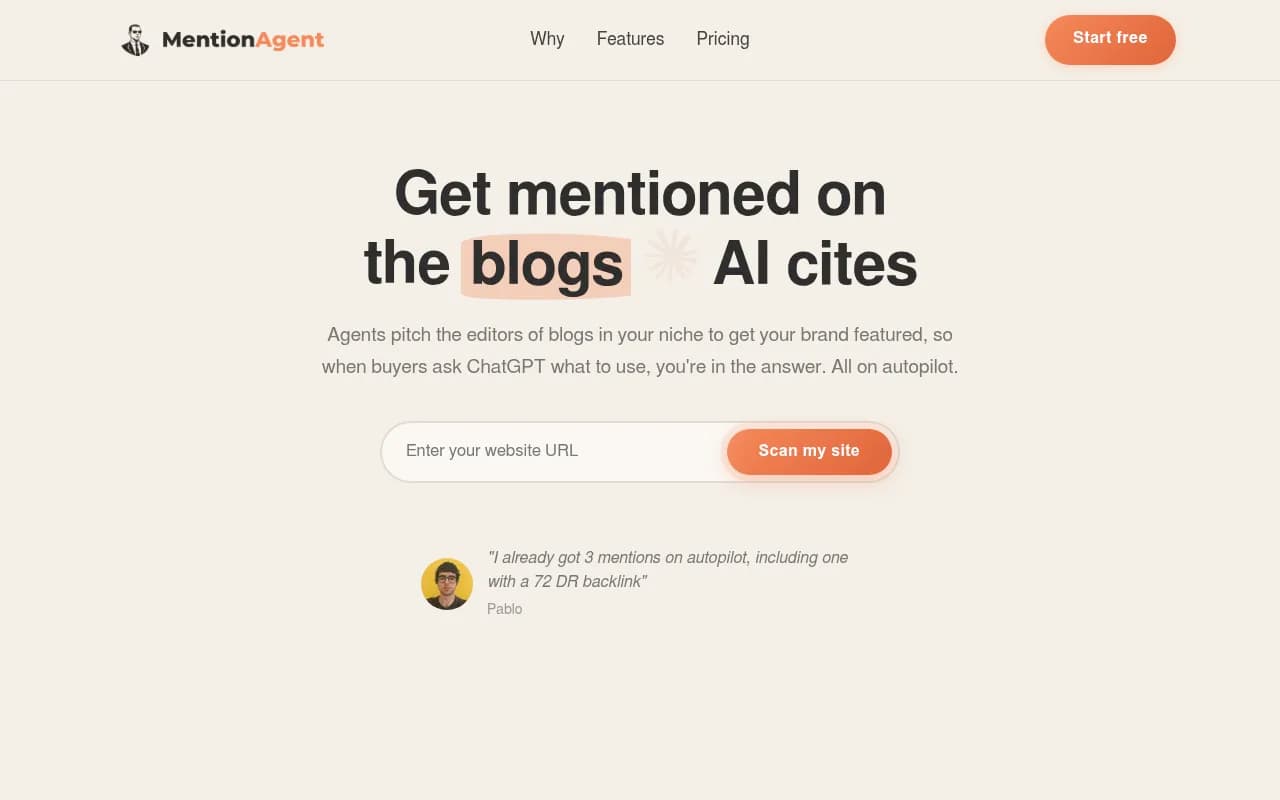
MentionAgent Review 2026
Automates link building and outreach campaigns, pursuing the offsite mentions that increasingly drive whether AI engines cite your brand.
Key takeaways
- MentionAgent automates the full link building chain: prospecting, domain qualification, contact lookup, personalized pitch drafting, sending, follow-ups, and reply handling, with a one-tap approval step before anything goes out.
- The included email infrastructure is the standout. It registers a sending domain, sets up a Gmail inbox, configures SPF/DKIM/DMARC, and warms the inbox up for you. Most competitors make you buy and stitch together three or four separate tools for this.
- The AI Visibility module (still labeled beta) is monitoring-only and thin: it checks ChatGPT, Gemini, and Claude weekly, but lacks the AI crawler logs, prompt volumes and difficulty scoring, traffic attribution, content gap analysis, and automated content optimization that Promptwatch offers.
- Pricing has changed at least once in 2026 and the site shows inconsistent numbers ($99/mo on the homepage, $129/mo flat on the pricing page, tiered inbox pricing elsewhere). Verify live pricing before you commit.
- Best for bootstrapped SaaS, small agencies, ecommerce, and local businesses that want editorial mentions without hiring an outreach agency or managing a tool stack. Skip it if you need multi-seat teams, an API, or high-volume cold sales email.
What MentionAgent actually does
MentionAgent is an AI outreach agent for one specific job: earning editorial mentions and backlinks on other people's blogs. It is deliberately not a full SEO platform. It doesn't write your content, audit your site, or do keyword research. The FAQ puts it well: it handles the half of SEO you can't do by editing your own pages.
The workflow is genuinely end-to-end. You give it your website URL, it reads the site, infers your niche, and starts finding blog posts where you should plausibly be mentioned: product roundups, gift guides, alternatives posts, city guides, resource pages. It checks each prospect's domain rating, finds the editor's email, verifies the address, and drafts a pitch that references the specific post it found. Not a template with a name swapped in, an actual pitch against that article.
Then it stops and waits for you. Every draft sits in an approval queue, reachable from the web dashboard or a Telegram bot, and nothing sends without your tap. This is the right design. Outreach tools that auto-send from day one are how sending domains get torched, and the human-in-the-loop step is the difference between an agent and a spam cannon.
The default deal structure is what they call a contextual mention exchange: they add a line about you to one of their posts, you add a line about them to one of yours. The agent drafts both sentences and picks the spots. Some editors just say yes and ask for nothing. You can also take over any thread yourself and the agent keeps handling follow-ups. There's no link buying; the agent reportedly turns down sites that ask for a fee.
The email infrastructure is the real product
This is the part I'd underline for anyone who has run outreach manually. To do this yourself you need a Google Workspace account ($7/mo), a warmup tool like Instantly or Mailreach ($30/mo), a contact finder like Hunter.io (~$49/mo), an outreach platform like Pitchbox ($165/mo), and either your own time or a freelancer to write the pitches. MentionAgent's own math puts the DIY stack at $751+/mo, and that roughly checks out.
MentionAgent bundles all of it. It registers a sending domain for you, sets up a dedicated Gmail inbox on it, handles the DNS records, and warms the inbox up over about three weeks, starting at 5 emails a day and stepping up to 40. Keeping outreach on a separate domain is smart: whatever happens in a cold inbox can't touch the reputation of the domain your business runs on.
Two details here earned my respect. First, the sending domain is yours; ask and they'll transfer it to your registrar for free, even if you've cancelled. Second, you can export your prospects, threads, and send history any time. Both are the opposite of the lock-in behavior you'd expect from a tool that owns your outreach infrastructure.
The AI visibility module: interesting idea, early execution
The newer AI Visibility tab is where MentionAgent's story gets interesting, and where it starts brushing up against dedicated GEO platforms. The pitch is that editorial mentions do three jobs at once: an SEO signal, a trust signal, and a source that AI assistants cite when buyers ask what to use.
That premise holds up against real citation data. Product pages led ChatGPT citations at roughly a third of all citations in July 2026, with listicles the fastest-growing format, per Promptwatch's ChatGPT citation types data. Google AI Overviews showed the same shift, with product pages overtaking listicles as the most-cited format in late July (Promptwatch Data). The roundup and comparison placements MentionAgent chases are exactly the page types AI engines are citing right now, so the strategy is sound.
The module itself, though, is beta and it shows. It asks ChatGPT, Gemini, and Claude your buyers' questions weekly, shows how often you're named versus competitors, and includes a genuinely nice touch: a proof log that ties specific AI answers back to the exact placed page that got cited. That closed loop between outreach and AI visibility is a compelling demo.
But as a visibility product it's shallow. Three models, weekly scans, no AI crawler logs to tell you whether bots can even read your pages, no prompt volumes or difficulty scores, no query fan-outs, no traffic attribution from AI platforms to your site, no Reddit or YouTube citation tracking, no ChatGPT Shopping coverage, and nothing that helps you create or fix content. If AI visibility is the main reason you're evaluating tools, Promptwatch is the stronger choice: it monitors ten-plus models including Perplexity, Grok, and Google AI Mode, logs 400+ AI crawlers hitting your site, attributes actual AI-driven visitors and conversions, and closes the loop with content gap analysis and automated GEO content publishing. MentionAgent's module is a proof-of-value feature for its link building; Promptwatch is a full optimization platform.

Pricing: check the live page
Here's my honest caveat: MentionAgent's pricing has visibly shifted during 2026, and different pages on its own site disagree. The homepage says "from $99/mo." The pricing blog shows tiered plans by sending inbox: Starter $99/mo (1 site, 1 inbox, 40 emails/day, 15,000 credits), Growth $179/mo (2 inboxes, 80/day), Scale $329/mo (2 sites, 4 inboxes), Agency $629/mo (4 sites, 8 inboxes). Another snapshot shows a flat $129/mo Starter with an optional $99/mo extra workspace. Treat every number here as approximate and verify at signup.
What is consistent: monthly billing only, no annual discount, no per-seat fees (there are no seats at all), a free start with one-time credits and no credit card, and a 14-day money-back guarantee. Credits are simple: drafts cost 2 (refunded if you discard), sends cost 2, and prospecting, contact extraction, and domain qualification are unlimited and free. The 15,000 monthly credits on Starter are generous; a full day of 40 drafts plus 40 sends barely dents it.
The volume ceiling is deliberate: 40 emails per inbox per day, max two inboxes per site, so 80/day is the hard cap for any single domain. If you want mass cold email, this is the wrong tool and they'll tell you so.
Who it's for, and who should wait
Good fit:
- Bootstrapped SaaS founders who want to show up in "best X software" roundups without a $4,000/mo agency
- Ecommerce and DTC brands chasing gift guides and review blogs
- Local service businesses targeting city guides and best-in-area lists
- Solo agencies and freelancers who'd rather approve drafts for ten minutes a day than build campaigns in Pitchbox
Think twice:
- Very new sites. MentionAgent says any site can start, and it sensibly focuses low-DR sites on similar-sized prospects, but an independent review suggests waiting until you're around DR 30 with 500+ monthly organic visitors, since editors rarely respond to unknown domains.
- Teams. There's no multi-seat support, roles, or permissions. It's a one-operator tool.
- Anyone needing an API, CRM integrations, or Zapier. There's no public API and no integration ecosystem; the Telegram bot is the only external interface.
Strengths and limitations
Strengths:
- The agent does real work, not assisted work: prospecting, qualification, drafting, sending, follow-ups, and reply drafts all run on their own
- Bundled sending domain, Gmail inbox, DNS, and warmup eliminate the entire tool stack and the setup knowledge it requires
- Approval-first design protects your domain reputation and keeps bad pitches from reaching good editors
- Plain-English targeting rules ("skip affiliate listicles, go for resource pages") actually filter prospects before drafts are written
- The proof log connecting placed links to AI citations is a genuinely novel way to demonstrate ROI
- Fair exit terms: domain transfers, data exports, no contracts
Limitations:
- The AI Visibility module is beta and monitoring-only. Compared to Promptwatch it lacks crawler logs, visitor analytics, prompt intelligence, Reddit and YouTube tracking, ChatGPT Shopping insights, content gap analysis, and any content creation or optimization capability
- Pricing pages contradict each other, which doesn't inspire confidence in a young product
- Discovery freshness isn't perfect; one third-party test surfaced a 2024 article as a match
- No annual billing, no seats, no API, no integrations beyond Telegram
- Thin independent review coverage. The product launched on directories in mid-2026 and has few verified user reviews. The founder's own DR gains from using the tool are the most visible proof so far, which is charming but not exactly third-party validation
Bottom line
MentionAgent is one of the more honest takes on agentic outreach I've seen. It picks a narrow problem, automates nearly all of it, keeps a human approval step where it matters, and bundles the infrastructure that normally takes five subscriptions and a DNS tutorial to assemble. For a bootstrapped SaaS founder, a small agency, or a DTC brand that wants editorial mentions and the AI citations that follow them, it's a legitimately good deal at $99-129/mo, with the caveat that you should confirm the current price yourself.
Just be clear about what the AI Visibility tab is: a proof-of-value feature for the link building, not a GEO platform. If your primary goal is understanding and improving how AI engines discuss and recommend your brand, across models, with crawler data, traffic attribution, and content optimization that actually fixes gaps, Promptwatch is the better fit. The ideal setup for some teams is honestly both: MentionAgent to earn the offsite mentions, Promptwatch to measure what those mentions do in AI answers. Used that way, each tool covers what the other doesn't.
Tags:
Frequently asked questions
How much does MentionAgent cost?
Does MentionAgent send emails automatically without approval?
Do I need to set up my own email domain and warmup tool?
How many emails can MentionAgent send per day?
Does MentionAgent track AI visibility in ChatGPT and other models?
Is MentionAgent suitable for a brand new website?
Can I export my prospects and email history if I cancel?
Similar and alternative tools to MentionAgent