Key takeaways
- A prompt tracker answers one question: was my brand mentioned? An AI visibility platform answers the harder ones: why, where from, what traffic did it drive, and what do I change.
- Mention counts are noisy. Citation sets churn weekly, single runs are close to coin flips, and a mention with the wrong price or tone is a liability, not a win.
- Engines behave differently. ChatGPT cites about 5 sources per web-search answer; Google AI Overviews and Perplexity cite about 10. One blended score hides that.
- The features that separate the categories are crawler logs, AI traffic attribution, content gap analysis, and some way of acting on findings.
- If your buyers do not use AI to shortlist vendors yet, or your source material is thin, a dashboard is the wrong first spend.
The question everyone starts with
Someone in marketing asks, "Are we showing up in ChatGPT?" Fair. It is the obvious first question. A dozen tools exist to answer it, most of them by sending a list of prompts to AI assistants and counting how often your brand name appears in the reply.
That works for about a month. Then the follow-ups arrive. Why did we drop this week? Which page got us cited? Did any of it send a visitor? What do we write next? A tool built to count mentions has nothing to say about any of those.
This guide separates the two categories, explains why mention counting breaks down as a measurement method, and gives you a checklist for evaluating tools without getting hypnotized by a visibility score.
What a prompt tracker actually does
Strip away the branding and most entry-level trackers do the same thing. They hold a list of prompts, run them against one or more AI models on a schedule, and check whether your brand string (and competitors') appears in the response. Output: a mention rate, maybe a share of voice, maybe a sentiment label.
That is useful as a smoke test. It is cheap, it is quick to set up, and it tells you whether you are completely absent. Tools like [tool:otterly-ai], [tool:peec-ai], and [tool:rankscale] sit in this part of the market, and a lot of newer entrants do too.
The limitation is structural, not a matter of polish. A mention count tells you what happened and nothing about why.
Why mention counting is shakier than it looks
The answers are not stable
Run the same prompt five times and you get five answers. Research from Kevin Indig and AirOps, covering 815,000 prompt-page pairs and quoted by Arcalea, found that after three runs of the same prompt in ChatGPT only 2.3% of citations stayed consistent. Arcalea also reports that Google AI Mode replaces about 56% of its cited sources every week and ChatGPT about 74%. I have not verified those figures independently, but they match what anyone sees when they re-run prompts by hand.
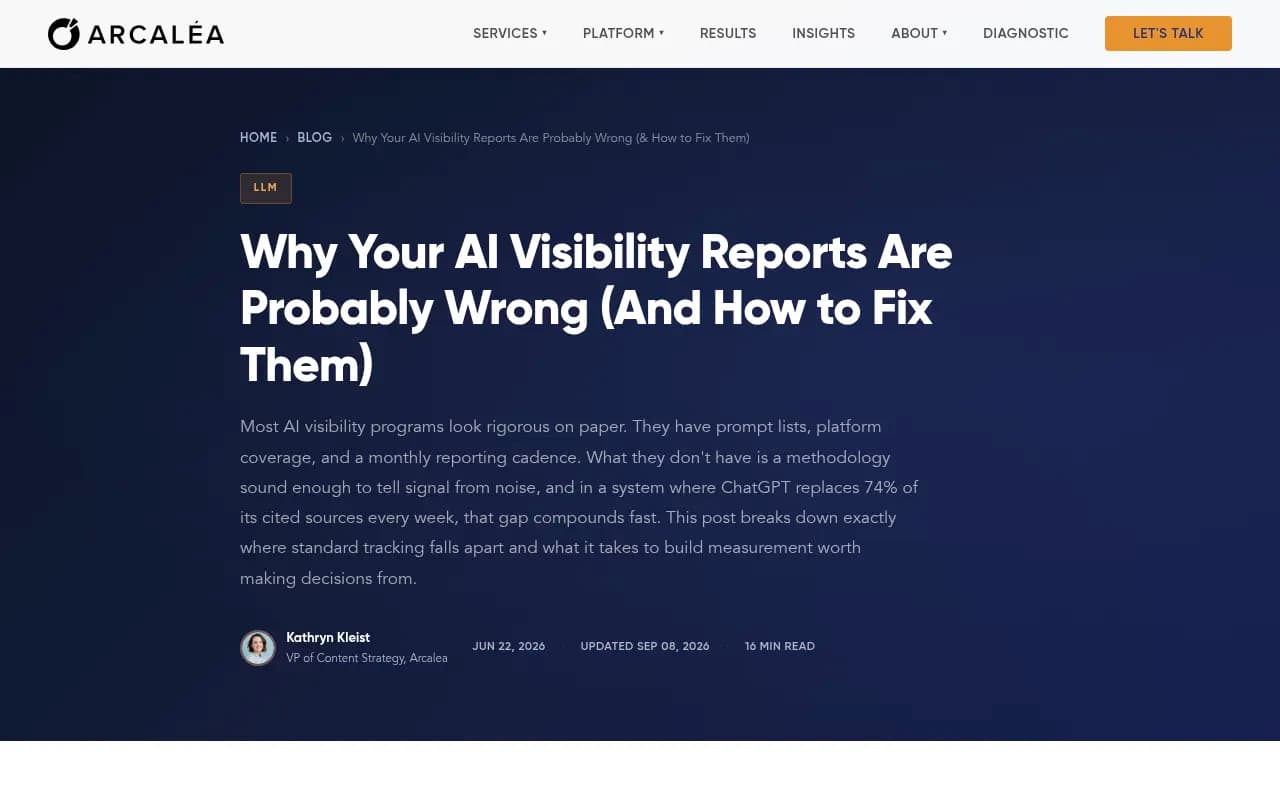
The practical consequence: a tool that runs each prompt once and reports a monthly number is describing noise as if it were signal. Arcalea's fix is sensible. Run multiple times per prompt, check weekly, separate platforms, and use persona-specific queries.
The tracking backlash is half right, though. Probabilistic is not the same as unmeasurable. It means you need more samples and trend lines, not a rejection of measurement.
Models disagree with each other
Search Engine Land's AI Visibility Index writeup reports that Google's AI Overviews and ChatGPT disagree on brand recommendations nearly two out of three times. I have not checked that number against the underlying data, but the direction is believable. Different engines pull from different sources and cite different numbers of them.
Promptwatch Data shows how different the engines are. In its average sources per response report, ChatGPT cites about 5 sources per web-search answer, Google AI Overviews about 10, and Perplexity almost exactly 10 every day. Microsoft Copilot swung from under 2 to nearly 17 within a few weeks. "Cited or not" means something different on each engine, so a single blended score is close to meaningless. Narrowly missing ChatGPT's shortlist can still land you on Google's longer list.
Behavior shifts overnight
Citation patterns move abruptly when platforms change. A few examples from Promptwatch's data:
- Average citations per ChatGPT response dropped across models around the GPT-5.3 rollout on March 4, 2026 (citation drop report).
- On August 8, 2026, ChatGPT started using the site: operator at scale, jumping from about 0.4% to about 17% of fan-out queries (site: operator report).
- reddit.com's share of ChatGPT citations fell from roughly 4% to 0.5% on August 14, 2026 (Reddit citations report).
If your dashboard shows a 12-point drop in week 33, check the model release notes before you panic or start a content sprint. A tool that cannot annotate these events will have you chasing drift.
A mention is not a recommendation
This is the one that matters most to buyers. Mighty and True makes the point well: showing up in an AI answer and being recommended by it are different outcomes, and most trackers fold them into one number. Their reading of a Foundation study on ClickUp is that the same prompt, run twice on the same day on the same model, returned different brand sets, and that ChatGPT and Claude did not agree on the shortlist.
A Medium piece on tracker comparisons puts the risk bluntly: a brand mentioned often with wrong information is not winning, it is a liability. A dashboard that only counts strings will call you visible in the same week an assistant quotes a wrong price to a prospect.
What an AI visibility platform adds
The useful way to think about it: a tracker is a thermometer, a platform is closer to a diagnostic workup plus a treatment plan. The gap shows up in four layers.
1. Why you are (or are not) visible
This needs data that does not come from prompting models at all. Server-side crawler logs show which AI bots visit which pages, what they read, and where they hit errors. If GPTBot gets a 403 on your pricing page, no amount of prompt tracking will tell you that. You will just see a low mention rate and guess.
Weekly site audits fill the same role on the technical side: blocked resources, missing pages in sitemaps, orphaned content.
2. Where AI finds your content
Citation analytics show which of your pages get cited, in what position, and which third-party pages shape the answer. This matters because of how many sources AI pulls. Promptwatch's unique domains per response data (Sep 28 to Oct 4, 2026) found 47.6% of ChatGPT responses cite 10 or more domains, and only 6% cite 3 or fewer. For organic prompts like "best project management software for small teams" that rises to 52.5% citing 10 or more. For brand-specific prompts like "is Asana good for small teams", the most common count is 5 domains, and those few sources (review sites, forums) heavily shape how ChatGPT describes you.
So you are almost always sharing the answer with others. Your job is to know who, and which third-party pages are doing the talking.
3. What it is worth
Mentions are not revenue. Visitor analytics that attribute real traffic and conversions from ChatGPT, Perplexity, Gemini, Claude and others to your site are what connect AI visibility to a budget conversation. Without it you are reporting a vanity metric to a CFO who will eventually ask what it is worth.
4. What to do next
This is where categories split most visibly. After you find a content gap, someone has to write the page, publish it, and check whether it gets crawled and cited. Some platforms generate a to-do list. A few go further and draft and publish content, then track the result.
There is a retrieval detail worth knowing here. Promptwatch's query fan-out data shows ChatGPT runs its own sub-queries rather than searching your prompt verbatim. Average fan-out query length fell from about 117 characters in December 2025 to about 53 characters from April 2026. Your page has to match a sub-query, not the user's prompt, which means a tracker's prompt list only approximates real retrieval. Headings that read like short search queries help.
Side-by-side comparison
| Capability | Prompt tracker | AI visibility platform |
|---|---|---|
| Mention rate and share of voice | Yes | Yes |
| Per-engine reporting | Sometimes | Yes, with engine-specific context |
| Sentiment and accuracy of the description | Basic label at best | Per-response, with trends |
| AI crawler logs (IP-verified) | No | Yes, in the stronger platforms |
| AI referral traffic and conversions | No | Yes |
| Citation analysis by page and source type | Limited | Yes |
| Content gap analysis | No | Yes |
| Content creation and publishing | No | Some platforms |
| Prioritized action list | Rarely | Yes |
| Model-change annotations | Rarely | Better platforms |
Who sits where
Be careful with any list like this, including mine. Categories blur, vendors ship features monthly, and I did not run a hands-on pricing and feature pass for every product. Treat it as a starting map and verify on each vendor's site.
| Category | Examples from our catalog | What to expect |
|---|---|---|
| Monitoring-focused trackers | [tool:otterly-ai], [tool:peec-ai], [tool:rankscale], [tool:llm-pulse], [tool:promptscout] | Prompt runs, mention rate, share of voice. Light on diagnosis and action |
| Enterprise monitoring suites | [tool:profound], [tool:scrunch], [tool:bluefish-ai], [tool:brandlight-ai] | Deeper analytics and reporting, typically higher price points |
| SEO suites adding AI tracking | [tool:semrush], [tool:ahrefs-brand-radar], [tool:seoclarity], [tool:conductor], [tool:brightedge] | Familiar workflow, but AI data tends to be a module bolted onto an SEO core |
| Tracking plus execution | [tool:promptwatch], [tool:gradial-geo], [tool:searchatlas-llm-visibility], [tool:airops] | Tries to close the loop from finding a gap to publishing a fix |
| Accuracy-focused | [tool:llmclicks], [tool:brandrank-ai] | Hallucination detection or recommendation share rather than raw mentions |
| Free diagnostics | [tool:amplitude-ai-visibility], [tool:hubspot-ai-search-grader], [tool:answergist] | One-off snapshots, good for a first look |
If you want to browse more options by category, the GEO software directory at bestgeosoftware.com and the AI rank tracker listings at ai-rank-tools.com are good places to keep scanning.
Where Promptwatch fits
Promptwatch is built as the second category: it pairs real-UI prompt tracking (with volumes, difficulty and query fan-outs) with IP-verified AI crawler logs, visitor analytics for AI referral traffic, citation tracking across Reddit, YouTube and LinkedIn, and weekly site audits. On the action side it has content gap analysis, an Action Board of prioritized tasks, and a Content Agent that can plan, write and publish to WordPress, Webflow or Framer, then track whether each page gets crawled and cited. Plans start at $95/month (Essential), with a free Explore tier limited to ChatGPT. Confirm current pricing at promptwatch.com/pricing.

Treehouse, the company behind Pararius, is a decent example of why the diagnostic layer matters: it fixed crawler access and published proprietary rental data, and AI search grew to about 25% of its organic conversions. That fix was found in crawler data, not in a mention count.
A checklist for evaluating any tool
The get3rd buyer's checklist makes a point I agree with: every serious platform sends prompts and counts mentions, so do not pay a premium for that part alone. Pay for the layers underneath. Questions worth asking on a demo:
- How many times is each prompt run, and how often? One run a month is astrology. Look for repeated runs and a weekly or daily cadence. Get3rd's data that brands with fewer than about 100 answers a day swung roughly twice as much as brands with 230 or more is a reminder that sample size matters.
- Does it test the real interface or only the API? User-facing answers and citations can differ from API output.
- Are engines reported separately? Given the source-count differences above, they should be.
- Can it separate mention, citation and recommendation? And does it show the actual language used about you, not just a score?
- Does it show crawler activity? Ask for IP-verified logs, not just robots.txt checks.
- Can it connect to traffic? AI referral visits and conversions, ideally per page.
- Does it annotate model changes? Otherwise you will misread drift as performance.
- What happens after the insight? A to-do list, content briefs, publishing, a re-check. Or nothing.
- Can you export the raw responses? If you cannot read what the model said, you cannot trust the number.
When you should not buy a platform yet
Some of the best advice in the research came from people skeptical of the whole category, and they have a point.
If your buyers are not using AI tools to shortlist vendors, a tracker is a premature spend. Enterprise security buyers and heavily regulated industries often still run RFPs and analyst calls. Ask sales how people first heard of you. If AI answers never come back, you have time.
If your source material is thin, a tracker will tell you repeatedly that you do not show up. You do not need software for that. You need pages that answer buyer questions clearly, presence in the review sites and comparison posts models read, and third-party coverage. Promptwatch's data points the same way: listicles, reviews and forums are often how a brand gets into the answer.
A free manual pass is a good start. Pick 20 buyer questions, run them in ChatGPT, Gemini and Perplexity three times each, paste the answers into a spreadsheet, and read the language. It is slow, but it forces you to see what the models say about you instead of a number. When that becomes tedious, you are ready for tooling. If you want a hand with the strategy behind it, 1001 SEO Media runs GEO and technical SEO work for teams in that position.
A practical setup that avoids the common traps
- Define test prompts first. Cover organic category queries, brand queries and competitor comparisons. Include a few personas. These matter more than whichever tool you buy.
- Track per engine, trend over time. Weekly or daily runs, with model releases annotated. Treat Copilot on monthly trends, since its source counts swing.
- Read the qualitative column. Is the description accurate? Is pricing right? Which source is the model leaning on?
- Check the technical foundation. Crawler access, site health, pages that rank in Google but never get cited.
- Tie it to traffic. Count AI referral visits and conversions, not just appearances.
- Act, then re-measure. Publish or refresh, then see whether the page gets crawled, cited and clicked.
The better question
"Was my brand mentioned?" is where you start. Better ones: was it recommended, accurately, by which engines, from which sources, and did it send anyone to the site? What is the next page I should publish or fix? A tool that cannot help with those is a thermometer. Fine, sometimes. Just do not mistake it for the treatment.