TrueRanker Review 2026
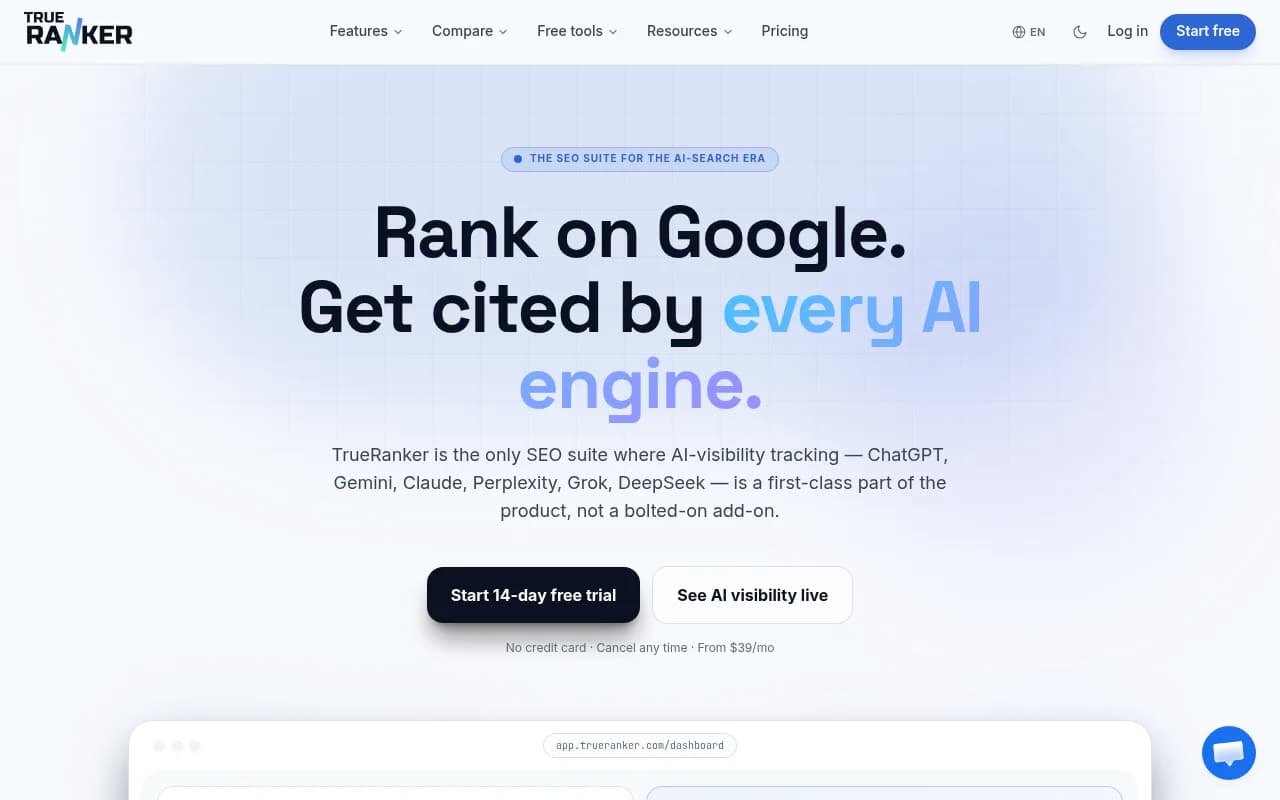
Tracks Google rankings alongside brand citations in ChatGPT, Gemini, Claude, Perplexity, Grok and DeepSeek in one suite.
Key takeaways
- TrueRanker bundles Google rank tracking, backlinks, audits, and AI citation monitoring (ChatGPT, Gemini, Claude, Perplexity, Grok, DeepSeek, Google AI Overviews) at a genuinely low price: from $39/mo billed yearly, with AI visibility on every paid plan rather than gated behind an upsell.
- The AI Visibility Score is well-constructed (mentions vs. citations are tracked separately, plus sentiment and share of voice), but it's monitoring-only. There's no content gap analysis, no AI crawler logs, no AI traffic attribution, no Reddit or YouTube citation tracking, and no content generation or CMS publishing like Promptwatch offers.
- Prompt limits are tight: 50 AI prompts on Starter, 100 on Pro, 200 on Agency. Agencies running serious AI visibility programs will hit that ceiling fast.
- A lifetime deal controversy on AppSumo, with buyers reporting lost access as recently as early 2026, is worth knowing about before committing long-term.
- Best fit: solo consultants and small agencies who want one affordable tool for classic SEO plus a basic read on AI visibility, and don't need deep GEO workflows.
What TrueRanker does
TrueRanker started life in 2019 as a rank tracker built by an SEO consultant in Spain for his own agency work, and it still carries that DNA. The core is a solid keyword rank tracker: daily updates, desktop and mobile, local-to-global targeting, SERP feature tracking, and cannibalization detection. Around it sit the usual suite modules: backlink monitoring with lost-link alerts, competitor research, an on-page SEO audit tool with side-by-side competitor comparison, and white-label reporting with a Looker Studio connector.
The interesting part is what they've bolted on top. The AI Visibility Tracker runs your custom prompts across ChatGPT, Gemini, Claude, Perplexity, Grok, and DeepSeek, plus Google AI Overviews, and reports where your brand gets named or cited. I like that they distinguish mentions (brand named in the answer) from citations (your site linked as a source). Most tools blur those together, and the difference matters: being talked about and being the source are two different wins.
The composite 0–100 AI Visibility Score is built from five weighted parts: mention rate (30%), citation rate (20%), sentiment (20%), share of voice (20%), and LLM coverage (10%). That's a more thoughtful formula than a simple
Tags:
Frequently asked questions
How much does TrueRanker cost?
Which AI engines does TrueRanker track?
Is TrueRanker a good AI visibility tool?
Does TrueRanker have a free trial?
Who should use TrueRanker?
Similar and alternative tools to TrueRanker