Advanced Web Ranking Review 2026
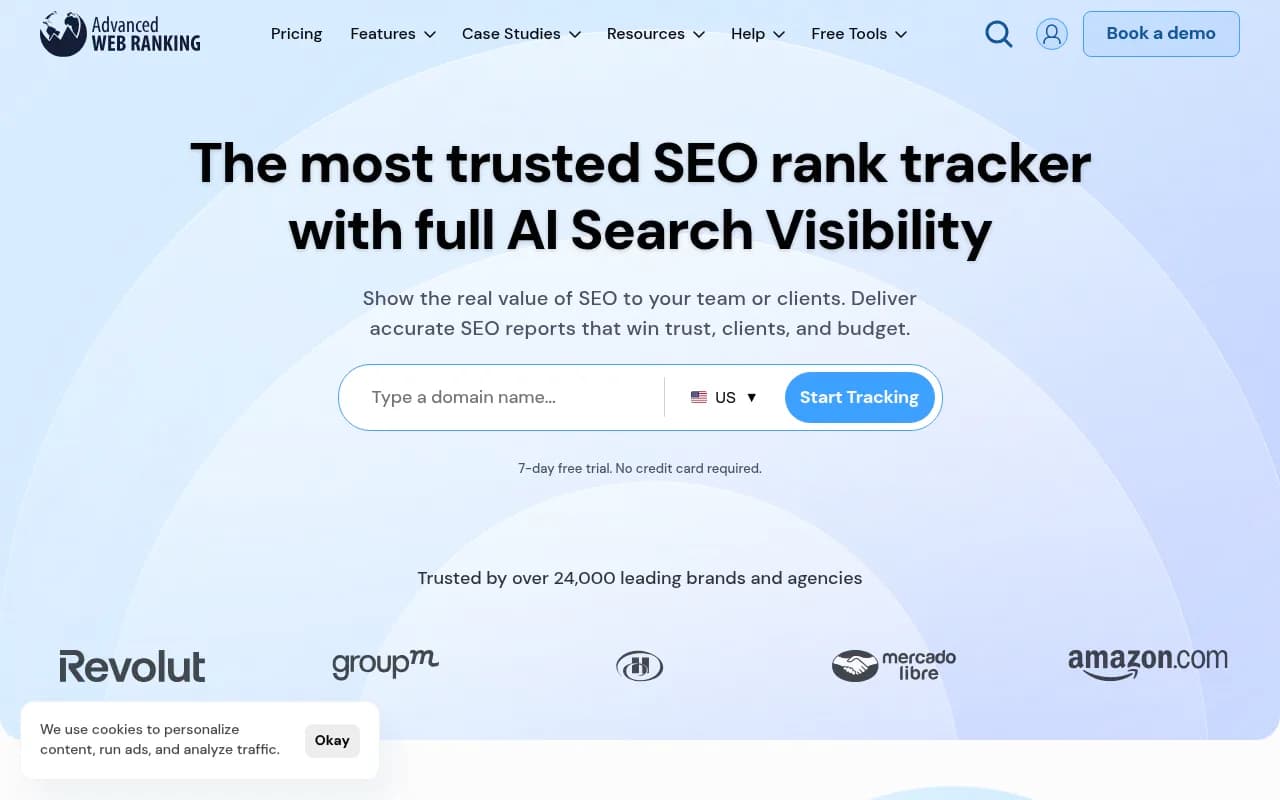
Advanced Web Ranking (AWR) is an enterprise-grade rank tracking and SEO reporting platform trusted by 24,000+ brands and agencies. Track rankings across Google, YouTube, Amazon, and AI search engines like ChatGPT, Perplexity, and Gemini. Features unlimited projects, white-label reporting, SERP pixel
Summary
- Proven accuracy: 20+ years of SERP tracking experience with pixel-level precision and exclusive CTR data that most rank trackers lack
- AI search visibility: Monitors Google AI Overviews, AI Mode, ChatGPT, Perplexity, Gemini, and Claude across 170+ countries -- but lacks content generation, crawler logs, and traffic attribution that Promptwatch offers
- Agency-focused pricing: Unlimited projects, users, and reports at every tier -- no per-seat or per-project fees
- Best for: SEO agencies managing 10+ clients, in-house teams tracking complex multi-market campaigns, and enterprise brands needing white-label reporting
- Limitations: Monitoring-only platform with no content optimization tools, no Reddit/YouTube tracking, and no AI traffic attribution

Advanced Web Ranking has been around since 2002, making it one of the oldest players in the rank tracking space. The company is based in Romania and serves over 24,000 customers including Revolut, Hilton, Amazon, and Mercado Libre. AWR built its reputation on SERP accuracy -- they track rankings down to the pixel and provide CTR data that most competitors don't offer. In 2024-2025, they added AI search visibility tracking to monitor how brands appear in ChatGPT, Perplexity, Gemini, Claude, and Google's AI Overviews.
The platform is designed for agencies and enterprise teams that need to track hundreds or thousands of keywords across multiple clients, locations, and search engines. Unlike tools that charge per project or per user, AWR's pricing model gives you unlimited projects, unlimited users, and unlimited reports at every tier. This makes it particularly cost-effective for agencies that are growing their client roster.
Rank Tracking (Core Feature)
AWR's rank tracker monitors rankings on Google, Bing, YouTube, Amazon, and country-specific engines like Baidu (China), Naver (South Korea), and Yandex (Russia). You can track rankings by device (desktop, mobile, tablet), location (country, state, city, or custom lat/long coordinates), and language. Updates run daily, weekly, or on-demand depending on your plan tier.
What sets AWR apart is pixel-level SERP tracking. Most rank trackers just tell you "you're position 3" -- AWR tells you how many pixels down the page your result appears, accounting for SERP features like featured snippets, People Also Ask boxes, local packs, and image carousels. This matters because a position 3 result below a massive featured snippet gets far less traffic than a position 3 result at the top of a clean SERP. AWR calculates a Visibility Percent metric that factors in pixel position and SERP features to give you a more accurate picture of how visible you actually are.
The platform also provides exclusive CTR data based on their own research and industry studies. You can see estimated click-through rates for each position, adjusted for SERP features and device type. This feeds into their traffic estimation and forecasting features.
You can track up to 50 competitors per project at no extra cost. Competitor data includes their rankings, visibility scores, market share, and which SERP features they're winning. The competitor tracking is automatic -- AWR scrapes the top 100 results for each keyword and identifies the domains that appear most frequently.
AI Search Visibility
AWR's AI visibility module tracks how your brand appears in Google AI Overviews, Google AI Mode, ChatGPT, Perplexity, Gemini, and Claude. You can monitor AI citations (when your page is used as a source), brand mentions (when your brand is named without a citation), and AIO Citation Rank (your position in the list of cited sources). The platform tracks AI visibility across 170+ countries and supports custom topics -- you define a set of prompts or queries, and AWR monitors how AI engines respond.
You can see which topics AI associates with your brand, which competitor domains AI recommends, and your share of AI visibility compared to competitors. The AI visibility data integrates with the rest of AWR's reporting, so you can build dashboards that show both traditional SEO rankings and AI search performance side by side.
However, this is a monitoring-only feature. AWR shows you where you appear (or don't appear) in AI search results, but it doesn't help you fix the gaps. There's no content gap analysis to show which prompts competitors are visible for but you're not. There's no AI content generation to help you create articles that rank in AI search. There are no AI crawler logs to see which pages ChatGPT or Perplexity are reading on your site. And there's no AI traffic attribution to connect AI visibility to actual website visits. For those capabilities, you'd need a platform like Promptwatch, which is built around the action loop of finding gaps, generating optimized content, and tracking results.
SEO Reporting and White-Label Dashboards
AWR's reporting engine is one of its strongest features. You can build custom reports with drag-and-drop widgets, schedule them to send automatically by email, or share a permalink that updates in real-time as new ranking data comes in. Reports are fully white-labeled -- you can add your agency logo, brand colors, and custom domain (e.g. reports.youragency.com).
The platform includes 50+ pre-built report templates for common use cases: client onboarding, monthly performance summaries, competitor analysis, keyword gap reports, and more. You can export reports as PDF, Excel, CSV, or HTML. There's also a Google Looker Studio connector that lets you pull AWR data into custom dashboards alongside Google Analytics, Google Search Console, and other data sources.
Integrations include Google Analytics (GA4 and Universal Analytics), Google Search Console, Bing Webmaster Tools, and Adobe Analytics. You can overlay traffic data, impressions, and clicks from these platforms onto your ranking charts to see how ranking changes correlate with traffic changes. The API is well-documented and supports read/write operations -- you can pull ranking data, create projects, add keywords, and trigger updates programmatically.
SEO Forecasting
The forecasting module estimates the traffic and revenue impact of ranking improvements. You input your current rankings, target rankings, and conversion data (traffic value per visit or revenue per conversion), and AWR calculates the potential upside. This is particularly useful for pitching new clients or justifying SEO budget to stakeholders. You can show "if we move from position 5 to position 2 for these 20 keywords, we'll generate an additional $15,000/month in traffic value."
The forecasts are based on AWR's CTR data and your historical traffic patterns (if you've connected Google Analytics or Search Console). You can also compare the cost of ranking organically vs. buying the same traffic through Google Ads, which helps make the ROI case for SEO.
Market Share and Competitor Analysis
AWR calculates organic market share by estimating the total search volume for your keyword set, then determining what percentage of clicks each domain captures based on their rankings and CTR. You can see your market share vs. competitors over time, broken down by keyword group, location, or device. This is more useful than just tracking average position because it accounts for search volume -- a #1 ranking for a 10-search/month keyword matters less than a #3 ranking for a 10,000-search/month keyword.
The Share of Voice metric shows what percentage of total visibility (across all tracked keywords) belongs to each domain. The Estimated Visits Distribution chart shows how many clicks each competitor is likely getting from organic search. These metrics are particularly valuable for enterprise brands and agencies that need to report on competitive positioning, not just their own performance.
Keyword Research and Difficulty Scoring
AWR includes a basic keyword research tool that pulls suggestions from Google Autocomplete, related searches, and "People Also Ask" boxes. You can see search volume estimates (sourced from Google Keyword Planner), CPC data, and Keyword Difficulty scores. The difficulty score is calculated based on the domain authority and page authority of the top 10 results, plus the number of backlinks and content length. It's a 0-100 scale where higher numbers mean harder to rank.
The keyword research tool is functional but not as robust as dedicated tools like Ahrefs or Semrush. It's best used for expanding an existing keyword list or finding low-hanging fruit, not for comprehensive keyword discovery.
Local Rank Tracking
For local SEO, AWR supports city-level and custom lat/long tracking. You can track rankings for "dentist near me" type queries from specific neighborhoods or zip codes. The platform also tracks Google Local Pack rankings (the map results that appear for local queries) and shows which businesses are appearing in the pack for each keyword. This is critical for multi-location businesses or agencies managing local clients.
Search Engine Coverage
AWR tracks over 4,000 search engines and variants, including:
- Google (all countries, mobile, desktop, tablet)
- Bing (all countries)
- YouTube (video search)
- Amazon (product search)
- Baidu (China)
- Yandex (Russia)
- Naver (South Korea)
- Yahoo (all countries)
- DuckDuckGo
- Ecosia
You can also set up custom search engines if you need to track a niche or regional engine that's not in the default list.
Who Is It For
AWR is built for three main audiences:
SEO agencies managing 10+ clients: The unlimited projects/users/reports model makes AWR extremely cost-effective at scale. A 10-person agency tracking 50 clients pays the same as a solo freelancer tracking 2 clients. The white-label reporting and client access controls (you can give clients read-only access to their own projects) are agency-focused features. Agencies like RBBi, Search Influence, and Online Toro use AWR to manage hundreds of client campaigns.
In-house SEO teams at mid-to-large companies: If you're tracking 500+ keywords across multiple countries, devices, and competitors, AWR's depth and accuracy matter. The SERP pixel tracking and market share analysis are particularly valuable for enterprise teams that need to report on competitive positioning to executives. Companies like Revolut, Hilton, and Mercado Libre use AWR for this.
Freelance SEOs and consultants: The Pro plan ($99/mo) is affordable for solo practitioners who need professional-grade tracking and reporting. The white-label reports help freelancers look more established when pitching or reporting to clients.
AWR is not ideal for beginners or small businesses that just need basic rank tracking. The interface has a learning curve, and many of the advanced features (pixel tracking, market share, forecasting) require some SEO knowledge to interpret. If you're a local business owner tracking 20 keywords for your own site, a simpler tool like SERPWatcher or Mangools would be easier to use.
Integrations and Ecosystem
AWR integrates with:
- Google Analytics (GA4 and Universal Analytics): Overlay traffic data on ranking charts
- Google Search Console: Import impressions, clicks, and CTR data
- Bing Webmaster Tools: Import Bing-specific metrics
- Adobe Analytics: For enterprise teams using Adobe's analytics suite
- Google Looker Studio: Build custom dashboards with AWR data
- Zapier: Trigger actions in other tools when rankings change
- API: Full read/write access to all AWR data and functions
The API is particularly robust -- it's RESTful, well-documented, and supports webhooks for real-time updates. Agencies often use the API to build custom dashboards or integrate AWR data into their own client portals.
There's a desktop app (Windows and Mac) in addition to the web app. The desktop app offers faster bulk operations (like adding 1,000 keywords at once) and offline access to reports. Some power users prefer the desktop app for day-to-day work, then use the web app for sharing reports with clients.
Pricing and Value
AWR uses a credit-based pricing model. Each plan includes a certain number of "ranking units" per month, and different types of ranking checks consume different amounts of units. A basic Google desktop ranking check = 1 unit. A mobile ranking check = 1 unit. A local ranking check (city-level) = 2 units. An on-demand ranking check = 2x the normal cost.
The tiers are:
- Pro: $99/mo for 7,000 units (roughly 7,000 daily keyword checks or 3,500 mobile checks). Daily updates. Unlimited projects, users, reports.
- Agency: $199/mo for 14,500 units. Daily updates. Everything in Pro.
- Enterprise: $499/mo for 35,000 units. Hourly updates (instead of daily). Priority support. Everything in Agency.
- Custom: $700+/mo for 50,000+ units. Custom update frequency. Dedicated account manager.
All plans include unlimited projects, unlimited users, unlimited competitors (up to 50 per project), unlimited reports, and all features (rank tracking, AI visibility, forecasting, reporting, API access). The only differences between tiers are the number of ranking units and the update frequency.
There's a 7-day free trial (no credit card required) that gives you access to the Pro plan. Annual billing gets you 2 months free (16% discount).
Value comparison: AWR is mid-priced for agencies but expensive for individuals. A solo freelancer tracking 200 keywords daily would pay $99/mo for AWR vs. $49/mo for SERPWatcher or $29/mo for Nightwatch. But an agency tracking 5,000 keywords across 20 clients would pay $199/mo for AWR vs. $400+/mo for Ahrefs or Semrush (which charge per project or per user). The unlimited projects/users model makes AWR more cost-effective at scale.
Strengths
Pixel-level SERP tracking: AWR is one of the few rank trackers that measures how far down the page your result appears, accounting for SERP features. This gives you a more accurate picture of visibility than just position number.
Exclusive CTR data: The platform provides CTR estimates based on their own research, adjusted for SERP features and device type. Most competitors rely on generic CTR curves that don't account for modern SERPs.
Unlimited projects/users/reports: The pricing model is extremely agency-friendly. You can scale your client roster without paying more per project or per seat.
White-label reporting: The reporting engine is powerful and fully customizable. You can build professional client reports in minutes.
Multi-engine support: AWR tracks YouTube, Amazon, Baidu, Naver, and other engines that most rank trackers ignore. This is valuable for e-commerce brands and international SEO.
20+ years of reliability: AWR has been around since 2002 and has a reputation for accurate, consistent data. They've survived multiple Google algorithm changes and SERP redesigns.
Limitations
Compared to Promptwatch, AWR's AI visibility tracking is monitoring-only. It lacks:
- Content gap analysis: No way to see which prompts competitors are visible for but you're not, or what content is missing from your site
- AI content generation: No built-in writing agent to create articles optimized for AI search
- AI crawler logs: No visibility into which pages ChatGPT, Perplexity, or Claude are actually reading on your site
- AI traffic attribution: No way to connect AI visibility to actual website visits or revenue
- Reddit and YouTube tracking: No monitoring of discussions or videos that influence AI recommendations
- ChatGPT Shopping tracking: No visibility into product recommendations in ChatGPT's shopping features
- Prompt volume and difficulty: No data on how often each prompt is used or how hard it is to rank for
AWR shows you the scoreboard but doesn't help you improve your score. If you want to actually optimize for AI search (not just monitor it), you need a platform like Promptwatch that closes the loop from gap analysis to content creation to results tracking.
Other limitations:
- Keyword research is basic: The keyword tool is functional but not as deep as Ahrefs, Semrush, or dedicated keyword research tools. You'll likely need a separate tool for comprehensive keyword discovery.
- Steep learning curve: The interface is powerful but not intuitive. New users often need to watch tutorials or read documentation to understand how to use advanced features like pixel tracking or market share analysis.
- No content optimization: AWR is purely a tracking and reporting tool. It doesn't help you optimize on-page content, build links, or fix technical SEO issues. You'll need separate tools for those tasks.
Bottom Line
Advanced Web Ranking is a solid choice for SEO agencies and enterprise teams that need accurate, reliable rank tracking with professional reporting. The unlimited projects/users/reports model makes it cost-effective at scale, and the pixel-level SERP tracking provides insights that most competitors miss. The AI visibility tracking is a nice addition, but it's monitoring-only -- if you want to actually optimize for AI search, Promptwatch is the stronger choice with its content gap analysis, AI writing agent, crawler logs, and traffic attribution. AWR is best for teams that already have a content and optimization workflow in place and just need a rock-solid rank tracker to measure results.
Tags:
Frequently asked questions
What is Advanced Web Ranking (AWR)?
How much does Advanced Web Ranking cost?
Does Advanced Web Ranking offer a free trial?
What search engines does Advanced Web Ranking track?
Does Advanced Web Ranking track AI search visibility?
Who is Advanced Web Ranking best for?
Does Advanced Web Ranking support white-label reporting?
What are the limitations of Advanced Web Ranking?
How accurate is Advanced Web Ranking's rank tracking?
How does Advanced Web Ranking compare to other rank tracking tools?
Does Advanced Web Ranking charge per user or per project?
Where is Advanced Web Ranking based and how long has it been around?
Similar and alternative tools to Advanced Web Ranking