Relevance AI Review 2026
Relevance AI is an AI workforce platform that helps sales, marketing, and customer success teams automate repetitive GTM work with autonomous AI agents. Build multi-agent teams that handle everything from BDR outreach to customer support—no code required, integrated with your existing stack.
Summary
Relevance AI is an enterprise-grade AI agent platform designed specifically for go-to-market teams. Unlike generic AI assistants or chatbots, this is a full workforce automation platform where you build specialized AI agents that execute sales, marketing, and customer success playbooks autonomously. The platform is used by major companies including Canva, Autodesk, Databricks, and KPMG to scale GTM results without scaling headcount. It's particularly strong for teams drowning in repetitive research, follow-ups, lead qualification, and data entry work. The no-code builder means your sales ops or RevOps team can build and deploy agents without engineering resources. But here's the catch: this is built for teams already running structured GTM motions. If you're a startup still figuring out your playbook, you'll get more value from simpler tools. And while the platform promises autonomous agents, most teams start with copilot-style workflows where humans review outputs before agents act independently.
What Relevance AI actually does
Relevance AI lets you build AI agents that automate specific GTM workflows end-to-end. Not just chatbots that answer questions, but agents that take actions across your entire tech stack. A BDR agent might monitor your CRM for new leads, research each company using Apollo and LinkedIn, draft personalized outreach emails, send them via Gmail, log everything in Salesforce, and book meetings on your calendar. All without human intervention. The platform calls this progression from "Assisted" (ad-hoc tasks via chat) to "Copilot" (agents execute playbooks but humans review) to "Autopilot" (agents act autonomously based on pipeline signals) to "Self-Driving" (agents learn and adapt). Most customers are currently in the Copilot to Autopilot range. The company was founded in Australia and raised $15M in funding. It's positioned as the AI workforce layer for GTM teams, competing with point solutions like Clay (enrichment), Instantly (outbound), and Qualified (inbound) by offering a unified platform where you build custom agents for any workflow.
Core capabilities in detail
Multi-agent workforces: You don't build one mega-agent. You build specialized agents that work together like a team. A typical inbound workflow might have a Lead Router agent that monitors form submissions, an Enrichment Agent that gathers company data from Apollo and ZoomInfo, and an Outbound SDR agent that drafts and sends personalized emails. Agents hand off work to each other based on triggers and conditions you define. This mirrors how actual GTM teams operate—specialists handling specific parts of the process. You can build workforces for inbound qualification, outbound prospecting, account research, customer onboarding, expansion plays, churn prevention, and more. The platform includes pre-built templates for common workflows (BDR agent, research agent, inbound qualification agent, customer support agent) that you customize to your process.
No-code agent builder: The builder uses a visual workflow interface similar to Zapier or n8n. You define triggers (new lead in HubSpot, deal stage change, Slack message), add steps (search Apollo, scrape LinkedIn, call OpenAI API, send email), and set conditions (if company size > 50, route to enterprise team). Each step can use different AI models—GPT-4 for reasoning, Claude for writing, Gemini for analysis. You're not locked into one LLM. The builder includes a custom tool creator where you can build reusable skills for your agents ("research company on LinkedIn", "check if domain uses our competitor", "draft case study outline"). These tools become part of your agent's toolkit. No Python or JavaScript required, though you can add custom code if needed.
1000+ integrations: Agents connect to your existing stack via native integrations and Zapier. Core GTM tools covered: Salesforce, HubSpot, Pipedrive (CRM), Apollo, ZoomInfo, BuiltWith (data enrichment), Gmail, Outlook, SendGrid (email), Slack, Microsoft Teams (communication), Google Calendar (scheduling), Gong, Chorus (conversation intelligence), Salesloft, Outreach (sales engagement), Intercom, Zendesk, Freshdesk (support), Notion, Confluence (knowledge bases), Airtable, Google Sheets (data), LinkedIn, Twitter/X (social). The platform also connects to data warehouses like Snowflake and Databricks for pulling customer data. Each integration lets agents read and write data—not just pull information but take actions like updating CRM fields, sending emails, posting to Slack, booking meetings.
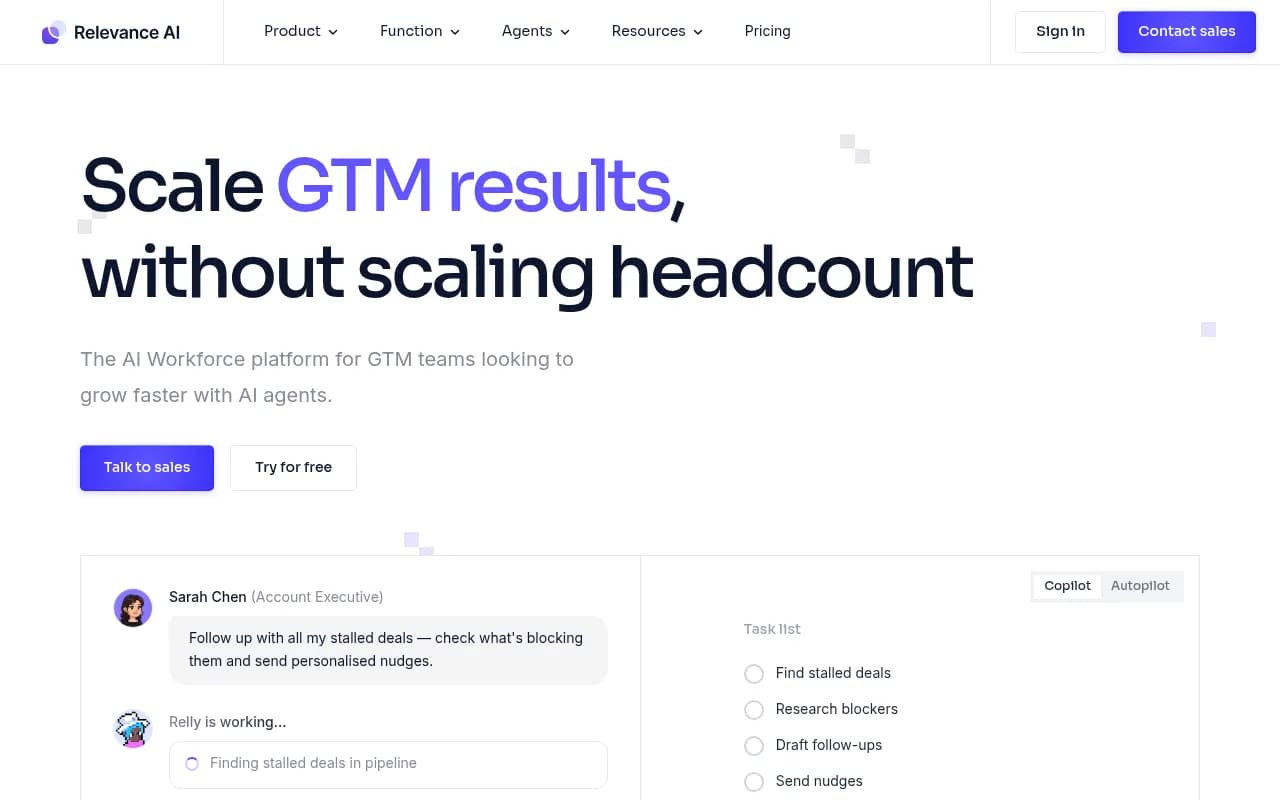
Relly chat interface: Every user gets "Relly", an AI assistant they can delegate to via chat. This is the entry point for most teams. Sales reps ask Relly to "research my top 10 accounts and draft personalized intros" or "follow up with all my stalled deals". Relly executes the task by calling the appropriate agents and tools. It's like having a junior SDR or sales ops person you can message anytime. The chat interface shows what Relly is doing in real-time ("Finding stalled deals in pipeline", "Researching blockers", "Drafting follow-ups"). This transparency builds trust—you see the agent's work, not just the output. Relly can @mention specific agents you've built ("@Enrichment Agent, get technographics for these 50 accounts").
Enterprise security and compliance: SOC 2 Type II certified and GDPR compliant. Data residency options for multi-region deployment (your data stays in your region). SSO via Okta, Azure AD, Google Workspace with role-based access control. Version control on every agent—full history of changes with ability to roll back. Audit logs for every action agents take. This matters because agents are accessing sensitive customer data and taking actions in production systems. The platform is built for enterprise buyers who need compliance documentation and security reviews. Smaller startups might find the security features overkill, but for companies like Canva and Autodesk, this is table stakes.
Agent evaluation and monitoring: Built-in metrics to track agent performance. How many leads qualified, emails sent, meetings booked, tickets resolved. You can set up custom evals to measure quality—are the emails personalized enough, is the research accurate, are responses on-brand. The platform includes a monitoring dashboard showing agent activity, errors, and escalations. When an agent encounters something it can't handle (ambiguous lead data, angry customer email), it escalates to a human. You define escalation rules ("if sentiment is negative, notify CSM in Slack"). This prevents agents from making mistakes in high-stakes situations. The monitoring is less sophisticated than dedicated observability tools like LangSmith or Braintrust, but it's sufficient for most GTM use cases.
Who this is built for
Relevance AI targets mid-market to enterprise B2B companies with established GTM motions. Think 50-5000 employees, $10M-$500M revenue, selling to other businesses. The ideal customer has a RevOps or sales ops team that's already built playbooks and processes—they're just drowning in manual execution. Specific personas: Sales leaders at companies with 10+ reps who want to scale outreach without hiring more SDRs. RevOps teams managing complex lead routing, enrichment, and scoring workflows across multiple tools. Customer success teams handling hundreds of accounts where proactive outreach and health monitoring is manual. Marketing ops running ABM campaigns that require personalized content at scale. Agencies managing GTM for multiple clients who need to automate repetitive client work. The platform is overkill for early-stage startups (under 20 employees) still figuring out product-market fit. You need repeatable processes to automate. It's also not ideal for companies with highly unstructured sales motions (complex enterprise deals with 12-month cycles and heavy customization). The agents work best when the playbook is clear.
What you won't find here
Relevance AI is not a CRM, not a data warehouse, not a sales engagement platform. It's the automation layer on top of those tools. You still need Salesforce or HubSpot, you still need Apollo or ZoomInfo, you still need Gmail or Outlook. The platform doesn't replace your stack—it connects it. Also, this isn't a plug-and-play solution. You're building custom agents, which means upfront work. Expect 2-4 weeks to build and test your first production agent. The learning curve is gentler than coding from scratch, but steeper than turning on a SaaS tool. The platform also doesn't include its own AI models—you bring your own OpenAI, Anthropic, or Google API keys and pay for model usage separately (though they're changing this with a new pricing model in 2025). Finally, the agents are only as good as your playbooks. If your sales process is inconsistent or your data is messy, the agents will amplify those problems.
Pricing breakdown
As of September 2025, Relevance AI is changing its pricing model. Previously it was credit-based (one pool for everything). Now it's split into Actions (what agents do—send email, update CRM, search database) and Vendor Credits (AI model costs—OpenAI, Anthropic API calls). The Free plan includes 200 actions per month and lets you explore the platform and chat with pre-built agents. The Team plan is for teams building agents to handle large workloads—pricing not publicly listed, contact sales. Enterprise plans include custom action limits, dedicated support, SSO, data residency, and SLA guarantees. Based on customer case studies, mid-market companies (50-200 employees) typically spend $500-$2000/month depending on agent volume. Enterprise deals (1000+ employees) are custom contracts. The new pricing model is more transparent than the old credit system, but you'll need to estimate your action volume to predict costs. A BDR agent sending 100 emails per day would consume roughly 3000 actions per month (email send + CRM update + enrichment lookup per lead).
Strengths
Built specifically for GTM teams: Unlike generic AI agent platforms (LangChain, AutoGPT, Crew AI), this is purpose-built for sales, marketing, and customer success workflows. The templates, integrations, and UI reflect deep GTM expertise. No-code but powerful: You can build sophisticated multi-agent workflows without writing code, but you're not limited—custom tools and code steps available for advanced users. Enterprise-ready: SOC 2, GDPR, SSO, RBAC, data residency. This passes procurement at large companies. Multi-model flexibility: Use the best LLM for each task instead of being locked into one vendor. Swap models without rebuilding agents. Strong customer base: Canva, Autodesk, Databricks, KPMG are real customers with public case studies. This isn't vaporware.
Limitations
Requires structured processes: If your GTM motion is ad-hoc or constantly changing, you'll struggle. The platform works best when you have repeatable playbooks to automate. Upfront build time: This isn't a plug-and-play tool. Expect weeks to build, test, and refine agents. Faster than coding from scratch, but slower than turning on a SaaS feature. Pricing complexity: The new action-based pricing is clearer than credits, but estimating costs requires understanding your workflow volume. Easy to underestimate. Limited pre-built agents: The template library is growing but still small compared to the universe of possible GTM workflows. You'll be building custom agents for most use cases. Agent quality depends on data quality: If your CRM data is messy or your enrichment sources are incomplete, agents will produce mediocre outputs. Garbage in, garbage out. Not a replacement for strategy: Agents automate execution, not decision-making. You still need humans to define ICP, messaging, and GTM strategy.
How it compares to alternatives
Versus Clay: Clay is an enrichment and data transformation tool with AI features. It's great for building lead lists and enriching data, but it doesn't execute full workflows (send emails, book meetings, update CRM autonomously). Relevance AI is broader—agents can use Clay as a data source but also take actions across your entire stack. Versus Instantly.ai or Smartlead: These are email outreach tools with AI personalization. They handle one part of the outbound workflow (sending emails). Relevance AI can build an agent that does research, writes emails, sends them, tracks responses, updates CRM, and books meetings—the full BDR workflow. Versus Qualified or Drift: These are inbound qualification and chatbot tools. Relevance AI can build similar inbound agents but also handle outbound, customer success, and support workflows in one platform. Versus LangChain or AutoGPT: These are developer frameworks for building AI agents. Relevance AI is the no-code version—your RevOps team can build agents without engineering. Trade-off: less flexibility than code, but 10x faster to deploy. Versus Zapier with AI: Zapier connects apps and has AI features, but it's not built for complex multi-step agent workflows. Relevance AI's agent builder is more sophisticated for GTM use cases (conditional logic, multi-agent handoffs, escalations).
Bottom line
Relevance AI is the strongest option for mid-market to enterprise GTM teams that want to automate repetitive sales, marketing, and customer success work without hiring engineers. If you have clear playbooks, a RevOps or sales ops team, and a tech stack you want to connect, this platform can genuinely scale your results without scaling headcount. The no-code builder and GTM-specific templates make it accessible to non-technical teams, while the enterprise security and multi-model flexibility satisfy procurement and IT requirements. But this is not a quick win. You're building custom agents, which requires upfront investment in defining workflows, testing outputs, and refining prompts. And the platform is overkill for early-stage startups or companies with unstructured sales motions. Best use case in one sentence: B2B companies with 50-500 employees and established GTM processes who want to automate the repetitive research, follow-up, and data entry work that buries their sales and CS teams.
Similar and alternative tools to Relevance AI