Key takeaways
- Promptwatch and MarketMuse are solving fundamentally different problems. Promptwatch is built for AI search visibility (ChatGPT, Claude, Perplexity, Gemini). MarketMuse is built for traditional Google SEO content strategy.
- If AI search is your priority in 2026, MarketMuse has nothing for you -- it has zero AI model monitoring, no citation tracking, no crawler logs.
- Promptwatch starts cheaper ($99/mo vs $150/mo) and includes content generation on all paid plans. MarketMuse's content briefs are more detailed for traditional SEO workflows.
- MarketMuse's topical authority modeling and personalized difficulty scores are genuinely impressive for Google-focused content teams. Promptwatch doesn't try to replicate that.
- For teams that want to cover both channels, these tools complement each other rather than compete. They barely overlap.
- If you're choosing one tool for 2026 and AI search is part of your strategy, Promptwatch is the clear pick. If you're purely focused on Google rankings and content depth, MarketMuse earns its price.
Overview
Promptwatch

Promptwatch is an AI search visibility platform used by 8,000+ brands and agencies. The core idea is simple: as more people use ChatGPT, Perplexity, and Claude to find products and services, your brand needs to show up in those responses -- not just on Google. Promptwatch tracks when and how AI models mention your brand, shows you which prompts you're missing, and then helps you create content specifically designed to get cited by those models.
It monitors 10 AI platforms: ChatGPT, Claude, Gemini, Perplexity, Google AI Overviews, Google AI Mode, Grok, DeepSeek, Meta/Llama, Copilot, and Mistral. Beyond tracking, it logs actual AI crawler activity on your site, analyzes 880M+ citations to understand what content gets recommended, and includes a built-in AI writing agent that generates articles grounded in that citation data.
MarketMuse
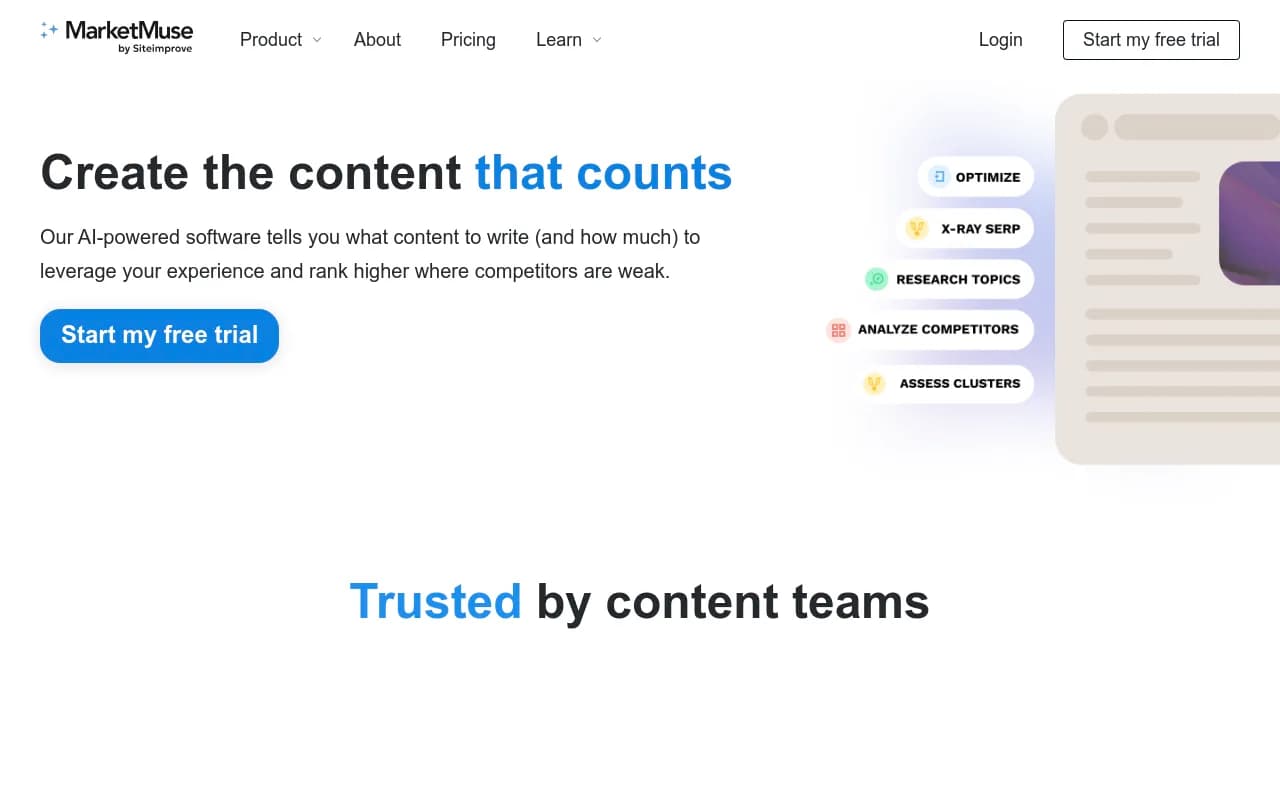
MarketMuse is a content intelligence platform built around a single insight: most content teams don't know what they should be writing. Its patented AI analyzes your entire content inventory, maps your existing topical authority, finds gaps competitors have missed, and generates personalized content plans. The output is a prioritized list of what to create, what to update, and what to skip -- with difficulty scores calibrated to your specific site, not generic industry averages.
It's a tool for SEO teams and content strategists who want to make smarter decisions about Google rankings. The content briefs are detailed, the topic modeling is sophisticated, and the competitive gap analysis is genuinely useful for traditional search. But it was built for a world where Google is the primary discovery channel -- and that world is changing fast.
Side-by-side comparison
| Feature | Promptwatch | MarketMuse |
|---|---|---|
| Primary use case | AI search visibility & optimization | Traditional SEO content strategy |
| AI model monitoring | 10+ models (ChatGPT, Claude, Perplexity, etc.) | None |
| Google SEO focus | Limited | Core product |
| Content generation | Yes (AI writing agent, all paid plans) | Yes (content briefs, higher tiers) |
| Topic authority modeling | No | Yes (patented AI) |
| Competitor gap analysis | AI search gaps | Google search gaps |
| Citation tracking | Yes (880M+ citations analyzed) | No |
| AI crawler logs | Yes (real-time) | No |
| Prompt volume & difficulty | Yes | No (keyword-based) |
| Reddit & YouTube tracking | Yes | No |
| ChatGPT Shopping tracking | Yes | No |
| Free tier | No (7-day trial) | Yes (10 queries/month) |
| Starting price | $99/mo | $150/mo |
| G2 rating | 4.7/5 | ~4.6/5 |
| Multi-site support | Yes (from Professional plan) | Yes |
| API access | Yes | Yes (higher tiers) |
Head-to-head feature deep-dive
What each tool actually monitors
This is where the two tools diverge completely.
Promptwatch watches AI search engines. You set up prompts relevant to your business ("best CRM for startups", "top project management tools for agencies"), and Promptwatch runs those prompts across ChatGPT, Claude, Perplexity, Gemini, and the rest. It records whether your brand appears, where in the response, what sentiment the AI uses, and which competitors show up instead. It also logs when AI crawlers visit your site -- so you can see that GPT-4o read your pricing page three times last week but never cited it.
MarketMuse watches your content inventory against Google search data. It analyzes every page on your site, maps which topics you have authority on, and compares that against what's ranking in Google. The output is a content plan: these 12 topics are high-value and you have existing authority, these 8 are gaps your competitors haven't filled, these 5 are too competitive to bother with right now.
Neither tool does what the other does. There's no meaningful overlap here.
Verdict: Depends entirely on your channel. AI search = Promptwatch. Google SEO = MarketMuse.
Content creation and optimization
Both tools generate content, but the inputs and outputs are very different.
Promptwatch's AI writing agent creates articles, listicles, and comparison pages grounded in citation data. It knows which content formats AI models tend to cite, which topics have high prompt volume, and what your competitors are being cited for that you're not. The content it produces is engineered to get picked up by ChatGPT and Perplexity, not to rank in Google.
MarketMuse generates content briefs with recommended word counts, subtopics to cover, questions to answer, and internal linking suggestions. The briefs are detailed and calibrated to your site's existing authority. If you're writing a 2,500-word guide on project management software, MarketMuse will tell you exactly which subtopics to include to outrank the current top results in Google.
| Capability | Promptwatch | MarketMuse |
|---|---|---|
| Content generation | Full articles (AI agent) | Content briefs + outlines |
| Optimization target | AI search citations | Google rankings |
| Data source | 880M+ AI citations | Google SERP analysis |
| Personalized to your site | Yes (citation gaps) | Yes (topical authority) |
| Included in base plan | Yes ($99/mo) | Limited (Standard plan) |
Verdict: MarketMuse wins for Google-focused content depth. Promptwatch wins for AI search content strategy. Pick based on your channel.
Competitive analysis
Promptwatch shows you competitor AI visibility: which brands appear in the same prompts you're tracking, how often, with what sentiment, and across which AI models. The Answer Gap Analysis is particularly useful -- it surfaces prompts where competitors are being cited but you're not, so you can see exactly what content you're missing.
MarketMuse's competitive analysis focuses on content gaps in Google. It finds topics your competitors haven't covered well, shows you where their content is thin, and identifies opportunities to outrank them by going deeper. The personalized difficulty score is one of its best features -- it tells you how hard a topic is to rank for given your site's existing authority, not just a generic industry estimate.
Verdict: Both do competitive analysis well, but for completely different channels. Promptwatch's gap analysis is more actionable for AI search; MarketMuse's difficulty scoring is more sophisticated for Google SEO.
Tracking and analytics
Promptwatch's tracking goes several layers deep. You get visibility scores per AI model, citation counts, share of voice vs competitors, sentiment analysis, and page-level tracking showing which specific pages on your site are being cited. The AI crawler logs are a unique feature -- real-time data on when GPT, Claude, Perplexity, and others crawl your site, which pages they read, and whether those pages end up cited. You can also connect traffic attribution via a code snippet, Google Search Console integration, or server log analysis to see how AI visibility translates to actual visits.
MarketMuse's analytics are content-performance focused. You can track how pages improve over time, monitor content scores, and see which topics you've built authority on. It doesn't have real-time tracking, AI model monitoring, or traffic attribution from AI sources.
Verdict: Promptwatch is significantly more comprehensive on the analytics side, especially for anyone who needs to connect AI visibility to business outcomes.
Ease of use and setup
MarketMuse has a steeper learning curve. The topic modeling and content inventory analysis are powerful, but understanding how to interpret personalized difficulty scores and build a content cluster strategy takes time. Teams that get the most out of it usually have a dedicated content strategist running it.
Promptwatch is more immediately actionable. You add your domain, set up prompts relevant to your business, and within a day you're seeing visibility data. The Answer Gap Analysis surfaces specific opportunities without requiring you to understand the underlying methodology. That said, getting the most out of the crawler logs and citation analysis does require some technical comfort.
Verdict: Promptwatch has a shorter time-to-value. MarketMuse rewards teams willing to invest in learning the platform.
Integrations and ecosystem
| Integration | Promptwatch | MarketMuse |
|---|---|---|
| Google Search Console | Yes | Yes |
| Looker Studio | Yes | No |
| Cloudflare | Yes | No |
| Vercel / Fastly | Yes | No |
| API access | Yes | Yes (higher tiers) |
| CMS integrations | No | Limited |
| Slack notifications | Yes | No |
Promptwatch's integrations are weighted toward infrastructure and analytics (Cloudflare, Vercel, GSC, Looker Studio). MarketMuse's integrations are lighter overall -- it's primarily a standalone platform.
Pricing comparison
| Plan | Promptwatch | MarketMuse |
|---|---|---|
| Free tier | No (7-day trial) | Yes (10 queries/month) |
| Entry paid | $99/mo (Essential: 1 site, 50 prompts, 5 articles) | $150/mo (Standard) |
| Mid tier | $249/mo (Professional: 2 sites, 150 prompts, 15 articles, crawler logs) | Custom (Premium) |
| Higher tier | $579/mo (Business: 5 sites, 350 prompts, 30 articles) | Custom |
| Agency/Enterprise | Custom pricing | Custom pricing |
| Annual discount | Yes | Yes |
| Free trial | 7 days | Free tier available |
MarketMuse's free tier is real but limited -- 10 queries per month is enough to evaluate the tool but not to run a content strategy. Promptwatch's 7-day trial gives you full access to evaluate properly.
At the entry level, Promptwatch is $51/mo cheaper. At scale, both move into custom pricing territory for larger teams.
Pros and cons
Promptwatch
Pros:
- The only platform that covers AI search visibility end-to-end (monitoring, gap analysis, content generation, traffic attribution)
- Real-time AI crawler logs are a unique capability most competitors lack entirely
- Content generation is grounded in actual citation data, not generic SEO signals
- Covers 10+ AI models including ChatGPT Shopping, Google AI Mode, and Grok
- Reddit and YouTube tracking surfaces content that influences AI recommendations
- More affordable entry point than MarketMuse
Cons:
- No traditional Google SEO features -- if Google is your primary channel, this doesn't help
- Topic modeling for traditional search is not part of the product
- Newer platform, so the feature set is still expanding (though quickly)
- Prompt limits on lower tiers can feel restrictive for large sites with many product categories
MarketMuse
Pros:
- Patented topic authority modeling is genuinely sophisticated
- Personalized difficulty scores calibrated to your site are more useful than generic keyword difficulty
- Content briefs are detailed and actionable for Google-focused content teams
- Free tier lets you evaluate before committing
- Strong track record with enterprise content teams
Cons:
- Zero AI search monitoring capabilities -- completely blind to ChatGPT, Perplexity, Claude
- No citation tracking, no crawler logs, no AI traffic attribution
- Pricing can get expensive at higher tiers
- Primarily a Google SEO tool in a world where AI search is growing fast
- Content briefs require a human writer to execute -- no full content generation
Who should pick which tool
Pick Promptwatch if:
- AI search visibility is a priority for your team in 2026
- You want to track how your brand appears in ChatGPT, Claude, Perplexity, and Gemini
- You need content that gets cited by AI models, not just ranked in Google
- You want to understand which AI crawlers are visiting your site and what they're reading
- You're an agency managing AI visibility for multiple clients
- You want a single platform that covers monitoring, gap analysis, and content generation for AI search
Pick MarketMuse if:
- Google search is your primary traffic channel and you want to build topical authority systematically
- You have a content team that needs detailed briefs and a clear content calendar
- You want personalized difficulty scores that account for your site's existing authority
- You're doing competitive content gap analysis for traditional search
- You want a free tier to evaluate before committing budget
Use both if:
- You're a larger team that cares about both Google rankings and AI search visibility
- You have separate SEO and content strategy functions that can each own a tool
- You want to cover all discovery channels as search behavior shifts toward AI
If you're tracking how your brand shows up across AI search engines, Promptwatch is purpose-built for exactly that -- and it goes well beyond monitoring to help you actually fix the gaps.
Final verdict
These tools aren't really competing. MarketMuse is a Google SEO content strategy tool. Promptwatch is an AI search visibility and optimization platform. Choosing between them is less about which is "better" and more about which channel matters to your business right now.
That said, if you're building a content strategy in 2026 and ignoring AI search, you're making a bet that Google stays the dominant discovery channel. That bet is getting riskier every quarter. Promptwatch covers the channel that's growing; MarketMuse covers the channel that's mature. For most teams, the honest answer is that both channels matter -- but if you can only pick one tool, pick the one that covers where your audience is heading, not just where they've been.