Key takeaways
- AI search traffic converts at roughly 14% vs. organic search's 2.8% -- but it's still a fraction of total traffic volume for most sites
- GA4 and Google Search Console can't distinguish AI-referred visits from regular organic traffic, so most teams are flying blind
- AI answers now handle about 60% of searches without any click at all, which means visibility and traffic have become two separate metrics
- Tracking AI search properly requires a different toolset than traditional SEO -- one that monitors citations, not just rankings
- The two traffic types require different optimization strategies: organic rewards keyword targeting, AI search rewards being the most citable source on a topic
There's a number that keeps coming up in 2026 research that I find genuinely hard to wrap my head around: 93% of Google AI Mode searches end without a click to any website. Not 30%. Not 50%. Ninety-three percent.
And yet -- the brands that do get cited in those AI-generated answers are seeing conversion rates 23x higher than standard organic traffic.
So we're in this strange situation where AI search simultaneously destroys traffic volume and produces the highest-quality visitors you've ever seen. That's not a paradox you can solve with a single strategy. It requires understanding what's actually different about these two traffic types, why your current analytics probably can't see either one clearly, and what to do about it.
Let's get into it.
What "organic traffic" actually means in 2026
Organic search traffic, in the traditional sense, is a user typing a query into Google, seeing a list of blue links, clicking one, and landing on your site. Google Search Console tracks impressions and clicks. GA4 attributes the session to "organic search." You optimize for rankings, and rankings drive clicks.
That model still works. It's just under serious pressure.
According to data from xSeek, AI answers now handle about 60% of searches without producing a click to any external site. Google AI Overviews are the main culprit for informational queries -- they synthesize an answer directly in the search results page, and most users never scroll down to click anything. One study found AI Overviews cause a 61% CTR drop on informational queries compared to standard results.
The traffic that does come through traditional organic is increasingly transactional or navigational -- people who already know what they want and are using Google to get there, not to learn something. That's a meaningful shift in intent distribution.
Traditional SEO tools still measure this well. Google Search Console shows you impressions, clicks, and average position.
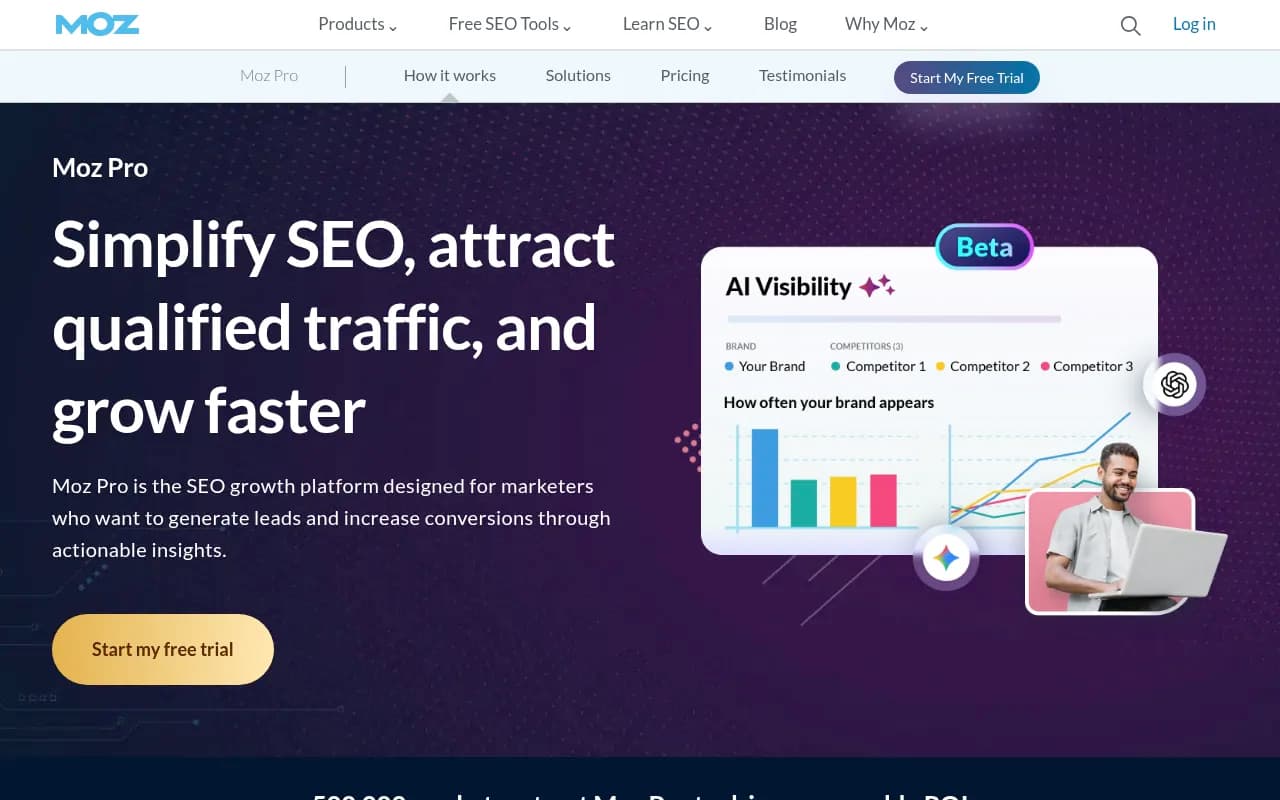
Rank trackers like Semrush, Moz Pro, and Ahrefs give you keyword-level visibility. That infrastructure is mature and reliable.
The problem is that none of these tools were built to see what happens when an AI model answers a question about your industry and either mentions your brand or doesn't.
What "AI search traffic" actually means
AI search traffic is what arrives at your site when a user interacts with an AI search engine -- ChatGPT, Perplexity, Google AI Mode, Claude, Gemini, Grok, Copilot -- and that AI either cites your content directly or recommends your brand, and the user clicks through.
It behaves differently from organic traffic in almost every measurable way.
The conversion rate gap is real
Multiple data sources are converging on the same finding: AI search visitors convert at dramatically higher rates than organic search visitors.
- Exposure Ninja found AI search traffic converts at 14.2% vs. Google organic's 2.8% -- roughly 5x higher
- Semrush tracked AI search traffic converting 4.4x better than organic across 500+ digital marketing topics
- ZipTie.dev research found brands cited in AI Overviews see a 23x conversion rate lift vs. standard organic
The reason isn't mysterious. Someone who reads an AI-generated answer that recommends your product and then clicks through to your site has already been pre-sold. The AI did the research and evaluation work. The click is much further down the decision funnel than a typical organic click.
The volume gap is also real
AI search traffic is growing 165x faster than organic search traffic -- but it still represents under 2% of total traffic for most sites. It's a supplemental channel right now, not a replacement. The question is what it looks like in 18 months.
The referral data is messy
Here's where it gets frustrating from a measurement standpoint. When a user clicks a citation link from Perplexity, your GA4 might show it as organic, direct, or referral depending on how the referral header is passed. ChatGPT's in-app browser strips referrer data entirely in many cases. Google AI Overviews don't show up as a separate traffic source in Search Console -- they're lumped into organic.
So you can have AI search traffic arriving at your site right now and have no idea it's there.
The three core differences that actually matter
1. Visibility vs. traffic are now separate metrics
In traditional SEO, ranking #1 means you get the most clicks. Visibility and traffic are tightly correlated.
In AI search, you can be cited in thousands of AI responses and receive zero direct traffic from those citations -- because the user got their answer from the AI and moved on. Your "visibility" in AI search is a real and valuable metric, but it doesn't map to traffic the way organic rankings do.
This means you need to track two separate things: how often AI models cite or mention your brand (visibility), and how often those citations actually drive clicks (traffic). Most analytics setups only capture the second one, and even then imperfectly.
2. The ranking signals are different
For organic search, Google's ranking signals are well-documented: backlinks, on-page relevance, E-E-A-T signals, technical health, Core Web Vitals, etc.
For AI search, the signals are less transparent but some patterns are clear. Research shows that 76.1% of URLs cited in AI responses already rank in the top 10 organic results -- so traditional SEO is still the foundation. But AI models also weight:
- Structured data (pages with schema markup appear 60% more often in AI answers)
- Direct, authoritative answers to specific questions
- Content that matches the exact phrasing of common user prompts
- Third-party citations: Reddit threads, YouTube videos, review sites, and other external sources that mention your brand
That last point is significant. AI models don't just read your website. They read the entire web's conversation about you. A Reddit thread recommending your product can influence AI citations just as much as a well-optimized page on your own site.
3. The content format that wins is different
Organic search rewards comprehensive, keyword-rich content that covers a topic broadly. AI search rewards content that directly answers specific questions in a citable, extractable format.
A 3,000-word pillar page might rank well organically but never get cited by an AI model if it doesn't contain clear, quotable answers. A shorter, more direct FAQ-style page might get cited constantly even if it ranks on page 2 organically.
This creates a genuine tension in content strategy. You can't fully optimize for both simultaneously -- you have to make deliberate choices about which format serves which goal.
Why your current analytics miss most of this
Let's be specific about the gaps.
Google Search Console shows organic clicks and impressions, but it can't separate AI Overview-influenced traffic from traditional blue-link traffic. When Google rolls out a new AI feature that changes how your content appears, you won't see it as a distinct signal in Search Console.
GA4 attributes sessions based on referrer data. When that data is missing or ambiguous (which it often is for AI search), sessions get bucketed into "direct" or misattributed to organic. There's no native "AI search" channel grouping.
Traditional rank trackers measure your position in the 10 blue links. They don't measure whether you're being cited in AI Overviews, ChatGPT responses, or Perplexity answers for the same queries.
The result: most marketing teams are looking at declining organic traffic numbers and don't know how much of that decline is AI cannibalization vs. algorithm changes vs. seasonal patterns vs. competitor gains.
How to track both traffic types properly in 2026
Tracking traditional organic traffic
This part is well-solved. The combination of Google Search Console and a rank tracker gives you solid coverage.
For rank tracking with good historical data and competitive benchmarking, Semrush and Moz Pro are the established options. Nightwatch is worth considering if you want something more focused on tracking without the full suite overhead.
One thing worth doing in GA4: create a custom channel grouping that captures known AI referrers. Perplexity.ai, chat.openai.com, claude.ai, and similar domains do pass referrer data sometimes. Setting up a custom channel group means you'll catch those sessions when they do come through properly tagged.
Tracking AI search visibility
This is where you need purpose-built tools, because GA4 and Search Console simply weren't designed for this.
The core capability you need is prompt-level monitoring: you define the questions your target customers are asking AI models, and the tool checks whether your brand appears in the AI's response across ChatGPT, Perplexity, Gemini, Claude, and others.
Promptwatch is the most complete option here. Beyond just monitoring citations, it tracks which specific pages are being cited, logs AI crawler activity on your site (so you can see when ChatGPT's bot crawls your content and when that crawl leads to a citation), and connects AI visibility to actual revenue through traffic attribution. It also surfaces the specific prompts where competitors are visible but you're not -- which is the starting point for any optimization effort.

For teams that want a simpler entry point, Otterly.AI and Peec AI offer basic AI mention monitoring at lower price points, though they don't go as deep on the optimization side.


Profound is strong for enterprise use cases with large prompt sets and multi-brand tracking needs.
The measurement stack that actually works
Here's a practical setup for 2026:
| Layer | Tool | What it covers |
|---|---|---|
| Organic rankings | Google Search Console + Semrush | Keyword positions, organic clicks, impressions |
| AI visibility | Promptwatch or similar | Citation frequency, brand mentions across LLMs |
| AI crawler activity | Promptwatch crawler logs | Which pages AI bots are reading, indexing errors |
| AI referral traffic | GA4 custom channel group | Sessions from known AI referrer domains |
| Offsite mentions | Promptwatch / Brand24 | Reddit, YouTube, third-party sites influencing AI |
The honest answer is that no single tool covers everything. You need at least one traditional SEO tool and at least one AI visibility tool running in parallel, with GA4 as the bridge for actual traffic attribution.
What to optimize for, given the difference
Once you understand that these are two distinct traffic types with different signals, the optimization strategy splits accordingly.
For organic traffic: Continue traditional SEO. Build backlinks, optimize for Core Web Vitals, target keywords with clear search volume, create comprehensive content that covers topics thoroughly. This still works and still drives the majority of search traffic for most sites.
For AI search visibility: The levers are different.
- Add structured data (FAQ schema, HowTo schema, Article schema) -- the 60% citation frequency lift from structured data is the single highest-ROI technical change you can make
- Write content that directly answers specific questions in extractable formats. Short, clear answers that an AI can quote verbatim
- Build your presence on the third-party sources AI models trust: get mentioned in relevant Reddit threads, industry publications, YouTube videos, and review sites
- Track which prompts your competitors are being cited for that you're not -- that's your content gap list
Tools like Promptwatch can automate the gap analysis step, showing you exactly which questions AI models are answering with competitor content instead of yours.
For the content creation side, platforms like AirOps and Relixir can help generate content specifically engineered for AI citation patterns.
The uncomfortable truth about 2026 search
Here's what I keep coming back to: the brands that will win in AI search are mostly the same brands that already win in organic search. 76% of AI citations come from top-10 organic results. Traditional SEO authority is still the foundation.
But "mostly the same" isn't "exactly the same." There's a meaningful gap between ranking well and being cited well. A brand can rank #3 for a query and never appear in AI responses for it, while a competitor at #7 gets cited constantly because their content is structured more citeably.
That gap is where the opportunity is in 2026. You don't have to choose between organic SEO and AI search optimization -- but you do have to measure them separately, because they're telling you different things about your visibility.
The teams that set up proper tracking for both, and optimize deliberately for each, will have a real advantage over teams that are still treating "search traffic" as a single undifferentiated number.