Key takeaways
- AirOps is a capable workflow automation platform for content planning, gap analysis, and article generation -- but it has no native way to track whether AI models like ChatGPT or Perplexity actually cite what you publish.
- In 2026, AI search engines handle a growing share of discovery. If you're generating content without knowing whether it gets cited, you're flying blind.
- The missing layer is citation tracking and AI visibility monitoring -- knowing which pages get picked up, by which models, and how often.
- Platforms like Promptwatch close this loop by connecting content creation to real citation data, so you can see what's working and fix what isn't.
- The fix isn't to abandon AirOps -- it's to pair it with tools that track what happens after you hit publish.
There's a real appeal to AirOps. You can build a workflow that scrapes your site and three competitors, identifies content gaps, generates briefs, assigns priority levels, and spits out article outlines -- all without touching a spreadsheet. For content teams drowning in manual processes, that's genuinely useful.
But here's the problem nobody talks about: AirOps tells you what to write. It doesn't tell you whether what you wrote actually shows up when someone asks ChatGPT, Perplexity, or Google AI Mode a question your article was supposed to answer.
That gap is getting more expensive by the month.
Why content generation without citation tracking is a problem now
HubSpot's 2026 State of Marketing Report found that 94% of marketers now use AI in their content creation. That means the volume of AI-generated content is enormous. The question isn't whether you're producing content -- it's whether AI search engines are selecting yours.
When someone asks Perplexity "what's the best project management tool for remote teams," Perplexity doesn't rank pages the way Google does. It reads a set of sources, synthesizes an answer, and cites the ones it found most useful. If your article isn't in that citation set, you don't exist in that answer -- regardless of how well-structured your AirOps workflow was.
This is the core issue. Content workflows like AirOps optimize for production. They help you create more, faster, with better structure. But they don't measure the output that actually matters in 2026: citation frequency across AI models.
What AirOps actually does well
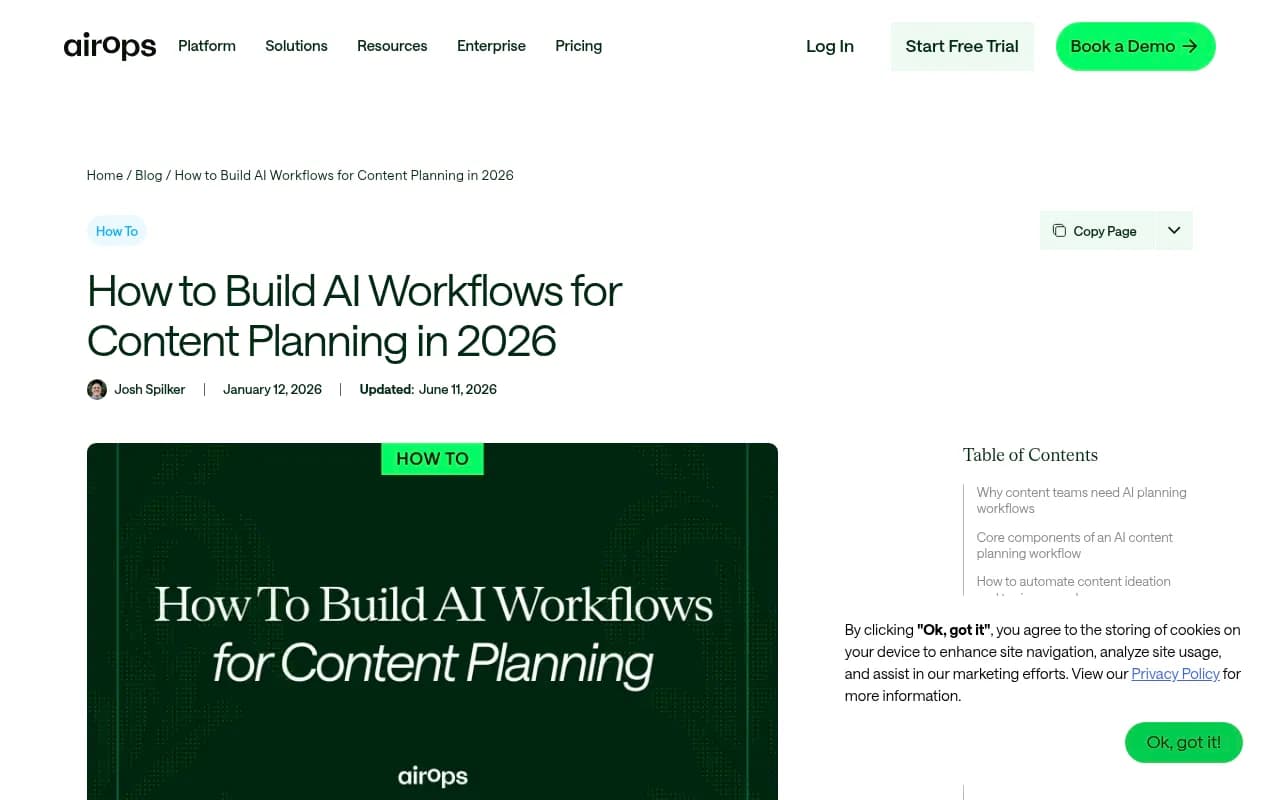
To be fair, AirOps has built something genuinely useful for content teams. Its workflow builder lets you chain LLM steps together, pass variables between them, and automate the kind of research that used to take hours.
A real example: one marketer in AirOps's March 2026 cohort built a workflow that scraped her company's site and three competitors, then produced structured content gap reports with topic ideas, story angles, competitor insights, unique positioning angles, format recommendations, and priority scores. That's a serious amount of research compressed into an automated pipeline.
AirOps also handles content refresh workflows. Their collaboration with SEO strategist Steve Toth covered how to identify which pages need updating, how to optimize meta titles and intro paragraphs, and how to use Google Search Console data to double down on content that's already gaining traction.
The platform is genuinely capable. But "capable at production" and "capable at measuring AI visibility" are two different things -- and AirOps only does the first.
The gap analysis problem
AirOps's content gap analysis is built around traditional signals: what topics competitors cover, what keywords they target, what angles they take. That's useful for SEO in the classic sense.
But AI search engines don't work on keyword coverage alone. They work on whether your content actually answers the specific questions users are asking AI models. The gap that matters in 2026 isn't "competitor X has an article on topic Y and you don't." It's "when someone asks ChatGPT about topic Y, your site isn't cited -- and here's exactly why."
That second kind of gap analysis requires real prompt data: knowing what questions people are actually typing into AI search interfaces, which sources those AI models pull from, and where your content falls short in answering those specific questions.
AirOps doesn't have this data. It can't tell you which prompts your competitors are winning and you're not, because it doesn't monitor AI model outputs at all.
What happens after you publish
Here's the workflow most AirOps users are running in 2026:
- Build a gap analysis workflow
- Generate article briefs or full drafts
- Publish the content
- ... wait?
Step four is where things get murky. Traditional SEO had Google Search Console, rank trackers, and traffic analytics to tell you whether your content was working. AI search has almost none of that infrastructure built into content creation tools.
You can't see whether ChatGPT is citing your new article. You can't see whether Perplexity discovered it. You can't see whether Google AI Mode is pulling from it or ignoring it. And you definitely can't see the timeline from "published" to "crawled by an AI agent" to "cited in a response."
Without that data, you're guessing. You might publish 30 articles from an AirOps workflow and have no idea which three are actually driving AI citations -- or whether any of them are.
The citation tracking layer that's missing
This is where dedicated AI visibility platforms come in. They sit on top of your content workflow and answer the questions AirOps can't:
- Which of your pages are being cited by ChatGPT, Claude, Perplexity, Gemini, and other models?
- Which prompts are your competitors winning that you're not?
- When did an AI crawler last visit a specific page, and did it result in a citation?
- Which external sources -- Reddit threads, YouTube videos, third-party listicles -- are influencing AI recommendations about your brand?
Promptwatch tracks all of this. It monitors 10 AI models in real user interfaces (not just APIs, which can give different results), logs AI crawler activity on your site, and shows you the path from publish to crawl to citation. It also runs answer gap analysis against real prompt data -- so instead of guessing what to write next, you see exactly which questions AI models are answering without citing you.

That's the loop AirOps can't close on its own: find the gaps in AI citations, create content to fill them, then track whether the new content actually gets picked up.
How to pair AirOps with citation tracking
The good news is these tools aren't mutually exclusive. AirOps handles the production side well. The smarter approach is to feed citation data back into your AirOps workflows so you're generating content based on what AI models actually need -- not just what competitors have covered.
A practical setup:
- Use a citation tracking platform to identify which prompts competitors are winning and you're not
- Feed those specific prompt gaps into AirOps as inputs for brief generation
- Publish the resulting content
- Track citation rates over time to see which articles get picked up and which don't
- Use that feedback to refine your next round of briefs
This turns AirOps from a content production tool into part of a genuine optimization loop. Without the citation data feeding back in, you're just producing more content and hoping.
Comparing the tools in this stack
| Tool | What it does | What it doesn't do |
|---|---|---|
| AirOps | Workflow automation, content briefs, gap analysis based on competitor content | No AI citation tracking, no prompt monitoring, no crawler logs |
| Promptwatch | AI citation tracking, prompt gap analysis, crawler logs, content generation grounded in real prompt data | Not a general-purpose workflow builder |
| Surfer SEO / Clearscope | On-page optimization for traditional search | No AI visibility monitoring |
| Google Search Console | Traditional search performance data | No AI search data |

The pattern is consistent: most content tools were built for traditional search and haven't added AI visibility layers. AirOps is the same -- it's a workflow tool that predates the AI search era and hasn't fully adapted to it.
What good AI content workflows look like in 2026
The teams getting real results from AI search aren't just generating more content. They're building tighter feedback loops between what they publish and what AI models actually cite.
A few things that separate effective workflows from ineffective ones:
Prompt-first planning. Instead of starting with "what topics haven't we covered," start with "what questions are people asking AI models in our category, and which ones are we not being cited for?" That requires real prompt data, not just competitor content analysis.
Page-level citation tracking. Knowing your overall "AI visibility score" is less useful than knowing that your pricing page gets cited 40 times a month by Perplexity but your comparison pages get zero citations. Page-level data tells you where to invest.
Crawler log analysis. AI crawlers behave differently from Googlebot. Knowing when ChatGPT's crawler visited a page, what it read, and whether it resulted in a citation is data most teams don't have -- but it's the data that explains why some content gets picked up and some doesn't.
Offsite citation awareness. AI models don't just cite your own website. They cite Reddit threads, YouTube videos, and third-party review sites. If a competitor is winning citations because of a well-placed Reddit post or a popular YouTube comparison video, you need to know that -- and AirOps won't tell you.
The real cost of ignoring citation tracking
The argument for just using AirOps and not worrying about citation tracking usually sounds like: "We're producing good content, the citations will come."
That might have been true in 2023. In 2026, with 94% of marketers using AI in content creation, the volume of "good content" is enormous. AI models are selective. They cite sources that are authoritative, specific, and directly responsive to the questions users are asking. Generic well-structured articles don't automatically get cited.
If you're running AirOps workflows and publishing regularly but not tracking citations, you have no way to know whether your content strategy is working. You might be producing 20 articles a month that get zero AI citations while a competitor's five articles dominate every relevant prompt. You'd never know.
That's the dead end: lots of production, no feedback, no improvement.
Practical next steps
If you're already using AirOps and want to close the citation tracking gap, here's where to start:
- Set up AI visibility monitoring for your domain. Platforms like Promptwatch, Otterly.AI, or Peec AI will show you your current citation baseline across major AI models.


-
Run a prompt gap analysis. Find out which questions in your category are being answered by AI models without citing you. These are your highest-priority content opportunities.
-
Feed those gaps into your AirOps workflows. Use the specific prompt data as inputs for brief generation rather than relying solely on competitor content scraping.
-
Track page-level citations after publishing. Give new content 4-6 weeks, then check whether AI models have picked it up. If not, look at crawler logs to understand why.
-
Iterate. The teams winning in AI search aren't the ones with the best workflows -- they're the ones with the tightest feedback loops.
AirOps is a real tool that solves a real problem. But content generation without citation tracking is only half a strategy. The other half is knowing what happens after you publish -- and right now, most AirOps users don't have that data.