Key takeaways
- AI models cite content based on format, structure, and authority signals -- not just topic relevance
- About 48% of AI citations come from community platforms like Reddit and YouTube, not brand-owned domains
- Pages with sequential headings and rich schema are cited at 2.8x higher rates than unstructured content
- Definitional, data-backed, and comparison formats consistently outperform generic blog posts in citation rates
- Tracking which formats earn you citations (and on which AI models) is the only way to know what's actually working
The question most marketing teams are asking in 2026 is some version of "how do we show up in AI answers?" It's the right question. But the answer isn't a single tactic -- it's a format strategy.
AI models don't cite randomly. They pull from content that's structured to be cited: clear, authoritative, specific, and easy to extract a useful fragment from. The data backs this up. Analysis of 680 million citations across ChatGPT, Perplexity, and Google AI Overviews (via Profound's 2025 study) shows that certain content types appear in AI answers at dramatically higher rates than others. Pages updated quarterly are 3x less likely to lose citations. Sequential headings and schema markup correlate with 2.8x higher citation rates.
What follows is a breakdown of the 12 content formats that the data consistently shows get cited -- with notes on why each works and how to build them right.
The formats that actually get cited
1. Definitional explainers ("What is X")
Sections that open with a clear, direct definition are significantly more likely to be selected as citation fragments. AI models are essentially trying to answer a question -- if your content answers it in the first sentence, you've done their job for them.
The format is simple: lead with a one-sentence definition, follow with context, then add nuance. Don't bury the answer in paragraph three. "What is X" content works especially well for technical terms, product categories, and industry concepts where there's genuine search demand.
This is probably the easiest win on this list. If you have existing blog posts that meander before getting to the point, restructuring them to lead with definitions is a quick way to improve citation eligibility.
2. Original research and data reports
If you publish a number that no one else has, AI models will cite you. It's that straightforward. Original data -- surveys, internal platform data, proprietary analysis -- gives AI engines something they can't get anywhere else.
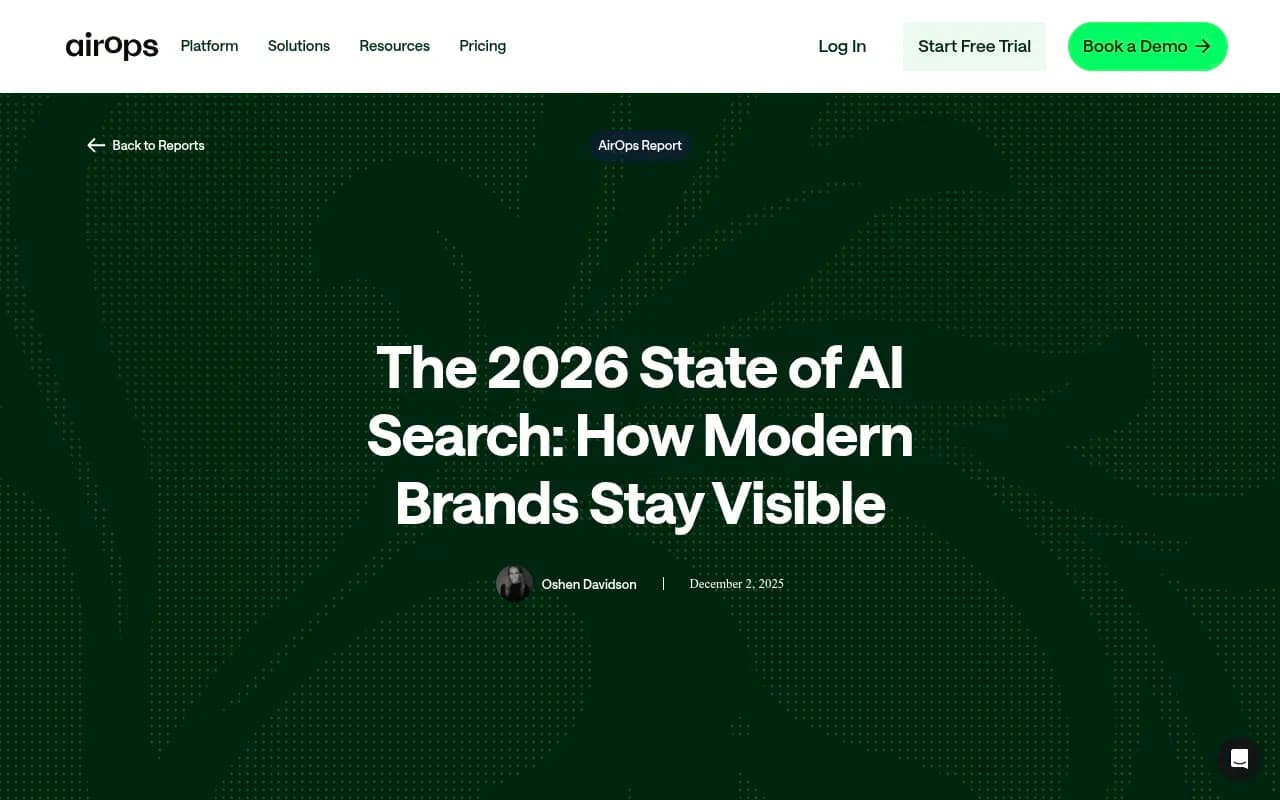
The AirOps 2026 State of AI Search report is a good example of this working in practice. It contains specific, citable statistics ("only 30% of brands stay visible from one answer to the next") that get pulled into AI responses because they're specific and attributable.
You don't need a massive research budget. Even a survey of 100 customers with interesting findings, published properly with methodology notes, can generate citations. The key is publishing the actual numbers, not just "our research shows customers prefer X."
Promptwatch tracks which of your pages are being cited by which AI models, so you can see whether your data content is actually landing.

3. Comparison pages and "X vs Y" content
Comparison content is one of the highest-performing formats for AI citation, particularly on Perplexity and ChatGPT, which handle a lot of commercial-intent queries. When someone asks "what's the difference between X and Y," AI models need a source that directly addresses that comparison -- and if yours does it clearly, you get cited.
The format matters here. A comparison table is almost mandatory. Prose comparisons are harder for AI to extract cleanly. A structured table with clear criteria, followed by a summary recommendation, gives AI models exactly the fragment they need.
4. "Best of" listicles with genuine criteria
"Best [category] tools/products/services" is one of the most common prompt types in AI search. The catch: AI models are getting better at distinguishing between genuine recommendations and affiliate-stuffed lists.
What works is specificity. Instead of "Best project management tools," write "Best project management tools for remote engineering teams under 20 people." Narrow the audience, explain your evaluation criteria, and include honest tradeoffs. AI models reward content that sounds like it was written by someone who actually used the things they're recommending.
5. FAQ pages with direct answers
FAQ content is structurally perfect for AI citation. Each question-answer pair is a self-contained, extractable unit. AI models can pull a single Q&A without needing surrounding context.
The mistake most brands make is writing FAQ answers that are too short or too vague. "Can I cancel my subscription?" followed by "Yes, you can cancel anytime" is technically an answer, but it's not citable content. Expand answers to 50-150 words, include relevant context, and make sure each answer stands alone.
Schema markup (FAQPage schema) helps AI crawlers identify these sections, which correlates with higher citation rates.
6. How-to guides with numbered steps
Step-by-step instructional content is highly citable because it's inherently structured. AI models can extract individual steps, summarize the process, or cite the guide as a source for a specific technique.
The format requirements: numbered steps (not bullets), a clear outcome stated upfront, and enough detail in each step that it's actually useful. Vague steps like "optimize your settings" are skipped. Specific steps like "navigate to Settings > Privacy > Data Sharing and toggle off the third option" get cited.
Tools like Clearscope can help you check whether your how-to content covers the full topic scope AI models expect.
7. Glossary pages and terminology hubs
A well-built glossary is a citation magnet. Every term is a potential citation fragment. AI models frequently need to define industry terms, and if your glossary is authoritative and comprehensive, it becomes a go-to source.
The key is depth. A glossary entry that's one sentence won't compete with one that includes the definition, context, related terms, and an example. Build glossary entries like mini-articles, not dictionary entries.
This format works particularly well for technical industries -- SaaS, fintech, healthcare, legal -- where terminology is specialized and AI models need reliable definitions.
8. Case studies with specific outcomes
Case studies are underutilized for AI citation. When someone asks "how did [company type] solve [problem]," AI models look for real examples with real numbers. "We helped a mid-market SaaS company reduce churn by 23% in 90 days" is citable. "We help companies improve their metrics" is not.
The format that works: clear problem statement, specific solution, measurable outcome, and a quote from the client. Keep the structure clean and lead with the result, not the backstory.
One caveat: case studies on your own domain face the off-site credibility challenge (more on that below). Getting your case studies mentioned or summarized on third-party sites amplifies their citation potential significantly.
9. Expert roundups and attributed quotes
AI models weight attributed expertise. Content that includes quotes from named experts, with their credentials, performs better than content that makes the same claims without attribution. "According to Dr. Sarah Chen, Head of AI Research at MIT..." carries more citation weight than "experts say."
Roundup posts -- where you collect perspectives from multiple experts on a single question -- are particularly effective because they're inherently multi-perspective and authoritative. They also tend to earn backlinks and social shares, which builds the off-site signals that AI models use to validate credibility.
10. Reddit-style community discussions (and actual Reddit posts)
This one might feel counterintuitive, but the data is clear: roughly 48% of AI citations come from community platforms, with Reddit being the dominant source. AI models trust peer discussion because it reflects real user experience, not brand messaging.
The practical implication: your brand needs a presence in community discussions. This means genuinely participating in relevant subreddits, answering questions on Quora, and contributing to industry forums -- not spamming links, but actually being helpful. When AI models pull from Reddit threads, they're citing the most useful, upvoted responses.
For brands that can't control Reddit, the alternative is creating content that mimics the authenticity and specificity of community discussion: real user scenarios, honest tradeoffs, and answers that acknowledge limitations.
11. Structured data pages with schema markup
This isn't a content "format" in the traditional sense, but it functions like one from an AI citation perspective. Pages with proper schema markup -- Article, HowTo, FAQPage, Product, Review -- are significantly easier for AI crawlers to parse and extract from.
The 2026 AirOps data shows sequential headings and rich schema correlate with 2.8x higher citation rates. That's not a marginal improvement. If your content team isn't thinking about schema as part of the publishing workflow, this is a gap worth closing.
Plugins like Yoast SEO handle a lot of this automatically for WordPress sites.
12. Thought leadership with a clear, defensible position
Generic "here are five things to know about X" content is getting crowded out. What AI models increasingly surface is content with a clear point of view -- something that takes a position, explains the reasoning, and can be cited as a perspective.
"Five things to know about AI search" is forgettable. "Why most brands are optimizing for AI search wrong (and what actually works)" is citable. The difference is a thesis. Content that argues something, backed by evidence, gives AI models a perspective to attribute.
This format requires more editorial investment, but it's one of the hardest to replicate and one of the most durable in terms of citation longevity.
The off-site problem most brands ignore
Here's the uncomfortable data point: brands are 6.5x more likely to be cited through third-party sources than their own domains. Your own site accounts for roughly 9% of AI citations on average.
This means the 12 formats above need to exist both on your site and in the broader ecosystem. Getting your research cited in industry publications, your comparisons referenced in review sites, your expert quotes picked up by journalists -- that's what builds the citation footprint that AI models actually pull from.
The implication for content strategy: every piece you publish should have a distribution plan that targets third-party placement, not just your own domain.
A quick format comparison
| Format | Best for | Citation strength | Effort level |
|---|---|---|---|
| Definitional explainers | Informational queries | High | Low |
| Original research | All query types | Very high | High |
| Comparison pages | Commercial queries | High | Medium |
| "Best of" listicles | Commercial queries | High | Medium |
| FAQ pages | Informational queries | High | Low |
| How-to guides | Instructional queries | High | Medium |
| Glossary pages | Informational queries | Medium-high | Medium |
| Case studies | Commercial/trust queries | Medium | High |
| Expert roundups | Informational queries | High | Medium |
| Community discussions | Trust/peer queries | Very high | Ongoing |
| Structured data pages | All query types | High (multiplier) | Low-medium |
| Thought leadership | Brand/trust queries | Medium-high | High |
How to know if your content formats are working
Publishing the right formats is step one. Knowing whether they're actually getting cited is step two -- and most teams skip it.
AI citation patterns vary significantly by platform. ChatGPT, Perplexity, Gemini, and Google AI Overviews pull from different sources and weight different signals. A comparison page that gets cited constantly by Perplexity might not appear in Google AI Overviews at all.
Tracking this at the page level -- which specific URLs are being cited, by which models, for which prompts -- is what separates a content strategy from a content guess. Tools like Promptwatch and Profound give you that page-level visibility.
For content creation that's specifically engineered to earn AI citations, Averi AI and Content at Scale are worth looking at.
For optimizing the structure and completeness of existing content, Surfer SEO and MarketMuse both have solid workflows.
Where to start
If you're building a citation-optimized content strategy from scratch, the highest-leverage starting point is usually a combination of original data (format #2) and structured FAQ/definitional content (formats #1 and #5). These have the best effort-to-citation ratio and work across all major AI platforms.
From there, build out comparison content for your core commercial queries and invest in community presence for the off-site signals that AI models weight so heavily.
The brands winning in AI search right now aren't publishing more content -- they're publishing the right formats, structured the right way, distributed to the right places. The 12 formats above are where that starts.