Key takeaways
- Switch for a concrete gap (reporting, engine coverage, integrations, or the Sitecore acquisition), not because a comparison page told you to.
- Pricing for both tools is inconsistent across third-party sources. Confirm everything on the vendors' current pricing pages before you decide.
- Run the new tool next to the old one for about a month so you can explain any change in your numbers.
- Numbers will not match between tools. Different prompts, models, and sampling produce different results, so rebase your baselines.
- Export what you can before cancelling, because history rarely moves across tools cleanly.
First, be honest about what you are trying to fix
Most switching decisions go wrong because the trigger is vague. "We want something better" is not a trigger. A trigger is "our clients can't use a PDF snapshot" or "we need Claude and Gemini tracking and that sits on the Enterprise tier."
I'd write down the two or three things that are actually hurting before opening a single pricing page. Everything below is easier once you have that list.
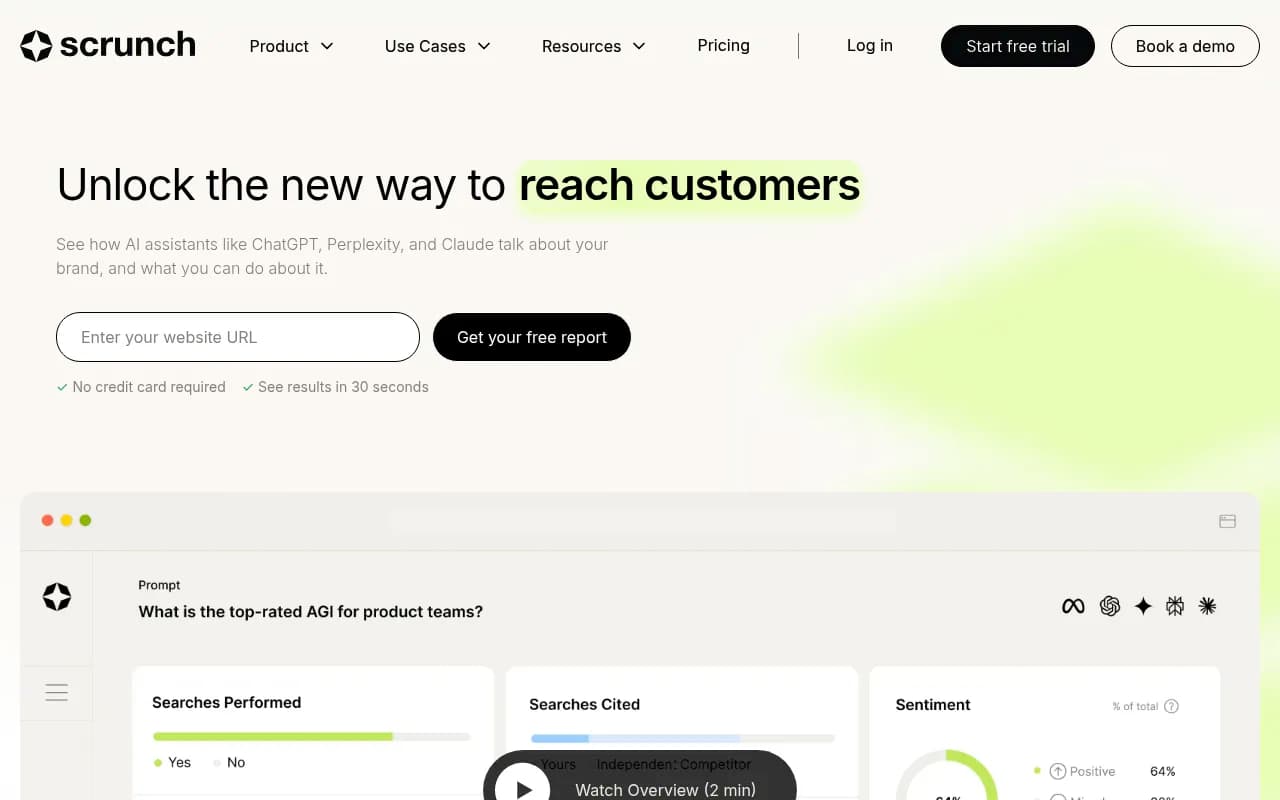
A caveat on sources. Much of what is published about Scrunch's limits comes from competing vendors. Searchable's write-up on Scrunch alternatives says the Core plan exports reports as a PDF snapshot of the dashboard, that tracking Claude, Gemini, or Google AI Mode needs the Enterprise plan, and that Core has no Data Studio, API, or MCP access. Another competitor, GetMint, lists a Scrunch Growth tier with eight engines. Those two claims conflict. That is exactly why you should verify on Scrunch's own pages and in a trial.
Why teams leave Scrunch
The commonly cited reasons fall into three buckets.
| Reason | What is claimed | What to check |
|---|---|---|
| Reporting | Entry plan exports a PDF snapshot, not live shareable reports | Can you share a live link or build a branded dashboard on your plan? |
| Engine coverage | Claude, Gemini, and Google AI Mode require Enterprise | Which engines are in your tier today? |
| Integrations | AI visibility and SEO data live in separate places; no Data Studio, API, or MCP on Core | Does your plan include API and GSC/GA4 connections? |
The Sitecore acquisition is a fourth factor. It is not a reason to leave on its own. It does raise fair questions about roadmap and pricing, and it is worth asking your account rep directly.
When Scrunch is still the right answer
Staying put is a legitimate outcome. Scrunch makes sense if you already run Sitecore, if you need Meta AI tracking (few tools in this category cover it), or if your procurement team wants a published price before approving a trial. If none of the three gaps above affects you, the migration cost is probably not worth it.
Why teams leave Profound (the other direction)
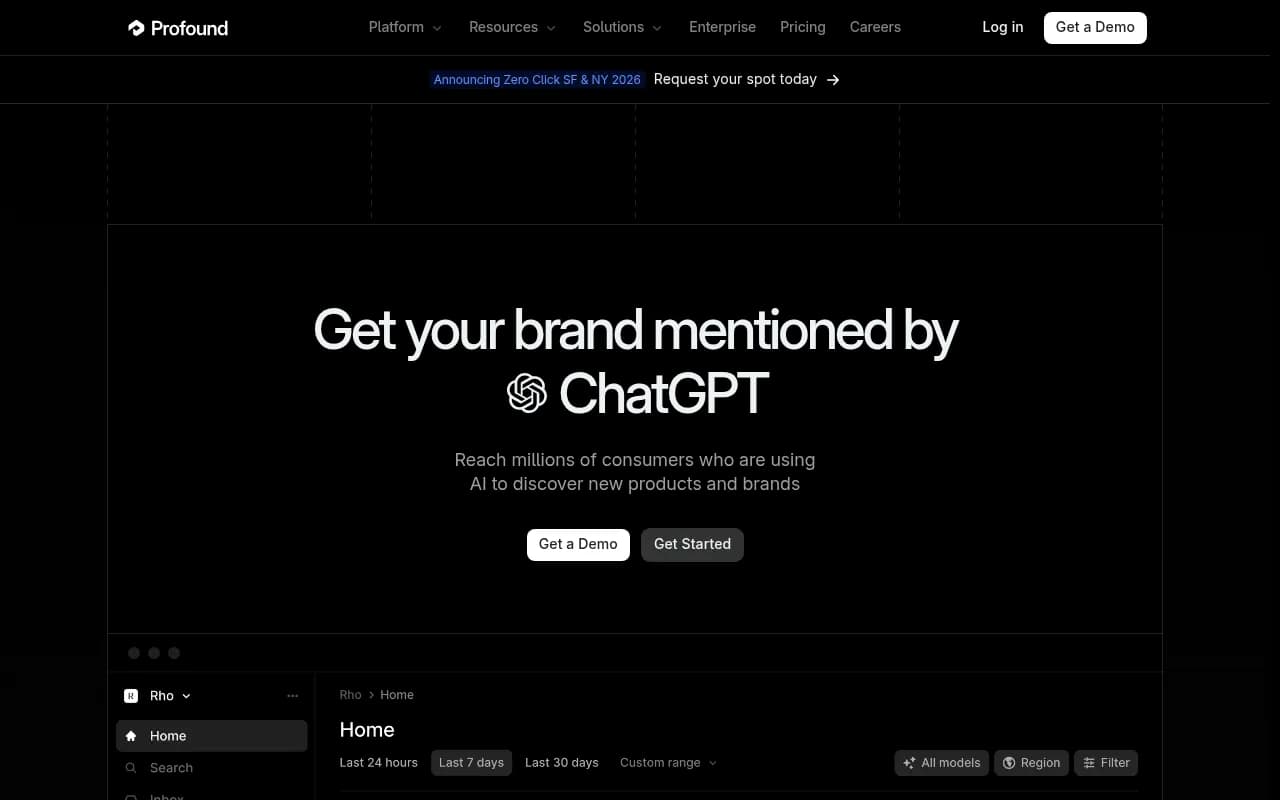
Going the other way has its own logic. Profound is positioned as an enterprise product. Third-party sources put enterprise contracts at roughly $2,000 to $5,000+ per month, though that figure comes from one competitor's page and should be treated as a rough signal. Profound's own comparison page lists a Starter plan at $250 per month billed annually, while GetMint lists $99 for ChatGPT only. Those do not agree.
Teams that move from Profound to Scrunch usually cite price transparency, Meta AI coverage, or Sitecore alignment. Teams that move off Profound to something else tend to cite cost per prompt, or wanting content execution rather than another dashboard.

Scrunch vs Profound at a glance
Treat this as a verification list, not a verdict. Every cell marked "verify" is something I could not confirm from vendor pages.
| Area | Scrunch | Profound |
|---|---|---|
| Positioning | Monitoring and optimization, now part of Sitecore | Enterprise AI visibility platform |
| Published pricing | Reported both ways across sources; verify | Starter reported at $250/mo annual by Profound, $99 by a third party; verify |
| Engine coverage by tier | Reported as four engines on Core, more on Enterprise (disputed); verify | Reported as three engines on a mid tier by a third party; verify |
| Reporting | PDF snapshot on entry plan (per Searchable) | Custom dashboards, shareable links, PDF export (per Searchable) |
| Meta AI tracking | Reported yes | Verify |
| API / MCP / Data Studio | Reported as Enterprise-only (per Searchable) | Verify |
If a cell says verify, put it in your demo questions.
The migration checklist
Before you commit
- List your non-negotiables: engines, countries, languages, prompt count, seats, and reporting format.
- Ask both vendors for the engine list for your exact tier in writing.
- Ask what "a prompt" and "a response" mean in their billing. Prompt counts and response counts are not interchangeable.
- Confirm export options: CSV, API, or scheduled exports, and how far back history goes.
- Ask about the contract: term, auto-renewal, and what happens to your data after cancellation.
- Check the integrations you rely on: Google Search Console, GA4, Looker Studio or Data Studio, Slack.
Export your history first
Before touching anything, pull everything you can out of the old tool. That means prompt lists, topic and persona structure, competitor sets, brand aliases, and historical visibility, share of voice, position, and sentiment numbers.
History will probably not import into the new tool. Keep it as a static archive in a spreadsheet or your data warehouse and label it with the tool and the date range. The research I reviewed did not confirm export and API details for either vendor, so this is the item most worth testing during a trial.
Rebuild your prompt set deliberately
Do not paste your old prompts in unchanged and call it done. A migration is a rare chance to prune. Drop prompts nobody cares about, add ones tied to real buying questions, and tag them by intent (branded, comparison, category) so reports are readable later.
If you want data to help choose prompts, tools like Promptwatch show prompt volumes, difficulty, and the query fan-outs AI runs per answer, which makes the pruning less of a guess.

Run both tools for a month
This is the single most useful piece of advice in the source material, and I agree with it. Run the new tool alongside the old one for about a month. Same prompts, same countries, same brand definitions.
The overlap gives you two things. You get a conversion factor between the tools, and you get a story for stakeholders: if the new dashboard shows a different score, the difference is measurement, not performance.
Rebase your baselines
After the overlap, set a new baseline date and note it in every report. Do not chart old-tool and new-tool numbers on one line without a marker. Someone will ask why visibility "dropped 14 points" in the month you switched.
Why the numbers will not match
Expect differences even when both tools are set up well. Some reasons are mundane: prompt wording, location, run time, and how a mention is counted. Others are structural.
AI platforms vary a lot in how many sources they cite. Promptwatch's average sources per response data (published September 2025, approximate averages) shows ChatGPT citing about 5 sources per web-search answer, Google AI Overviews about 10, and Perplexity almost exactly 10 each day. Copilot swung from under 2 to nearly 17 sources per response within a few weeks before settling at the low end, which the report attributes to probable retrieval changes on Microsoft's side.
The practical lesson is to judge Copilot on monthly trends, not weekly snapshots. And if one tool uses real interface scraping while the other relies on API calls, expect divergence in both mentions and citations. For wider context, Promptwatch's data hub collects research on how citations behave across models.
Questions to ask in the demo
- Which exact engines are included on my tier, and what is the add-on price for the rest?
- Is data collected from the real user interface or from APIs?
- Can I share a live, branded dashboard link with clients, not just a PDF?
- Do you offer white-label reports and client read-only access?
- Is there an API or MCP server, and on which plans?
- How do GSC and GA4 connect, and can I see AI traffic next to organic?
- What changed after your last acquisition or funding event, and what is on the 12-month roadmap?
- What is the cancellation process, and can I export everything?
If neither feels right
The research suggested a few other names depending on your gap. Searchable, OtterlyAI, and LLM Pulse were all pitched as options for engine coverage and reporting. Treat that as a starting list from a competing vendor, not a recommendation.


If your real problem is that monitoring tells you where you are invisible but nobody fixes it, look at platforms that connect tracking to action. Promptwatch, for example, pairs tracking with AI crawler logs, visitor analytics, and a content agent that publishes to your CMS, so you can check whether a fix got crawled and cited. For a wider scan of the category, the GEO software directory at bestgeosoftware.com lists many more options.
A simple decision rule
| Your situation | Likely move |
|---|---|
| Sitecore shop, need Meta AI, want published pricing | Stay on Scrunch |
| Need live shareable client dashboards and your tier only gives PDFs | Test Profound or a reporting-friendly alternative |
| Need Claude, Gemini, and AI Mode without Enterprise pricing | Compare add-on pricing on alternatives first |
| Enterprise budget, want deep monitoring | Profound is worth a serious demo |
| Tight budget, small prompt set | Price a lighter tracker before either |
| Need the tool to fix problems, not just report them | Look at action-oriented platforms |
The short version
Switch if a specific, verified gap is costing you work. Do not switch on the strength of a competitor's comparison page, including this one. Confirm pricing and engine lists on the vendors' own pages, export your history, run both tools for a month, and rebase your baselines with a visible marker. That sequence costs a few weeks and saves you from explaining a mystery drop in the numbers to a client.