Yext Review 2026
Yext is a digital presence platform for multi-location brands, helping businesses manage listings, reviews, local pages, and AI search visibility across 200+ publishers. Built for enterprise and mid-market brands with 10+ locations.
Key takeaways
- Yext is a mature, enterprise-grade platform for managing local listings, reviews, and brand presence across hundreds of publishers and directories simultaneously
- Strong fit for multi-location brands (restaurants, hotels, healthcare, retail) that need consistent NAP data and local page management at scale
- The new Scout agent adds AI search competitive intelligence, but Yext's AI visibility features are primarily local-search focused rather than full LLM citation tracking
- Compared to dedicated GEO platforms like Promptwatch, Yext lacks content gap analysis, AI crawler logs, AI traffic attribution, and a writing agent for generating content that ranks in LLMs -- it monitors AI search presence but doesn't help you systematically fix it
- Pricing is enterprise-oriented and can get expensive quickly for smaller teams; the annual billing model with limited transparency makes cost comparison difficult
Yext has been around since 2006, originally built to solve a problem that sounds simple but turns out to be genuinely painful at scale: keeping business information accurate across the internet. Hours, addresses, phone numbers, holiday closures -- all of it has a way of going wrong on Google, Yelp, Apple Maps, Bing, and dozens of other directories. For a single-location coffee shop, that's manageable. For a hotel chain with 5,000 properties or a healthcare network with hundreds of clinics, it's a logistical nightmare. That's the problem Yext was built to solve, and for a long time, it was the dominant answer.
The company went public on the NYSE in 2017 and has since expanded well beyond listings management into a broader "digital presence platform" that now includes review management, local landing pages, social content, site search, and -- more recently -- AI search visibility tools. Customers include IHG Hotels & Resorts, FedEx, McDonald's, Samsung, and Subway, which gives you a sense of the scale and enterprise orientation of the platform.
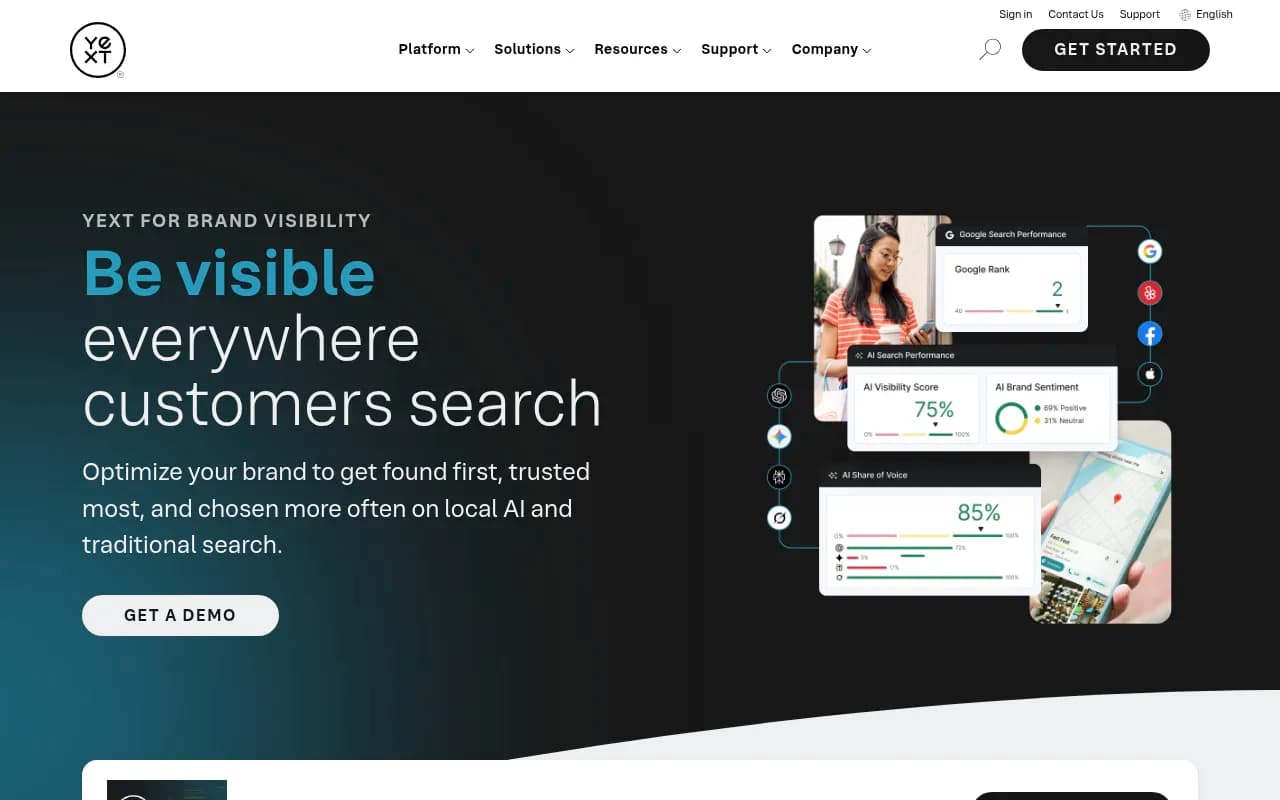
In 2025 and 2026, Yext has been pushing hard into AI search, launching features like Scout (an AI search and competitive intelligence agent) and positioning its Knowledge Graph as the structured data backbone that helps AI models understand and surface brand information. Whether that pivot is deep enough to satisfy teams seriously focused on LLM visibility is a fair question -- and one worth examining closely.
Key features
Knowledge Graph The Knowledge Graph is Yext's core data layer. It's a structured database where you store all your business entities -- locations, products, people, events, FAQs -- and from which all other Yext features pull. The idea is that if your data is clean and structured in one place, it can be syndicated accurately everywhere else. In practice, this means you define your business information once (name, address, phone, hours, attributes, photos) and Yext pushes it to 200+ publishers. The Knowledge Graph also supports custom entity types, which is useful for healthcare providers managing physician profiles or financial services firms managing advisor listings.
Listings management This is still Yext's bread and butter. The platform syncs your business data to a network of publishers including Google Business Profile, Apple Maps, Bing Places, Yelp, Facebook, Foursquare, TripAdvisor, and many more. Changes propagate in near real-time rather than waiting for crawlers to pick them up. For multi-location brands, the ability to bulk-update hours across thousands of locations for a holiday or emergency closure is genuinely valuable. Yext also offers duplicate suppression, which finds and removes conflicting listings that could confuse both customers and search engines.
Scout (AI search and competitive intelligence) Scout is Yext's newest major feature, launched in 2025. It functions as an AI agent that monitors how your brand appears in AI search results and compares your visibility against local competitors. You can see how AI models are describing your business, which competitors are appearing in AI-generated answers for relevant queries, and get recommendations on what to fix. Scout is specifically oriented toward local AI search (think Google AI Overviews for "best Italian restaurant near me" queries) rather than broad LLM monitoring across ChatGPT, Claude, Perplexity, and similar tools. It's a meaningful addition to the platform, but it's narrower in scope than dedicated AI visibility platforms.
Reviews management Yext aggregates reviews from Google, Facebook, Yelp, TripAdvisor, and other sources into a single dashboard. You can respond to reviews directly from the platform, set up automated response workflows, and track sentiment trends over time. For multi-location brands, the ability to route reviews to the right regional manager or franchise owner is useful. Review generation tools let you send customers to your preferred review platform via email or SMS campaigns. The reporting side shows you rating trends by location, which helps identify underperforming stores or clinics.
Local pages (Pages) Yext generates and hosts location-specific landing pages for each of your business locations. These pages are built on Yext's own CMS and are designed to rank in local search. You can customize templates, add location-specific content, embed maps, show hours, and pull in live review data. For brands with hundreds or thousands of locations, having a scalable way to create and maintain these pages without a developer for each one is a real operational win. The pages are also structured with schema markup to help search engines (and increasingly AI models) parse the content correctly.
Social content management The Social module lets you create and schedule localized social content across Facebook, Instagram, Google Posts, and other channels. You can create a template at the brand level and let individual locations customize it within defined parameters -- useful for franchise brands that want brand consistency without being completely rigid. Content can be scheduled in bulk across locations, and performance metrics are pulled back into the platform.
Site search (Search) Yext offers an AI-powered site search product that you can embed on your own website. It uses natural language understanding to return relevant results from your Knowledge Graph data. This is particularly useful for healthcare networks (searching for doctors by specialty and location), financial services (finding advisors by zip code), or large retailers (product and store finder). It's a distinct product from the listings and visibility features, and it's priced separately.
Relate (1:1 messaging) Relate is Yext's customer messaging product, enabling compliant two-way messaging with customers via SMS and other channels. It's positioned as a way to convert inbound inquiries from local search into actual customers. For regulated industries like healthcare and financial services, the compliance features (audit trails, opt-out management) matter.
Who is it for
The clearest use case for Yext is a multi-location brand with at least 10 locations that needs to keep business information accurate across the web at scale. Think regional restaurant chains, hotel groups, healthcare networks, retail chains, and financial services firms with branch networks. The operational pain of managing listings manually across Google, Apple Maps, Yelp, and 200 other directories grows exponentially with location count, and Yext's automation genuinely solves that problem. A healthcare network managing 150 clinic locations and 400 physician profiles, for example, would find the Knowledge Graph and listings syndication enormously useful.
Enterprise marketing and local SEO teams are the primary buyers. These are people who understand that inconsistent NAP data hurts local search rankings and that a wrong phone number on Apple Maps means lost patients or customers. Yext gives them a single source of truth and the tooling to enforce it across the publisher network. Agencies managing local SEO for multi-location clients also use Yext, though the pricing model can make it challenging to resell at a margin.
Industries where Yext particularly shines: hospitality (IHG, Accor, Best Western are all customers), quick-service restaurants (McDonald's, Subway, Bojangles), healthcare (OhioHealth), and financial services. These verticals have high location counts, regulated information requirements, and customers who rely heavily on local search to find them.
Who should probably look elsewhere: single-location businesses will find Yext expensive relative to simpler tools like BrightLocal or even managing Google Business Profile directly. Teams primarily focused on tracking and improving their brand's visibility in ChatGPT, Claude, Perplexity, or other LLMs will find Yext's AI features too narrowly focused on local search. And startups or SMBs without dedicated marketing operations staff may find the platform's complexity more burden than benefit.
Integrations and ecosystem
Yext has a reasonably broad integration ecosystem. On the publisher side, the 200+ network includes all the major directories and maps platforms. On the marketing stack side, Yext integrates with Salesforce (CRM data sync), Adobe Experience Manager, HubSpot, and various analytics platforms. There's a Zapier integration for connecting Yext to other tools in automated workflows.
The Yext API is well-documented and used by enterprise customers to sync data from internal systems (like a store database or HR system for employee profiles) directly into the Knowledge Graph. This is important for large organizations where location data lives in a source-of-truth system that needs to feed Yext rather than the other way around.
Yext has a GitHub presence (github.com/yext) with open-source reference apps and SDKs, particularly around the Search product. The developer experience for the Search product is reasonably mature, with React components and headless options for custom implementations.
There's no dedicated mobile app for the core platform, though the review management and messaging features have mobile-accessible interfaces. Browser extension support is limited.
Pricing and value
Yext's pricing is not straightforward to pin down, which is a recurring complaint from buyers. The company uses annual billing and the pricing varies significantly based on location count, feature set, and negotiated enterprise contracts.
From publicly available information, plans start around $199/year for very basic listings on a limited publisher network (the "Emerging" plan). More realistic entry points for meaningful publisher coverage run higher. Individual publisher add-ons (like a dedicated Yelp PowerListing at $150/year) can add up quickly. Enterprise contracts for large location counts are custom-priced and typically require a sales conversation.
The lack of transparent, self-serve pricing is a genuine friction point for buyers trying to compare options. BrightLocal, by contrast, publishes clear monthly pricing starting around $39/month. Yext's value proposition is strongest when the location count is high enough that the per-location cost becomes reasonable relative to the operational savings.
For teams specifically interested in AI search visibility, the Scout feature is included in Yext's platform but the depth of AI monitoring is limited compared to dedicated tools. If AI LLM visibility is the primary goal rather than local listings management, the cost-benefit calculation shifts considerably.
Strengths and limitations
Where Yext does well:
- Listings syndication at scale is genuinely best-in-class. The publisher network is large, the sync is reliable, and the duplicate suppression works. For a brand with 500+ locations, this alone justifies the platform.
- Knowledge Graph flexibility allows complex entity modeling beyond simple location data -- physician profiles, financial advisors, products, events. This makes Yext useful for industries with complex data structures.
- Local pages at scale with proper schema markup and template-based customization is a real operational advantage for large brands that can't afford to hand-build location pages.
- Review aggregation and response across multiple platforms in one interface saves significant time for multi-location brands managing reputation at scale.
Honest limitations:
- AI visibility is local-search focused, not LLM-focused. Scout monitors AI search for local queries, but Yext does not offer the kind of broad LLM monitoring (across ChatGPT, Claude, Perplexity, Gemini, Grok, DeepSeek, etc.) that dedicated GEO platforms provide. There's no content gap analysis showing which prompts competitors rank for that you don't, no AI crawler logs, no traffic attribution connecting LLM citations to actual site visits, and no built-in content generation agent for creating content that gets cited by AI models. Teams serious about GEO will need a separate tool -- Promptwatch covers all of these gaps and is built specifically around the optimization loop, not just monitoring.
- Pricing opacity and cost is a real issue. The annual billing model, add-on structure, and lack of self-serve pricing make it hard to budget and compare. Smaller multi-location brands often find the cost hard to justify.
- Platform complexity can be a barrier. Yext is a powerful platform, but it takes time to set up properly, and organizations without dedicated marketing ops or local SEO expertise may struggle to extract full value.
Bottom line
Yext is the right tool if you're managing listings, reviews, and local pages for a brand with dozens to thousands of physical locations and you need reliable, scalable data syndication across the publisher network. The Knowledge Graph is a solid foundation, and the new Scout features show Yext is paying attention to the AI search shift.
But if your primary goal is understanding and improving how your brand appears in ChatGPT, Perplexity, Claude, or other LLMs -- tracking citations, finding content gaps, generating optimized content, and attributing AI traffic to revenue -- Yext isn't built for that. For that use case, Promptwatch is the more purpose-built option, covering 10+ AI models with content gap analysis, a writing agent, crawler logs, and traffic attribution in one platform.
Best use case in one sentence: Yext is the go-to platform for enterprise and mid-market multi-location brands that need to keep business data accurate and consistent across hundreds of directories and local search surfaces at scale.
Tags:
Frequently asked questions
What is Yext used for?
How much does Yext cost?
Is Yext good for AI search visibility?
Who is Yext best suited for?
Does Yext have a free trial?
How does Yext compare to BrightLocal?
Similar and alternative tools to Yext