Key takeaways
- Listicles are a top-three format in ChatGPT citations (13.6% overall, 15.0% on commercial prompts in Promptwatch Data, Sep 28 to Oct 4, 2026), behind product pages and landing pages. Third-party studies report much higher shares, so treat the format as important but not magic.
- The format gets cited when it is extractable: numbered, self-contained items with hard numbers attached.
- Listicles age well. Pages ChatGPT cited on July 6, 2026 kept 60% of their citations after 60 days, but refreshing prices and specs still matters.
- AI can write a generic listicle better than you can. What it cannot fake is a real opinion and original research, like a customer quote or a scored test.
- Getting listed in third-party roundups is often worth as much as publishing your own.
Why everyone suddenly cares about listicles
When someone asks ChatGPT for the best tool or the right pick, the answer is often assembled from list-shaped pages. That much is clear. How much is where the numbers get messy.
Third-party studies disagree wildly. Masset's write-up cites a Search Engine Land analysis claiming 63% of nearly 400 million AI citations pointed to listicle pages. A Wix study of 75,000 AI answers put listicles at about 22%, still the top format. Qvery's own data says 45.8%. These studies use different classifiers and different prompt sets, so none of them is wrong exactly, but none should be your planning number either.
The first-party data is more modest. In Promptwatch Data's ChatGPT content type report (Sep 28 to Oct 4, 2026), listicles were 13.6% of classified ChatGPT citations. Product pages led at 22.4%, landing pages followed at 16.8%, and listicles came third. How-tos were at 8.7%, comparisons at 5.9%, news at 5.7%.
The interesting split is by intent. On commercial prompts like "best CRM for small businesses", listicles rose to 15.0%, and product pages, landing pages, listicles and comparisons together made up almost 70% of citations. The list wins the decision, which is why it is worth getting right.
Two caveats before we start. In Google AI Overviews, product pages overtook listicles in late July 2026. And ChatGPT's mix moves month to month: in August 2026 listicles averaged 10.1% of daily citations while how-tos climbed from 4.3% to 9.1%. Don't bet the whole content plan on one format.
Why a listicle gets cited and a blog post gets skimmed
It is mechanical. A question like "best X for Y" is shaped like a ranking, so the model goes looking for something already shaped like a ranking. A numbered list with self-contained entries is easy to lift cleanly. A 2,000-word essay with the answer buried in paragraph nine is not.
There is also a trust angle. Comparison posts are naturally full of specs, prices and named sources, and research from Princeton and Georgia Tech, the paper that coined "Generative Engine Optimization", found that adding statistics, quotes and citations to real sources lifted visibility by up to 40%. I haven't independently verified that figure, but it matches what I see: pages that look like evidence get treated like evidence.
The rules for a listicle AI will actually cite
1. Pick a question that is already list-shaped
"Best project management tools for agencies" is a list. "How to set up Google Analytics" is a tutorial. Match format to intent. If the query is a how-to, write a how-to. How-tos are the fastest-growing citation format in Promptwatch's August data, so that is not a consolation prize.
Before writing, check what ranks and what the AI answer cites for your prompt. Tools like AnswerThePublic and AlsoAsked help find the questions people phrase as rankings.
2. Put the answer at the top
Open with the pick and the reason in two or three sentences. Then show the list. A model that only reads the first screen should still walk away with your verdict. A reader in a hurry will thank you too.
3. Number it and make every item stand alone
A study cited by Masset found that 71% to 86% of cited listicles are ranked, numbered lists rather than loose roundups. Write each item so it still makes sense if someone tears it out of the page: name the product, say who it is for, state the price, give one specific strength and one specific weakness. No "as mentioned above".
A workable item template:
### 3. Tool name
Best for: [specific audience]
Price: [real number, date checked]
What it does well: [one concrete claim with a number]
Where it falls short: [one honest limitation]
Verdict: [one sentence]
4. Put a real number on every claim
"Fast" is skimmable and uncitable. "Imports 50,000 contacts in under four minutes in our test" is quotable. Prices, limits, response times, user counts, scores. Link each number to its source, or say it came from your own test.
5. Render an actual verdict
An honest ranking beats a flattering one. If your own product is on the list, say who it is not right for. Qvery argues that self-ranking-as-number-one lists get ignored; that is a vendor opinion rather than something verified, but readers punish it for sure, so I'd avoid it either way. Don't trash competitors either. Specific and fair reads as credible to people and models alike.
6. Add something AI cannot fake
This is the rule that matters most. A model can produce a generic top-10 in seconds, so a generic top-10 gives it no reason to cite you. Do one of these:
- Interview one real customer. Ask what they liked and what made them want to throw their laptop.
- Run the same task in every tool and publish the scores.
- Include your own usage data or screenshots with dates.
One interview is enough to separate your page from the pile. It also lines up with branded prompts, where reviews are 5.6% of ChatGPT citations, over three times their overall share.
7. Keep it current
Listicles decay slowly. In Promptwatch Data's half-life study of pages ChatGPT cited on July 6, 2026, listicles kept 60% of their citations after 60 days, ahead of product pages at 55%. Comparison pages held 63% at the same point. News lost half its pages in 36 days.
So you are not chasing news-style freshness. You are keeping prices and specs honest. If your title says 2025, you are already behind. Put a visible "last updated" date and a quarterly refresh on the calendar.
Structure and markup that help extraction
A few boring things pay off:
- Use clear H2 or H3 headings with the item name and a number in them.
- Add a comparison table near the top so the model gets a clean, parseable summary.
- Add schema markup where it fits (FAQ, ItemList). A tool like Schema App handles this at scale.
- Make sure AI crawlers can read the page at all. Check robots.txt and server errors before blaming the content.
A sample table for the top of a listicle:
| Tool | Best for | Price (checked Oct 2026) | Main drawback |
|---|---|---|---|
| Tool A | Small agencies | $29/mo | No API on entry plan |
| Tool B | Enterprise teams | Custom | Slow onboarding |
| Tool C | Solo creators | Free tier | 3 projects max |
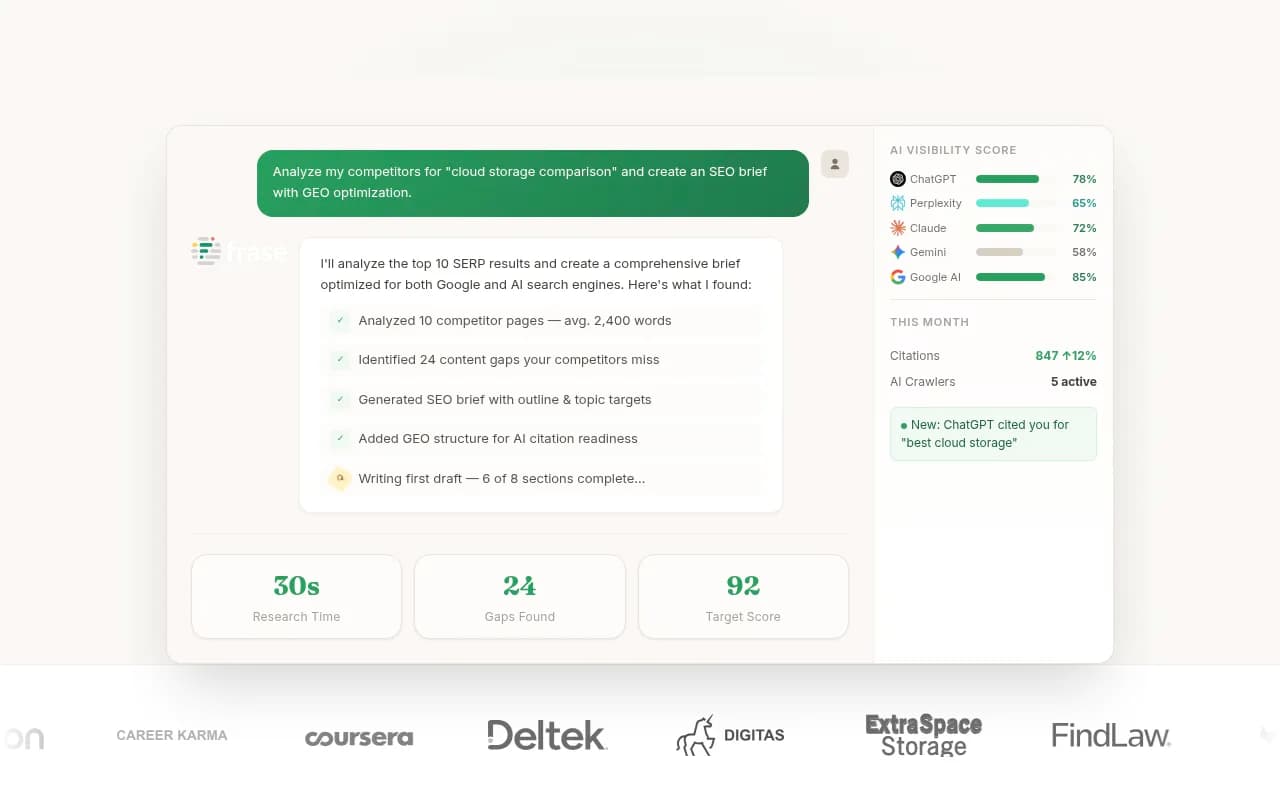
For the page-level SEO checks, content tools like Clearscope, Surfer SEO and Frase can show gaps against what already ranks. Use them for coverage, not as a substitute for the first-hand work in rule 6.
Getting into other people's listicles
Your own list is half the strategy. For commercial prompts, ChatGPT leans on third-party roundups, and Promptwatch's advice from the content type report is to get listed in the "best of" pages ChatGPT cites for your category while also publishing your own comparison pages.
That also fits the domain picture. Mid-authority sites (DR 46 to 75) earned almost half of ChatGPT citations in August 2026, while DR 91 to 100 fell to about 3%. You do not need a giant publication to be a useful source, and the roundup that features you does not need to be on one either.
Also keep in mind that almost half of ChatGPT responses cite 10 or more unique domains. There is room for more than one winner per answer.
How to find which roundups matter
- Run your category prompts in ChatGPT, Perplexity and Google AI Mode.
- Note which listicles get cited, not just which brands get named.
- Check whether you are on them, and what they say about you.
- Pitch the editors with specific data: pricing changes, new features, customer results.
A tracking platform makes steps 1 to 3 repeatable. Promptwatch shows which pages get cited for your prompts, including third-party listicles, and its content gap analysis points to the prompts where competitors appear and you do not.

Other options in the same area include Profound, Peec AI and Otterly.AI, which are mostly monitoring-focused. For a wider browse, the GEO software directory at bestgeosoftware.com lists many more.


A quick comparison of listicle approaches
| Approach | Cited by AI? | Effort | Risk |
|---|---|---|---|
| Generic top 10, no data | Rarely | Low | Looks like every other page |
| Ranked list with sourced numbers | Often | Medium | Needs quarterly updates |
| Ranked list plus original research | Best odds | High | Takes real interviews or tests |
| Self-promotional list, you at #1 | Weak | Low | Readers and models discount it |
| Placement in third-party roundups | Strong on commercial prompts | Medium | Depends on outreach |
Measuring whether it worked
Publishing is not the finish line. Check three things after a few weeks:
- Is the page being crawled by AI bots? Server logs or a crawler analytics view will tell you.
- Is it cited for the prompts you targeted, and at what position in the source list?
- Does the AI answer describe your product correctly?
If a page is crawled but never cited, the content is the problem: thin items, no numbers, no point of view. If it is not crawled, the problem is technical. Google Search Console is useful for the classic side of that check.
Promptwatch's own results back this loop. It tracks crawls, citations and AI-driven traffic per page, so underperforming pages show up as something to fix rather than a vague feeling.
A short checklist before you hit publish
- The title names the category, the audience and the year.
- The first paragraph gives the pick and the reason.
- Every item is numbered and readable on its own.
- Every number has a source or says it came from your test.
- There is a table, a verdict and at least one real customer voice.
- You said who each option is not for.
- A last-updated date is visible and a refresh is scheduled.
The honest summary
The pitch that listicles "run AI search" is overstated. They are one of the three big formats, and the biggest on commercial intent after product and landing pages. They also hold their citations longer than most editorial content. But AI can generate an average list on demand, so the only version worth publishing is the one with real homework behind it: sourced numbers, a clear pick, and at least one voice that is not yours. Do that, refresh it every quarter, and chase a few placements on other people's roundups. For more on the tooling side, the directory at surferstack.com has reviews and alternatives across content and AI visibility software.