Key takeaways
- A citation is not revenue. You need three linked layers: citations (visibility), clicks (referral sessions), and conversions (events tied to money in your CRM or store).
- ChatGPT now shows ads next to organic citations. Tag them separately or your "organic ChatGPT" revenue will be inflated.
- Product pages and landing pages take about 39% of ChatGPT citations, so the pages that get cited are often close to the sale. Segment your reports by page type.
- Not every visit is identifiable. Don't credit unexplained direct traffic to ChatGPT, and don't ignore it either. Use a "how did you hear about us" field as a backstop.
- Treat big conversion multipliers (4.4x, 6.8x) as unverified vendor claims. Measure your own numbers over 90 days.
Why the citation-to-revenue chain breaks
A buyer asks ChatGPT for a recommendation. Your page is cited. Maybe they click, maybe they don't. If they do, they land on your site, and a few days later they might sign up or buy. Four different systems hold pieces of that story: a citation tracker, web analytics, your CRM, and your payment tool. None of them talks to the others by default.
Quattr published an observational analysis of this exact problem. Its finding is blunt: many citations show no revenue at all because the answer satisfies the user without a click. Its suggested fix is to give cited pages a reason to click, like a calculator, a tool, or data the answer can't carry. That is a good frame. Before you build any dashboard, accept that some of your visibility will never be measurable as revenue.
The rest of this guide is about measuring what can be measured, and being honest about the gap.
The three-layer model
Think of it as a funnel with a join key at each step.
| Layer | Question | Data source | Join key |
|---|---|---|---|
| Citations | Which prompts cite which of my pages? | AI visibility platform | Cited URL |
| Clicks | Which ChatGPT visits reach my site, and where do they land? | Web analytics (GA4, Usermaven, etc.) | Landing page URL |
| Conversions | Which of those visits become leads or orders? | Analytics events, CRM, commerce platform | Session or user ID |
The landing page URL is the bridge between layers one and two. If your tracker says /pricing was cited for 40 prompts and analytics says /pricing received 12 ChatGPT sessions, you have a click-through story. If analytics then shows 2 demo requests from those sessions, you have a revenue story.
Step 1: Measure citations with prompt-level data
Start by knowing which of your URLs ChatGPT actually cites, for which prompts, and how often. You can do this manually by running a list of buyer questions each week, but it gets noisy fast, because a single run can land on an outlier day. Check across several days before drawing conclusions.
A dedicated tracker is the sane option. Promptwatch tracks the real ChatGPT interface and shows cited pages per prompt, and its visitor analytics tie AI-referred traffic and conversions back to those pages, which is the join this guide is about. Other tools in the space include Profound, Peec AI, and Athena HQ, which the Evolve Media walkthrough also mentions. Browse the GEO software directory at bestgeosoftware.com or ai-rank-tools.com to compare more.



Whatever you use, export two things: cited URL per prompt, and the prompt's intent (organic, brand-specific, or competitor comparison). You will need both later.
Know which page types earn citations
Promptwatch Data's content type report (Sep 28 to Oct 4, 2026) breaks down what ChatGPT cites:
| Content type | Share of ChatGPT citations |
|---|---|
| Product pages | 22.4% |
| Landing pages | 16.8% |
| Listicles | 13.6% |
| How-to guides | 8.7% |
| Documentation | 7.5% |
| General articles | 6.1% |
| Comparisons | 5.9% |
| News | 5.7% |
| FAQ pages | 3.3% |
| Reviews | 1.7% |
For commercial prompts the skew is stronger: product pages (26.0%), landing pages (20.6%), listicles (15.0%) and comparisons (7.9%) together are almost 70% of citations. This matters for attribution. The pages ChatGPT cites are frequently the ones one click away from a purchase, so conversion rates on these landing pages should differ a lot from your blog traffic. Group your reports by page type or you will average two very different audiences together.
Also keep in mind that citations decay at different speeds. Promptwatch's content half-life report found landing pages and docs stay cited longest while news lost half its cited pages within 36 days. Revenue from a cited news post will be spiky. Revenue from a cited landing page will be steadier.
Step 2: Capture ChatGPT clicks in analytics
Citations only produce clicks if the link survives to your analytics. Some ChatGPT visits arrive with a recognizable referrer or UTM parameter. Others arrive stripped and look like direct traffic, or show up as Bing or an in-app browser, as the Evolve Media video points out.
The practical setup:
- In GA4, check whether recognized assistant visits land in the AI Assistant default channel group (Usermaven notes this exists). Don't rely on it alone.
- Build a custom segment or report filtering on source/referrer containing chatgpt.com, plus any utm_source value ChatGPT appends. Verify the exact values in your own data first, since this guide's research didn't confirm them.
- Report landing pages for that segment, not just sessions.
- Keep unidentified direct traffic as its own bucket. Usermaven's advice is right here: a visit without source evidence stays unknown, and shouldn't be credited to ChatGPT automatically.
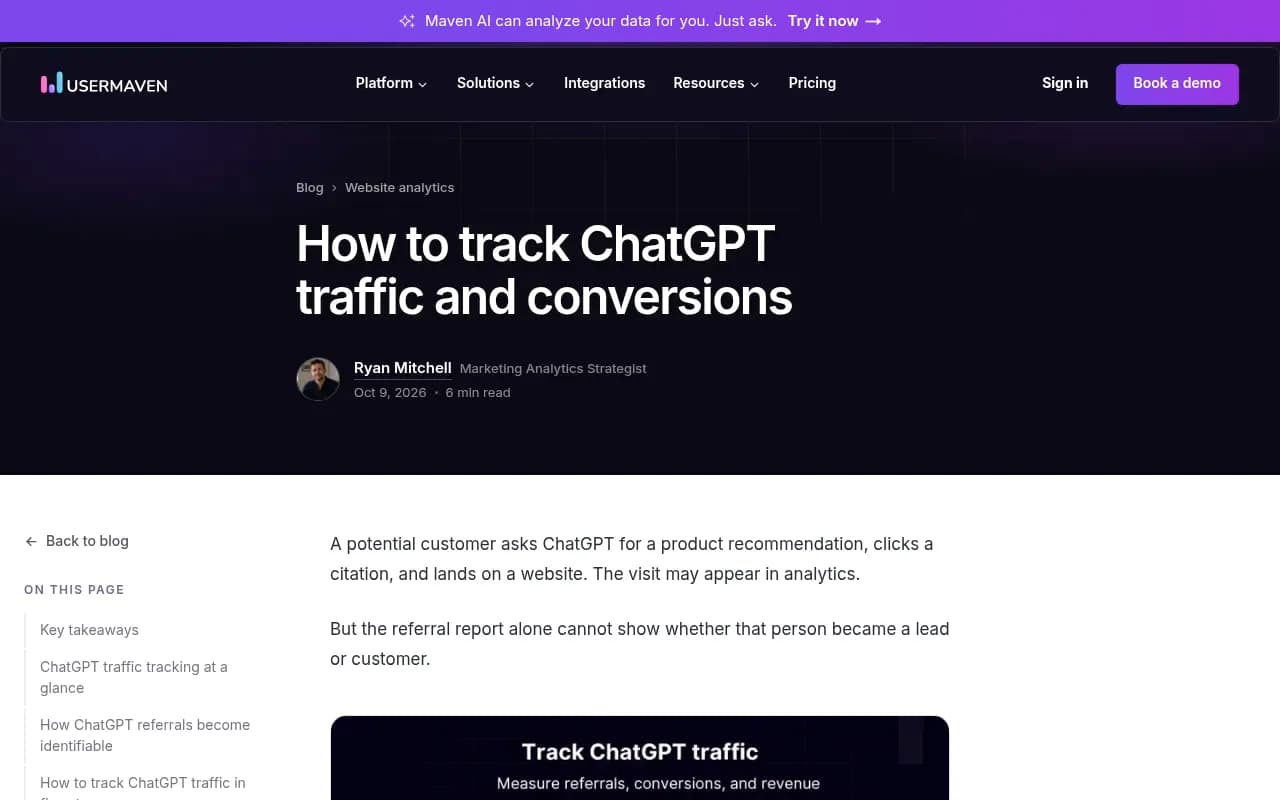
Tools like Usermaven are built around this identification problem and connect visits to later activity. HockeyStack is another attribution option for B2B teams with longer journeys.
Separate paid ChatGPT ads from organic citations
This is the new pitfall of 2026. Promptwatch's ChatGPT ads data covers May 20 to August 17, 2026: ChatGPT served no ads until May 27, then appeared in 1.69% of responses that day. The 90-day average was 20.1% of web-searching responses, with a daily peak of 43.9%. Ads passed 30% on July 1 and stayed mostly in the low 20s to high 30s afterward. The 7-day average at the time of the report was 32.4%.
Those ads show up on organic prompts most of the time. Of ad-bearing responses over the last 7 days, 73.3% were organic prompts, 18.0% brand-specific, and 8.6% competitor comparisons. That's a volume mix rather than the odds that a prompt type triggers an ad, but the takeaway holds: paid and unpaid clicks now come from the same product, often on the same query.
If you run ChatGPT ads, give them their own UTM parameters (for example a distinct utm_medium like paid-chatgpt) and keep your organic filter from matching them. Otherwise ad spend quietly inflates your "organic ChatGPT" revenue number and you will overinvest in citation work that isn't producing what you think. A LinkedIn post by Elizabeth Clark mentions sending conversion events back to OpenAI for ads, but I haven't verified how that API works, so check OpenAI's documentation before building on it.
Step 3: Define conversions that matter
A ChatGPT session that bounces after 8 seconds is not a lead. Decide what counts, and wire it up before you start comparing.
- B2B: demo requests, trial signups, pricing page to contact form, and eventually opportunity created or closed-won in the CRM.
- Ecommerce: orders, AOV, and repeat purchase value. Evolve Media suggests comparing AI-sourced customers by AOV and LTV, which is worth doing since the cohort may differ.
- Content/lead gen: email opt-ins with a source tag.
Push the ChatGPT source onto the lead record. In a CRM such as HubSpot, Salesforce, or Pipedrive, add a field for original source and capture the referrer or UTM on form submit. Without that, revenue closes weeks later and nobody can trace it back.
Note that attributed credit isn't causal lift. Multi-touch reports assign credit to observed touchpoints. They don't prove ChatGPT caused the sale.
Step 4: Add the backstop for invisible traffic
Much AI-influenced demand is never visible as a referral. Someone sees your brand in ChatGPT, then types your name into Google a day later. That shows up as branded organic or direct.
Two cheap fixes:
- Add a "How did you hear about us?" field to forms and checkout, with ChatGPT or AI assistant as a choice (plus a free-text option). Evolve Media recommends this and I agree. It's imperfect, but it catches what referrers miss.
- Watch branded search volume in Google Search Console next to your citation trend. If citations rise and branded queries follow a few weeks later, that's circumstantial evidence worth tracking.
Treat these as directional. Label them that way in reports.
Step 5: Join the layers
Now build the table that answers the question. One row per cited landing page, over a fixed window:
| Page | Page type | Prompts citing it | ChatGPT sessions | Conversions | Revenue |
|---|---|---|---|---|---|
| /pricing | Landing | 40 | 12 | 2 | Pull from CRM |
| /compare/x-vs-y | Comparison | 25 | 30 | 1 | Pull from CRM |
| /blog/guide | How-to | 60 | 9 | 0 | None |
The numbers above are placeholders to show the shape. What you want to read out of your real version:
- Click-through proxy: sessions divided by prompts citing the page. Pages with many citations and few sessions are being answered without a click (Quattr's point).
- Conversion rate by page type, not blended.
- Revenue per cited page, so you know which pages deserve refreshing.
You can do this in a spreadsheet, a BI tool, or by connecting your AI visibility and analytics data through an API or MCP connection. Automation tools like Zapier or n8n can move the exports on a schedule.
Step 6: Don't chase the wrong clicks
Old assumptions about where ChatGPT clicks come from are out of date. Promptwatch's social citations report (Sep 28 to Oct 4, 2026) found social platforms are now just 0.46% of ChatGPT citations. Reddit fell from 5.19% to 0.09% after the August collapse, and LinkedIn is the top social source at 0.3%. Google AI Overviews, by contrast, draws 12.2% of its citations from social, about 26 times ChatGPT's share.
So if you are trying to earn ChatGPT revenue, your own product and landing pages, plus listicles, guides and comparisons, are where the action is. Reddit seeding is a poor bet for this channel right now. It may still matter for AI Overviews, so track each engine separately and don't merge them into one "AI traffic" line.
Step 7: Run a 90-day cadence
Signal takes time. The Evolve Media workflow uses a 90-day rhythm, and it's a sensible one:
- Day 1: baseline citations, ChatGPT sessions, conversions, and your self-reported source data.
- Day 30: first join of the layers. Fix tagging gaps. Expect messy data.
- Day 60: compare conversion by page type. Pick two or three cited pages to improve.
- Day 90: judge the program. Did revenue per cited page move? Did the "heard about us" field mention AI more?
Between checkpoints, turn findings into work. Add a reason to click to cited explainer pages. Refresh the landing pages that get cited. Fix crawler access if your best pages aren't being read at all. Promptwatch includes AI crawler logs and an Action Board for this, but a spreadsheet and discipline also work.
What to be skeptical about
You'll see claims that AI search traffic converts 4.4x better than organic, or that ChatGPT clicks convert 6.8x higher than Google organic. Those come from a vendor blog and a social post, not controlled studies, and none of Promptwatch's data contains conversion-rate figures. Your own audience may differ. Smaller, higher-intent traffic often converts well, but run your numbers before you promise anyone a multiplier.
Also keep in mind CXL's caution, drawing on Semrush clickstream data: ChatGPT enabled web search on only 34.5% of observed queries in February 2026. A lot of ChatGPT usage never produces a citation to measure at all.
Quick tool map
| Job | Option types | Examples |
|---|---|---|
| Citation and prompt tracking | AI visibility platforms | Promptwatch, Profound, Peec AI, Athena HQ |
| Referral and conversion analytics | Web analytics and attribution | GA4, Usermaven, HockeyStack |
| Revenue source of truth | CRM and commerce | HubSpot, Salesforce, Pipedrive |
| Data movement | Automation | Zapier, n8n |
| Branded demand signal | Search data | Google Search Console |
For more options, the AI rank tracking directory and SurferStack list reviews and alternatives.
The short version
Track citations by URL, capture ChatGPT sessions by landing page, tag paid ads separately, push the source into your CRM, and ask customers how they found you. Then join it all by page and page type over 90 days. You will end up with a table, not a certainty. That table still beats counting mentions.