Key takeaways
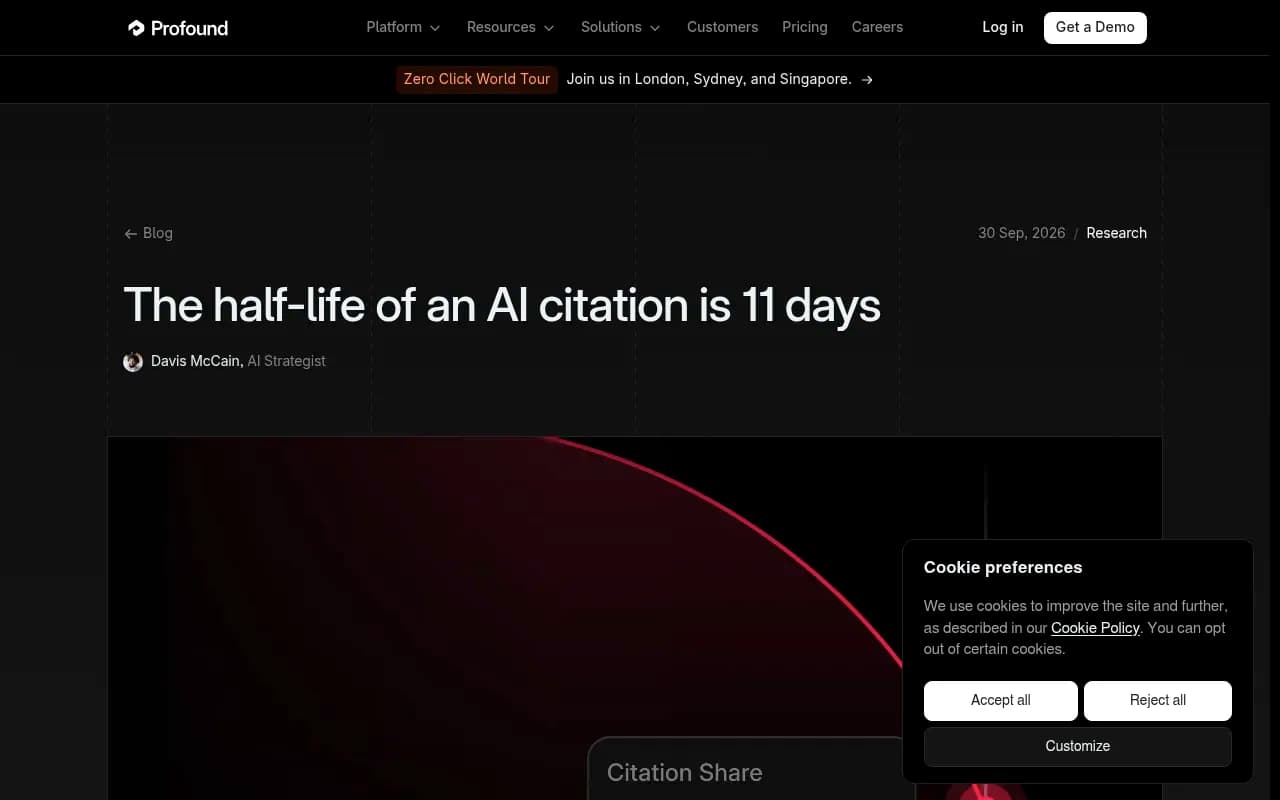
- Most AI citations are short bursts. Profound found that 78% of cited pages drop to half their peak citation share within 14 days of peaking, with an 11-day median.
- Promptwatch Data measures something different for ChatGPT: whether a page gets cited again at all. By that measure, landing pages, docs and comparisons hold for 60+ days, while news loses half its pages in 36 days.
- Both findings are true. "Share fades fast" and "the page still gets cited sometimes" describe different things.
- A sensible re-check rhythm: weekly for news and event pages, every two weeks for guides and listicles, monthly for product and comparison pages, quarterly for docs and landing pages.
- A citation is rented, not owned. Plan refreshes the way you plan any recurring cost.
Why citation half-life matters
SEO trained us to expect that a ranking, once earned, sticks around. You publish, you earn links, you hold position for months. AI search does not behave that way, and the numbers are blunt about it.
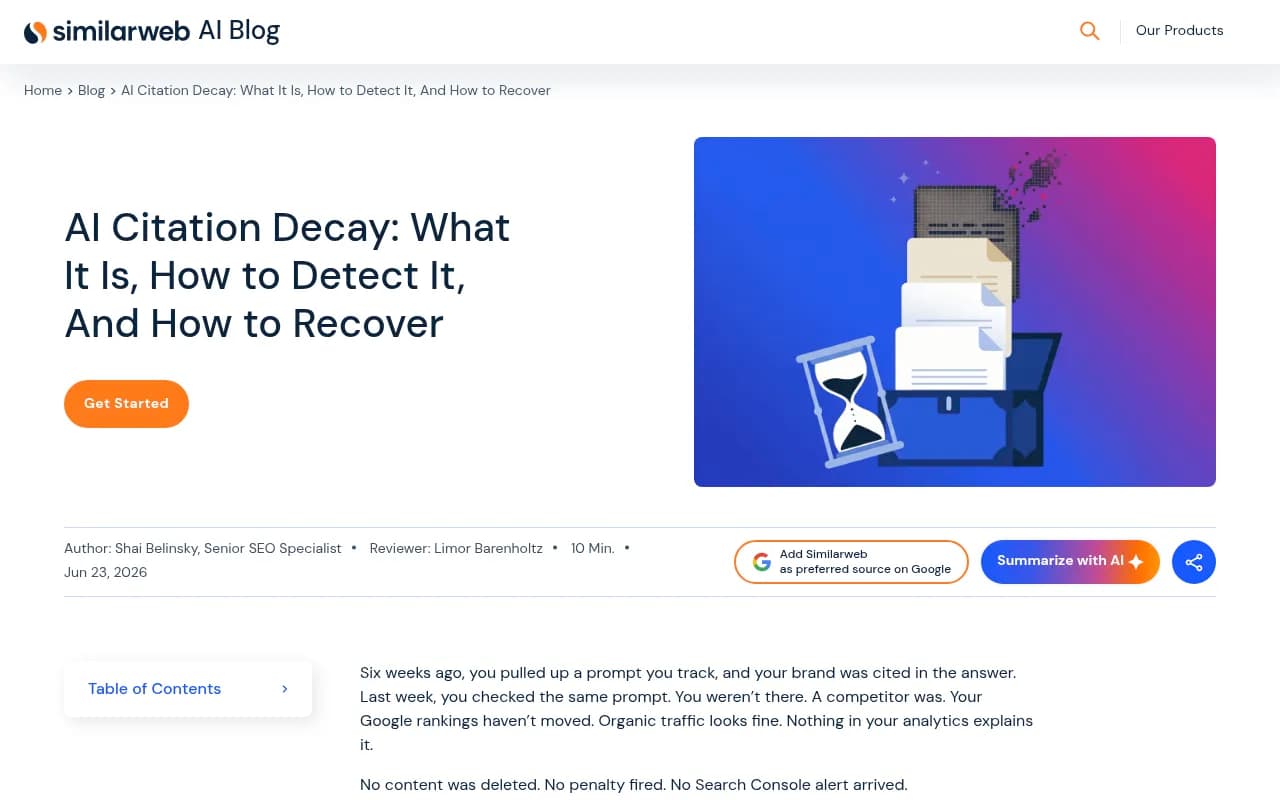
If you checked a prompt six weeks ago, saw your brand cited, and then found a competitor there last week, nothing broke. No penalty, no deleted page, no Search Console alert. The answer was simply rebuilt, and your page lost its slot. Similarweb's write-up on citation decay describes exactly this scenario, and it cites the AirOps 2026 State of AI Search report: only 30% of brands show up consistently when the same prompts are run back to back.
So the practical question is not "how do I get cited" but "how long will it last, and when do I look again?" Different studies give different answers, and the differences are worth understanding before you set a monitoring schedule.
What half-life actually means (it depends on who measures it)
The term is borrowed from physics, and even librarians use a version of it (the Journal Citation Reports' "cited half-life" is the median age of a journal's cited articles). In AI search, three definitions are in circulation.
Share-based half-life (Profound)
Profound tracks a page's citation share per day, smooths it over a trailing 14-day window, finds the peak, and counts the days until the share falls to half of that peak and stays there for 14 days. It covered 883,000 pages across seven engines over twelve months, which gives 1.19 million page and engine lifecycles.
This definition is harsh. A page that is cited 100 times on its best day and 40 times a day later has decayed, even though it is still being cited.
Survival-based half-life (Promptwatch Data)
Promptwatch took every classified page ChatGPT cited on July 6, 2026 and tracked which of them ChatGPT still cited, on that day or later, through October 4 (90 days). The half-life is where the share of surviving pages crosses 50%. The question is binary: is the page ever cited again? You can read the full dataset in Promptwatch's ChatGPT content half-life report.

Time-to-first-citation and platform averages
Other sources measure different clocks. Similarweb puts the median citation half-life at 4.5 weeks, with ChatGPT at 3.4 weeks, Gemini at 4.6 and Perplexity at 5.8. A LinkedIn post from Joshua Blyskal puts median time from publishing to a ChatGPT or Claude citation at 6.81 days, with 75% of pages cited within 18.68 days. Neil Patel's summary of similar data says 44% of sources get cited exactly once and the median citation lasts 11 to 15 days.
None of these are wrong. They answer different questions, so don't average them.
What the data says, side by side
| Source | What it measures | Headline number | Scope |
|---|---|---|---|
| Profound | Days for 14-day-smoothed citation share to fall to half its peak | 11 days median; 78% within 14 days | 7 engines, 883K pages |
| Promptwatch Data | Share of day-0 cited pages still cited later | Most page types hold 60+ days; news half-life 36 days | ChatGPT, 90-day cohort from July 6, 2026 |
| Similarweb | Citation half-life by platform | 4.5 weeks median; ChatGPT 3.4 weeks | Multi-platform |
| Green Flag Digital | Top-cited finance pages, Oct 2025 vs Sep 2026 | 50% of 215 pages now get zero citations | ChatGPT, finance |
| DerivateX (citing Semrush) | Share of new pages cited within 30 days | 42% | ChatGPT |
The reconciliation is simple. Profound asks how long a page stays as prominent as it was at its best. Promptwatch asks whether it shows up at all. A page can lose most of its share in two weeks and still pick up occasional citations for three months. Both can be true at once.
The Profound findings worth remembering
Most citations are single events
Of 1.11 million page and engine pairings observed for at least two weeks past their peak, 78% had a half-life of 14 days or less. Because Profound averages over a rolling two-week window, a single burst of citations holds a page's share up for about two weeks and then it falls away. The remaining 22% are sustained pages with a median half-life of 27 to 29 days.
The explanation is the breadth of the source pool. When AI can pick from a huge set of pages, the odds that any given page gets chosen a second time are low.
Engines do not move together
Cross-engine correlations in decay timing run between 0.03 and 0.09, which is close to nothing. Among sustained pages, a Claude citation is 2.8 times as likely as a ChatGPT citation to still carry half its peak share eight weeks later. Perplexity and Claude return to the same page repeatedly across weeks (62% and 63% of sustained pages), while ChatGPT, AI Mode and Gemini tend to cite a page intensively for a few days and move on.
Practical consequence: a ChatGPT check tells you nothing about Claude or Perplexity. Track each engine on its own.
Breadth predicts durability
| Engines citing the page | Pages | Median rise | Still above half-peak at day 56 |
|---|---|---|---|
| 1 | 679,077 | 19 days | 1.2% |
| 2 | 275,530 | 31 days | 2.0% |
| 3-4 | 190,439 | 33 days | 3.5% |
| 5 or more | 43,770 | 46 days | 6.8% |
Pages cited by five or more engines are 5.5 times as likely to still be above half their peak at eight weeks. Even so, 6.8% is small. Durability is rare everywhere.
Date-tied pages fade first
Pages tied to a date or event decay fastest. Everything else holds at roughly 1.4 to 1.6 times their rate.
How long each page type stays cited in ChatGPT
This is where the Promptwatch cohort data gets useful for planning. It breaks survival down by content type.
| Content type | Still cited after 30 days | Still cited after 60 days | Notes |
|---|---|---|---|
| Landing pages | 78% | 69% | Likely 90+ day half-life |
| Docs | 76% | 67% | 93% were cited again after day 0 |
| Comparisons | 72% | 63% | Likely close to or beyond 90 days |
| Listicles | n/a | 60% | Likely close to or beyond 90 days |
| Product pages, reviews, how-tos | n/a | 55% | Half-life of 74 to 77 days |
| News | n/a | 41% | Half gone after 36 days; almost a quarter never cited again |
A caveat from the report itself: every line drops in the last week because the window ends and there are fewer days left for a page to be cited again. So landing pages, docs, comparisons and listicles should be read as "90+ days," not as a measured number. Pricing pages are classified as landing or product pages.
The broader citation-mix data points the same way. Product pages are the most cited type in ChatGPT at 22.4% of citations (Sep 28 to Oct 4, 2026), followed by landing pages and listicles, per Promptwatch's content type report. So the type that gets cited most is not the type that lasts longest. Product pages decay about as fast as how-tos.
Decay at the top: what happened to last year's winners
Green Flag Digital looked at the 250 most-cited pages in ChatGPT from October 2025 (215 had usable data) and checked them again eleven months later. The result is sobering:
- 107 of the 215 finance pages (50%) now get zero ChatGPT citations.
- The group kept 14% of its citations, and only 8 pages grew.
- Only 34 of 435 pages (8%) from the October 2025 top 500 are still in the top 500.
- Chase went from 4 cited pages to 63 across its subdomains, and bank, card issuer and government pages rose from 2% to 28%.
- The 20 pages with 2024 or 2025 in the URL fared worst: 80% went to zero.
That is a finance-specific study, so don't generalize too far. But the lesson is clear: a citation is rented, not owned, and primary sources tend to take space back from intermediaries.
A freshness caveat
It would be easy to read all this as "publish constantly." The data doesn't say that. DerivateX cites Ahrefs' April 2026 dataset showing the median cited ChatGPT source is around 500 days old, with some cited pages over 2,700 days old. It also cites Semrush data that only 42% of newly published pages get cited within 30 days, and that after 90 days without a citation the chance of ever being cited drops sharply.
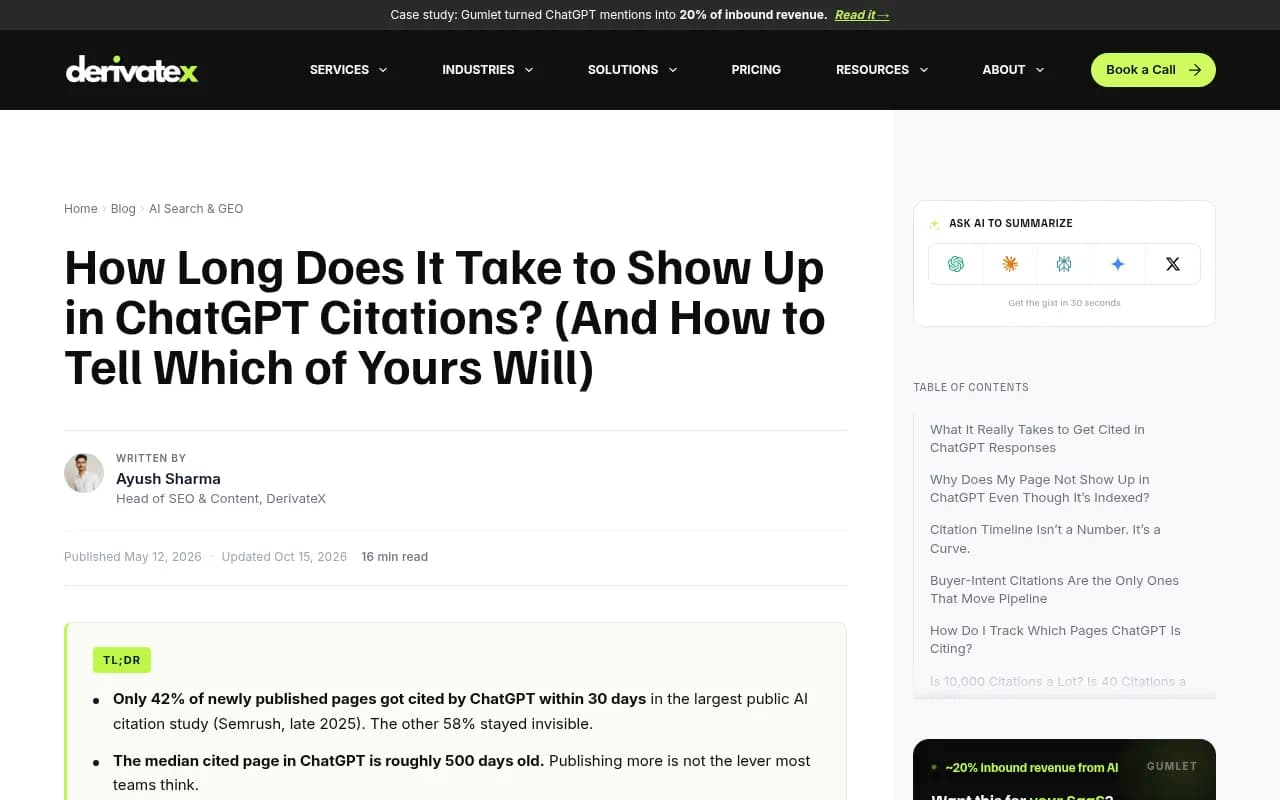
So old pages can be cited, new pages often are not, and the fix for an uncited page is usually structural (title, URL, a direct answer near the top of the page), not a new publish date. Updating facts that have actually changed is different from touching a date to look fresh.
How often to re-check: a practical schedule
The right rhythm follows the decay profile of each page type. Here is a schedule I would actually use.
| Page type | Re-check cadence | What to look for |
|---|---|---|
| News, press, event pages | Weekly | Expect fast loss; use them for short bursts, not baseline visibility |
| Guides, how-tos, reviews | Every 2 weeks | Half-life around 74 to 77 days in ChatGPT, but share can fade sooner |
| Product pages | Monthly | Specs, availability and prices going stale |
| Listicles and comparisons | Monthly | Competitors entering or leaving; refresh before they drop out |
| Landing pages, pricing, docs | Quarterly | Accuracy of prices, features and positioning |
| Any page, any type | Immediately after a model update or a sudden share drop | Check whether it is a platform change or your content |
A few rules that go with it:
- Check engines separately. Because cross-engine decay correlations are near zero, a stable ChatGPT result says nothing about Perplexity or Claude.
- Use a rolling window, not a single run. AI answers vary between runs, so one missed citation is noise. Three consecutive misses across a week or two is a signal.
- Set a recovery trigger. If a high-value page loses its citations, Similarweb suggests recovery typically takes 6 to 12 weeks depending on the gap and category competitiveness, so start early.
- Treat 90 days uncited as a red flag. After that, DerivateX's read of the data is that structural rewrites matter more than waiting.
- Put your cited pages on a refresh calendar. Green Flag's advice to check cited pages quarterly is the floor, not the ceiling.
Detecting decay before it costs you
The hard part of decay is that nothing in standard analytics flags it. Your rankings hold, organic traffic looks normal, and the loss only shows up if you are watching the prompts themselves.
What you need is page-level tracking over time: which of your URLs are cited, on which engine, for which prompts, with a history. Tools like Promptwatch can track which pages ChatGPT keeps citing and flag listicles and guides that need a refresh before they drop out. Its crawler logs also help you see whether AI bots are still reading the page at all, which separates "not cited" from "not crawled."
Other options in the same space include:


A basic tracker that only answers "was my brand mentioned?" will tell you that decay happened. It will not tell you which page decayed, to whom you lost it, or whether the fix worked. For a wider view of the category, the GEO software directory at bestgeosoftware.com lists the options.
A recovery playbook when a page decays
- Confirm it is real. Re-run the prompts several times and on multiple engines. One missing citation proves nothing.
- Check access. Make sure AI crawlers can still reach the page and that it returns no errors. Crawler logs make this a five-minute check.
- Look at who replaced you. Often it is a primary source or a fresher, more specific page. Compare structure, not just word count.
- Fix what changed. Update prices, specs, dates that matter, and the first paragraph so it answers the prompt directly.
- Add breadth. The Profound data suggests pages cited on five or more engines last far longer, so look for the engine where you have no presence and ask why.
- Pair evergreen with bursts. Use news and press coverage for spikes, and landing pages, docs and comparisons as the durable base.
- Re-measure at the cadence in the table above, not in a month of silence.
What to take from all this
Two things can be true. Citation share in AI search is short-lived: Profound's 11-day median and the fact that 78% of pages are one-time bursts make that clear. And in ChatGPT specifically, most page types still get cited again for 60 days or more, with landing pages, docs and comparisons the safest bets and news the weakest.
So don't build a strategy around any single half-life number. Build it around page types, track each engine separately, and re-check on a schedule that matches how fast each type fades. For raw data on how ChatGPT's citations are shifting, the Promptwatch Data hub is updated regularly. And if you take only one action this week: pull a list of the pages you know were cited 90 days ago and see how many still are.