Key takeaways
- Start with the goal, not the price. A tracker that only reports mentions is a different purchase from one that also helps you fix gaps.
- Under roughly $50 a month, tools like Otterly.AI and Airefs cover solo founders and early tests. Treat the listed prices as unverified until you check each vendor's pricing page.
- Whatever you buy, it should report cited domains and co-cited competitors, and let you split prompts into organic, brand and comparison types.
- Most trackers shift results after ChatGPT model changes. Annotate those changes so you don't blame your content.
- Run a free manual baseline of 30 to 50 buyer prompts before paying for anything.
Why the tracker choice matters more than it looks
Search for "track ChatGPT citations" and nearly every page that ranks is written by a vendor selling a tracker. One of the roundups I read ranks its own product fifth of five, which is refreshingly honest. Most of the others put themselves first without saying so. Keep that in mind with every comparison, including this one: pricing figures in vendor listicles are claims, not facts.
So this guide doesn't crown a winner. It gives you a decision tree. Three questions, in order: what is the budget, how big is the team, and what job do you need done.
What a citation tracker actually measures
Every tool in this category does the same core thing. It runs a fixed set of prompts against AI engines on a schedule, saves the answers, and extracts two signals.
- Mentions: did the engine name your brand, and in what context?
- Citations: which source URLs did it link to or draw from?
Roll those up and you get citation share, the percentage of tracked prompts where you appear versus competitors. Everything else is convenience on top: dashboards, alerts, content suggestions.
The citation side is the part people underuse. According to Promptwatch Data (ChatGPT responses with citations, Sep 28 to Oct 4, 2026), 47.6% of responses cite 10 or more unique domains, and for organic prompts with no brand named that rises to 52.5%. For brand-specific prompts the most common count is 5 domains, and only 21.3% of responses cite 10 or more. That tells you something practical: if your tracker only says "you were mentioned: yes or no," you're missing the ten other domains sitting in the same answer.
Step 0: run a free baseline first
Before paying for anything, do it by hand. Write 30 to 50 prompts a buyer would plausibly type. Mix three types, because ChatGPT behaves differently on each:
- Organic prompts, no brand named ("best project management software for small teams")
- Brand-specific prompts ("is [your brand] good for small teams")
- Competitor comparisons ("[you] vs [competitor]")
Log whether you're mentioned, whether your domain is cited, who else is cited, and the position in the answer. It takes an afternoon. You'll learn which questions you actually care about, which makes every demo you sit through sharper. Free options exist too: RightChoice.Ai and AI Rank Checker offer free checks, and Geoptie advertises a free ChatGPT tracker.
The decision tree
Question 1: what is your monthly budget?
Under $50. You're a solo founder, a tiny team, or still testing whether AI search matters for you. Look at Otterly.AI (listed around $29 a month in vendor roundups) and Airefs (listed around $24 a month). Otterly covers ChatGPT, Perplexity, Google AI Overviews, Gemini and Copilot at the prompt level. Airefs bundles some content help. The catch with cheap plans is prompt counts and refresh frequency, so read those limits closely. Also worth a look at this tier: PromptRush (daily scans from $19 a month) and Dageno AI, which has a free plan.

$50 to $300. This is where focused monitoring tools and the SEO-suite add-ons live. Ahrefs Brand Radar (listed around $199 a month) suits teams already working inside Ahrefs. Scrunch (around $250) and AthenaHQ (around $295) are positioned at brand and marketing teams. Peec AI and LLMrefs sit in the lean-monitoring camp.

$300 and up. You're paying for execution, multiple projects, or enterprise needs like SSO and audit logs. Profound is the usual enterprise name. Promptwatch lands here too, with a Business plan at $579 a month, but it has cheaper entry points as well (Essential at $95, Professional at $245), so it appears in more than one bracket.


Question 2: how big is the team?
Solo or two people. You need low setup time and a small, readable dashboard. You don't need seats, roles or approval flows. Pick on price and on whether the tool tracks ChatGPT at the real interface level. Be wary of anything that makes you configure ten integrations before you see a single answer.
A marketing team of 3 to 15. Now sharing matters: multiple seats, scheduled reports, Slack delivery, a way to hand findings to a writer. This is also where the question shifts from "are we cited?" to "who owns fixing it?" Tools with a task board or action list earn their keep here, because dashboards nobody acts on are just expensive wallpaper.
An agency. You need unlimited or high project counts, white-label reports and client access. Promptwatch's agency plans start at $199 a month (Kick-off) with unlimited projects and 10 seats. Slate positions itself at agencies as well, and Cairrot targets agencies on a budget with multi-LLM tracking.
Enterprise. You'll care about security reviews, SSO, audit logs and data volume. Promptwatch is ISO/IEC 27001 certified and GDPR compliant, which tends to matter in procurement. Others to evaluate: Bluefish AI, Brandlight, Conductor, BrightEdge and seoClarity if you want it inside an existing enterprise SEO suite.
Question 3: what is the goal?
This is the question people skip, and it's the one that matters most.
Goal: know where we stand. You want a share-of-voice number and a trend line. A pure monitor is fine. Otterly.AI, Peec AI, LLMrefs and similar tools do this well enough.
Goal: understand why we're not cited. Now you need more than answers. You need to see whether AI crawlers can even reach your pages, which pages get cited, and what sources dominate your category. Crawler logs and page-level citation data are the differentiators here, and most lightweight trackers don't have them. Promptwatch includes IP-verified AI crawler logs, citation analytics and visitor analytics for AI-referred traffic.
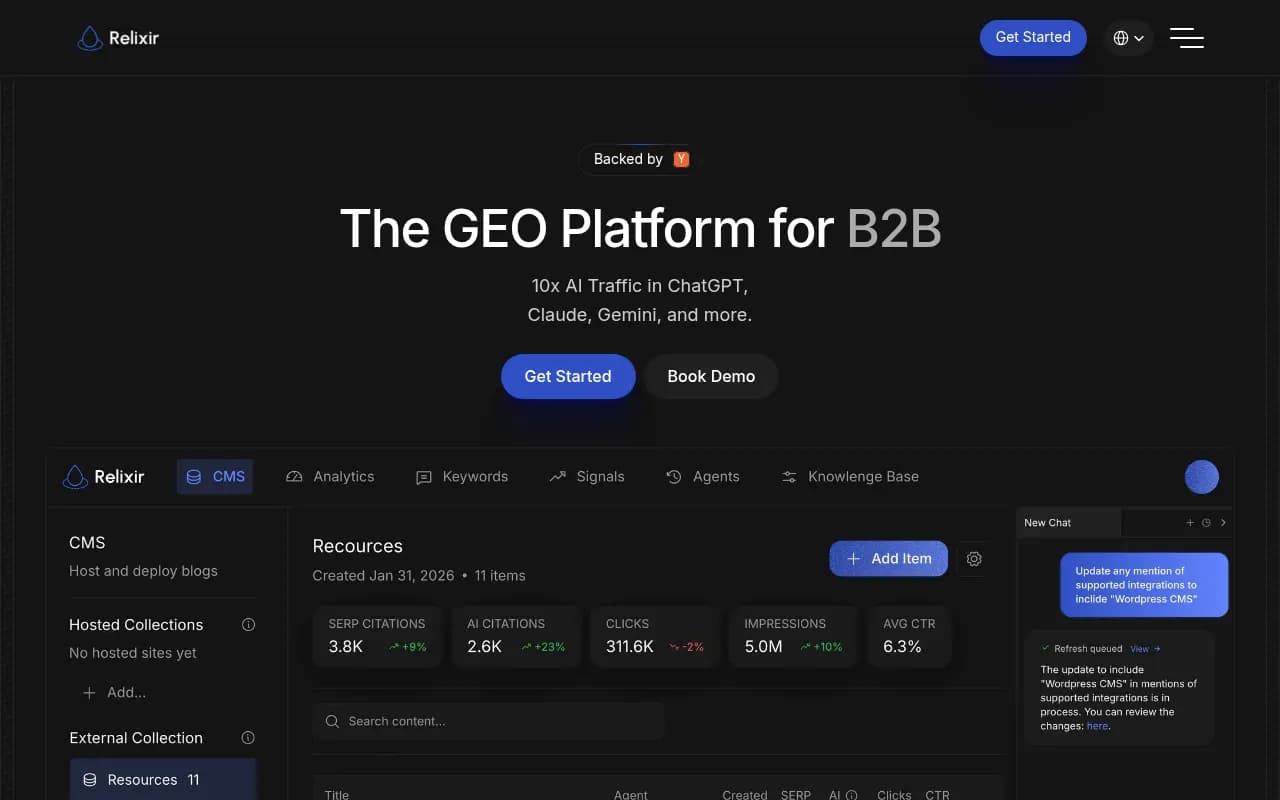
Goal: fix it. You want content produced against the gaps. Options include Promptwatch's Content Agent (Business plan and above), which plans, writes and publishes to Webflow, Framer or WordPress, as well as Slate, Airefs and Relixir. Pair any of these with human editing. Auto-published content that nobody reviews is a risk.
Goal: prove revenue. Mentions don't pay anyone's salary. You want AI-referred sessions and conversions tied to pages. Look for visitor analytics or a GA4 workflow, and for tools that connect citations to traffic, such as XFunnel or Promptwatch.

Comparison table
Prices are as listed in vendor roundups and vendor materials, not independently verified. Confirm on each pricing page.
| Tool | Typical entry price | Best for | Goes beyond monitoring? |
|---|---|---|---|
| Airefs | ~$24/mo | Founders, lean teams | Yes, content generation |
| Otterly.AI | ~$29/mo | Solo, early testing | Light GEO guidance |
| Ahrefs Brand Radar | ~$199/mo | Teams already in Ahrefs | Limited |
| Scrunch | ~$250/mo | Brand teams | Agent delivery layer |
| AthenaHQ | ~$295/mo | Marketing teams | Recommendations |
| Slate | ~$499/mo | B2B SaaS, agencies | Yes, workflows and CMS publishing |
| Promptwatch | $95/mo (Essential) to $579/mo (Business) | Teams that want tracking plus the fix | Yes, Content Agent, Action Board, crawler logs |
| Profound | Custom | Enterprise | Monitoring-heavy |
What to demand from any tracker
Whatever your branch of the tree, five features separate a useful tool from a toy.
- Real interface data. Answers and citations from the actual ChatGPT interface can differ from API outputs. Ask the vendor which one they capture.
- Cited domains and co-cited competitors, not only brand mentions. Given that about half of ChatGPT responses cite 10 or more domains, you need to see the rest of the cast.
- Prompt type splits. Organic, brand and comparison prompts behave differently, so your reports should too.
- Position and description. Promptwatch's own advice from its domains report is to track where you appear and how ChatGPT describes you, not only whether you're cited.
- Volume of prompts. One prompt tells you almost nothing. Measure across many.
Watch out for noise that isn't your fault
ChatGPT changes behavior in steps. Promptwatch's query fanout data shows average searches per response falling from 2.15 in early December to about 1.84 by early March, and average query length dropping from about 117 characters to the high 80s over the same stretch. Separately, Promptwatch Data recorded ChatGPT's use of the site: operator jumping from about 0.4% to about 17% of fanout queries on August 8, 2026. And Reddit's share of ChatGPT citations fell from roughly 4% to 0.5% on August 14, 2026.
The lesson: your visibility score can move without you touching a page. Keep a simple change log of model updates next to your weekly numbers. Otherwise you'll spend a month rewriting content to fix a problem that was a platform shift.
Quick recommendations by scenario
| Scenario | Start here |
|---|---|
| Solo founder, testing the waters | Free checks, then Otterly.AI or Airefs |
| Small SaaS team, wants fixes | Promptwatch Essential or Professional, or Slate |
| Already live in Ahrefs | Ahrefs Brand Radar as a first layer |
| Agency with many clients | Promptwatch agency plans, Slate or Cairrot |
| Enterprise with security review | Promptwatch Enterprise, Profound, Bluefish |
| Need a broader shortlist | GEO software directory or AI rank tracking tools |
A sensible rollout
Week one: manual baseline, 30 to 50 prompts. Week two: trial one or two tools with the same prompt set and compare what each captures. Most paid plans offer a trial, and Promptwatch has a 7-day free trial on its monthly Essential and Professional plans. Week three: choose, wire up reporting, and pick three gaps to fix. Month two onward: track six things monthly, namely mention rate, citation rate, share of voice, sentiment, source diversity and AI referral traffic.
The honest summary is that cheap trackers answer "are we in the answer?" and pricier ones answer "why not, and what do we do next?" Decide which of those two questions is actually costing you sleep, and the tree mostly picks the tool for you.