Usermaven Review 2026
Analytics tool for growing businesses to track user behavior, conversion funnels, and product usage metrics to inform GTM strategies.
Summary
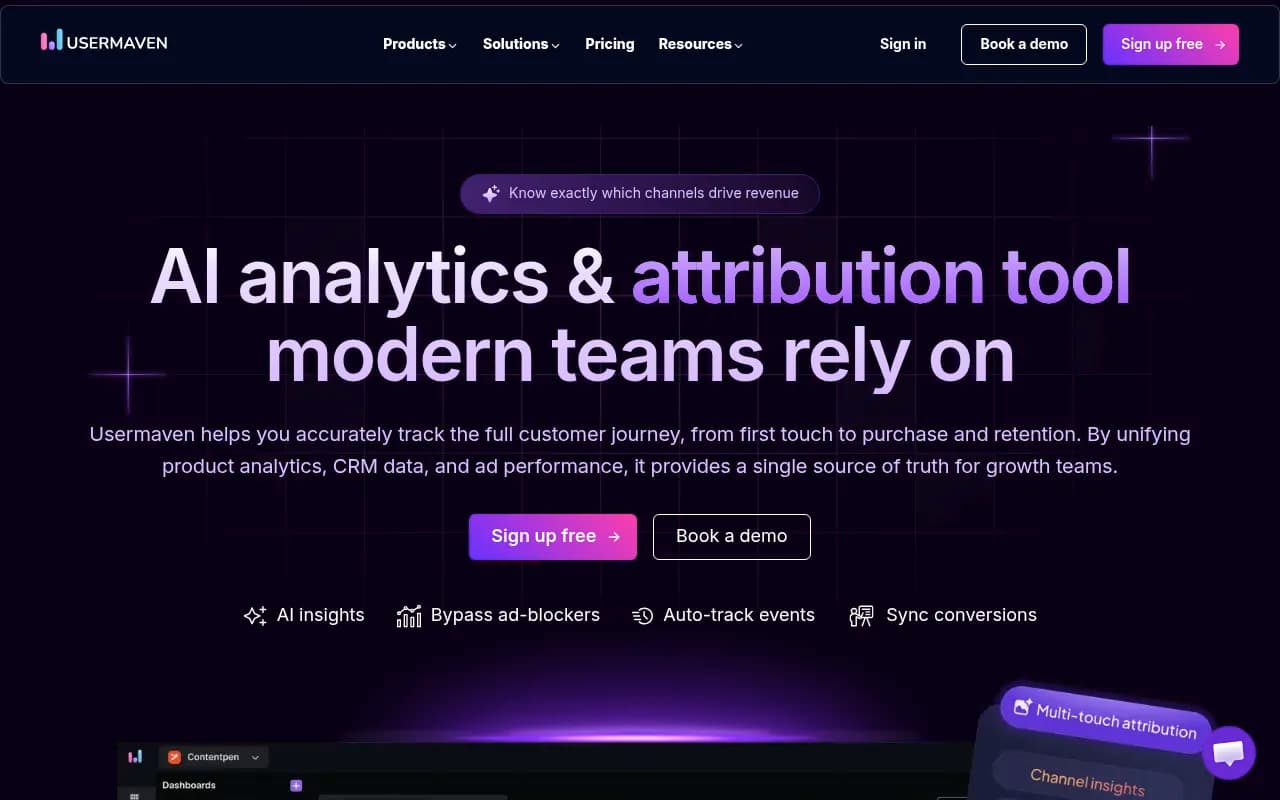
Usermaven is a combined attribution and product analytics platform built for marketing teams, agencies, and SaaS companies who need to connect every touchpoint to revenue. It tracks the full customer journey -- from anonymous visitor to product-activated user to high-value customer -- using multi-touch attribution, auto-event tracking, and AI-powered insights. The platform addresses a core problem most analytics tools ignore: you can see where traffic comes from OR how users behave in your product, but rarely both in one place. Usermaven unifies these data streams so you can answer questions like "which campaigns bring power users?" and "which features drive retention?" without stitching together multiple tools.
The platform launched as a privacy-focused Google Analytics alternative but has evolved into something more ambitious: a complete growth analytics stack that replaces GA4, Mixpanel, and attribution tools like Rockerbox or HockeyStack. It's particularly strong for SaaS companies running paid acquisition campaigns who need to track users from ad click through signup, onboarding, feature adoption, and renewal. The team is based in the Netherlands (Usermaven B.V.) and the product is hosted exclusively in the EU for GDPR compliance.
Key features (detailed breakdown)
Multi-touch attribution with seven models: Usermaven offers first-touch, last-touch, linear, time-decay, U-shaped, W-shaped, and custom attribution models. You can switch between models in real-time to see how credit shifts across channels. The platform tracks UTM parameters, referrers, organic search terms, and paid campaign data, then connects those touchpoints to conversions and revenue. Unlike last-click attribution in GA4, multi-touch shows you the full journey -- for example, a user might discover you via organic search, return through a LinkedIn ad, and convert after reading an email. Usermaven attributes partial credit to each touchpoint based on the model you choose. The attribution data syncs with CRM systems (HubSpot, Salesforce, Pipedrive) so you can tie marketing spend to actual deal value and customer LTV, not just form submissions.
Auto-event tracking (no-code setup): This is the feature that sets Usermaven apart from tools like Mixpanel or Amplitude. Instead of manually instrumenting every button click, form submission, or page view, Usermaven's JavaScript SDK automatically captures all user interactions on your website or web app. You install one script tag and the platform starts tracking pageviews, clicks, form submissions, file downloads, and custom events without writing code. You can then "pin" specific events (like "clicked pricing page" or "completed onboarding step 3") to create custom metrics. For SaaS products, this means you can track feature usage, onboarding completion rates, and activation milestones without waiting on engineering. The auto-tracking works for both marketing sites and logged-in product experiences, giving you a unified view of the entire funnel.
Product analytics suite: Usermaven includes funnels, user journeys, cohort analysis, retention curves, and trend reports. Funnels show you where users drop off in multi-step flows (signup, onboarding, checkout). User journeys visualize the paths people take through your product, surfacing common patterns and unexpected detours. Retention analysis tracks how many users come back after their first session, broken down by cohort (e.g. users who signed up in January vs February). Trends let you plot any metric over time and segment by user properties, traffic source, or behavior. These features are table stakes for product analytics tools, but Usermaven's advantage is that they're connected to attribution data -- you can see retention rates by acquisition channel, or funnel performance by campaign source.
Contacts Hub and segmentation: Every visitor and user gets a profile in the Contacts Hub, which stores behavioral data, UTM parameters, device info, location, and custom properties you send via API. You can segment users by any combination of attributes -- for example, "users from paid search who completed onboarding but haven't used Feature X" or "companies with 10+ seats who visited the pricing page twice." Segments update in real-time and can be used across all reports (funnels, journeys, retention). The Contacts Hub also syncs with CRMs, so you can enrich marketing automation workflows with product usage data. For example, trigger an email to users who haven't logged in for 14 days, or flag high-intent leads who viewed your enterprise features page.
AI-powered insights (Maven AI): Usermaven's AI assistant analyzes your data and surfaces anomalies, trends, and optimization opportunities. It answers natural language questions like "which campaigns drove the most signups last month?" or "why did our conversion rate drop on Tuesday?" and provides follow-up suggestions. The AI also powers automated funnel analysis (it identifies drop-off points and suggests fixes) and attribution recommendations (it highlights underperforming channels and reallocates budget). This isn't a chatbot that queries your database -- it's a layer of intelligence that proactively flags issues and opportunities you might miss in manual analysis. The AI features are newer (rolled out in 2025) and still evolving, but early users report they save hours of manual digging.
Adblocker bypass and accurate tracking: Usermaven uses pixel white-labeling and server-side tracking to bypass adblockers, which block 25-40% of client-side analytics scripts. The platform routes tracking requests through your own domain (e.g. analytics.yourdomain.com) so they look like first-party traffic. This dramatically improves data accuracy compared to GA4 or other tools that rely on third-party scripts. Usermaven claims 99% tracking accuracy, which is a bold number but backed by the fact that their tracking infrastructure is designed to evade iOS privacy restrictions and browser extensions like uBlock Origin. For paid acquisition teams, this is critical -- if you're missing 30% of conversions, you're making budget decisions on incomplete data.
Pre-built dashboards for SaaS and e-commerce: Usermaven ships with templates for common use cases: SaaS onboarding metrics, WooCommerce sales funnels, paid traffic performance, and product engagement. These dashboards are fully customizable but give you a starting point instead of building reports from scratch. For example, the SaaS dashboard tracks signups, activation rate, feature adoption, churn, and MRR by cohort. The WooCommerce dashboard shows cart abandonment, average order value, and revenue by traffic source. You can clone these templates and tweak them for your specific KPIs.
Integrations and ecosystem: Usermaven integrates with Google Search Console (for organic keyword data), Google Ads, Facebook Ads, HubSpot, Salesforce, Pipedrive, Slack (for alerts), Zapier, and Segment. The platform has a REST API for custom integrations and data exports. You can also push data to Looker Studio for custom reporting. The JavaScript SDK works with React, Vue, Next.js, and vanilla HTML sites. There are plugins for WordPress, Shopify, Bubble, and Squarespace. Server-side SDKs are available for Node.js and Python, which let you track backend events (like subscription renewals or API usage) alongside frontend interactions.
Privacy and compliance: Usermaven is GDPR and CCPA compliant, hosted in the EU (AWS Frankfurt), and offers cookieless tracking. You can anonymize IP addresses, respect Do Not Track signals, and configure data retention policies. Users can request data exports or deletion at any time. The platform doesn't sell or share data with third parties. For companies that need to avoid Google's data practices, Usermaven is a strong alternative -- it's fully owned by you, not a surveillance capitalism giant.
Who is it for
Usermaven is built for three main personas. First, SaaS marketing teams at companies with 10-200 employees who run paid acquisition campaigns and need to prove ROI. These teams are tired of stitching together GA4 (for traffic), Mixpanel (for product usage), and spreadsheets (for attribution). They want one tool that shows which campaigns bring users who actually activate and stick around. Second, digital marketing agencies managing 5-50 client accounts who need a white-label analytics solution that's easier to set up and explain than GA4. Usermaven's auto-tracking and pre-built dashboards let agencies onboard clients quickly without custom development. Third, product managers and growth teams at early-stage startups (seed to Series A) who need product analytics but don't have the budget or engineering resources for Amplitude or Heap. Usermaven gives them funnel analysis, retention tracking, and user segmentation without requiring a data engineer.
The platform works best for companies with web-based products (SaaS apps, e-commerce sites, content platforms) that drive traffic through paid channels (Google Ads, Facebook, LinkedIn) and need to optimize both acquisition and activation. It's less suited for mobile-first apps (the mobile SDKs are in beta), enterprise companies with complex data governance requirements (no on-premise deployment), or teams that need advanced features like A/B testing, session replay, or feature flags (Usermaven doesn't offer these). If you're a solo founder or small team (<5 people) with simple analytics needs, Usermaven might be overkill -- Plausible or Fathom would be cheaper and simpler. If you're a large enterprise with a dedicated data team, you might outgrow Usermaven's feature set and need something like Amplitude or Heap.
Integrations and ecosystem
Usermaven connects with Google Search Console for organic keyword tracking, Google Ads and Facebook Ads for paid campaign data, and CRMs like HubSpot, Salesforce, and Pipedrive for revenue attribution. The Slack integration sends alerts when key metrics hit thresholds (e.g. conversion rate drops 20%). The Zapier integration lets you trigger workflows based on user behavior (e.g. add high-intent leads to a nurture sequence). The platform has a REST API for custom integrations and webhooks for real-time event streaming. The JavaScript SDK works with all major frameworks (React, Vue, Angular, Next.js, Nuxt) and there are plugins for WordPress, Shopify, WooCommerce, Bubble, and Squarespace. Server-side SDKs for Node.js and Python let you track backend events. You can export data to Looker Studio for custom reporting or pull raw event data via API for warehouse integration.
Pricing and value
Usermaven offers three paid tiers plus a free plan. The free plan includes 10,000 events per month, basic dashboards, and 30-day data retention -- enough for a personal project or very small site. The Growth plan starts at $84/month ($71/month billed annually) and includes 100,000 events, multi-touch attribution, funnels, user journeys, and 12-month data retention. The Pro plan is $14/month (this seems like an error in the scraped data -- likely $140/month based on typical SaaS pricing) and adds advanced segmentation, AI insights, and CRM integrations. The Premium plan is $49/month (again, likely $490/month) and includes white-labeling, priority support, and custom event limits. Enterprise pricing is available for teams that need SSO, dedicated infrastructure, or SLAs.
Compared to competitors, Usermaven is priced aggressively. Mixpanel starts at $20/month for 10,000 MTUs but quickly scales to $1,000+/month for serious usage. Amplitude's free tier is generous but paid plans start at $50,000/year. HockeyStack (a direct attribution competitor) starts at $500/month. Usermaven undercuts all of them while offering a broader feature set (attribution + product analytics). The main trade-off is that Usermaven is less mature -- it launched in 2021 and doesn't have the enterprise features, integrations, or scale of Mixpanel or Amplitude. But for small to mid-sized teams, the value is excellent. You get 80% of the functionality at 20% of the cost.
Strengths and limitations
Usermaven excels at three things. First, the auto-event tracking is genuinely magical -- you can start tracking user behavior in minutes without writing code or waiting on developers. Second, the unified attribution + product analytics view is rare and valuable -- most tools force you to choose between marketing data or product data, but Usermaven gives you both. Third, the adblocker bypass and server-side tracking deliver significantly more accurate data than GA4 or client-side-only tools. The platform is also fast, with real-time reporting and a clean, intuitive UI that doesn't require a PhD in data science.
The limitations are mostly about maturity and scope. Usermaven doesn't offer session replay (like Hotjar or FullStory), A/B testing (like Optimizely), or feature flags (like LaunchDarkly). The mobile SDKs are in beta and not production-ready. The AI insights are promising but still early -- they're not as sophisticated as dedicated AI analytics tools. The platform lacks advanced data modeling features like custom SQL queries or data warehouse integrations (Snowflake, BigQuery). For enterprise teams with complex data needs, Usermaven might feel limiting. The customer support is responsive but the documentation could be more comprehensive, especially for advanced use cases like custom event schemas or API integrations.
Bottom line
Usermaven is the best choice for SaaS marketing teams and agencies who need accurate attribution and product analytics in one affordable platform. If you're running paid campaigns and want to know which channels bring users who actually stick around, Usermaven gives you that answer without requiring a data engineer or a six-figure budget. The auto-event tracking and adblocker bypass are standout features that solve real pain points. The main caveat is that the platform is still evolving -- if you need enterprise-grade features or mobile app analytics, look elsewhere. But for web-based SaaS companies with 10-200 employees, Usermaven is a strong alternative to the Mixpanel + HockeyStack stack at a fraction of the cost. Best use case in one sentence: SaaS growth teams tracking paid acquisition campaigns who need to connect ad spend to product activation and revenue.
Tags:
Similar and alternative tools to Usermaven