Key takeaways
- AthenaHQ is a solid AI visibility tracker, but at $295/mo with no free trial and no built-in content generation, it leaves a lot of teams stuck at the monitoring stage
- The best alternatives don't just show you where you're invisible — they help you do something about it with content gap analysis, AI writing tools, and citation-grounded recommendations
- Promptwatch is the only platform in this comparison rated as a "Leader" across all GEO categories, with a full action loop: find gaps, generate content, track results
- Budget-conscious teams can get started for as little as $29/mo with tools like Otterly.AI, though capabilities vary significantly
- If content generation is your priority, look for platforms that ground their writing suggestions in real citation data — not just generic SEO prompts
AthenaHQ has a genuinely impressive track record. Rootly achieved roughly 10x citation rate growth using the platform. Lago saw a 50% increase in demos alongside 11x AI Overview impressions. Those are real numbers, not marketing fluff.
But here's the problem: AthenaHQ costs $295/mo as its lowest non-enterprise tier, has no free trial (just a first-month discount that resets), and doesn't include built-in content generation. You get visibility data. You don't get help acting on it.
For a lot of teams, that's the gap. Knowing you're invisible in ChatGPT or Perplexity is step one. Actually fixing it — creating the content that gets cited — is where most AthenaHQ users are left on their own.
This guide covers the five best AthenaHQ alternatives that include content generation or content optimization as part of their core workflow, not as an afterthought.
What to look for in an AthenaHQ alternative
Before getting into specific tools, it's worth being clear about what "built-in content generation" actually means in this context, because the term gets stretched.
Some platforms offer a basic AI writing assistant that spits out generic articles. That's not the same as a tool that analyzes which prompts your competitors are visible for, identifies the specific content gaps on your site, and then generates articles grounded in real citation data from 880M+ AI responses.
The difference matters because AI models don't cite content randomly. They cite sources that are authoritative, specific, and structured in ways that match how the model reasons about a topic. Generic AI content won't get you cited. Content engineered around real prompt data might.
When evaluating alternatives, look for:
- Prompt-level gap analysis (which prompts are your competitors winning that you're not?)
- Citation data informing content recommendations (what are AI models actually citing?)
- Content generation that targets specific AI models, not just generic SEO
- Traffic attribution to connect AI visibility to actual revenue
- Crawler logs to understand how AI bots are reading your site
The 5 best AthenaHQ alternatives with content generation
1. Promptwatch — best overall for the full optimization loop
Promptwatch is the most complete platform in this category. Where AthenaHQ and most competitors stop at monitoring, Promptwatch is built around a three-step action loop: find the gaps, create content that ranks in AI, track the results.

The Answer Gap Analysis shows exactly which prompts your competitors appear in that you don't. You see the specific topics, angles, and questions that AI models want answers to but can't find on your site. That's genuinely useful — it's not a generic content calendar suggestion, it's a map of where you're losing to competitors in AI search right now.
From there, the built-in AI writing agent generates articles, listicles, and comparisons grounded in citation data from over 880 million AI responses analyzed. The content is engineered to get cited by ChatGPT, Claude, Perplexity, and other models — not just optimized for traditional search.
A few things that stand out compared to AthenaHQ:
- AI Crawler Logs show real-time data on which AI bots are hitting your pages, which pages they're reading, and any errors they encounter. Most competitors don't have this at all.
- Prompt Intelligence includes volume estimates and difficulty scores, so you can prioritize high-value, winnable prompts instead of guessing.
- Reddit and YouTube tracking surfaces discussions that directly influence AI recommendations — a channel most platforms ignore.
- ChatGPT Shopping tracking monitors when your brand appears in product recommendations and shopping carousels.
- Traffic attribution connects AI visibility to actual revenue through a code snippet, GSC integration, or server log analysis.
Promptwatch monitors 10 AI models: ChatGPT, Perplexity, Google AI Overviews, Google AI Mode, Claude, Gemini, Meta/Llama, DeepSeek, Grok, Mistral, and Copilot.
Pricing starts at $99/mo (Essential: 1 site, 50 prompts, 5 articles), $249/mo for Professional (2 sites, 150 prompts, 15 articles, crawler logs), and $579/mo for Business (5 sites, 350 prompts, 30 articles). A free trial is available, and annual billing reduces costs further.
In a 2026 comparison of 12 GEO platforms, Promptwatch was the only tool rated as a "Leader" across all categories. The core reason: it's the only platform that closes the loop between visibility data and content execution.
2. Writesonic — best for teams that want AI writing plus visibility tracking
Writesonic started as an AI writing tool and has since built out AI search visibility tracking on top of that foundation. That heritage shows — the content generation capabilities are more mature than most pure-play GEO tools.
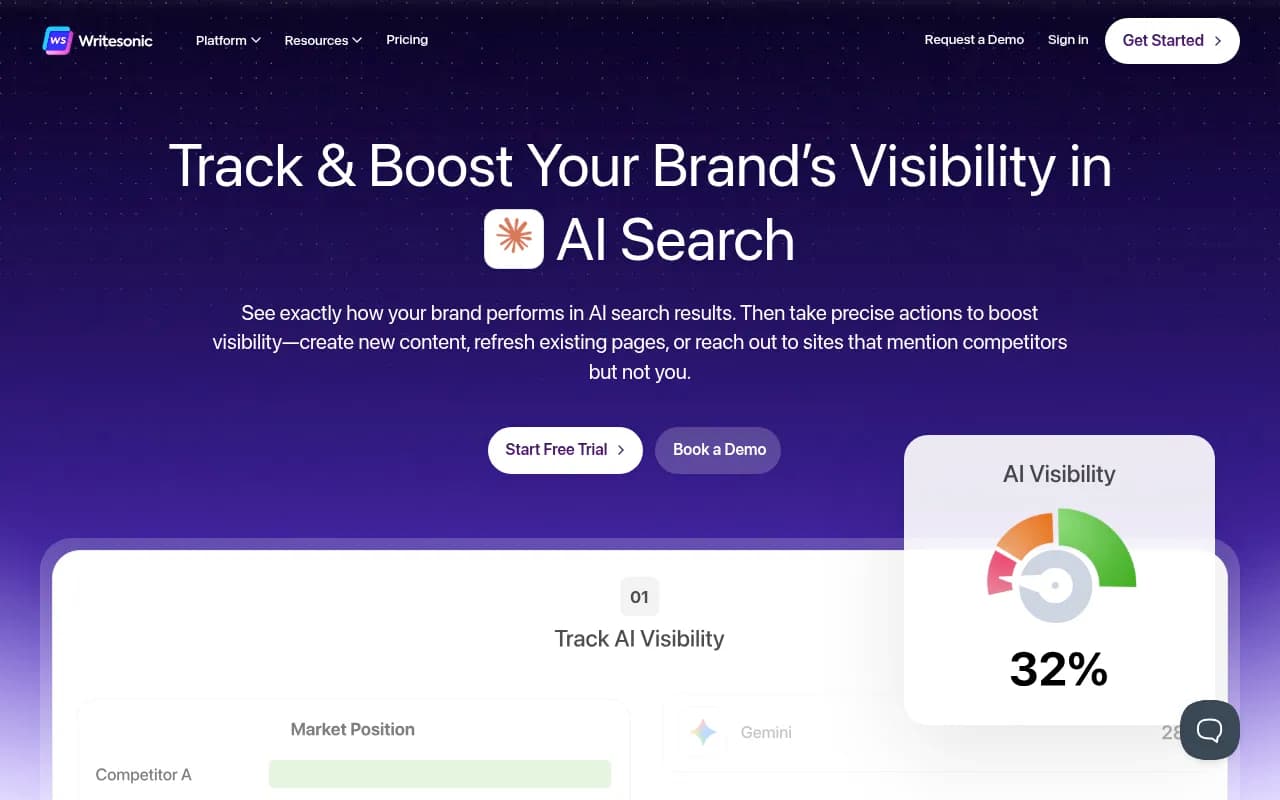
The platform tracks brand mentions and citations across major AI models and surfaces optimization recommendations. The writing tools are solid for teams that need volume — blog posts, landing pages, product descriptions — and want those assets to be informed by AI search data.
Where it falls short compared to Promptwatch: the citation data informing content recommendations isn't as deep, and there's no crawler log functionality. It's a better fit for content-heavy teams that want AI writing assistance with some GEO awareness baked in, rather than teams that need precision prompt-level gap analysis.
3. Relixir — best for all-in-one GEO with content generation
Relixir positions itself as an all-in-one GEO platform with AI content generation built in from the start. It's worth looking at if you want a single platform that handles both the tracking and the content creation without stitching together multiple tools.
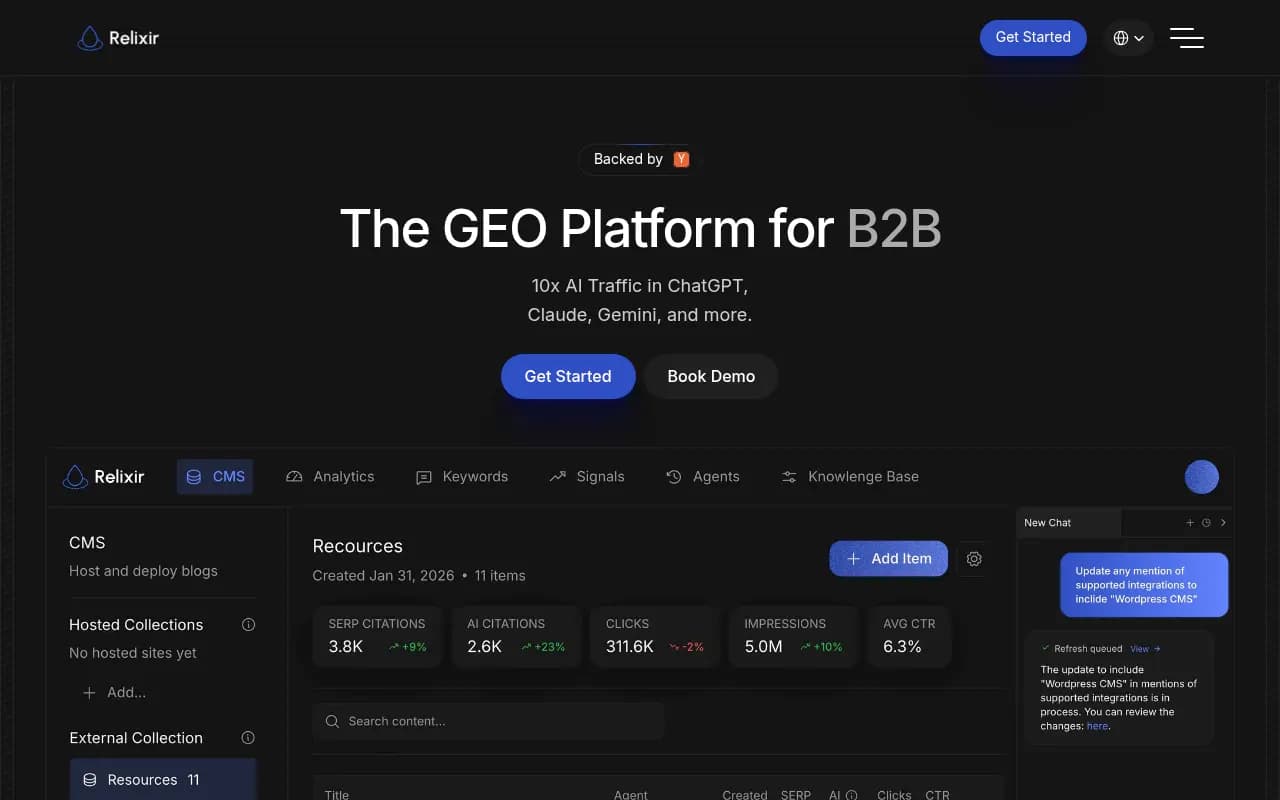
The platform analyzes which prompts your brand should be winning, generates content targeting those specific gaps, and tracks how visibility changes over time. It's a more integrated workflow than many competitors offer.
The tradeoff is depth. Relixir covers the core use case well, but doesn't match Promptwatch on features like Reddit/YouTube tracking, ChatGPT Shopping monitoring, or the granularity of prompt volume and difficulty scoring. For teams that need a clean, focused workflow without a lot of configuration, it's a reasonable choice.
4. Otterly.AI — best budget option with GEO audit capabilities
Otterly.AI is one of the most affordable entry points in the GEO category, starting at $29/mo. It earned Gartner Cool Vendor recognition in 2025, which gives it more credibility than most tools at this price point.
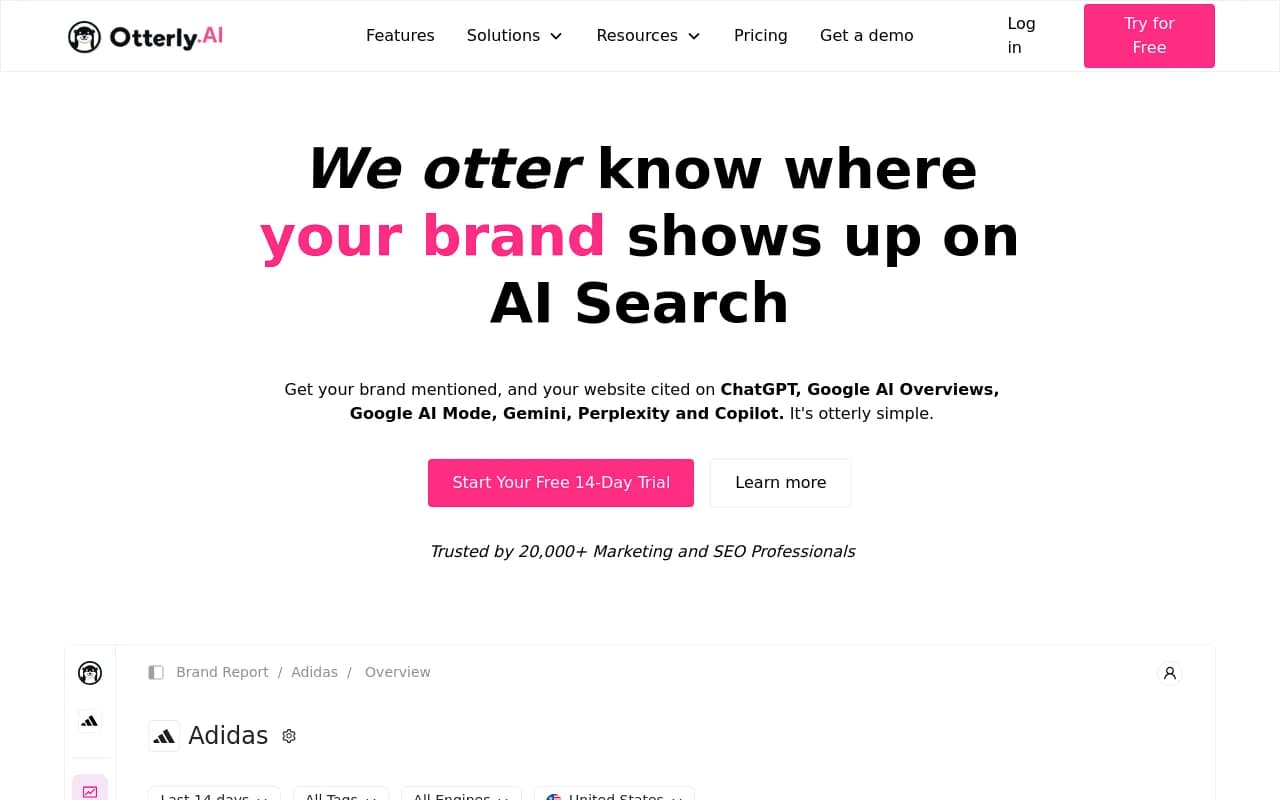
The GEO Audit feature is the main draw — it gives you a structured assessment of how your content performs across AI search engines and where the gaps are. It's not as deep as Promptwatch's Answer Gap Analysis, but it's a meaningful starting point for teams that are new to GEO and don't have a $295/mo budget.
The honest limitation: Otterly.AI is primarily a monitoring and audit tool. Content generation is not a core part of the platform. If you need the full loop from gap analysis to content creation to tracking, you'll hit the ceiling quickly. But as an affordable way to get visibility data and identify where to focus, it's hard to beat at $29/mo.
5. SearchAtlas LLM Visibility — best for teams already using SearchAtlas for SEO
SearchAtlas has built out LLM visibility tracking as part of its broader SEO platform. If your team is already using SearchAtlas for traditional SEO work, the LLM visibility layer integrates naturally into existing workflows.

The platform includes AI-powered content generation and optimization tools, and the integration with traditional SEO data means you can see how your AI search visibility relates to your organic search performance. That's a useful lens that pure-play GEO tools don't offer.
The downside is that LLM visibility feels like an add-on rather than a core product. Teams that are primarily focused on AI search optimization — rather than traditional SEO with AI search as a secondary concern — will likely find the depth of prompt-level analysis and citation tracking underwhelming compared to dedicated GEO platforms.
Comparison table
| Platform | Starting price | Content generation | Prompt gap analysis | Crawler logs | Reddit/YouTube tracking | Free trial |
|---|---|---|---|---|---|---|
| Promptwatch | $99/mo | Yes (citation-grounded) | Yes (Answer Gap Analysis) | Yes | Yes | Yes |
| Writesonic | ~$99/mo | Yes (mature AI writing) | Basic | No | No | Yes |
| Relixir | Custom | Yes (integrated) | Yes | No | No | Yes |
| Otterly.AI | $29/mo | No | Basic (GEO Audit) | No | No | Yes (14-day) |
| SearchAtlas LLM | Part of SearchAtlas plan | Yes (SEO-focused) | Basic | No | No | Yes |
| AthenaHQ | $295/mo | No | Yes | No | No | No (discount only) |
Why "monitoring only" isn't enough in 2026
There's a pattern worth naming directly. Most GEO tools launched in 2024-2025 were built as dashboards. They show you visibility scores, citation counts, and competitor comparisons. That data is genuinely useful — but it's also where the product ends.
The problem is that knowing you're invisible doesn't make you visible. You still have to figure out what content to create, write it, publish it, and then wait to see if AI models start citing it. For most marketing teams, that gap between "here's the data" and "here's what to do" is where momentum dies.
The tools that are pulling ahead in 2026 are the ones that close that gap. Promptwatch's action loop — find gaps, generate content, track results — is the clearest example of this. But even simpler tools like Relixir are moving in this direction by integrating content generation into the core workflow.
If you're evaluating GEO platforms right now, the right question isn't just "what data does this show me?" It's "what does this help me do?"
Which tool should you pick?
It depends on where you are and what you need.
If you're a marketing or SEO team that wants the most complete platform — gap analysis, citation-grounded content generation, crawler logs, traffic attribution, and multi-model tracking — Promptwatch is the clear choice. The $99/mo Essential plan is a reasonable starting point, and the free trial lets you see the gap analysis before committing.
If you're primarily a content team that needs AI writing assistance with some GEO awareness, Writesonic is worth evaluating. The writing tools are mature and the AI search tracking is improving.
If you want an all-in-one GEO workflow without a lot of configuration, Relixir covers the core use case cleanly.
If budget is the primary constraint and you're just getting started with GEO, Otterly.AI at $29/mo gives you enough to understand where your gaps are, even if you'll need other tools to act on them.
If you're already deep in the SearchAtlas ecosystem, the LLM visibility layer is a natural extension rather than a separate tool to manage.
The one thing I'd push back on: don't let price be the only factor. A $29/mo tool that shows you data but leaves you stuck costs more in opportunity than a $99/mo tool that actually helps you rank in AI search. The math changes when you factor in what you're trying to accomplish.