Key takeaways
- AthenaHQ, Semrush, and Promptwatch solve different problems -- there's less overlap than you'd expect, but also less reason to run all three simultaneously than vendors would have you believe.
- Semrush is still the best all-in-one tool for traditional SEO: keyword research, backlinks, site audits. Its AI search features exist but are limited and use fixed prompts.
- AthenaHQ is a solid AI visibility monitoring platform, but it's primarily a dashboard -- it shows you data without helping you act on it.
- Promptwatch is the only one of the three built around the full optimization loop: find gaps, create content, track results. It's the most complete option if AI search is your priority.
- Most teams don't need all three. The right combination depends on how much of your traffic is shifting to AI search and what you're actually trying to do about it.
The question "do I need all three?" usually comes up when someone has been using Semrush for years, hears about AthenaHQ from a conference talk, and then sees Promptwatch mentioned in a comparison article. Suddenly you're looking at three tools, three subscriptions, and no clear sense of what each one actually covers.
This guide cuts through that. We'll look at what each platform does well, where they genuinely overlap, and how to decide which combination (or single tool) makes sense for your team in 2026.
What each tool is actually built for
Before comparing features, it helps to understand the design philosophy behind each platform. These tools were built with different problems in mind.
Semrush: traditional SEO, with AI features bolted on
Semrush has been the dominant all-in-one SEO platform for over a decade. Keyword research, backlink analysis, site audits, rank tracking, competitor analysis -- it does all of this well and at scale. If you're running a content operation that depends on Google organic traffic, Semrush is hard to argue with.
The AI search features are newer and more limited. Semrush tracks brand mentions in AI responses, but it uses fixed prompts rather than letting you define your own. That means you're seeing data for prompts Semrush decided were relevant, not necessarily the ones your actual customers are typing into ChatGPT or Perplexity. There's no AI traffic attribution, no crawler logs, and no content generation tied to AI citation data.
AthenaHQ: AI visibility monitoring, no optimization
AthenaHQ is purpose-built for AI search visibility. It tracks how your brand appears across multiple AI models, gives you share-of-voice data against competitors, and surfaces which prompts you're winning or losing. The interface is clean and the monitoring is solid.
The limitation is that AthenaHQ stops at monitoring. It shows you where you're invisible -- but it doesn't help you do anything about it. No content generation, no content gap analysis tied to citation data, no crawler logs showing how AI models are actually reading your site. For teams that want to understand their AI visibility and then go figure out the fixes themselves, that might be fine. For teams that want to close the loop, it's a frustrating half-solution.
Promptwatch: the full optimization loop
Promptwatch was designed around a different premise: monitoring is only useful if it leads to action. The platform tracks AI visibility across 10 models (ChatGPT, Perplexity, Claude, Gemini, Google AI Overviews, Grok, DeepSeek, Copilot, Meta AI, Mistral), but the core value is what happens after you see the data.
The Answer Gap Analysis shows you exactly which prompts competitors are visible for that you're not -- and what content your site is missing to compete. The built-in AI writing agent then generates articles, listicles, and comparisons grounded in real citation data (880M+ citations analyzed). Once you publish, page-level tracking shows which new pages are getting cited, by which models, and how often. Traffic attribution connects that visibility to actual revenue.
That cycle -- find gaps, generate content, track results -- is what separates it from the other two.

Feature comparison
Here's how the three platforms stack up across the capabilities that matter most for AI search in 2026:
| Feature | Semrush | AthenaHQ | Promptwatch |
|---|---|---|---|
| Traditional SEO (keywords, backlinks, audits) | Excellent | None | None |
| AI model coverage | Limited (fixed prompts) | 8+ models | 10 models |
| Custom prompt tracking | No | Yes | Yes |
| Prompt volume & difficulty scoring | No | No | Yes |
| Competitor AI visibility | Basic | Yes | Yes (with heatmaps) |
| Content gap analysis | No | No | Yes |
| AI content generation | No | No | Yes |
| AI crawler logs | No | No | Yes |
| Reddit & YouTube tracking | No | No | Yes |
| ChatGPT Shopping tracking | No | No | Yes |
| Traffic attribution from AI | No | No | Yes |
| Pricing (entry) | ~$139/mo | Custom/enterprise | $99/mo |
| Free trial | Limited | No | Yes |
The table tells a clear story. Semrush and AthenaHQ don't overlap much -- they're solving different problems. Promptwatch overlaps significantly with AthenaHQ on monitoring, and then goes further on optimization.
Where they actually overlap (and where they don't)
Semrush vs AthenaHQ
These two barely compete. Semrush is a traditional SEO platform that added some AI monitoring features. AthenaHQ is an AI-first monitoring platform with no traditional SEO capabilities. If you're running both, you're probably using Semrush for keyword research and backlinks, and AthenaHQ specifically for AI visibility dashboards. That's a legitimate combination -- just an expensive one.
The AthenaHQ website itself acknowledges this, describing the two as "not direct competitors." That's accurate. The question is whether you need a dedicated AI monitoring tool at all, or whether the monitoring features in another platform are sufficient.
AthenaHQ vs Promptwatch
This is where the real comparison lives. Both platforms track AI visibility across multiple models, both let you define custom prompts, both show competitor data. The monitoring capabilities are broadly comparable.
The difference is everything that comes after monitoring. Promptwatch has content gap analysis that shows you specific topics and angles your site is missing. It has an AI writing agent that generates content engineered to get cited. It has crawler logs that show you which pages AI models are actually reading and what errors they're hitting. AthenaHQ has none of this.
For teams that want to improve their AI visibility (not just measure it), AthenaHQ requires you to take the data and figure out the next steps yourself. Promptwatch builds those next steps into the platform.
Semrush vs Promptwatch
These two are more complementary than competitive. Semrush handles traditional SEO; Promptwatch handles AI search. Where they touch is in content strategy -- Semrush's keyword data and Promptwatch's prompt intelligence both inform what content to create, but from different angles.
The honest answer is that if AI search is becoming a significant traffic source for your business, Semrush's AI features aren't going to cut it. Fixed prompts and basic mention tracking don't give you the data you need to actually optimize for ChatGPT or Perplexity.
Do you actually need all three?
Probably not. Here's how to think about it:
If your traffic is still 90%+ from Google organic search: Semrush is your core tool. Add Promptwatch when you're ready to start tracking and optimizing for AI search -- it's the most efficient way to do both monitoring and optimization without adding a third platform.
If AI search is already a meaningful traffic source: You need a dedicated AI visibility platform. Between AthenaHQ and Promptwatch, Promptwatch gives you more -- monitoring plus the tools to actually improve your position. AthenaHQ makes sense if you have a team that prefers to take raw data and build their own optimization workflows.
If you're an agency managing multiple clients: Promptwatch's agency/enterprise tier is built for this. AthenaHQ tends to be enterprise-priced and less flexible for multi-client reporting. Semrush has agency features but won't help you answer "why isn't our client appearing in ChatGPT?"
If budget is tight: Promptwatch's Essential plan at $99/mo covers one site, 50 prompts, and 5 articles per month. That's a reasonable starting point for most small teams. AthenaHQ doesn't publish pricing, which usually means it's expensive. Semrush's entry plan is around $139/mo but doesn't include meaningful AI search features.
The scenario where all three make sense is a large enterprise with a dedicated SEO team (using Semrush for traditional search), a separate AI search team (using AthenaHQ for executive-level dashboards), and a content team actively optimizing for AI (using Promptwatch). That's a real use case, but it's not most companies.
The monitoring-only trap
One thing worth naming directly: there's a tendency in this space to treat "monitoring" as the goal. It's not. Knowing that your brand appears in 12% of ChatGPT responses for your category is interesting data. Knowing which specific content gaps are causing you to miss the other 88%, and having a tool that helps you close those gaps, is what actually moves the number.
AthenaHQ and Semrush's AI features both stop at monitoring. That's useful for reporting and for understanding the landscape, but it doesn't help you rank better in AI search next quarter.
Promptwatch's crawler logs are a good example of what "actionable" looks like in practice. You can see exactly which pages ChatGPT or Perplexity's crawlers are visiting, how often, and what errors they're hitting. If a key product page is returning a crawl error to AI bots, you'd never know from a monitoring dashboard -- you'd just see that the page isn't getting cited and wonder why.
Which tool to start with
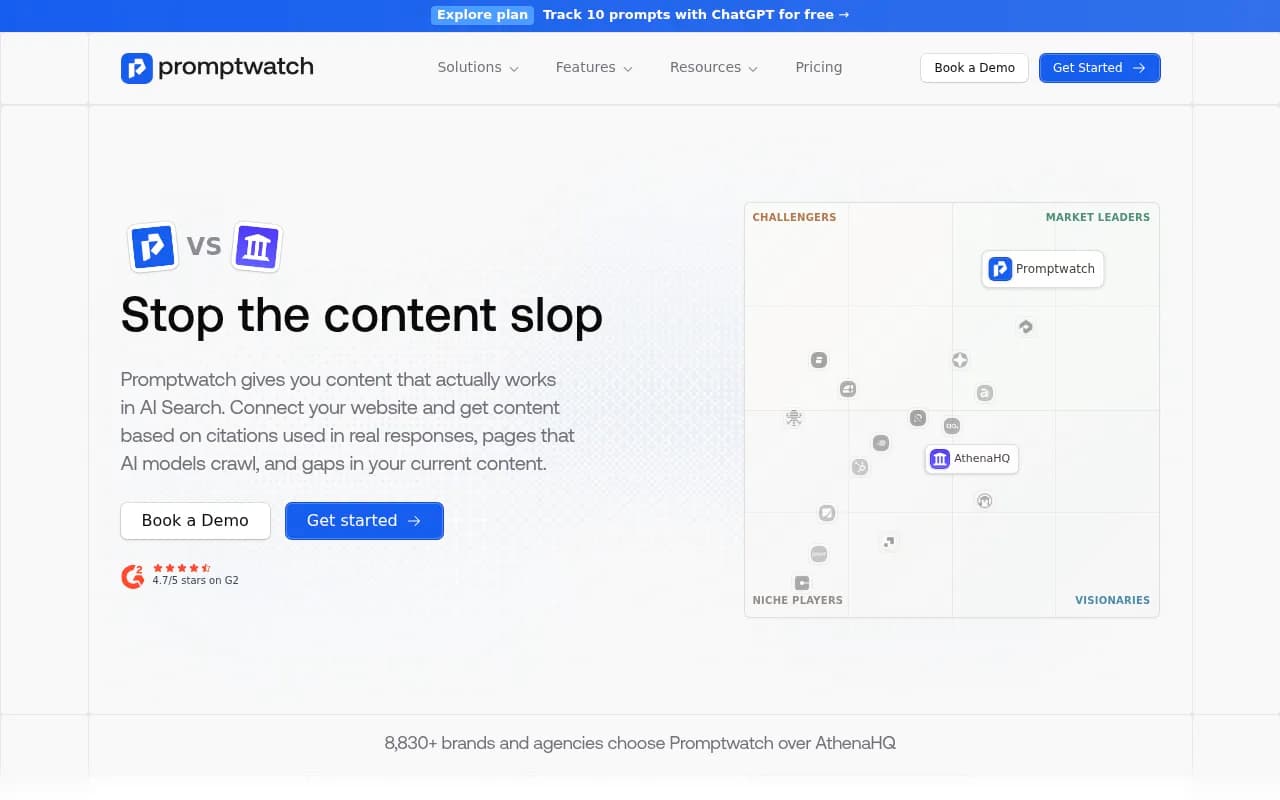
If you're new to AI search visibility and trying to figure out where to begin, start with Promptwatch. The free trial lets you track 10 prompts with ChatGPT at no cost, which is enough to see whether your brand is showing up and where the obvious gaps are. From there, the Essential plan at $99/mo gives you enough to run a real optimization program for a single site.
If you're already on Semrush and happy with it for traditional SEO, keep it. Add Promptwatch for AI search rather than trying to stretch Semrush's limited AI features to do a job they weren't designed for.
If someone is pushing you toward AthenaHQ, ask them specifically what you'll do with the data it gives you. If the answer is "we'll analyze it and figure out a content strategy," that's a workflow you can run inside Promptwatch without needing a separate platform.
A note on the broader market
The AI visibility tool space has exploded in 2026. There are now dozens of platforms claiming to solve this problem, and most of them are monitoring dashboards with different UIs. The meaningful differentiator isn't which models a tool tracks or how pretty the charts are -- it's whether the platform helps you do something with what you find.
That's the lens to apply when evaluating any tool in this category, including the three discussed here.
The short version: Semrush for traditional SEO, Promptwatch for AI search (monitoring plus optimization), and AthenaHQ only if you have a specific reason to prefer a monitoring-only platform at a higher price point. Most teams can cover what they need with two tools, not three.