Key takeaways
- AthenaHQ and Peec AI are both monitoring-first platforms — they show you where you stand in AI search but offer limited help with what to do next.
- Promptwatch is the only one of the three that closes the full loop: find gaps, generate content to fix them, track results, and attribute revenue.
- Peec AI has the weakest feature set of the three — no crawler logs, no content generation, limited trend data, and it currently only tracks a handful of AI models.
- AthenaHQ is more capable than Peec AI but still stops short of content optimization and generation, which is where real GEO improvement happens.
- If you're a brand or agency that wants to actually move the needle on AI visibility — not just observe it — Promptwatch is the more complete choice.
There's a version of this comparison that just lines up three pricing tables and calls it a day. This isn't that.
AthenaHQ, Peec AI, and Promptwatch all sit in the same general category: AI search visibility platforms. They all track how your brand appears when people ask ChatGPT, Perplexity, Gemini, or other AI models a question. But the similarity mostly ends there. The gap between what these tools actually do — not what their landing pages say — is significant enough to matter when you're deciding where to put budget.
Let me walk through each one honestly.
What these tools are trying to solve
Before getting into the comparison, it's worth being clear about the problem. When someone asks an AI model "what's the best CRM for a startup?" or "which project management tool should I use?", your brand either gets mentioned or it doesn't. Traditional SEO tools can't see this. Google Search Console doesn't track it. Your analytics show a trickle of "direct" traffic that's actually coming from AI referrals, with no way to connect it to revenue.
AI visibility platforms are supposed to fix that. They systematically query AI models with prompts your customers are likely using, then analyze the responses to tell you: are you being mentioned? How often? What are competitors getting recommended for that you're not? Which pages are being cited?
That's the monitoring layer. The harder question — and where these three platforms diverge sharply — is what happens after you have that data.
Peec AI: monitoring without much else
Peec AI is a straightforward AI visibility tracker. You set up prompts, it queries AI models, and you get back data on brand mentions, share of voice, and competitive positioning. The interface is clean and the competitive benchmarking reports are decent, especially for agencies that need to show clients something visual.
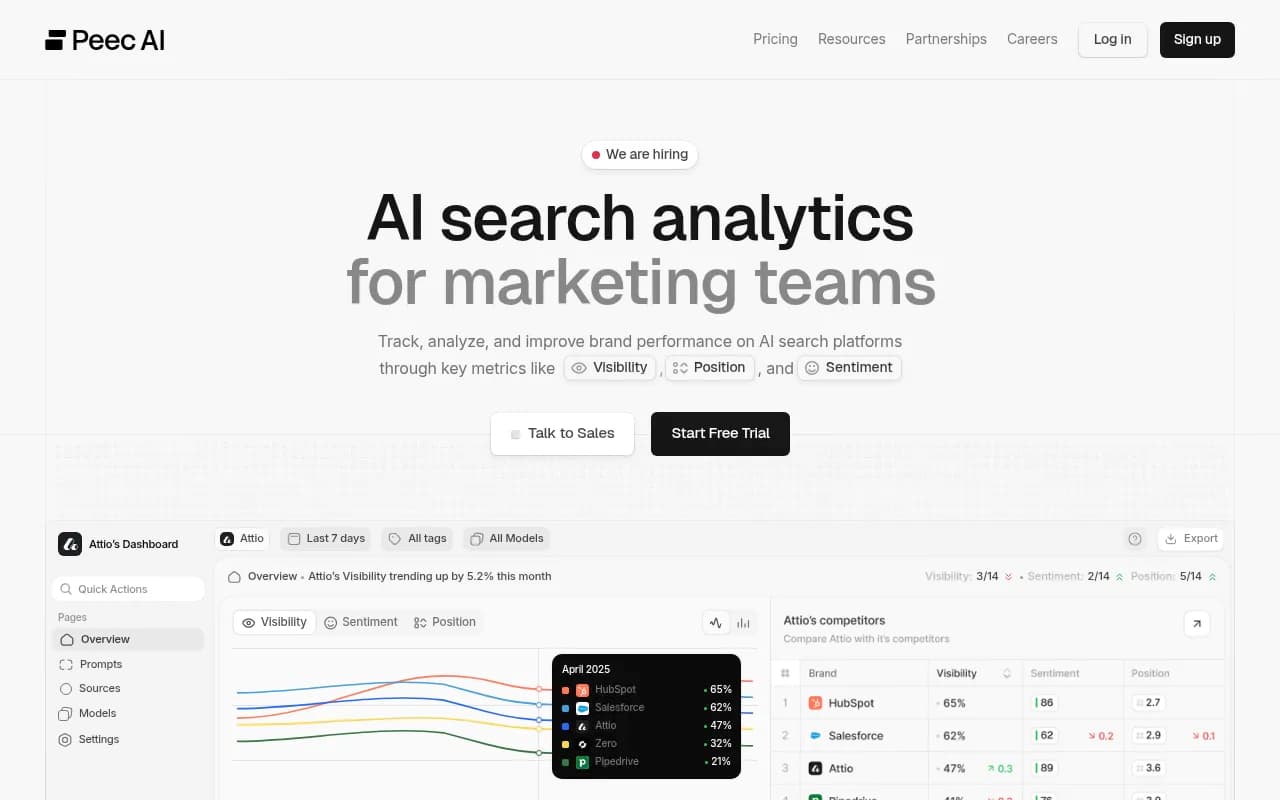
The limitations are real, though. Zapier's review of AI visibility tools noted that Peec AI is "notably lacking actionable insights, trend data, and AI crawler visibility insights." That's a fair read. You can see that your brand is invisible for a set of prompts, but Peec AI doesn't tell you why, and it doesn't help you fix it. There's no content generation, no gap analysis that surfaces specific missing topics, and no crawler log data to understand how AI models are actually reading your site.
Model coverage is also limited compared to the other two. Peec AI currently tracks a smaller set of AI platforms, which matters as search behavior fragments across ChatGPT, Perplexity, Gemini, Claude, Grok, and others.
For teams that just need a basic monitoring dashboard and already have a content team ready to act on the data, Peec AI can work. But for most brands, "here's your visibility score" without any path to improving it is a frustrating place to stop.
AthenaHQ: more capable, still monitoring-focused
AthenaHQ is a step up from Peec AI in terms of depth. It covers more AI models, offers more granular tracking, and is designed to work for both self-guided users and teams that want more structured workflows. The platform has solid brand mention tracking, sentiment analysis, and competitive benchmarking.
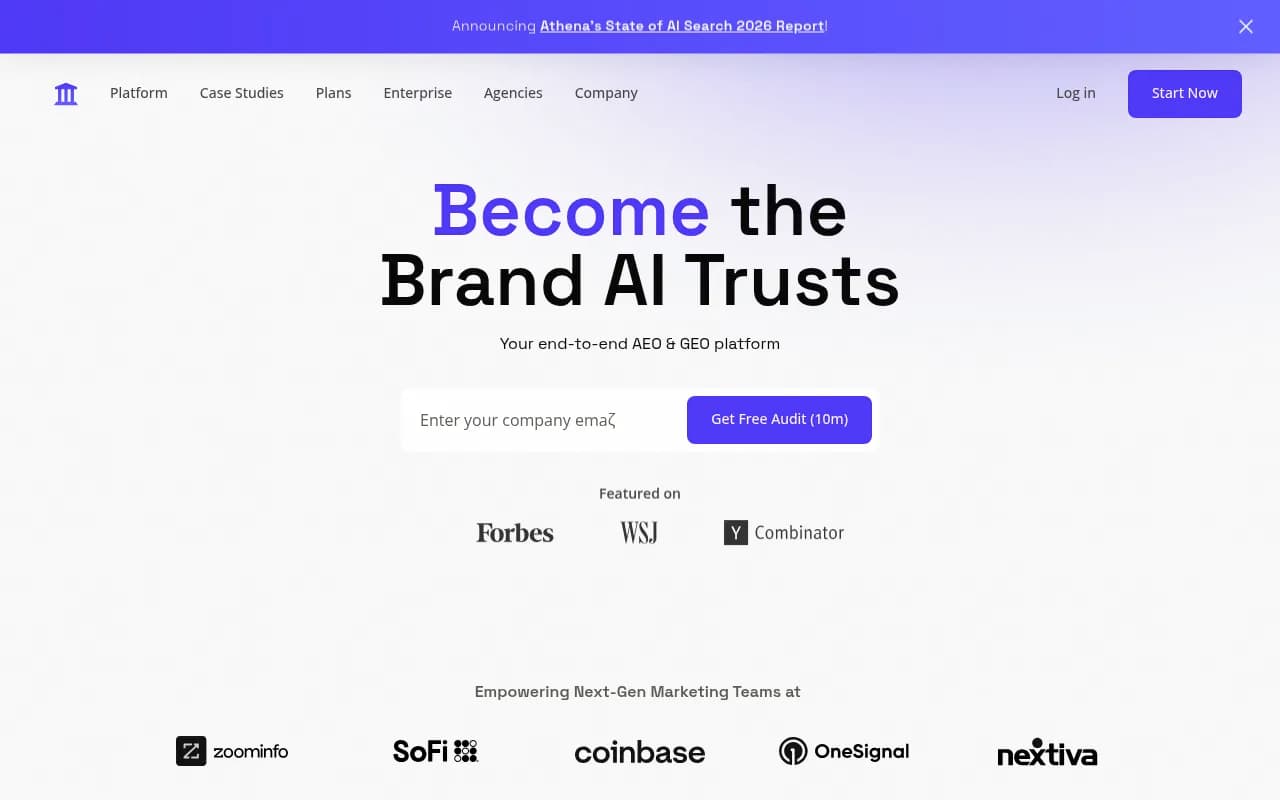
Where AthenaHQ falls short is in the same place as Peec AI: it's primarily a monitoring tool. It shows you the state of your AI visibility with reasonable precision, but the optimization side is thin. There's no built-in content generation, no AI writing agent that can take your gap analysis and turn it into articles designed to get cited. The platform can tell you that a competitor is winning for a set of prompts you're not visible for — but it leaves you to figure out what to actually create.
That's not a fatal flaw if you have a strong in-house content team and a clear process. But it does mean AthenaHQ is one piece of a larger workflow, not a complete solution.
Promptwatch: the full loop
Promptwatch is built around a different premise: monitoring is only useful if it leads to action. The platform is structured around three steps — find gaps, create content, track results — and it actually delivers all three rather than stopping at step one.

The Answer Gap Analysis is where this starts. It shows you exactly which prompts your competitors are visible for that you're not, and what content your site is missing that would make AI models want to cite you. This isn't a vague "you should write more about X" suggestion — it surfaces specific topics, angles, and questions that AI models are actively looking for answers to.
From there, Promptwatch has a built-in AI writing agent that generates articles, listicles, and comparison pages grounded in real citation data. The platform has analyzed over 880 million citations, so when it generates content, it's working from an understanding of what actually gets cited by ChatGPT, Claude, Perplexity, and others — not generic SEO patterns.
Then the tracking closes the loop. Page-level visibility scores show exactly which pages are being cited, how often, and by which AI models. Traffic attribution connects that visibility to actual website visits and revenue, via a code snippet, Google Search Console integration, or server log analysis.
A few other things worth mentioning: Promptwatch has AI crawler logs — real-time data on when ChatGPT, Claude, Perplexity, and other AI crawlers visit your site, which pages they read, and what errors they hit. Most competitors don't have this at all. It also tracks Reddit and YouTube as citation sources, which matters because AI models frequently pull from those platforms when forming recommendations. And it covers ChatGPT Shopping specifically, which is increasingly relevant for e-commerce brands.
The platform monitors 10 AI models: ChatGPT, Perplexity, Google AI Overviews, Google AI Mode, Claude, Gemini, Meta/Llama, DeepSeek, Grok, Mistral, and Copilot.
Side-by-side comparison
| Feature | Peec AI | AthenaHQ | Promptwatch |
|---|---|---|---|
| Brand mention tracking | Yes | Yes | Yes |
| Share of voice | Yes | Yes | Yes |
| Sentiment analysis | Basic | Yes | Yes |
| AI model coverage | Limited | 8+ models | 10 models |
| Answer gap analysis | No | No | Yes |
| Built-in content generation | No | No | Yes |
| AI crawler logs | No | No | Yes |
| Page-level citation tracking | No | Partial | Yes |
| Reddit/YouTube citation tracking | No | No | Yes |
| ChatGPT Shopping tracking | No | No | Yes |
| Traffic attribution | No | No | Yes |
| Prompt volume/difficulty scoring | No | Limited | Yes |
| Multi-language/region | Limited | Yes | Yes |
| Starting price | ~$99/mo | ~$199/mo | $99/mo |
| Free trial | Yes | Yes | Yes |
Who should use which
The honest answer depends on what you're trying to accomplish.
If you want a simple monitoring dashboard to show clients that you're tracking AI visibility, Peec AI is cheap and functional. It's not going to help you improve anything, but it gives you a number to report.
If you need deeper monitoring with more model coverage and better competitive data, AthenaHQ is the stronger choice between the two monitoring-only options. It's more expensive, but the data quality is better.
If you want to actually improve your AI visibility — not just measure it — Promptwatch is the only one of the three that gives you the full toolkit. The gap analysis tells you what's missing, the content generation helps you create it, and the tracking shows you whether it worked. For marketing teams, SEO teams, and agencies that are accountable for results rather than just reports, that complete loop matters.
The pricing is also worth noting: Promptwatch's Essential plan starts at $99/month, which is competitive with Peec AI and cheaper than AthenaHQ's entry point. The Professional plan at $249/month adds crawler logs, state/city tracking, and more prompts and articles. Business is $579/month for five sites.
The monitoring-only trap
One thing that's become clear in 2026 is that the AI visibility space has split into two camps: platforms that show you data, and platforms that help you do something with it.
Most tools — including Peec AI and AthenaHQ — are firmly in the first camp. That's not necessarily a bad product decision, but it does mean you're buying a dashboard, not a solution. You still need to figure out what content to create, who's going to write it, whether it's actually optimized for AI citation patterns, and whether it's working.
Promptwatch is one of the few platforms that tries to solve the whole problem. The 880M+ citations analyzed, the query fan-outs that show how one prompt branches into sub-queries, the competitor heatmaps that show who's winning for each prompt and why — these aren't just monitoring features. They're inputs to an optimization workflow.
That's the actual difference. Not features on a spec sheet, but whether the tool leaves you with a report or leaves you with a plan.
Bottom line
AthenaHQ and Peec AI are both legitimate tools for tracking AI visibility. If monitoring is all you need, either can work depending on your budget and how much model coverage you want.
But if the goal is to actually show up more in AI search results — to get cited by ChatGPT when someone asks a question your brand should be answering — then you need more than a dashboard. You need to know what content is missing, be able to create it efficiently, and verify that it's working.
That's what Promptwatch is built to do. It's the more complete platform, and for most brands and agencies operating in 2026, that completeness is what makes the difference between AI visibility as a vanity metric and AI visibility as a growth channel.