Key takeaways
- AthenaHQ monitors 8 AI platforms (ChatGPT, Claude, Gemini, Perplexity, Google AI Overviews, Copilot, Meta AI, Grok) and holds a 4.9/5 rating on G2 from 32 reviews
- Pricing starts at $295/month with a credit-based model -- no free trial, just a 67% discount on month one
- The ACE Citation Engine (the feature most reviewers actually recommend) is Enterprise-only, not included in Self-Serve plans
- Self-Serve plans are single-country only; multi-region coverage requires an upgrade
- Alternatives like Promptwatch go beyond monitoring to include content gap analysis, AI content generation, and crawler logs -- capabilities AthenaHQ doesn't offer at any tier
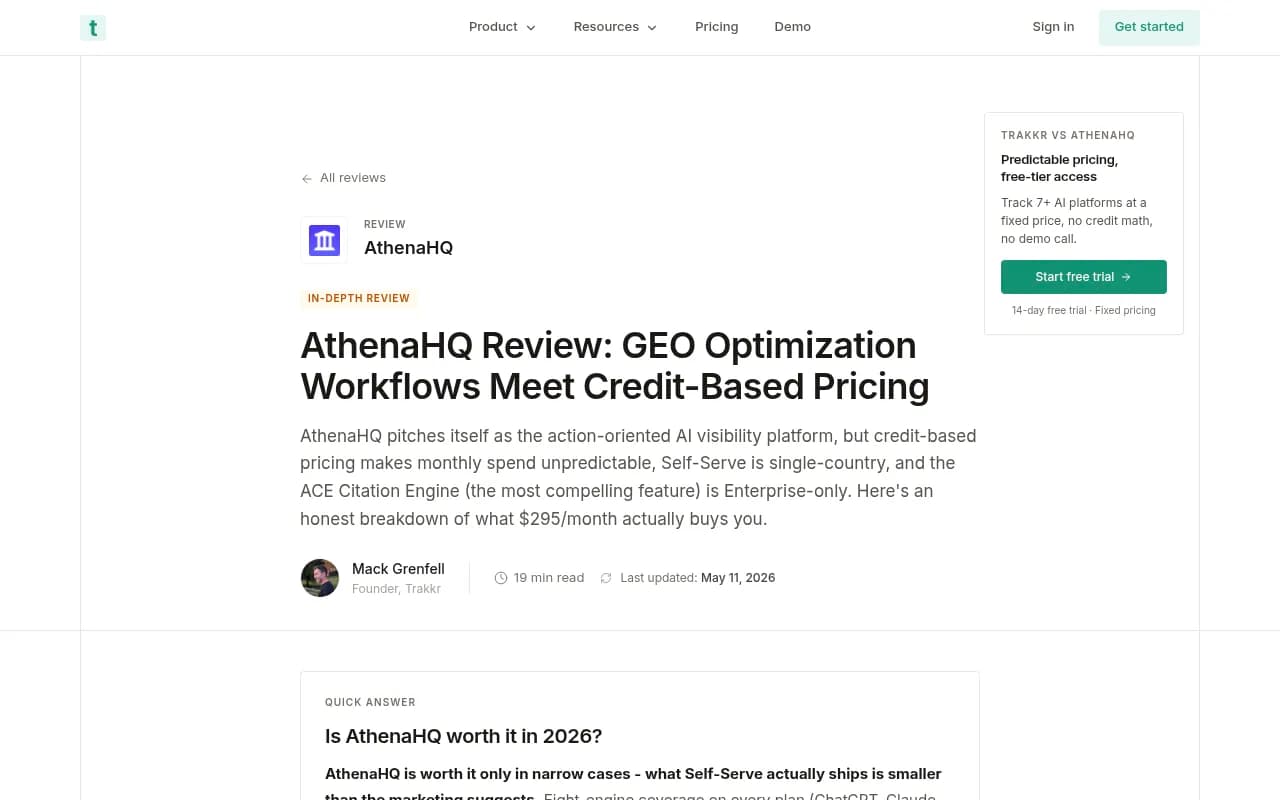
AthenaHQ has been getting a lot of attention in the GEO space, and the G2 score alone (4.9/5 from 32 reviews, with 96% five-star ratings) is hard to ignore. But a near-perfect rating on a review platform doesn't always tell the full story, especially when the platform has a credit-based pricing model, no free trial, and some of its most-hyped features locked behind an Enterprise paywall.
This review covers what AthenaHQ actually does, what you get at each pricing tier, where it genuinely delivers, and where it falls short compared to other tools in the market.
What AthenaHQ is
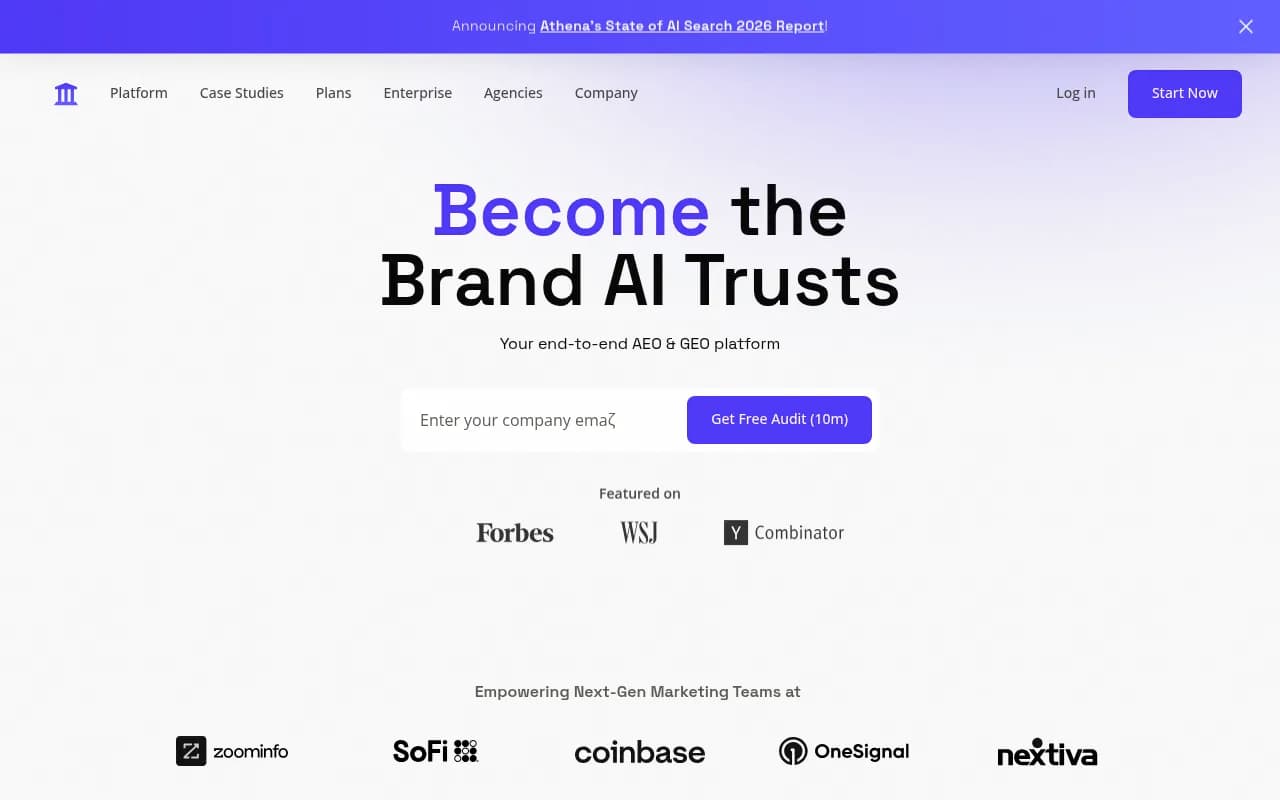
AthenaHQ is a generative engine optimization (GEO) platform built to help brands track and improve how they appear in AI-generated search responses. Rather than tracking traditional SERP rankings, it monitors how AI models like ChatGPT, Claude, Perplexity, and Gemini reference your brand in their answers.
The core pitch is a unified dashboard that shows:
- How often your brand appears in AI responses across 8 platforms
- Which competitors are getting cited instead of you
- Content gaps -- topics where AI models are answering questions without referencing your site
- Sentiment and framing -- not just whether you're mentioned, but how you're described
It's aimed at marketing teams, SEO leads, and growth teams that are starting to take AI search seriously and want data to guide their strategy.
Core features
AI platform coverage
AthenaHQ monitors 8 AI engines on all plans: ChatGPT, Claude, Gemini, Perplexity, Google AI Overviews, Microsoft Copilot, Meta AI, and Grok. That's genuinely broad coverage and one of the platform's real strengths -- many competitors monitor fewer models or charge extra for certain platforms.
Action Center
The Action Center is AthenaHQ's attempt to move beyond pure monitoring into task-based workflows. It surfaces recommendations based on your visibility data and frames them as actionable steps rather than raw metrics. In practice, it's more of a prioritized to-do list than a full optimization engine, but it's a step in the right direction compared to dashboards that just show you numbers.
ACE Citation Engine
This is the feature that gets the most praise in reviews -- and the one most people don't realize is Enterprise-only. The ACE Citation Engine analyzes which sources AI models are citing and helps you understand what it would take to get cited alongside them. If you're on a Self-Serve plan, you don't get this.
Competitive benchmarking
AthenaHQ shows you how your AI visibility compares to competitors across the 8 platforms it monitors. You can see share of voice, which prompts competitors are winning, and where you're being left out of AI-generated answers.
Sentiment and framing analysis
Beyond frequency of mentions, AthenaHQ tracks how AI models are describing your brand -- positive, neutral, or negative framing. For brand teams managing reputation, this is useful context that pure citation trackers miss.
Pricing
AthenaHQ uses a credit-based pricing model, which is worth understanding before you sign up.
| Plan | Price | Key limits |
|---|---|---|
| Self-Serve | $295/month | Single country, credit-based, no ACE Citation Engine |
| Professional | $499/month | Expanded prompts, more credits |
| Enterprise | Custom | Multi-region, ACE Citation Engine, full feature access |
There's no free trial. AthenaHQ offers 67% off the first month as an entry point, which softens the initial cost but doesn't give you the same low-pressure evaluation window that a 14-day trial would.
The credit model is the part that trips people up most. Your monitoring frequency becomes a budget decision -- run too many queries and you're paying overage fees (roughly $0.08 per credit); run too few and you're paying $295/month for data you're not actually pulling. Most teams find fixed-price plans easier to work with because you can scale monitoring to your strategy rather than your wallet.
Multi-region coverage is also locked out of Self-Serve. If your brand operates in multiple countries or you need to monitor AI responses in different languages, you're looking at Enterprise pricing.
What users are saying
The G2 reviews are overwhelmingly positive, with users consistently praising the platform's ease of use and the quality of its competitive insights. The 4.9/5 average is real -- this isn't a platform with hidden one-star reviews being suppressed.
That said, the critical feedback that does exist tends to cluster around a few themes:
- The credit model creates budget anxiety, especially for teams that want to monitor at higher frequencies
- The gap between Self-Serve and Enterprise feels large -- the ACE Citation Engine is the feature most reviewers actually recommend, and it's not available on the entry plan
- No free trial makes it harder to evaluate before committing
A LinkedIn review from 2026 put it plainly: "entry pricing starts in the high hundreds per month and uses a credit-based model, AthenaHQ can feel expensive for small teams."
Where AthenaHQ genuinely delivers
To be fair to the platform, there are real strengths here.
Eight-platform coverage on every plan is meaningful. A lot of competitors either monitor fewer AI engines or charge more for broader coverage. If you need visibility across ChatGPT, Claude, Gemini, Perplexity, Copilot, Meta AI, Grok, and Google AI Overviews without having to stitch together multiple tools, AthenaHQ delivers that.
The sentiment and framing analysis is also something many competitors don't offer at all. Knowing that Perplexity is citing your brand but describing you in a way that's slightly off-brand is genuinely useful intelligence.
For e-commerce brands focused on a single market with Shopify or GA4 revenue attribution, the Self-Serve plan has a reasonably clear use case. The revenue attribution features help connect AI visibility to actual business outcomes, which is the question every team eventually asks.
Where AthenaHQ falls short
No content generation
AthenaHQ can tell you what content gaps exist -- topics where AI models are answering questions without referencing your site. What it can't do is help you fill those gaps. There's no built-in content writing tool, no AI writing agent, no way to go from "here's what's missing" to "here's the article that fixes it" without leaving the platform.
This is the core limitation of monitoring-only tools. You get the diagnosis but not the treatment.
No crawler logs
AthenaHQ doesn't show you which AI crawlers (GPTBot, ClaudeBot, PerplexityBot, GoogleOther) are hitting your site, which pages they're reading, or whether they're encountering errors. This matters because crawler behavior directly affects whether AI models can discover and cite your content. Without this data, you're optimizing blind on the technical side.
No Reddit or YouTube monitoring
Reddit threads and YouTube videos are increasingly influential in what AI models recommend. AthenaHQ doesn't track either. If a Reddit discussion is shaping how ChatGPT answers questions in your category, you won't see it.
Self-Serve is single-country
If your brand operates internationally, the Self-Serve plan won't cover you. Multi-region monitoring requires Enterprise, which means a sales conversation and custom pricing.
The best feature is Enterprise-only
The ACE Citation Engine is what most reviewers recommend as the reason to use AthenaHQ. It's not available on Self-Serve or Professional plans. This creates a real mismatch between the marketing and what most buyers actually get.
How AthenaHQ compares to alternatives
| Feature | AthenaHQ | Promptwatch | Profound | Otterly.AI |
|---|---|---|---|---|
| AI platforms monitored | 8 | 10+ | 6+ | 5+ |
| Free trial | No | Yes | No | Yes |
| Pricing model | Credit-based | Fixed tiers | Custom | Fixed tiers |
| Content gap analysis | Yes (monitoring) | Yes + generation | Limited | No |
| AI content generation | No | Yes | No | No |
| Crawler logs | No | Yes | No | No |
| Reddit monitoring | No | Yes | No | No |
| Multi-region (standard plans) | No | Yes | Enterprise | Limited |
| ChatGPT Shopping tracking | No | Yes | No | No |
| Sentiment analysis | Yes | Yes | Yes | No |
The table above shows where AthenaHQ sits relative to a few key competitors. The monitoring coverage is competitive, but the lack of content generation and crawler analytics is a real gap compared to platforms that have built optimization workflows rather than just dashboards.
Promptwatch is worth mentioning here specifically because it takes a different approach to the same problem. Where AthenaHQ shows you gaps, Promptwatch helps you close them -- with a built-in AI writing agent that generates articles grounded in real citation data, plus crawler logs that show you exactly how AI bots are interacting with your site. For teams that want to act on their data rather than just look at it, that distinction matters.

For teams that specifically need Enterprise-grade prompt volume data, Profound is worth evaluating. For budget-conscious teams that want fixed pricing and a free trial, Otterly.AI covers the basics.

Who should consider AthenaHQ
AthenaHQ makes the most sense for:
- Single-market brands (primarily US) with a budget of $295+/month who want broad AI platform coverage without managing multiple tools
- E-commerce teams using Shopify or GA4 who want to connect AI visibility to revenue attribution
- Teams that are primarily in monitoring mode and aren't yet ready to invest in content optimization workflows
- Enterprise buyers who need the ACE Citation Engine and can negotiate custom pricing
It's harder to justify for:
- Small teams or startups where $295/month is a meaningful budget line and the credit model adds unpredictability
- International brands that need multi-region coverage on standard plans
- Teams that want to act on their data -- find gaps, generate content, track results -- rather than just monitor
- Anyone who needs crawler analytics or Reddit/YouTube signal as part of their GEO workflow
The verdict
AthenaHQ is a solid monitoring platform with genuine strengths: broad AI platform coverage, sentiment analysis, and competitive benchmarking that's clearly resonating with its users (hence the 4.9/5 G2 score). The Action Center is a real attempt to make the data actionable, even if it stops short of full optimization.
But the credit-based pricing model, no free trial, Enterprise-only ACE Citation Engine, and single-country limitation on Self-Serve plans are real constraints that will rule it out for a significant portion of buyers. And the absence of content generation, crawler logs, and Reddit monitoring means it's fundamentally a monitoring tool -- useful for understanding where you stand, less useful for changing it.
If your team is ready to move beyond monitoring and wants a platform that helps you find gaps, generate content to fill them, and track the results, you'll likely outgrow AthenaHQ's Self-Serve tier quickly. The question is whether the Enterprise tier's additional capabilities justify the custom pricing -- and that depends heavily on your budget and how central AI search visibility is to your overall strategy.
For most teams in 2026, the combination of broad coverage, content generation, crawler analytics, and fixed predictable pricing is a better fit than what AthenaHQ's standard plans offer. But if you're a single-market brand that primarily needs monitoring across 8 AI platforms and can live with the credit model, AthenaHQ delivers on that specific use case.