Key takeaways
- Agencies need different things than in-house teams: clean client separation, branded reports, per-brand economics, and a way to run prospect audits before a pitch.
- Most vendor listicles on this topic are written by vendors. Rank Prompt's ranking puts itself first and Gauge sixth, and Semrush's piece features Semrush first. Verify every price and feature directly before you buy.
- Pricing models differ a lot: per domain (Semrush's AI Visibility Toolkit, listed at $99/month per domain), flat agency tiers (Scrunch's Agency Core, listed at $500/month), or per-brand bundles. Model your real client count, not the entry price.
- White-label support is uneven. Some tools have it natively, some sell it as an add-on, and some have none (Semrush's guide says OtterlyAI lacks native white-label reporting).
- Tracking is only half the job. If you are selling results, pick a platform that also helps you act on the gaps and measure whether the fix worked.
Why agencies look for Gauge alternatives
Gauge is an AI visibility platform that monitors how brands show up in ChatGPT, Claude, Gemini and Perplexity. A third-party profile on checkthat.ai describes it as a Y Combinator-backed company that emerged in 2024. It is a reasonable product for a team watching its own brand.
Agencies run into a different set of problems. You are tracking twenty or fifty brands, each with its own competitors, reporting cadence and a client who wants to see their logo rather than yours. A tool built around a single brand with an extra seat bolted on tends to creak once you scale past five or six accounts.
I should be upfront about the evidence here. I could not find independent, verified detail on Gauge's own agency pricing or white-label features. The claim that Gauge is lighter on agency reporting comes from Rank Prompt, a competitor, so treat it as an opinion rather than a finding. Gauge's own agency guide does list white-label capability as something agencies should look for, so ask them directly in a demo what they offer today.
What agencies actually need from an AI visibility tool
Before comparing vendors, write down your criteria. These are the ones that kept coming up across the sources I read:
- Multi-client structure. Separate workspaces or projects so one client's data never leaks into another's.
- White-label reporting. PDFs or dashboards carrying your branding, ideally scheduled and emailed automatically.
- Client portals. A login where the client sees their own data, instead of you emailing attachments every month.
- Per-brand pricing that stays predictable. Does adding client number 15 cost a flat amount or trigger an upsell?
- Prospecting and pitch features. Can you run an audit on a prospect before the sales call?
- API access. Can you push data into your own reporting stack or client dashboard?
- Engine-by-engine reporting. Citation behaviour differs by engine. According to Promptwatch Data's average sources per response report, ChatGPT cites about 5 sources per web-search answer, while Google AI Overviews and Perplexity cite about 10. A client who looks strong on one engine can be invisible on another, so your reports should split them out.
The last point matters more than it seems. Social citations vary just as much: in Promptwatch's November 2026 social citations report (Oct 11 to Nov 9, 2026), social platforms earned 13.16% of AI Overviews citations but only 0.64% of ChatGPT's. A one-size-fits-all client report hides that.
Gauge alternatives for agencies at a glance
Prices below come from the vendor-written sources in my research. They change often, so confirm on each pricing page.
| Tool | Agency angle | Pricing noted in sources | White-label | Best for |
|---|---|---|---|---|
| Promptwatch | Agency plans with unlimited projects and seats, plus content and crawler data | Kick-off $199/mo, Growth $399/mo, Scale $799/mo | Branded PDFs; full white-label dashboard and portal on Enterprise | Agencies that want to fix visibility, not just report it |
| Rank Prompt | Built around many small clients | Agency $149/mo (50 brands), Agency Plus $299/mo (500 brands), per its own site | Yes, per vendor | Agencies with many small clients |
| Profound | Agency Mode for delivery and pitching | Custom, typically four figures per month per Rank Prompt | Yes, per vendor | Larger agencies and enterprise clients |
| Semrush | AI Visibility Toolkit inside an SEO suite | $99/month per domain | Paid add-on | Agencies already on Semrush |
| Scrunch | Agency Core with pitch environment | $500/month | Yes, per Semrush's guide | Custom client reports |
| AthenaHQ | Agency partner program | Starter $295/month | Yes, per Semrush's guide | Agencies growing their roster |
| SE Ranking | White-label SEO suite with AI visibility added | Check vendor | Yes | Agencies that already do white-label SEO reporting |
| OtterlyAI | Unlimited workspaces on Standard and up | Check vendor | No native white-label | Lightweight monitoring |
The alternatives, one by one
Promptwatch
Promptwatch is the option I would look at first if your agency sells outcomes rather than screenshots. Most tools on this list stop at reporting where a client stands. Promptwatch tracks the real interfaces of ChatGPT, Gemini, Perplexity, Google AI Overviews, Google AI Mode, Copilot and others, shows which sources get cited, and then helps you act: content gap analysis, the Content Agent that writes and publishes to WordPress, Webflow or Framer, and an Action Board of prioritised to-dos. IP-verified AI crawler logs and visitor analytics then show whether the fix got crawled, cited and clicked.

For agency work specifically, the agency plans give you unlimited projects, prompts and team seats, with country, state and city tracking, Brand Narrative, Ads Radar, crawler logs, visitor analytics, site audits and API/MCP access. Pricing is Kick-off at $199/mo, Growth at $399/mo and Scale at $799/mo, with a 7-day free trial on monthly billing. Confirm on promptwatch.com/pricing.
Honest caveats. Agency plans don't include the Content Agent, AEO articles or Knowledge Base, and a fully white-label dashboard and client portal sits on Enterprise. Scheduled PDF reports can carry your own branding on white-label organizations. If you need content generation for clients, Enterprise or a brand plan is the route. There is a dedicated Promptwatch vs Profound comparison if Profound is on your shortlist, and more detail on the agency setup. Monks, whose clients include Netflix and BMW, uses Promptwatch's Answer Gap Report to build client content roadmaps.
Rank Prompt
Rank Prompt pitches itself hard at agencies: white-label reports emailed on a schedule, a client portal, and per-brand limits that are generous on paper. Its listed Agency plan is $149/mo for 50 brands, with Agency Plus at $299/mo adding client logins, prospecting and 500 brands. If those numbers hold, the per-brand economics are hard to argue with for a book of many small clients.
The catch is the source. The ranking I read is published by Rank Prompt and ranks Rank Prompt first. That does not make it wrong, but run the 7-day trial with three or four real clients and look at the actual white-label output before committing.
Profound
Profound is the enterprise end of the market. Sources describe an Agency Mode for multi-client delivery and pitching, API access and white-label. Pricing is custom, and Rank Prompt's piece says it typically starts in four figures per month. That suits agencies productising AI visibility for large clients, and it is probably overkill for a boutique shop.

Semrush
If your team already lives in Semrush, the AI Visibility Toolkit is the path of least resistance. Semrush's own guide lists it at $99/month per domain, with the Visibility Overview report usable across unlimited clients and white-label reporting as a paid add-on. Enterprise AIO includes white-label and separate projects per client. Per-domain pricing adds up quickly across a large roster, so do the arithmetic.
Scrunch
Scrunch's Agency Core is listed at $500/month, with white-label reporting and a pitch environment. One source cautions that the platform is oriented more toward a brand's own team than an agency running many accounts, so test the multi-brand pricing during a trial.

AthenaHQ
AthenaHQ is listed with an agency partner program, content optimisation and white-label reporting, with a Starter plan at $295/month. It is aimed at agencies actively growing their client list.
SE Ranking
Gauge's own guide recommends SE Ranking for agencies that already want white-label SEO reporting with AI visibility added to an existing suite. If your reporting stack is already branded SE Ranking dashboards, adding AI visibility there avoids another login for clients.
Peec AI and Otterly
Both are solid monitoring tools with limits for agency work. Peec AI gets credit for competitor benchmarking but is described as lighter on white-label and portfolio tooling. OtterlyAI supports unlimited workspaces on Standard and above, but Semrush's guide says it lacks native white-label reporting. Both can work for a small book if you are willing to brand exports by hand.


Other agency-oriented names worth a look
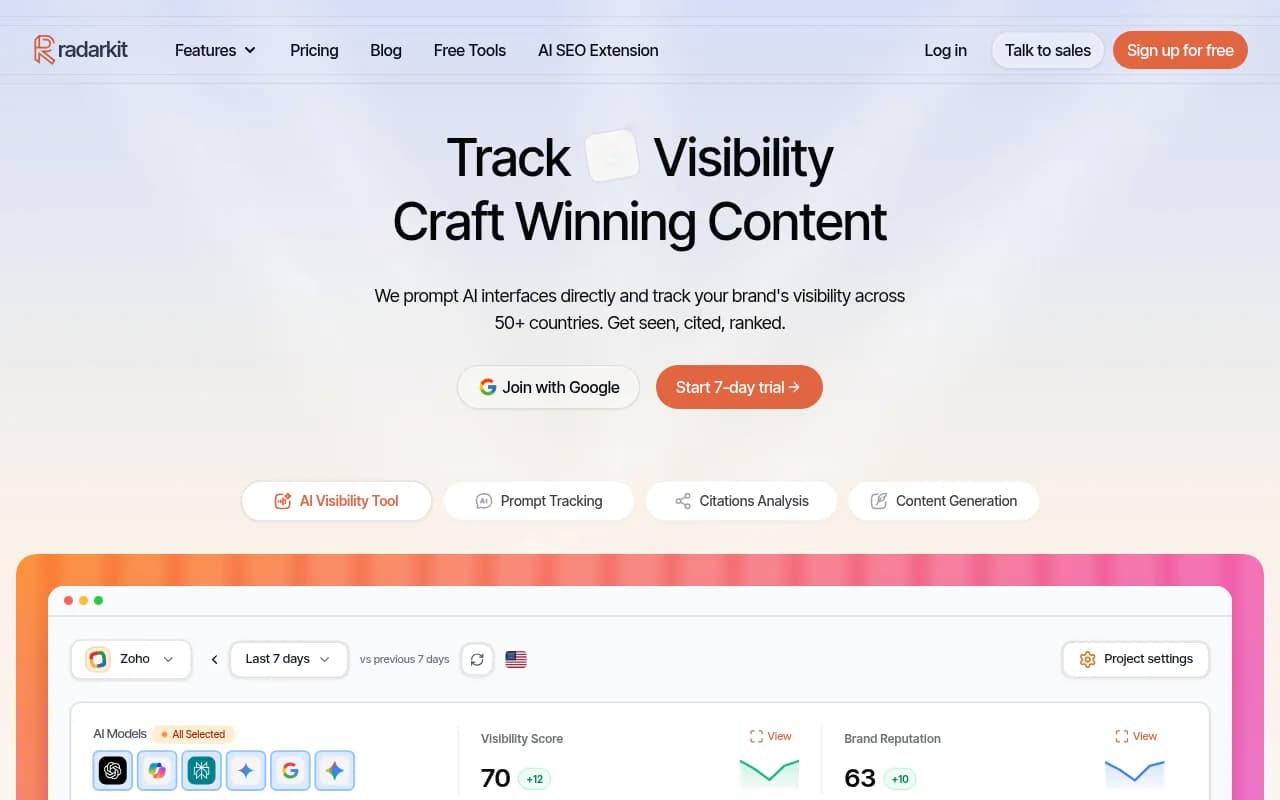
The catalog also includes tools positioned for agencies, such as Slate, Cairrot and Radarkit. Radarkit was named best overall in one Reddit roundup for affordable multi-engine tracking and reporting, though that is a community post, not a test. For a wider scan, the GEO software directory at bestgeosoftware.com and ai-rank-tools.com list many more.
Monitoring tool or content engine?
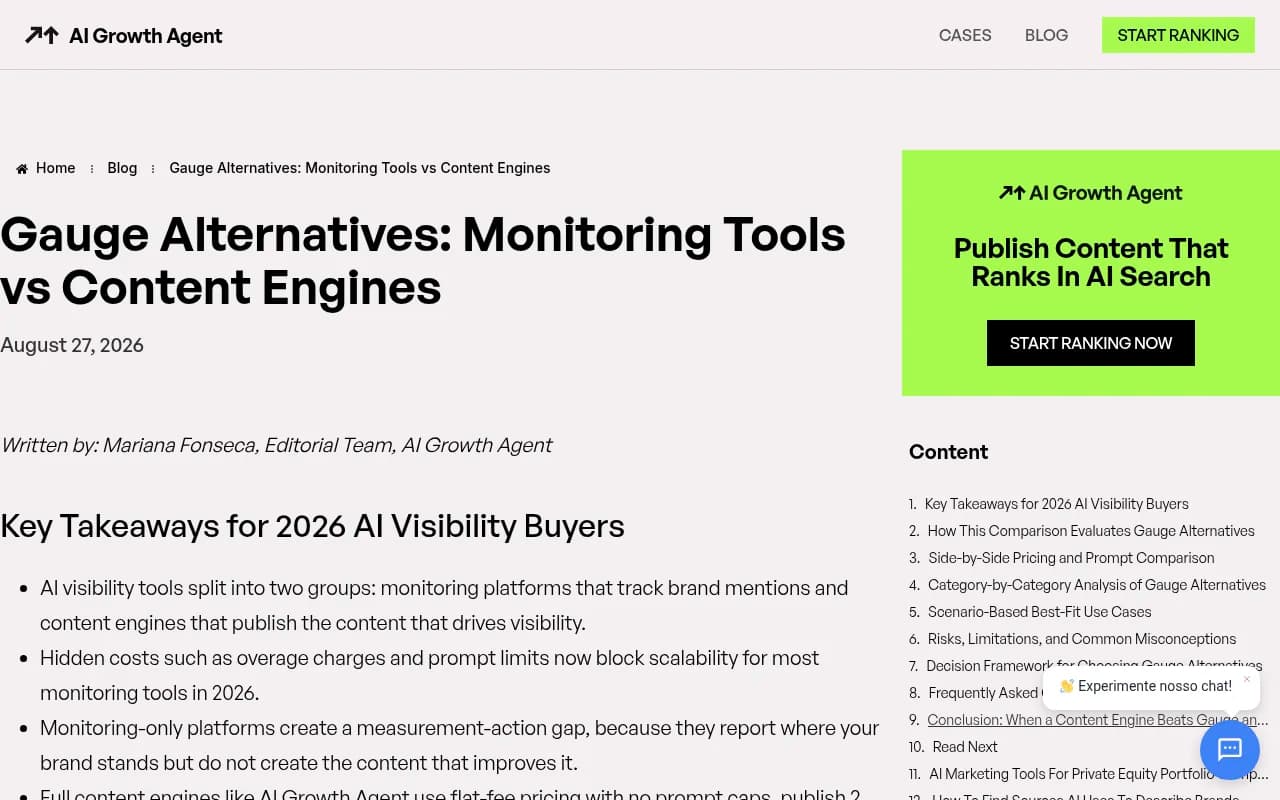
AI Growth Agent's comparison makes a useful distinction: monitoring platforms tell you where a brand stands, while content engines produce the pages that change it. It also warns about hidden costs such as prompt caps and overage fees. That is a vendor pushing its own product, but the framing is fair.
For an agency, it comes down to what you sell. If the deliverable is a monthly visibility report, a monitoring tool with good white-label output is enough. If clients expect measurable movement, you need either an in-house content process or a platform that closes the loop. The 1001 SEO Media team, which publishes this site, runs its own GEO work on Promptwatch for that reason: the useful question for clients is never just "were we mentioned" but "what did we publish, and did AI start citing it."
How to run a fair trial
A demo with a vendor's sample brand tells you nothing. Do this instead:
- Pick three real clients: one large, one small, one in a competitive niche.
- Load the same 20 to 30 prompts into every tool you are testing.
- Check how long setup takes and whether prompts can be tagged by client persona or market.
- Export a white-label report and send it to yourself as if you were the client. Is your logo on it? Is the domain yours?
- Ask for the real per-brand cost at 10, 25 and 50 clients, in writing.
- Check whether the data comes from real AI interfaces or only API calls, since user-facing answers and citations can differ.
- Test the API or exports with your existing reporting stack, such as AgencyAnalytics or Looker Studio.
Choosing by agency type
| Agency profile | Likely fit | Why |
|---|---|---|
| Many small clients, productised monthly reports | Rank Prompt, Radarkit, Otterly | Low per-brand cost, simple reporting |
| Already invoicing for white-label SEO | SE Ranking, Semrush | Fits existing branded reporting |
| Selling results and content, not just reports | Promptwatch | Tracking, content gaps, publishing and crawler/traffic measurement in one place |
| Enterprise clients, large budgets | Profound, Promptwatch Enterprise | Depth, API, white-label, security reviews |
| Pitch-heavy new business | Scrunch, Profound, Rank Prompt | Pitch or prospecting environments |
If you want a quick check of a prospect before any of this, Promptwatch's free AI visibility report runs without a login and gives you something concrete to bring to a first call.
Questions to ask every vendor
- Is white-label included, an add-on, or Enterprise only?
- Can clients log in, or only receive PDFs?
- What counts as a brand or project, and what happens at the limit?
- Do prompts run daily on every plan, and can I go faster for a launch?
- Is data collected from real user interfaces in each client's country and language?
- Can I export raw data and use an API?
Bottom line
Gauge is not a bad tool, but nothing I found proves it is built for agency operations, and the only direct criticism comes from competitors. If your book is mostly small clients and reports are the product, Rank Prompt or a suite add-on may be cheapest. If you are accountable for results, Promptwatch's agency plans are the most complete option here because they connect tracking to fixes and to measured traffic. Start with a 7-day trial on two or three of these, load real clients, and let the exported report decide.