Key takeaways
- G2 is the most cited review site in ChatGPT software answers, but at 0.73% of software citations (Sep 28 to Oct 4, 2026) it is a small slice. GitHub alone earns 1.2%.
- Documentation, help centers and vendor sites earn about three times as many ChatGPT software citations as review sites and analysts combined.
- Review volume barely moves citations. G2's own 500-category analysis found 10% more reviews goes with about 2% more citations.
- Review sites matter most on evaluation prompts like "[brand] reviews" or "X vs Y". They matter much less when a developer asks a how-to question.
- Keep your G2 and Capterra profiles complete, but put the real money into docs, GitHub and consistent third-party mentions.
The short answer
Yes, G2 is worth some investment. No, it is not worth a big one if your only goal is ChatGPT visibility, and especially not if you sell to developers.
A lot of SaaS advice treats G2 as the lever for AI recommendations. The data is messier than that. Most of the studies behind the "G2 matters" claim come from G2 itself or from vendors that sell AI-visibility or PR services. None is clearly independent. So treat every number below as a direction, not a law.
What the citation data shows
Promptwatch analyzed organic software prompts (comparisons, alternatives, how-to questions) run through ChatGPT between September 28 and October 4, 2026. The full numbers are in Promptwatch's ChatGPT citation share report for software.

| Source type | Share of ChatGPT software citations |
|---|---|
| Documentation and help centers | 2.64% |
| Vendor sites | 2.01% |
| Review sites and analysts (G2, Gartner, Capterra, Software Advice) | 1.57% |
| GitHub | 1.2% |
| App stores | 0.47% |
A warning on reading this table: 1.57% is the combined figure for four review and analyst domains. G2 on its own is 0.73%, Gartner 0.34%, Capterra 0.32%. Percentages are shares of all software citations, not shares of the 23 domains charted.
For individual domains, the ranking looks like this:
| Domain | Share of software citations |
|---|---|
| github.com | 1.2% |
| learn.microsoft.com | 0.98% |
| g2.com | 0.73% |
| docs.aws.amazon.com | 0.41% |
| docs.cloud.google.com | 0.35% |
| gartner.com | 0.34% |
| capterra.com | 0.32% |
| intercom.com | 0.28% |
| zapier.com | 0.24% |
Two things stand out for developer tools. GitHub beats G2 outright. And docs sites from Microsoft, AWS and Google sit right alongside it. If you ship an SDK or an API, that is the neighborhood ChatGPT expects to find you in.
It is also worth noting that the review-site and analyst group, at 1.57%, earns more than any single vendor, Microsoft included. So review sites are not irrelevant. They are just not the main event.
What the third-party studies say
The numbers disagree, and the reason is mostly methodology.
| Study | Who ran it | Sample | Finding |
|---|---|---|---|
| G2 Learn Hub (Kevin Indig) | G2 | ~35,000 ChatGPT citations, US, Dec 2025 | Review platforms were 7.4% of citations on discovery prompts and 13.2% on evaluation prompts; G2 and its acquired brands held 84% of review-platform citations |
| G2 Learn Hub (Kevin Indig) | G2 | 500 categories, 30,000 citations | 10% more reviews goes with about 2% more citations; reviews explain under 2% of variance |
| SupaIntent | AI-visibility vendor | 167,514 AI answers, Aug 1 to Nov 4, 2026 | g2.com cited in 9.4% of answers, capterra.com in 4.0% |
| AuthorityTech | PR and AI-visibility services | 8,343 ChatGPT runs | G2 cited in 64 runs, 0.77% |
| DerivateX | Agency | 233 ChatGPT recommendations, June 2026 | Review aggregators 0.9% of citations; zero for G2 and Capterra |
| Growfusely | Agency | 1,739 citations via OpenAI and Perplexity APIs | All review sites combined 7.3% |
The gap between 9.4% and 0% looks absurd until you notice the denominators. One counts the share of answers that cite G2 at least once. Another counts the share of all citations. Another counts runs. Different windows, different prompt sets, different results.
One more caveat. G2 owns Capterra, Software Advice and GetApp, and it published two of the studies above. The 84% figure is G2 describing its own portfolio. Useful, but not neutral.
Why more reviews do not buy a higher position
A March 2026 analysis found that ChatGPT's ordering did not track review counts. OnlyOffice ranked third in one answer with 325 Capterra and 64 G2 reviews, while Slack ranked eighth with tens of thousands. Coda, with 472 G2 reviews, ranked above ClickUp with more than 10,000.
What correlated better was how widely the brand is referenced across the web, things like domain authority and having a Wikipedia page. That fits how retrieval works: models look for agreement across many independent pages, not one big pile of stars on one site.
Kevin Indig's LinkedIn post on the 30,000-citation study is worth reading with the comments, where several people point out the obvious confound.
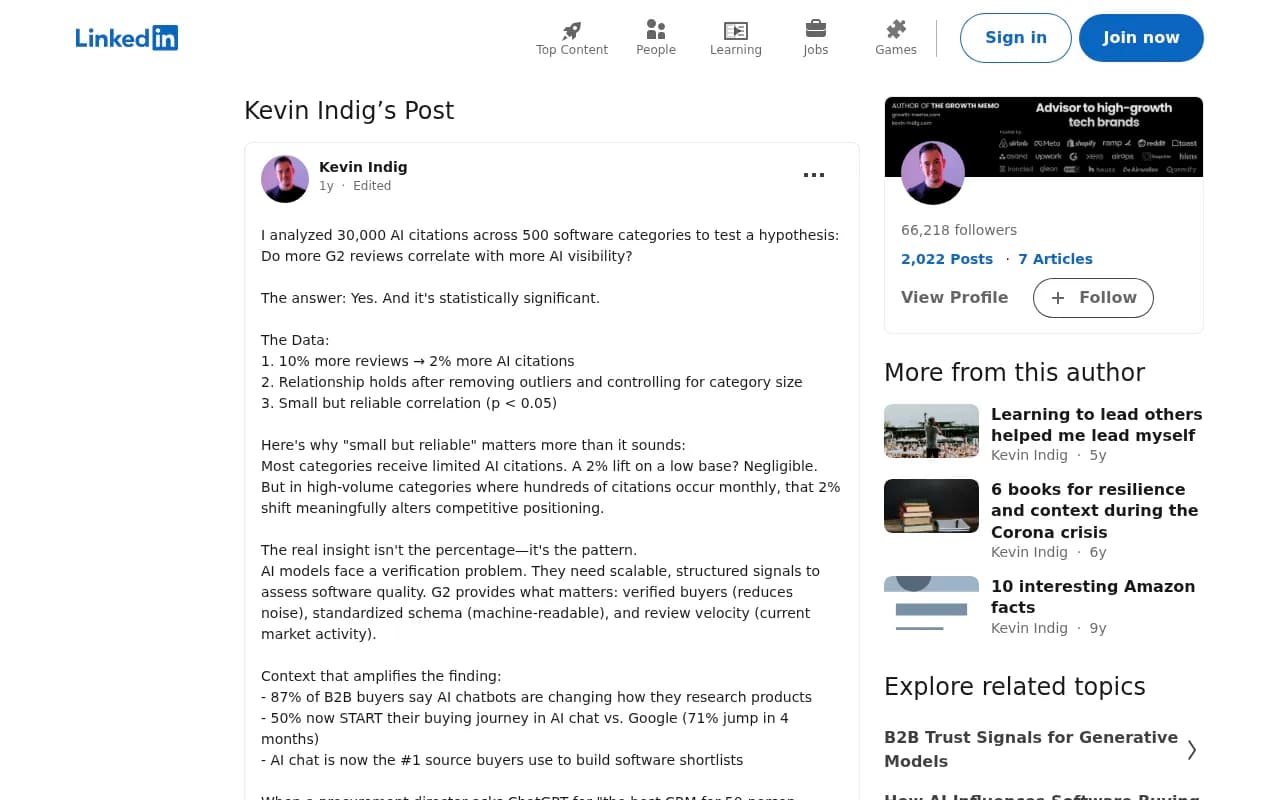
Bigger, better-known brands attract more reviews and more mentions everywhere. So a small positive correlation between reviews and citations is probably brand prominence showing up in two places, not reviews causing citations. Nobody has run a test where a brand adds reviews and everything else stays still.
Position inside an answer is what drives a brand's visibility score. A sole recommendation scores 100, first in a ranked list 90 to 94, fourth or later 25 to 49. Getting listed on G2 can help you into the answer. Moving from fourth to first takes consistent corroboration from other sources and content that matches the buyer's exact use case.
When review sites do matter
They matter at the bottom of the funnel. G2's analysis found review platforms at 13.2% of citations on evaluation prompts versus 7.4% on discovery prompts. A 2026 retrieval study from Discovered Labs, covering 291,607 ChatGPT citations, found review sites were 2% of what ChatGPT read but 6% of what it cited. In practice ChatGPT rarely fetches review sites unless the prompt asks for reviews, and tends to keep them as citations when it does.
So picture the buyer who types "Sentry vs Datadog reviews" or "is [your tool] any good". That person lands on G2 content. The buyer who types "how do I add distributed tracing to a Node service" does not.
There is also the description effect. Whatever pros and cons appear on your G2 page can get repeated in the model's summary of you. If your profile is thin, outdated or full of complaints about a bug you fixed two years ago, that is what gets paraphrased.
How other AI engines treat review sites
The picture changes by engine. In the Promptwatch snapshot behind the software report:
- ChatGPT cited learn.g2.com 13 times, more than any other domain, followed by help.openai.com (9). That is G2's research and editorial content more than profile pages.
- Google AI Mode cited g2.com 3 times and capterra.com twice, alongside Reddit (5).
- Google AI Overviews cited g2.com, capterra.com and gartner.com twice each, with LinkedIn the most cited source (5).
- Gemini cited reddit.com 9 times, with a single G2 link.
- Microsoft Copilot cited marketing blogs and AEO agencies, with no review-site citations.
Those are small samples, so do not over-read them. The point is that a G2 strategy built for ChatGPT does not automatically carry over. For the wider picture on social sources, see Promptwatch's social media citations by AI model report: ChatGPT got 0.46% of its citations from social platforms in the week of Sep 28 to Oct 4, 2026, while Google AI Overviews got 12.2%.
A decision rule for your budget
| Situation | Action | Why |
|---|---|---|
| You want to pay for reviews or placement purely for AI citations | Hold the budget | Review count explains under 2% of citation variation in G2's own data, and no study tested paid tiers |
| Your buyers shortlist on G2 or Capterra | Keep investing in reviews and profile quality | Evaluation prompts lean on review platforms, and buyers use those pages directly |
| You sell a developer tool, SDK or API | Prioritize docs and GitHub first | GitHub (1.2%) and docs sites out-earn G2 (0.73%) in ChatGPT software answers |
| Your G2 profile is empty or stale | Fix it this quarter | Cheap, and it feeds how models describe you |
My own read: the profile is table stakes, the review drive is optional, and anything beyond that should be justified by buyer behavior, not by a chart about ChatGPT.
What to do instead (and alongside)
Make your docs the main source
Documentation and help centers are the largest citation group at 2.64%. Clear, crawlable pages for pricing, integrations, authentication, rate limits and use cases give the model something it can quote directly. Check that AI crawlers can actually reach them. Promptwatch's free Agentic Readiness Check and its AI crawler logs show which bots read which pages and where they fail.
Keep a real GitHub presence
For developer tools this is the single biggest domain in the data. A maintained README, clear examples and active issues give models material to cite. A dead repo does the opposite.
Keep G2 and Capterra complete
Fill every field, answer reviews, update screenshots and pricing, and ask recent customers for detailed reviews. Detail beats volume, because the text is what gets paraphrased.
Build agreement across independent sources
Models reward consensus. Reddit threads, YouTube walkthroughs, comparison articles and press mentions that all say the same thing about you carry more weight than one channel. Note that Reddit's share of ChatGPT citations fell from roughly 4% to 0.5% on August 14, 2026 in Promptwatch's data on Reddit citations, while Google surfaces declined more gradually, so don't bet everything on one community.
Check which content types get cited
Product pages are the most cited content type in ChatGPT at 22.4% of citations (Sep 28 to Oct 4, 2026), followed by landing pages and listicles, per the content type report. Landing pages and docs also stay cited longest, according to the content half-life data.
How to measure whether your review work is paying off
Don't guess. Run the prompts your buyers actually use and check which sources show up.
- Build a prompt set with three types: discovery ("best X for Y"), evaluation ("[brand] reviews", "X vs Y"), and how-to.
- Record whether you are mentioned, where you land in the list, and which domains are cited.
- Compare before and after a review push or profile rewrite, over several weeks, since single runs are noisy.
- Separate mentions from citations. Being named without a link to your site usually means a content or crawlability gap.
Tools like Promptwatch track this across ChatGPT, Gemini, Perplexity and Google AI Overviews, show which review pages and docs get cited per prompt, and tie it to AI-referred traffic. If you want to compare options, the GEO software directory lists alternatives, and other trackers in our catalog include [tool:otterly-ai] and [tool:peec-ai], which focus on monitoring, and [tool:profound] for enterprise setups.
FAQ
Does ChatGPT cite G2?
Sometimes. Promptwatch measured g2.com at 0.73% of software citations in one week of 2026, while SupaIntent found it in 9.4% of answers over three months. The studies count different things.
Does ChatGPT cite Capterra?
Less often than G2. Promptwatch put it at 0.32% of software citations in the same snapshot.
Should we stop collecting G2 reviews?
No. Stop treating them as the main AI visibility lever. Reviews still serve buyers directly and feed how models describe you.
Does paid G2 placement change ChatGPT answers?
No study here tested it, so there is no number. Be skeptical of anyone who claims one.
Is this different for developer tools?
Yes. GitHub and documentation sites out-earn G2 in the software citation data, so developer-facing products should lead with those.
Bottom line
G2 is worth a complete profile and a steady trickle of detailed reviews. It is not worth a budget line justified only by ChatGPT visibility. Spend first on docs, GitHub and a spread of independent mentions, then measure what ChatGPT actually cites for your own prompts.