Key takeaways
- Coding agents and AI assistants now do a growing share of developer tool research, so your docs, GitHub presence, and site structure are read by machines before people.
- Humans still make the buying decision, which means DevRel has to serve two audiences: developers and the agents working for them.
- Promptwatch Data shows docs, vendor sites, and GitHub earn most ChatGPT citations for software prompts. Your owned properties are the main lever.
- Check that AI crawlers can actually reach your docs. Blocked bots mean invisible products.
- Measurement needs to cover AI citations, crawler activity, and AI-referred traffic, not just campaign clicks.
What actually changed
For a decade, developer marketing ran on a simple loop. Write something useful, get it in front of engineers, let them try the product, and hope a colleague recommends it. That loop still works. What changed is who does the reading.
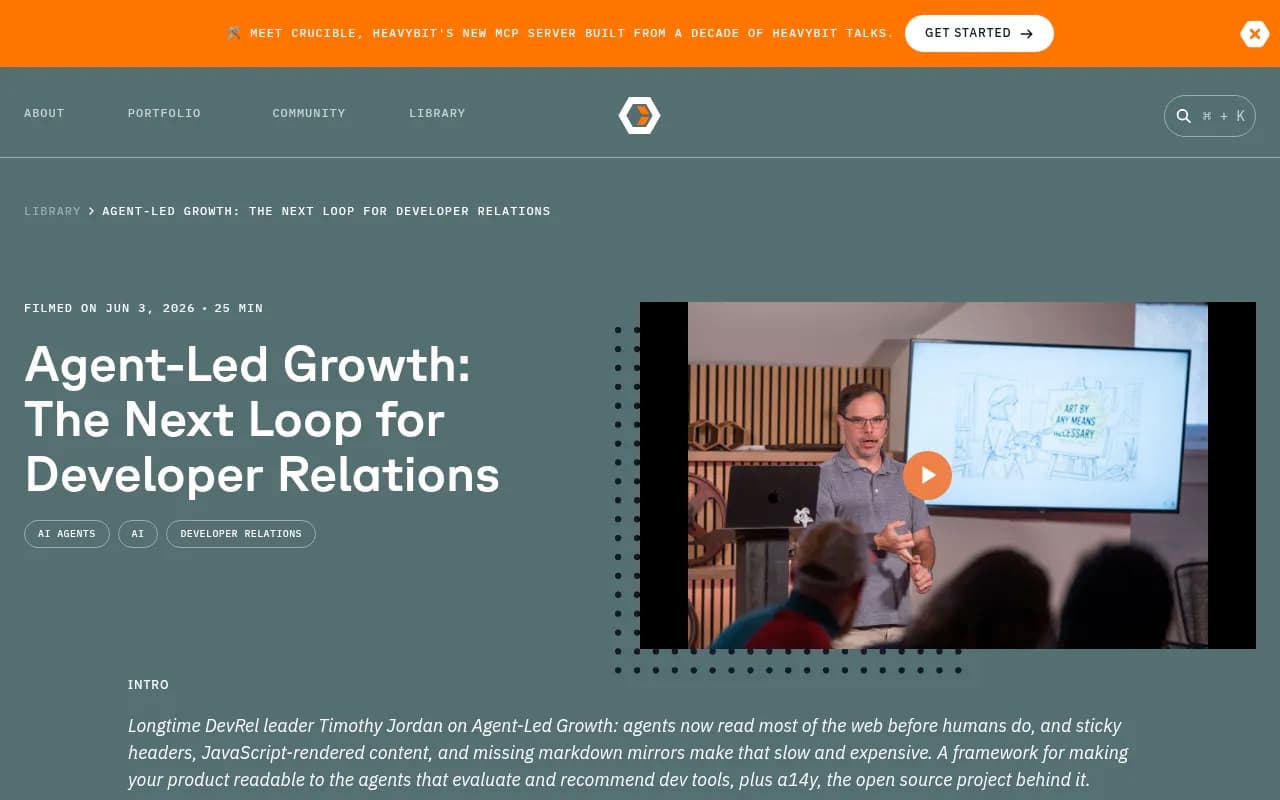
Timothy Jordan, a longtime DevRel leader, put it bluntly in a Heavybit talk filmed June 3, 2026: agents now read most of the web before humans do, and sticky headers, JavaScript-rendered content, and missing markdown mirrors make that slow and expensive. His framing is "agent-led growth," the next loop after developer-led growth. The goal is still making developers successful. The methods are different.
I think that framing is right, with one caveat. It is easy to read "agent-led" as "humans are out of the loop." They are not. Jordan himself notes that the people making buying decisions are often still humans. The agent is the researcher. The developer is the approver.
The audience got wider
There is a second shift. At DevRelCon New York 2026, the recurring theme was that developers are orchestrating multiple agents while marketers, operations staff, and people in agriculture and other fields use AI to build software. A write-up of the event on LinkedIn calls this the next billion builders.
The daily.dev guide to developer marketing makes the practical point: a program now has to decide whether it speaks to professional engineers, AI-native builders, or both, because those groups read different things and trust different proof. A staff engineer wants an architecture page and a reproducible benchmark. A founder building with a coding agent wants a working quickstart they can paste into a prompt.
Trust got scarcer
Developers have lived through pricing changes, license changes, and AI-washed launches. Honest comparison pages, benchmarks with published methodology, and visible changelogs outperform brand campaigns. Coding agent tooling is a good example of why. Even the pace of change, with benchmark retractions, quiet pricing restructures, and product mergers in a single month (July 2026, per one roundup on Medium), teaches developers to verify claims in the docs rather than believe a launch post.
DevRel is more important, not less
It would be easy to assume agents make DevRel redundant. The opposite looks more likely. Kevin Cochrane, CMO of Vultr, argued in Forbes on October 16, 2026 that the developer now carries even more weight in B2B dealmaking. His evidence is anecdotal, a hackathon at Milan AI Week where developers built business applications rather than features, but the logic holds. If a vendor has to prove it belongs in the agentic-era stack, developers are the ones who decide whether it does.
What changes is the craft. Jordan's point is that DevRel teams should practice their work the way their customers do, which means using agents in the process of doing DevRel. If your audience triages tools with an agent, your team should know what that agent sees.
What agents see when they read your product
This is the part most DevRel teams have not audited. An agent evaluating your SDK does not scroll your landing page. It fetches URLs, parses text, and moves on. Things that hurt:
- Documentation rendered entirely by client-side JavaScript
- Sticky headers and nav chrome that bloat every fetched page
- No plain-text or markdown version of key docs
- Robots.txt, CDN, or WAF rules that block AI crawlers by accident
- Quickstarts that assume a human will click through a wizard
There is nuance on markdown. Promptwatch Data's Markdown in AI Search report found markdown files are just 0.05% of AI search citations. Its conclusion is that markdown serves AI agents, not AI search. So a markdown mirror helps when an agent is working inside someone's editor. It will not, on its own, get you cited in a ChatGPT answer. Do both: keep clean HTML docs for search, and offer markdown for agents.
Check the crawlers first
Before writing anything new, find out whether the bots can get in. Promptwatch's AI crawler traffic report, covering weekly IP-verified requests from June 8 to September 6, 2026, shows OpenAI at 79.8% of verified AI crawler requests in the week of Aug 31 to Sep 6, down from 94.8% in early June. Anthropic, Google, Perplexity, and Mistral make up the rest. The report's advice is sensible: compare your own logs to that mix. If a provider is large in the benchmark but near zero in your logs, you are probably blocked.
Also separate training crawlers from answer-time fetchers. Blocking one for policy reasons should not accidentally block the other.
Promptwatch has IP-verified AI crawler logs that show which pages bots read and which fail, which is the quickest way to tell an access problem from a content problem.

For a no-login first pass, the Agentic Readiness Check shows which AI crawlers can read your site and which agent standards, like llms.txt, you support.
Where AI cites developer tools
If your discovery channel is increasingly an AI answer, it helps to know what those answers cite. Promptwatch's ChatGPT citations for software prompts (Sep 28 to Oct 4, 2026) are a useful map for DevRel teams.
| Source type | Share of software citations |
|---|---|
| Docs and help centers | 2.64% |
| Vendor sites | 2.01% |
| Review sites and analysts (G2, Gartner, Capterra, Software Advice) | 1.57% |
| GitHub | 1.2% |
| App stores | 0.47% |
GitHub is the single most cited software domain at 1.2%, followed by learn.microsoft.com at 0.98% and G2 at 0.73%. AWS docs get 0.41% and Google Cloud docs 0.35%. Vendor sites and docs together earn 4.65%, about three times the share of review sites and analysts.
The individual percentages look small because software prompts are spread across a huge number of domains. The ratios are what matter. Your own docs and repo outperform third-party opinion by a wide margin.
What I take from this:
- Docs are marketing. The team that writes them is doing the highest-leverage content work you have.
- A public GitHub presence is a citation asset, not just a distribution channel.
- Keep G2 and Capterra profiles accurate. They are a smaller slice, but they decide the comparison-style answers.
- Product pages matter too. Promptwatch's content-type data shows product pages are the most cited type in ChatGPT at 22.4% (Sep 28 to Oct 4, 2026).
One more thing. Promptwatch's social media citations data shows ChatGPT drew just 0.46% of citations from social platforms in the week of Sep 28 to Oct 4, 2026, versus 12.2% for Google AI Overviews. A community-heavy DevRel strategy still builds trust with humans, but do not expect Reddit threads to carry you in ChatGPT. Different engines, different source mixes. Promptwatch's Reddit data shows reddit.com's share of ChatGPT citations fell from about 4% to 0.5% on August 14, 2026.
A practical DevRel playbook for 2026
1. Audit agent readability
Fetch your docs the way an agent does: no JavaScript, no cookies. Is the content there? Can you reach the API reference in two hops? Jordan's team built an open source project called a14y around this idea, and it is worth looking at as a starting framework.
2. Write docs for retrieval
Short pages with one job. Descriptive headings. Code samples that run as pasted. An explicit statement of what the product does and does not do, since agents quote these lines in comparisons. Version and date everything.
3. Publish the honest comparison
Developers distrust campaign copy. A comparison page that admits where a competitor is better is more credible to a human and more quotable to a model. Include methodology for any benchmark.
4. Track prompts your buyers actually ask
Build a list of prompts like "best SDK for X," "how do I do Y in framework Z," and "alternatives to [competitor]." Run them across ChatGPT, Gemini, Perplexity, and Claude. Also run them through coding agents, since Codex, Claude Code, and OpenCode recommend tools and docs directly inside the editor. Promptwatch tracks those three coding agents, which matters if you sell an API or developer tool.
5. Close the loop on measurement
The daily.dev guide notes that measurement has moved first-party: conversion pixels, incrementality tests, and branded-search lift. Add three AI-specific signals on top:
- Citation share and position for your tracked prompts
- Crawler hits and failures on docs pages
- AI-referred visits and signups
A caveat on the last one. ChatGPT stopped sending a referrer on October 8, 2026, so some traffic will look direct. Tagging links with utm_source=chatgpt.com where you control them, and counting those visits explicitly, recovers part of it. The Promptwatch Academy has a guide on attributing AI traffic.
Tools worth considering
Not every team needs an enterprise stack. Here is how the options split for developer-focused programs.
| Need | Tool | Notes |
|---|---|---|
| End-to-end AI visibility, crawler logs, content workflows | Promptwatch | Monitors, traces citations, publishes content, measures traffic |
| Basic prompt tracking | Otterly.AI | Monitoring only |
| Enterprise monitoring | Profound | Higher price point |
| Free quick check | Amplitude AI Visibility | One-off analysis |
| Search data from Google | Google Search Console | Pair with AI data for coverage |
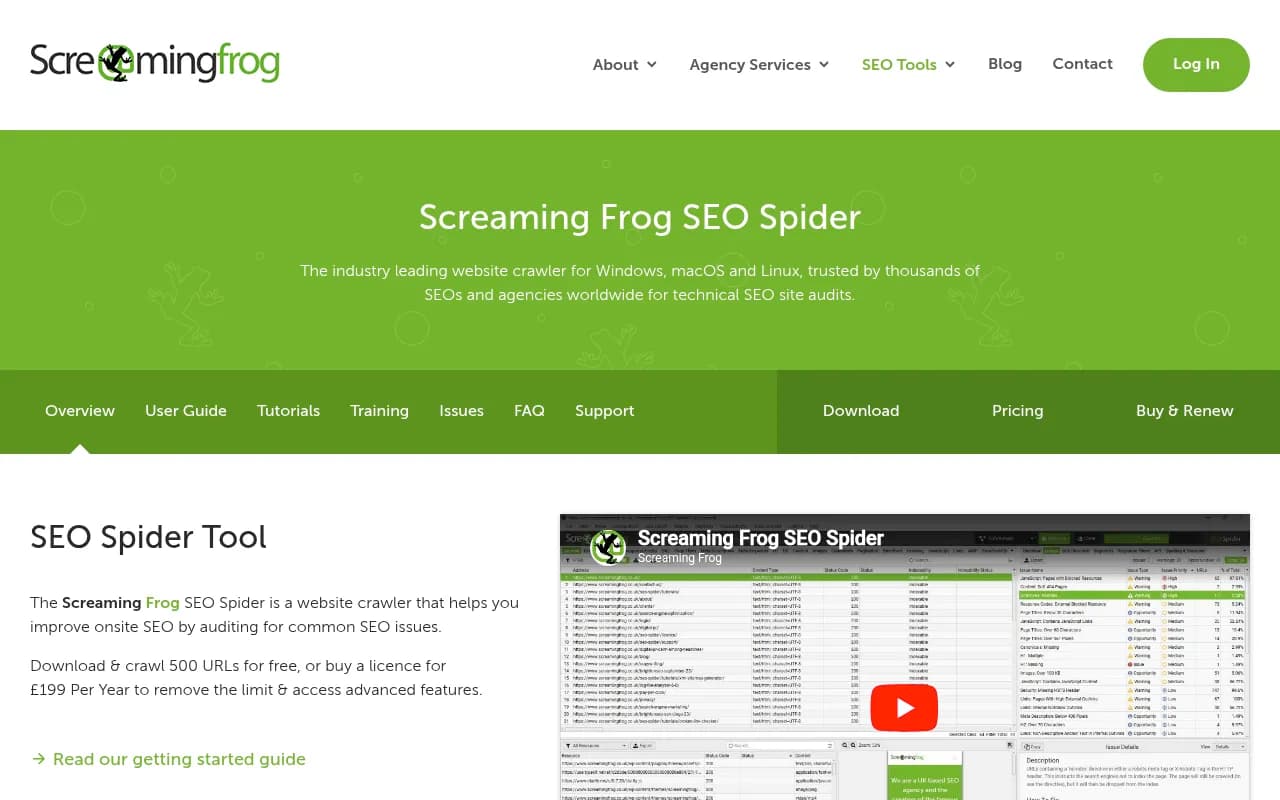
| Technical crawl audits | Screaming Frog SEO Spider | Finds rendering and link issues |
Promptwatch is the one I would start with if the question is "what do AI engines say about us, and what do we fix?" Plans start at $95 per month for Essential, and the Content Agent, local targeting, and faster tracking come with Business at $579. Confirm current pricing at promptwatch.com/pricing. There is a 7-day free trial on monthly billing and a free AI visibility report if you want a baseline first.



For more options by category, the GEO software directory at bestgeosoftware.com lists dozens of trackers and optimization platforms.
Team structure: who owns what
A split I see working: DevRel owns docs, samples, and community. Product marketing owns comparison pages and positioning. SEO or growth owns crawler access, structured data, and AI visibility measurement. The failure mode is when none of them owns the question "what does ChatGPT say about us?" Pick an owner and give them a weekly report.
If you do not have in-house capacity, an agency can run the technical and measurement side. 1001 SEO Media works on technical SEO and generative engine optimization for brands that want to be cited in AI answers, and uses Promptwatch for that tracking.
Mistakes to avoid
- Blocking all AI bots in robots.txt because of a policy discussion, then wondering why no assistant recommends you
- Treating a markdown file as a GEO strategy
- Measuring only signups and ignoring the research that happens inside an assistant first
- Writing launch posts that read like pitches. Developers verify claims in docs and on GitHub.
- Ignoring the builder who is not a professional engineer
What to do this quarter
Run the crawler check. Fetch your top ten docs pages without JavaScript. Write down twenty buyer prompts and record which tools get named. Fix the three worst gaps, usually a missing comparison page, a stale quickstart, or a blocked bot. Then re-run the prompts in a month. That small loop will tell you more about where DevRel fits in agent-led growth than another year of conference talks.