Key takeaways
- Developer tools are discovered in two places now: chat assistants like ChatGPT, and coding agents like Claude Code, Codex and OpenCode that pick and install SDKs on their own.
- A mention is not an adoption. You need to measure visibility, crawler access, referral traffic and, ideally, whether an agent can actually implement your product.
- Most marketing-oriented AI trackers cover ChatGPT, Perplexity and Gemini well and stop there. Coding agent coverage is the filter that matters for this guide.
- Promptwatch tracks Codex, Claude Code and OpenCode next to ChatGPT, and adds crawler logs and AI traffic. Gauge goes deeper on testing agent implementations. Pick based on whether your gap is discovery or implementation.
- Docs, GitHub presence and review-site profiles drive a lot of software citations in ChatGPT. Fix those before you pay for fancier tooling.
Why developer tools need a different kind of visibility tracking
If you sell a payments API, a database, an email SDK or a deployment platform, your buyer is increasingly not a person typing into Google. It is a developer who tells Claude Code "add transactional email to the signup flow," and the agent picks a vendor, reads the docs, installs a package and writes the integration. Sometimes the developer never sees a comparison page.
That changes what you track. A normal brand-monitoring setup asks "did ChatGPT mention us?" For developer tools, there are at least four separate questions:
- Do chat assistants recommend us when someone asks "what is the best X for Y?"
- Do coding agents choose us when they have a task and a free hand?
- Can AI crawlers and agents actually reach our docs, pricing and changelog?
- When an agent does pick us, does the integration work?
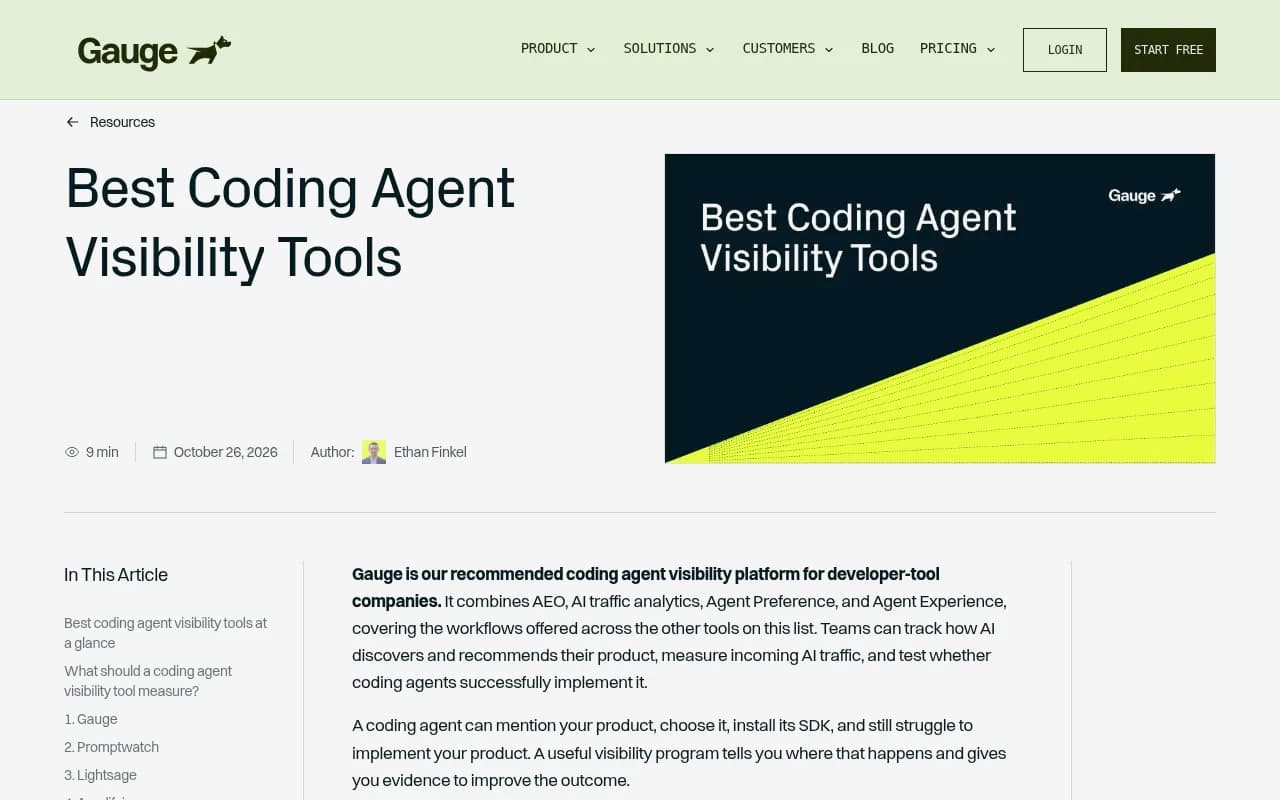
The Gauge team, which sells in this niche, makes the last point well in its coding agent visibility comparison: an agent can mention your product, choose it, install the SDK and still fail to implement it. A mention-only dashboard will never show you that. Keep in mind that guide is vendor-authored, based on public docs rather than hands-on benchmarks, so treat its rankings as one opinion.
What the data says about how developer tools get cited
Before picking software, it helps to know what AI engines actually pull from for software queries. Promptwatch Data's software citation report (ChatGPT, Sep 28 to Oct 4, 2026) shows the pattern:
- GitHub is the most cited domain for organic software prompts at 1.2% of all software citations.
- learn.microsoft.com is next at 0.98%, then G2 at 0.73%.
- AWS docs get 0.41%, Google Cloud docs 0.35%, Gartner 0.34% and Capterra 0.32%.
- By source type, docs and help centers lead at 2.64%, then vendor sites at 2.01%, review sites and analysts at 1.57%, and GitHub at 1.2%.
The interesting bit: vendor sites and docs together earn about three times the share of review sites and analysts. For a developer-tool company that is good news, because you control the docs. The takeaway from that report is blunt: publish crawlable docs, keep a public GitHub presence, and keep your G2 and Capterra profiles current.
There is also the question of whether the bots can read you at all. Promptwatch's AI crawler traffic data (weekly, June 8 to Sep 6, 2026) puts OpenAI at 79.8% of IP-verified AI crawler requests in the week of Aug 31 to Sep 6, down from 94.8% in mid-June. If a provider is big in that report but near zero in your own logs, you are probably blocking it with robots.txt, a CDN rule or a WAF. Docs sites behind aggressive bot protection are a very common cause.
And don't assume one assistant tells you about the others. Content types, citation habits and sources vary a lot by engine, which is why the social citation data shows ChatGPT pulling 0.46% of its citations from social platforms while Google AI Overviews pulls 12.2%.
What a developer-tool visibility platform should cover
Here is the checklist I would use when evaluating anything in this category.
- Real coding agent coverage. Claude Code, Codex and OpenCode at minimum. Many trackers add these only on expensive tiers, or not at all.
- Real interface data for chat assistants. Surfer's own roundup of trackers notes that about 75% of brands named via APIs didn't match what the real AI interfaces showed. API-only tracking can mislead you.
- Prompt design for developers. You want task-style prompts ("add rate limiting to my Express API") and comparison prompts, not just "best CRM software."
- Citation and source tracing. Which of your doc pages, GitHub repos or third-party posts get cited.
- Crawler logs. Proof that GPTBot, ClaudeBot, PerplexityBot and friends can fetch your docs.
- AI referral traffic. Signups and trials from AI, not just mentions.
- A way to act. Content gap analysis or at least a prioritized to-do list.
- Optional but valuable: implementation testing, where an agent actually tries to integrate your SDK.
The platforms worth considering
Promptwatch
Promptwatch is an end-to-end AI visibility platform, and it is the one on this list that covers the whole loop for a developer-tool company without stitching together three products. It monitors the real interfaces of ChatGPT, Gemini, Perplexity, Google AI Overviews, AI Mode, Copilot and Meta AI, and it tracks how the coding agents Codex, Claude Code and OpenCode recommend tools, SDKs and docs. API models like Claude, DeepSeek, Mistral and Grok are tracked alongside, so you can see what models believe from training data versus what they say with live search.

What makes it useful for developer tools specifically:
- Coding agent visibility sits in the same dashboard as ChatGPT, so you can compare how the same product is recommended in a chat answer versus an agent session. See the prompt tracking feature for how monitors, personas and query fan-outs work.
- AI crawler logs are IP-verified, covering GPTBot, OAI-SearchBot, ClaudeBot, Claude-User, PerplexityBot and others. They show which docs pages bots read, where they hit errors, and the crawl-to-citation path, so you can tell an access problem from a content problem. Setup works through Cloudflare, Vercel, Netlify, Fastly, CloudFront and others.
- Visitor analytics attribute traffic and conversions from ChatGPT, Claude, Perplexity, Gemini and Copilot. Note that ChatGPT stopped sending a referrer on October 8, 2026, so there is a setting that counts visits tagged utm_source=chatgpt.com as ChatGPT traffic.
- Content gap analysis, the Action Board and the Content Agent cover the fixing side, with publishing to WordPress, Webflow or Framer. Good for docs-adjacent content like integration guides and comparison pages.
- Citation tracking covers Reddit, YouTube, LinkedIn and GitHub-adjacent sources, plus a Page Tracker to watch any URL, yours or a competitor's.
Pricing, confirmed at promptwatch.com/pricing: Essential $95/mo, Professional $245/mo, Business $579/mo, with agency plans from $199/mo. Every plan tracks all supported AI models and includes unlimited seats, Agent Chat, and MCP and API access, and there is a 7-day free trial on monthly billing. Crawler logs start at Professional, and the automated Content Agent starts at Business. There is no free plan, but the free AI visibility report is a no-login way to see where you stand. A Black Friday discount of 30% was running at the time of writing, ending Nov 30, so check the pricing page before you budget.
In fairness, Promptwatch doesn't run an agent through your SDK and grade the resulting code. That is a different job, and Gauge is built around it.
Gauge
Gauge positions itself around what it calls Agent Preference and Agent Experience: testing which product a coding agent picks and whether the agent then implements it correctly, with session traces, final code changes and evaluation results as evidence. It also includes AEO and AI traffic analytics. Per its own guide, Claude Code, Codex, OpenCode, Pi and Antigravity are included on its $499/month Pro plan.
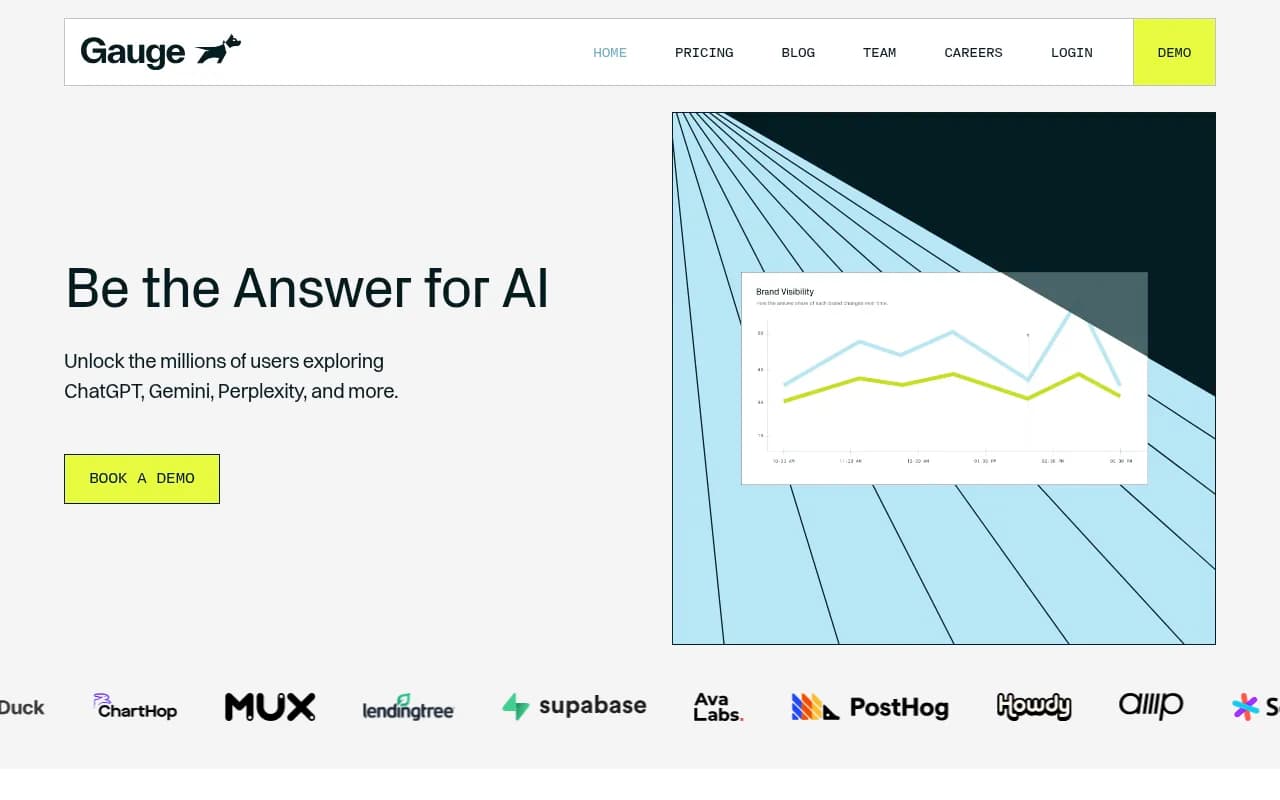
Its strength is that implementation testing. If your support queue is full of "the agent used the deprecated endpoint" tickets, that evidence is valuable. The caveat: the guide that ranks Gauge first is written by Gauge, and its $499 vs $1,000 pricing comparison against Lightsage comes from a competitor's reading of pricing pages. Verify before you cite it in a budget meeting.
Other names in the coding agent space
The Gauge guide also lists Lightsage (recommendation monitoring plus recorded integration runs and website requests), Amplifying (competitive product-selection research) and Known Agents (seeing agents hit your website and APIs). I could not verify pricing or coverage details for these three independently, and none of them are in our catalog yet, so I'd ask each for a demo and a sample report before deciding.
General AI visibility trackers
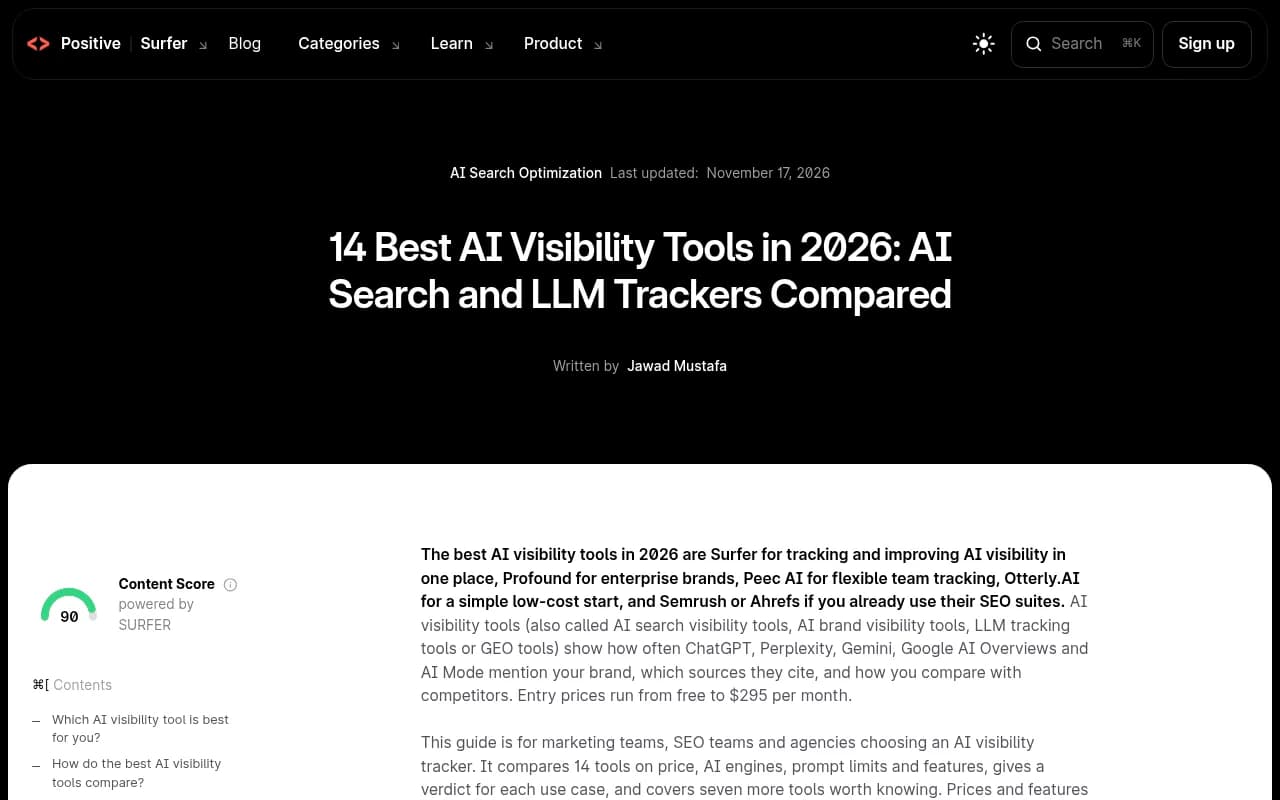
If you are mostly worried about chat assistants and your budget is tight, there are many cheaper options. Surfer's list of 14 AI visibility tools puts entry prices between free and $295/month, and notes Claude and Copilot are often paid add-ons. Surfer is also a vendor with its own product on that list, so same caveat as above.
Options in our directory worth a look for chat-assistant tracking only:




These are mostly prompt trackers or monitoring-first platforms. I have not verified that any of them track Claude Code or Codex, so confirm that before paying. For wider browsing, the GEO software directory lists many more.
Side-by-side comparison
| Platform | ChatGPT and chat assistants | Coding agents (Claude Code, Codex) | Crawler logs | AI traffic attribution | Implementation testing |
|---|---|---|---|---|---|
| Promptwatch | Yes, real UI data | Yes: Codex, Claude Code, OpenCode | Yes, IP-verified | Yes | No |
| Gauge | Yes (AEO) | Yes: Claude Code, Codex, OpenCode, Pi, Antigravity | Per vendor: AI traffic analytics | Yes | Yes |
| Lightsage | Yes | Per Gauge's guide, yes | Website requests | Per vendor | Recorded runs |
| Known Agents | Not the focus | Detects agent requests | Yes, request-level | Referral traffic | No |
| Typical marketing trackers | Yes | Usually no | Rarely | Sometimes | No |
The Lightsage and Known Agents rows come from Gauge's description and are unverified by me.
How to choose
A rough decision path:
- You don't know whether you are visible anywhere. Start with the free AI visibility report, or a low-cost tracker, and learn the baseline.
- You want discovery across chat and coding agents, plus the fix. A platform like Promptwatch fits, particularly because crawler logs and AI traffic are in the same product.
- Your funnel breaks after the recommendation (agents pick you, then fail). Add implementation testing, which is Gauge's lane. Running both is reasonable: one tells you where you appear and why, the other tells you whether it works.
- You are an agency serving several dev-tool clients. Look at agency plans with unlimited projects. Promptwatch's start at $199/mo.
A practical setup for the first 30 days
Week 1: baseline and access
Write 30 to 50 prompts that look like real developer asks. Mix "best tool for X" comparisons, task prompts ("add X to a Next.js app") and branded prompts about you and two or three competitors. Run them across ChatGPT and the coding agents. In parallel, check robots.txt, CDN and WAF rules for every AI crawler, using the AI crawler URL inspector or the agentic readiness check.
Week 2: read the citations
Look at which URLs get cited for you and for competitors. Expect docs, GitHub and review sites to dominate. Note where a competitor's quickstart gets cited and yours does not.
Week 3: fix the obvious
Sort out crawlability first. Then refresh the pages that agents seem to read: quickstarts, API references, migration guides. Update G2 and Capterra profiles. Consider an llms.txt file, with the caveat that markdown files are only 0.05% of AI search citations; markdown helps agents more than search engines, so don't expect a citation jump from it alone.
Week 4: connect to outcomes
Tie AI-referred visits to signups. Compare the conversion rate with other channels. Crisp reported 2x higher conversion on AI traffic versus traditional channels, per the Crisp case study, which is a useful benchmark for what to look for, though your numbers will differ.
Common mistakes
- Tracking only ChatGPT. Coding agents run their own searches and have their own preferences.
- Trusting API-only data. User-facing answers can differ from API output.
- Counting mentions as wins. An agent that names you but can't integrate you is a support cost, not a lead.
- Blocking bots by accident. Docs behind bot protection are invisible to agents.
- Ignoring third-party profiles. G2 and Capterra still show up in software citations.
If you want help building the content and technical side once you have the data, 1001 SEO Media works on GEO and technical SEO for software companies. Whatever you choose, run the same prompt set monthly and treat the numbers as a trend line, because AI answers move around more than classic rankings do.
Bottom line
For most developer-tool teams, the sensible stack is one platform that covers ChatGPT plus coding agents with crawler logs and traffic attribution, and optionally a specialist for implementation testing. Promptwatch is the pick for the first job. Gauge is the pick if you need the second. Everything else I'd treat as chat-only until a vendor shows you Claude Code and Codex coverage in a live demo.