Key takeaways
- API companies are found through documentation, GitHub and increasingly coding agents, so the right tool tracks developer-style prompts and shows whether AI crawlers can read your docs.
- Promptwatch is the only one of the four with coding agent tracking (Codex, Claude Code, OpenCode), plus crawler logs, visitor analytics and a Content Agent that writes and publishes pages.
- Profound is strongest on enterprise governance and prompt volumes, but its brand pricing has moved to a trial plus custom Enterprise, so budget a sales conversation.
- Peec AI and Otterly.AI are the simpler, cheaper monitors. Both are good at tracking, with less help fixing what you find.
- Check API and MCP access on the plan you will actually buy. It differs a lot between these tools.
Why API companies need a different evaluation
Most AI visibility comparisons are written for consumer brands. They ask whether ChatGPT mentions your shoe brand. If you sell an API, SDK or developer platform, the questions are different.
Developers ask things like "what is the best payments API for marketplaces" or "how do I add SMS verification in Node". The answers lean on documentation, GitHub repos, changelogs and comparison pages. Promptwatch's data on software prompts backs this up: in Promptwatch Data's October 2026 software citation report (Sep 28 to Oct 4, 2026), GitHub, Microsoft's docs and G2 lead ChatGPT citations, and documentation and help centers earn the largest share. Your docs site is your main landing page for AI.
So for an API company, I would judge these tools on five things:
- Do they track the real consumer interfaces, or only model APIs?
- Can they show whether AI crawlers actually read your docs?
- Do they cover coding agents like Claude Code and Codex?
- Do they have an API or MCP server, so your team can pull data into its own dashboards?
- Do they help you fix gaps, or only report them?
The four tools at a glance
| Promptwatch | Profound | Peec AI | Otterly.AI | |
|---|---|---|---|---|
| Entry price | $95/mo (Essential) | 7-day trial, then custom Enterprise | $95/mo (Starter, 50 prompts) | $29/mo (15 prompts) |
| Data collection | Real UI sessions for ChatGPT, Gemini, Perplexity, Copilot, AI Overviews, AI Mode, Meta AI, Alexa; APIs for others | Browser capture, daily | Logged-out UI scraping, daily | Public web interfaces, daily; API for Claude |
| Coding agent tracking | Codex, Claude Code, OpenCode | Not listed | Not listed | Not listed |
| AI crawler data | Crawler logs from Professional ($245) | Agent Analytics | Crawl insights | Agent Analytics from Standard ($189) |
| API / MCP | REST API and MCP on every paid plan | REST API on Enterprise | REST API on Enterprise | API and MCP from Standard |
| Content creation | Content Agent, CMS publishing (Business) | Limited | Recommendations only | Briefs only |
| Prompt volumes | Volume and difficulty scores | Enterprise | 1-5 score | Not listed |
Prices for Profound, Peec AI and Otterly.AI come from third-party roundups checked in October 2026, so confirm them on each vendor's pricing page before buying. Promptwatch prices are at promptwatch.com/pricing.
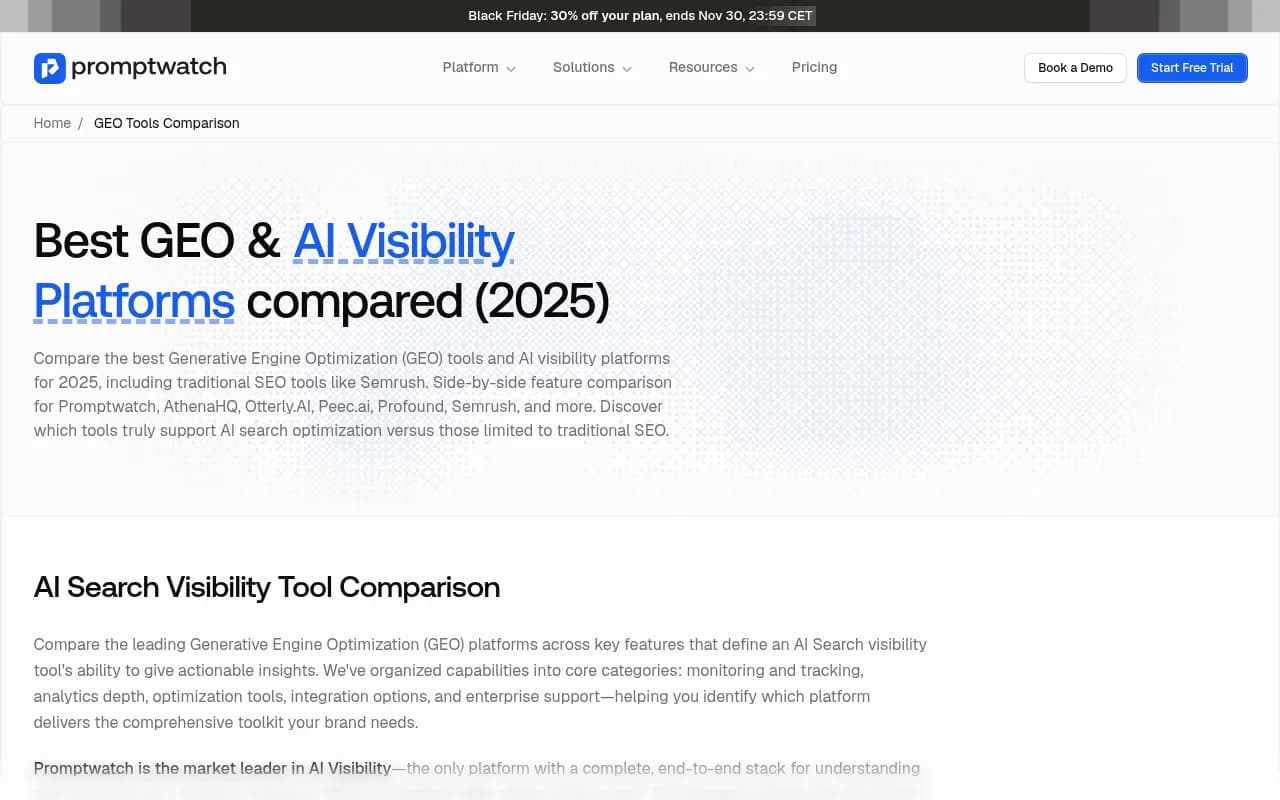
The matrix above is Promptwatch's own, so read it as a vendor view. It is still a useful checklist of what to ask each competitor.
Promptwatch
Promptwatch is the one I would shortlist first for an API company, mostly because of two features the others do not match: coding agent tracking and a full loop from monitoring to publishing.

Coding agents are an increasingly real discovery channel for developer tools. Promptwatch tracks how Codex, Claude Code and OpenCode recommend tools, SDKs and docs, alongside the consumer products (ChatGPT, Gemini, Perplexity, Copilot, Google AI Overviews and AI Mode, Meta AI and Alexa). If a developer asks Claude Code which SMS API to wire in, you want to know whether you are the answer.
The second piece is AI crawler logs. They are IP-verified, so you see which pages GPTBot, ClaudeBot, PerplexityBot and others read, where they hit errors, and which crawled pages go on to get cited. For a docs site behind a CDN, an auth wall or a JavaScript-heavy renderer, this is how you tell an access problem from a content problem.
Then there is the work after the diagnosis. Content gap analysis maps your pages against the prompts AI answers, the Action Board prioritizes what to do, and the Content Agent can write and publish to WordPress, Webflow or Framer. Page Tracker and visitor analytics then show whether the new page gets crawled, cited and clicked. Business is the first plan with the automated Content Agent.
On access, the REST API and a hosted MCP server with 110+ tools are on every paid plan, which suits teams that want visibility data inside Claude or Cursor, or in their own BI stack.
Plans: Essential $95/mo (50 prompts), Professional $245/mo (150 prompts, crawler logs, 5 AEO articles), Business $579/mo (350 prompts, Content Agent, state and city tracking). All include unlimited seats, all models and Agent Chat.
The honest downsides: crawler logs need Professional, so the cheapest plan is monitoring and analysis only, and the breadth means a bit more to learn than a pure tracker. Head-to-head pages: Promptwatch vs Profound, vs Peec AI and vs Otterly.AI.
Profound
Profound is the most heavily funded company in the category. A third-party roundup reports a $96M Series C in February 2026 at a $1B valuation, with customers including MongoDB, Figma and DocuSign, which tells you it has real traction with technical companies.
Its strengths are enterprise-shaped. It captures answers from the browser rather than model APIs, covers up to nine engines on Enterprise, and has a proprietary Prompt Volumes dataset that estimates how often queries are asked across LLMs. Enterprise adds SOC 2 Type II, SAML SSO and a REST API reported at 600 requests an hour per key. Agent Analytics reads server and CDN logs.
The friction is access and price. Pinggy's October 2026 check found the $99 and $399 plans gone, with a 7-day trial and custom Enterprise pricing in their place. Promptwatch also claims that Profound locks models, API and MCP behind Enterprise contracts. That is a competitor's claim, so verify it on a demo. If you are a 20-person API startup, a sales-led process is a poor fit. If you are a public company with a security review, it may be exactly what you need.
Peec AI

Peec AI is a Berlin company that scrapes the interface as a logged-out user, which one Reddit commenter attributes to Peec's CPO. It runs prompts daily and has clear pricing: Starter $95/mo (about 85 EUR) for 50 prompts, Pro $245 for 150, Advanced $495 for 350 prompts, five projects and multi-country tracking.
Self-serve plans choose three models from ChatGPT, AI Mode, AI Overviews, Copilot, Gemini and Naver AI, with Perplexity as a paid add-on. Enterprise opens up to 13 models including Claude, Grok, DeepSeek and Mistral. Prompt demand is scored 1 to 5, and crawl insights come on every plan.
For API companies, the catch is the three-model cap and an Enterprise-only REST API. You will pay for extra engines, and there is no coding agent tracking in the sources I reviewed. Peec is a clean monitor with good agency ergonomics (unlimited seats), but its recommendations stop at advice. Compare it directly in Promptwatch vs Peec AI.
Otterly.AI

Otterly.AI is a Vienna-founded, marketer-built tool and the cheapest way in here, with plans from about $29/mo for 15 prompts. It sends prompts through public web interfaces daily and uses an API only for Claude. ChatGPT, AI Overviews, Perplexity and Copilot come on every plan; AI Mode, Gemini and Claude are paid add-ons, so model the add-ons before you budget.
It has a free GEO audit, AI crawler simulation and query fan-out tools. Standard (around $189) adds API and MCP access at 2,000 requests a month each, a Looker Studio connector and Agent Analytics with 200,000 crawler events a month. Content support is URL audits and briefs.
Otterly suits a small team that wants to watch a handful of developer prompts without a big commitment. It is less suited to heavy API-driven reporting, since the request quotas are modest. G2 shows 4.8/5 on Otterly's own site.
Which one fits which API company
| Your situation | Best fit | Why |
|---|---|---|
| Developer-tool company, wants coding agent visibility and fixes | Promptwatch | Codex, Claude Code and OpenCode tracking, crawler logs, Content Agent |
| Large enterprise, security review, SSO required | Profound | SOC 2, SAML, Prompt Volumes, Enterprise REST API |
| Mid-market team wanting simple tracking plus crawl data | Peec AI | Clear tiers, crawl insights on every plan |
| Startup testing the waters on a tight budget | Otterly.AI | Low entry price, free audit tools |
| Agency running several API clients | Promptwatch Agency plans or Peec AI | Unlimited projects and seats |
What to track once you pick one
Whatever you buy, set up these prompt groups first:
- Category prompts: "best [your API category] for [use case]".
- Implementation prompts: "how to integrate [capability] in Python/Node/Go".
- Comparison prompts: "[you] vs [competitor]" and "alternatives to [competitor]".
- Pricing and limits prompts, since AI often repeats outdated claims about free tiers and rate limits.
Two habits matter more than the tool. First, check the crawler side early: if your docs block AI bots or render content only with client-side JavaScript, no amount of content work will help. Free helpers like Promptwatch's Agentic Readiness Check and the LLMs.txt generator are a quick first pass. Second, read citations per engine. Promptwatch's report on average sources per response shows ChatGPT citing about 5 sources per web-search answer while Google AI Overviews and Perplexity cite about 10, so one blended score hides a lot.
Also expect volatility. Promptwatch Data found ChatGPT began using the site: operator at scale on August 8, 2026, jumping from about 0.4% to about 17% of fan-out queries. For a docs-heavy company, that favors clean, well-structured pages on your own domain.
If you want to browse more options, the GEO software directory at bestgeosoftware.com lists the wider field.
Verdict
If your goal is only to watch a score, Peec AI or Otterly.AI will do it for less. If procurement drives the decision, Profound is built for it. For an API company that needs to see coding agents, know whether crawlers can read its docs, and ship fixes without a separate content stack, Promptwatch covers the most ground. Start with the 7-day free trial or the free AI visibility report, run your 20 most important developer prompts, and compare what each tool shows you before committing to annual billing.