Key takeaways
- Self-serve GEO tools run from roughly $20 to $800 a month. Enterprise is "custom" almost everywhere, so the quote you get is the only price you will see.
- The billing unit differs by vendor (credits, prompts x models x frequency, seats), so compare cost per tracked response, not the headline monthly fee.
- Enterprise tiers usually add SSO, API access, audit logs, multi-country tracking, more models and a named specialist. Check which of those you are paying extra for.
- Benchmark with three anchors: public list prices as a floor, third-party estimates as a rough ceiling, and general SaaS contract data for terms like escalators and liability.
- Ask what the platform does after it reports a problem. A dashboard and a platform that fixes things are priced very differently.
Why enterprise GEO pricing is so hard to pin down
Try to find a real enterprise number for a GEO platform and you will mostly find the word "custom." I went looking for verified contract values, discount ranges and renewal data from primary sources. They do not exist publicly. What does exist is a set of list prices for lower tiers, a few vendor-authored comparison pages that contradict each other, and one or two third-party estimates.
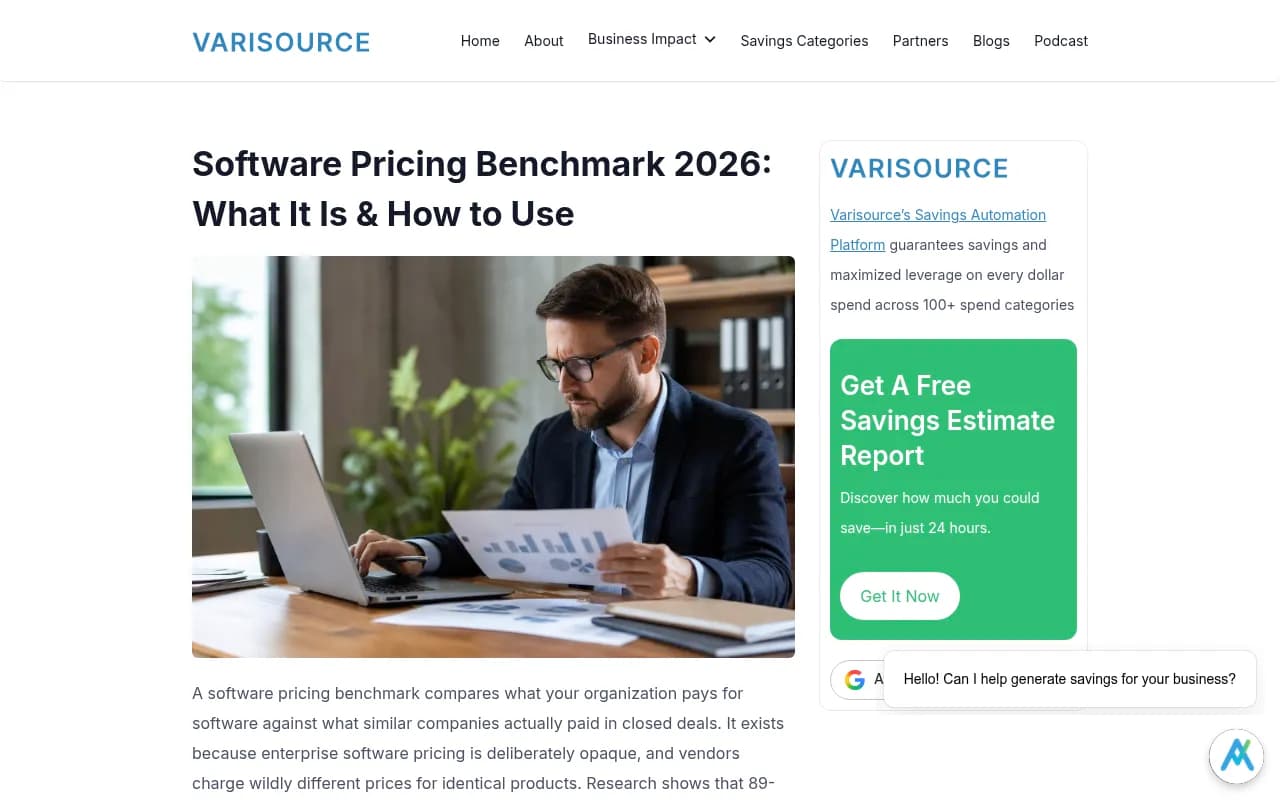
That is normal for enterprise software. The research on software buying is blunt about it: pricing is opaque on purpose, and vendors benefit when buyers do not know what others pay. One benchmarking write-up from Varisource cites analyses saying roughly 89-90% of companies overpay on software, typically by 22-26%, and that the same tool can carry a spread of over 100% between two customers. Those are vendor-published figures from benchmarking companies, so treat them as directional. Still, the shape of the problem is clear.
GEO makes it worse because the category is new. Nobody has a decade of closed-deal data. So you benchmark with what you can get.
What the public price points tell you
The self-serve tiers are your floor. Anything an enterprise contract charges should be explainable as this floor plus specific things you cannot get on a self-serve plan. These figures come from third-party comparison pages dated around September 2026, and plans change often, so confirm on each vendor's pricing page.
| Vendor | Entry or mid tier | Top published tier | Enterprise |
|---|---|---|---|
| Peec AI | $95/mo (50 prompts) | $495/mo (350 prompts) | Custom, API, SSO, up to 13 models |
| AthenaHQ | $295/mo (3,600 credits) | n/a | Custom, SAML SSO, audit logs, GEO specialist |
| Otterly.AI | $189/mo (100 prompts) | $489/mo (400 prompts) | From about $1,000/mo |
| Scrunch | $300/mo | $500/mo | Custom, 9 models |
| Profound | Conflicting reports | Conflicting reports | Custom, est. $30k-$100k+/yr (unverified) |
| Rankscale | EUR 20/mo | EUR 99/mo | EUR 780/mo |
| Promptwatch | $95/mo (50 prompts) | $579/mo Business (350 prompts) | Custom |
Two cautions. First, some of these conflict. One source lists Otterly at $29 a month for 15 prompts, another at $189 for 100. Profound is described as having $99 and $399 tiers in one place and only a trial plus custom enterprise in another. Second, AthenaHQ's own comparison test lists competitor prices that do not match anyone else's. Vendor-authored comparisons are marketing, not benchmarks.
The only published enterprise anchors are Otterly's roughly $1,000 a month and Rankscale's EUR 780. The $30,000 to $100,000+ a year figure for Profound is an estimate from Surmado, not a confirmed contract value. For agency services, Nutshell puts enterprise-level GEO work at $25,000 to $50,000 a month, built from public package structures and described by the author as planning estimates, not quotes.
In other words, enterprise GEO software plausibly spans from low five figures to six figures a year, and the range is wide because scope varies so much.
Why you cannot compare prices without comparing meters
This is where most buyers get burned. Every vendor meters differently.
- Peec bills on "AI answers," which is prompts x models x tracking frequency. Extra models on self-serve plans cost more.
- AthenaHQ and Rankscale use credits.
- Otterly prices by prompt count.
- Scrunch leans on seats, with extra seats at $25 a month each on Starter.
- Promptwatch lists responses per plan (6,000 on Essential up to 42,000 on Business) with unlimited seats and all models included.
A $500 plan with 400 prompts on three models is not comparable to a $500 plan with 3,600 credits on eleven. Convert everything to one unit before you talk to anyone. The cleanest one is cost per tracked response per month: take monthly price, divide by prompts x models x runs per month. Then add the extras you would actually need.
A quick example of the arithmetic:
prompts: 350
models: 6
runs per month: 30 (daily)
tracked responses = 350 x 6 x 30 = 63,000
quote: $2,500/mo  ->  about $0.04 per response
If a vendor will not tell you how many responses your quote covers, that is information in itself.
What custom contracts usually include
Across the vendor pages I reviewed, the enterprise tier shows a consistent set of additions over self-serve plans.
| Typical enterprise inclusion | Why it matters | What to ask |
|---|---|---|
| SSO / SAML | Security teams require it | Is it included or an add-on? |
| API and MCP access | Feeds your BI stack | What are the request limits per hour? |
| Audit logs | Change tracking for compliance | Do they cover API and agent changes? |
| Multi-country, multi-project tracking | Regional teams and brands | Are extra markets billed per market? |
| More models | Claude and others cost extra on some plans | Which models, and are new ones added free? |
| Dedicated specialist or CSM | Onboarding and reviews | Named person, or a shared queue? |
| SOC 2 or ISO 27001 | Procurement checklists | Which certificate, and can you see it? |
| Faster tracking frequency | Launches and campaigns | Hourly or 6-hourly, and at what price? |
Some of these are free elsewhere, which is the useful part. On Promptwatch, every plan includes unlimited seats, all supported models, API and MCP access, and Brand Narrative. The audit log starts on Business, and SSO and a white-label client portal are Enterprise. Promptwatch is also ISO/IEC 27001 certified and GDPR compliant. If a competitor is charging an enterprise premium for something another vendor puts in its mid tier, that is a negotiating point.
The inclusions that separate a dashboard from a platform
Most of the price difference between vendors is not the monitoring. It is what happens after you see the numbers. When you review a quote, sort the features into two piles.
The first pile is monitoring: prompts, visibility scores, sentiment, competitor share. Nearly every vendor has this, and it is increasingly a commodity.
The second pile is the work: content gap analysis, content generation and CMS publishing, AI crawler logs, visitor analytics that show whether AI sends traffic, and a way to see whether a published fix worked. This is where enterprise budgets either pay off or do not.
Crawler analytics is worth singling out. Promptwatch Data's AI crawler traffic report (IP-verified requests, June 8 to September 6, 2026) shows OpenAI at 79.8% of tracked crawler requests in the week of August 31 to September 6, down from 94.8% in the week of June 8. The mix is shifting quickly, which is a good reason to want crawler logs in your contract instead of guessing which bots can read your site. Verifying that the vendor checks visits against published operator IP ranges, so spoofed user agents are filtered out, is a fair question to ask.
Promptwatch is built around that loop: monitor, trace the sources, act with the Content Agent and Action Board, then measure through crawler logs and visitor analytics. The Content Agent and the managed Agentic AI Search Optimization service start on the Business plan at $579 a month, with tailored terms for Enterprise. Confirm current prices at promptwatch.com/pricing.

Other vendors that sell into the enterprise tier and are worth putting in the same spreadsheet:


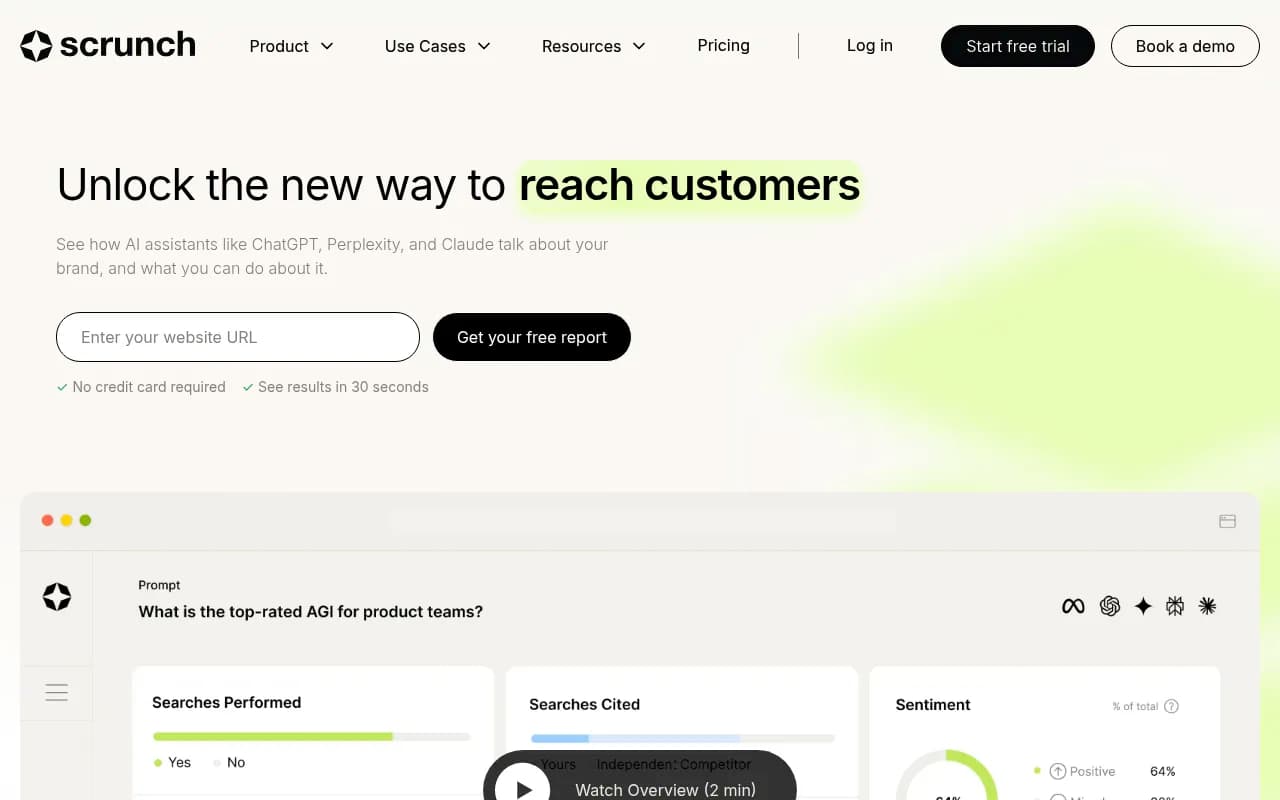
The last two are enterprise SEO suites that added AI visibility, so expect bundle pricing that is hard to separate from the SEO contract. If you want a wider survey, the GEO software directory at bestgeosoftware.com lists more options.
Contract terms to benchmark, not just price
A benchmark that only looks at the monthly fee misses most of the real cost. Two contracts at the same price can differ a lot once you read the terms.
Price escalators
Varisource describes an escalator as a clause permitting annual increases, often 3-7% a year, and says capping them is a core negotiating tactic. Common Paper's 2026 SaaS Contract Benchmark Report adds some useful context: only 13% of signed contracts now include automatic fee increases, down from 23% in 2024, and buyers are pushing back on increases justified by new AI features. That is general SaaS data, not GEO, but it tells you a no-escalator or capped-escalator ask is normal in 2026, not aggressive.
Liability and data terms
The same Common Paper report found unlimited liability claims rising from 1.1% to 10.2% of cloud service agreements. If the vendor will process your prompts, customer data or connected analytics, have legal look at the liability cap and data processing terms before you debate the discount.
Usage caps and overage
Ask what happens when you exceed your response or prompt volume. Does tracking stop, or do overage rates apply? Some platforms keep tracking through a late payment so your data has no gaps. Others do not. Get it in writing.
Model coverage
Model counts differ by source (AthenaHQ shows 9 in one place and 11 in another), so ask for the exact list in the contract. Also ask whether data comes from the real consumer interfaces or from APIs. Answers and citations can differ between the two, and that affects whether the numbers you pay for reflect what customers see.
Frequency and add-ons
Daily tracking is the baseline. Hourly or 6-hourly runs, state and city targeting, and shopping or ads modules are usually priced separately. Only buy them if a specific launch, local campaign or ecommerce motion needs them.
How to benchmark a quote step by step
- Define scope in numbers. Prompts, models, markets, runs per day, seats, projects. Without this, every quote is incomparable.
- Convert each vendor's meter to cost per tracked response, using the formula above.
- Price the self-serve equivalent. Take the closest public tier, scale it up linearly, and see how far the enterprise quote sits above it. The gap is what you are paying for SSO, support and the rest. Decide whether that gap is worth it.
- List the extras you would pay for separately: more models, markets, API volume, specialist hours.
- Check the terms: escalator, renewal, liability, data handling, exit and data export.
- Ask for a pilot. A 7-day trial or paid pilot on a smaller scope reveals whether the data matches reality before you sign a 12-month deal.
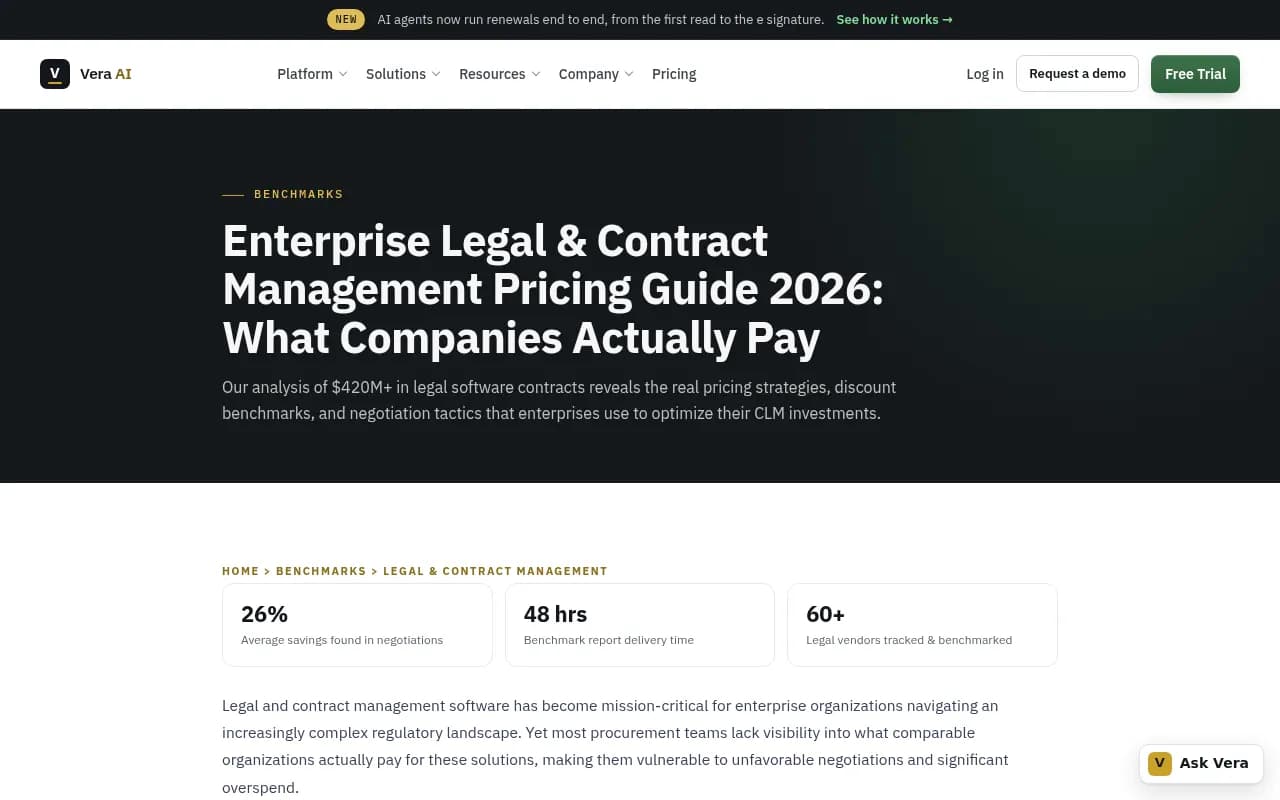
- Get at least three quotes. Even in a young category, tension between vendors is your main lever. VendorBenchmark claims enterprise legal software pricing varies by up to 340% for functionally identical products and that benchmarking yields about 26% average savings. That is a vendor claim for a different category, so I would not plan around the number, but it supports the idea that quotes should not be accepted at face value.
Normalize for deal context
A benchmark only works when it compares like with like. Varisource makes the point that a 10-seat startup deal says nothing about what a 2,000-seat enterprise should pay. The same applies here. A single-brand company tracking 350 prompts in one country is not a reference point for a multi-brand group tracking thousands of prompts across a dozen markets.
Red flags in an enterprise GEO quote
- No stated volume. If the quote says "unlimited" without defining prompts, models or frequency, the limits are hidden somewhere else.
- Pricing by seat in a category where teams are growing. Seat-based meters penalize collaboration. Several platforms include unlimited seats, so a per-seat fee should justify itself.
- Core features sold as add-ons, such as API access or additional models.
- A dashboard with no path to action. If the platform only reports a score, you still need a content team, an agency or both to do the work. Budget for that separately.
- Auto-renewal with an uncapped increase, especially when the vendor justifies it by pointing to new AI features.
- No way to export your data when you leave.
When an agency is part of the equation
Some enterprise teams skip the software-only route and buy managed GEO services. Nutshell's estimate of $25,000 to $50,000 a month for enterprise-level agency work is a reasonable order of magnitude to hold in mind, though real quotes depend heavily on scope. If you go this route, ask which platform the agency uses and whether you will have access to the underlying data. 1001 SEO Media, which publishes this directory, runs GEO work for clients on Promptwatch, with no long-term contracts and transparent monthly reporting. As with any vendor, ask for scope and deliverables in writing and compare at least two proposals.
A short benchmark worksheet
Copy this into a spreadsheet and fill one column per vendor.
| Line item | Vendor A | Vendor B | Vendor C |
|---|---|---|---|
| Annual price | |||
| Responses included per month | |||
| Cost per response | |||
| Models included | |||
| Markets included | |||
| Seats | |||
| API / MCP limits | |||
| SSO, audit log, certifications | |||
| Crawler logs and visitor analytics | |||
| Content creation and publishing | |||
| Escalator and renewal terms | |||
| Exit and data export |
If you want a quick read on where your brand currently stands before you start these conversations, Promptwatch has a free AI visibility report that needs no login. It gives you a baseline, which makes it easier to judge whether a vendor's pitch addresses your real gaps.
What I would do
I would not start with the vendor who talks about enterprise. I would start with the self-serve tiers, run a trial on one or two tools, and learn which metrics I actually use. Then I would write the scope in numbers and send it to three vendors. The quotes will land far apart, and that spread is the most honest benchmark available in a category without public contract data.
Prices on this page come from third-party sources and change quickly. Check each vendor's own pricing page before you put a number in a budget.