Key takeaways
- AI hallucinations about brands are wrong prices, invented features, confused competitor claims and outdated company facts. They reach buyers before your sales team ever speaks to them.
- When a prompt names your brand, ChatGPT draws on fewer sources, so each source has more say in what gets said about you. Auditing that short list is the highest-leverage task.
- A wrong claim on a landing page, doc or pricing page can stay cited for months, according to Promptwatch's content half-life data.
- Single-prompt spot checks tell you almost nothing. Brand safety monitoring needs many prompts, many models, many countries, run on a schedule, with claim-level tracking.
- The fix is usually upstream: correct your own pages, then the review sites and forums AI cites, then verify the answer actually changed.
Why hallucinations are a brand safety problem now
Brand safety used to mean ad placement: keeping your banner away from bad content. In AI search it means something different. The model itself writes the sentence about you, and nobody on your team reviews it before a buyer reads it.
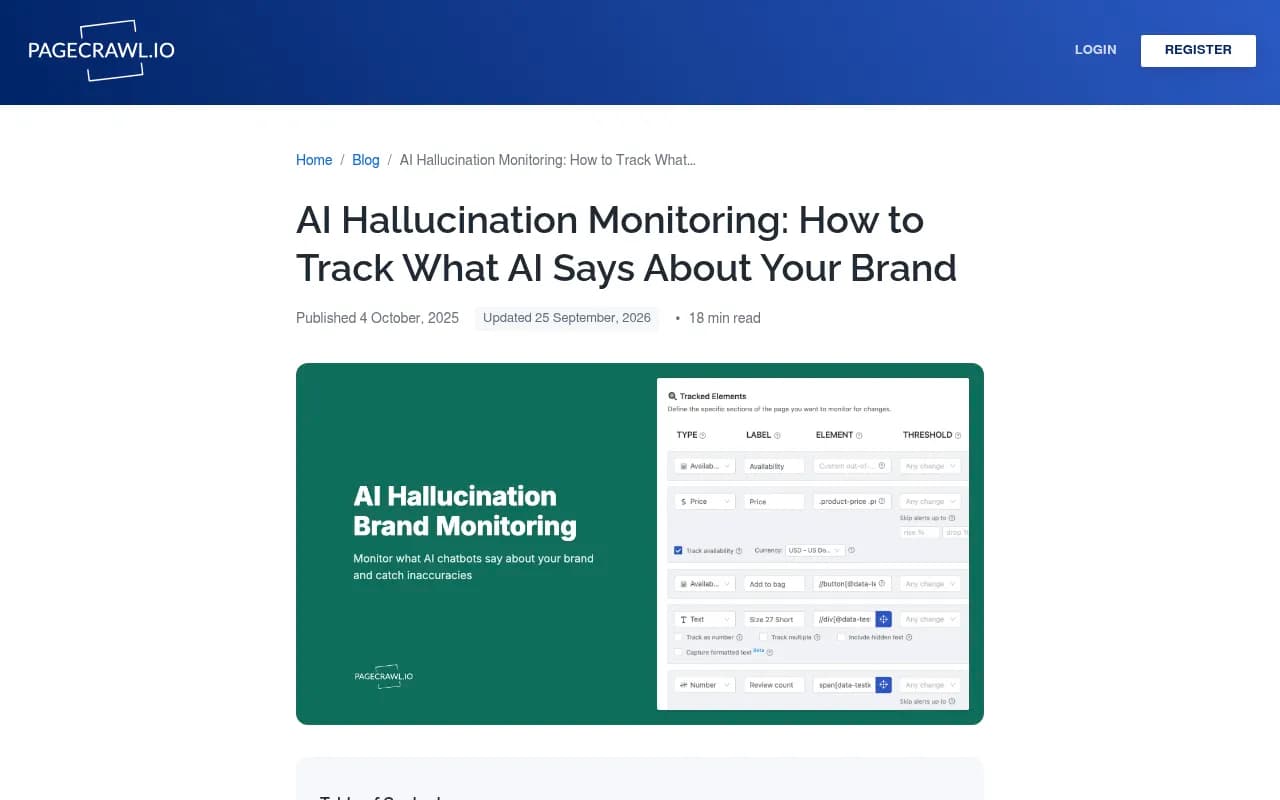
A typical discovery story goes like this. A prospect mentions on a call that your product was discontinued. It was not. The model confused a rebrand with a shutdown, and the answer circulated for months before anyone in marketing asked ChatGPT about their own company. PageCrawl's write-up of AI hallucination monitoring describes exactly this pattern, and it matches what enterprise teams tell us: the discovery is almost always accidental.
The categories are fairly consistent:
- Wrong pricing. Old pricing pages, blog posts and comparison articles feed the answer. Sometimes the model invents a "free forever" tier that never existed.
- Fabricated features. Integrations or capabilities your product does not have, which produces frustrated customers who bought on a false promise.
- Confused competitor claims. Your differentiator gets credited to a rival, or theirs to you.
- Outdated descriptions. Pivots, acquisitions and leadership changes go unnoticed.
- Invented company facts. Wrong founding dates, headquarters, funding amounts, partnerships.
The math on scale is unforgiving. One published estimate puts GPT-4o at a 1.5% hallucination rate on benchmark tasks. If your brand appears in 10,000 AI responses a month, that is roughly 150 wrong answers, and brand-specific questions are not benchmark tasks, so treat that figure as a floor for thinking about volume, not a measured rate for your brand.
A caution on statistics floating around this topic. You will see the claim that AI search tools misrepresent brands 60% of the time, attributed to Columbia University. The underlying Tow Center study (published in CJR, March 2025) tested citation accuracy for news content, not brand claims. I would not repeat that number in a board deck.
Regulated industries raise the stakes
For healthcare, pharma, finance and legal brands, a wrong claim is not just embarrassing. It can influence patient or customer decisions and create compliance exposure. Adobe's guidance on testing AI models makes the same point from the content-production side: if AI output is not verified by humans, a false claim can become the answer, attributed to a brand that no longer controls it.
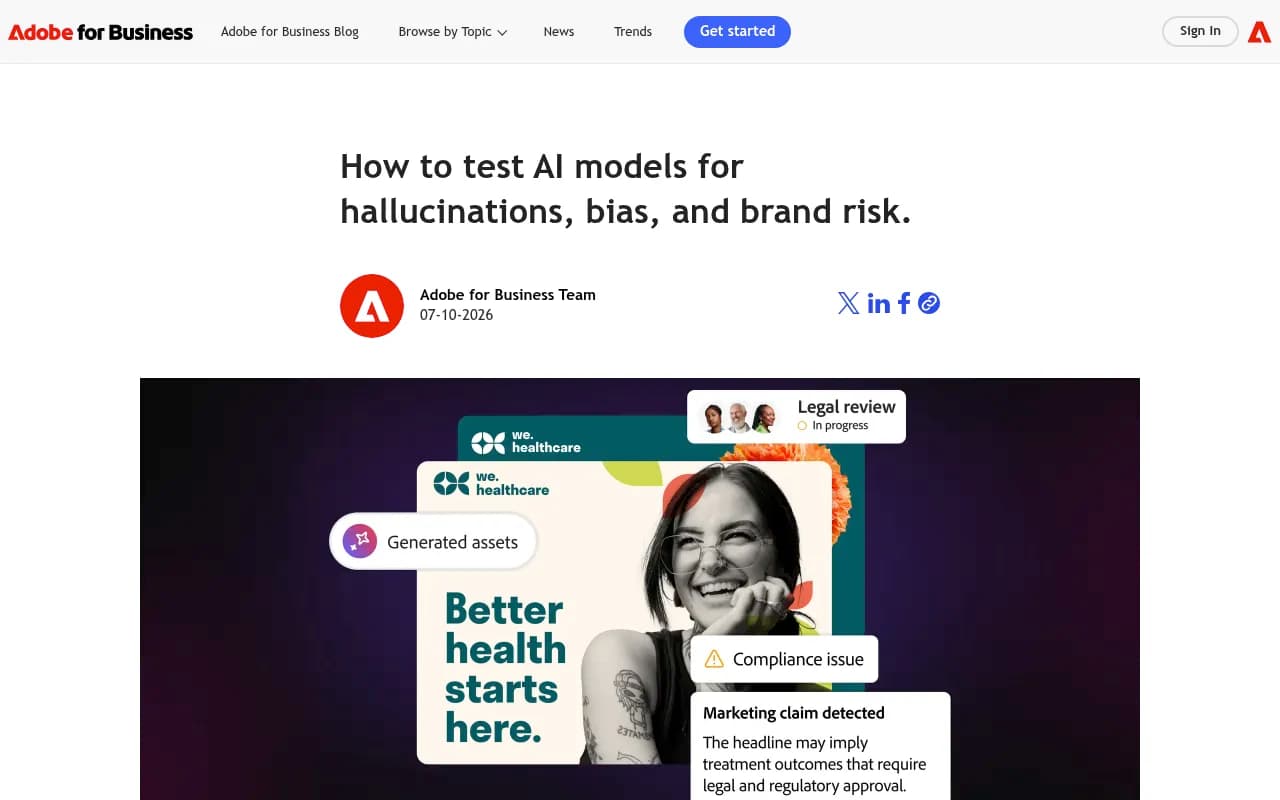
That Adobe piece is mostly about outputs your own team generates. This guide is about the other half: what third-party AI systems say about you, which you do not control but can influence.
Where wrong claims come from
Understanding the source matters, because the fix differs. Models answer from two places: training data (frozen at a cutoff) and live retrieval (web results fetched at answer time). A stale price can come from either.
The retrieval side is the part you can act on quickly, and Promptwatch Data has useful numbers on it.
Branded prompts use fewer sources
In Promptwatch data covering Sep 28 to Oct 4, 2026, 47.6% of ChatGPT responses cite 10 or more domains. But when a prompt names a single brand, the pattern flips: 5 domains is the most common count (14.9% of responses), 40.7% cite five or fewer, and only 21.3% cite ten or more.
The brand-safety reading is blunt. When someone asks "is [your brand] any good?", ChatGPT leans on a short list of sources, so each one carries more weight. If one of those is an outdated review or a stale comparison page, it can dominate the answer.
Your own pages are the main suspects
In the ChatGPT citation share by content type report (same period), product pages are 22.4% of all classified citations and landing pages 16.8%. For branded prompts, product pages are 23.3% and landing pages 22.8%, while reviews jump to 5.6%, more than three times their overall share. FAQ pages are 4.8% of branded citations.
So for "is [brand] good?" questions, the audit list is short: your product and landing pages, your FAQ, and the third-party reviews that get cited.
Wrong claims linger
The content half-life report tracked every page ChatGPT cited on July 6, 2026 for 90 days. After 30 days ChatGPT still cited 78% of landing pages and 76% of docs; after 60 days, 69% and 67%. Product pages, reviews and how-tos were at 55% after 60 days. Pricing pages are classified as landing or product pages, which means an outdated price on one of them can keep getting cited for months. News is the exception: half of cited news pages are gone by day 36.
This is why "we will update the pricing page eventually" is a brand safety failure, not a housekeeping task.
Building a monitoring program that scales
A one-off audit finds problems. A program keeps finding them. Here is the structure I would use for an enterprise brand.
Step 1: Define the facts that must be right
Write a short canonical fact sheet: current pricing and tiers, supported integrations, what you do not offer, headquarters, founding year, leadership, certifications, and any regulated claims. Legal and product should sign off. This becomes the answer key you grade AI responses against.
Also list the things AI commonly invents for your category. If competitors are known for a feature you lack, that is a likely hallucination target.
Step 2: Build a prompt set that mirrors real buyers
Cover four prompt types: organic category prompts with no brand named, brand-specific prompts, competitor comparison prompts, and "alternatives to" prompts. Add persona variation, since a CFO and a developer ask differently. Add every country and language you sell in; a monitor should be pinned to one market so results do not blur together.
Size matters. Promptwatch's own advice from the domains-per-response data is to measure across many prompts, because a single prompt tells you little. Hallucinations are probabilistic: a claim may show up in 3 of 20 runs.
Step 3: Monitor at the claim level, not the mention level
Mention counts and visibility scores will not tell you that ChatGPT says you cost twice what you charge. You need to extract the individual claims AI makes, group repeated ones, and see which models repeat them. Then grade each as accurate or inaccurate against the fact sheet.
This is the capability gap between tools. Most trackers answer "was I mentioned?". Hallucination work needs "what exactly did it say, and is it true?"
Step 4: Trace each wrong claim to a source
For every inaccurate claim, find which page the model is learning it from. Is it your own outdated page, a third-party review, a Reddit thread, a comparison listicle? Citation data answers this. Then check whether AI crawlers can even read your current pages; a blocked or erroring site leaves the model with only old copies elsewhere.
Step 5: Fix, then verify
Correct the source. Update the pricing page, add an FAQ that states the facts in plain language (Promptwatch recommends this for common brand questions), request corrections from third-party sites, and publish clear comparison and documentation pages. Then re-run the prompts and confirm the claim has actually changed. Without the verification step you are guessing.
Some platforms accept direct feedback on wrong answers, which is worth using, but treat it as a supplement. Source correction is what lasts.
Step 6: Set cadence and ownership
Daily tracking is fine for most brands. Move to faster cycles around launches, pricing changes, funding news or a crisis. Assign an owner for triage, a threshold for escalation to legal or PR, and a weekly review. Brand safety dies when alerts go to a shared inbox nobody owns.
What to look for in a tool
When evaluating platforms for enterprise brand safety, ask:
- Does it query the real interfaces of ChatGPT, Gemini, Perplexity, AI Overviews and others, or only APIs? User-facing answers and citations can differ from API output.
- Does it extract and score individual claims, or just report mentions and sentiment?
- Can it flag a claim as inaccurate and point to the page that taught the model that?
- Does it show AI crawler activity on your own site, so you can separate an access problem from a content problem?
- Does it support multiple markets, personas and audit logs, plus SSO and security certification for procurement?
- Does it help you fix the problem, or only report it?
Tool options for hallucination and wrong-claim monitoring
The category is crowded. Here is how the main options fit this specific use case.
| Tool | Strength for brand safety | Typical fit |
|---|---|---|
| Promptwatch | Claim-level Brand Narrative, Fact Check linking wrong claims to source pages, crawler logs, content fixes | Enterprise teams that need to detect and correct |
| seoClarity | Documented hallucination detection inside an enterprise SEO suite | Large SEO teams already on the platform |
| LLMClicks | AI visibility tracking with hallucination detection | Teams wanting a focused detection tool |
| Profound | Enterprise AI visibility monitoring | Large brands prioritizing monitoring depth |
| Evertune | Enterprise GEO with brand safety content | Fortune 500 style programs |
| PageCrawl.io | Change monitoring of specific AI answer URLs | Lightweight spot monitoring |
| Otterly.AI | Basic AI visibility tracking | Smaller budgets, simple tracking |
Promptwatch
Promptwatch is an end-to-end AI visibility platform, and its Brand Narrative feature is the most direct fit for this problem. It pulls the individual claims AI makes about you and your competitors out of every tracked response, groups repeated claims, shows which models say them, and files them under themes like Pricing, Features, Support or Reputation with a 0-100 score per theme.
Fact Check (Business, Agency Scale and Enterprise plans) goes a step further. You mark a claim Accurate or Inaccurate, and it reads the pages crawled from your site to find the ones that state the claim or its opposite, with quotes and a recommended next step. That answers the question "which of my pages is teaching AI the wrong thing?" Combined with IP-verified AI crawler logs, citation tracking and the Content Agent for publishing corrections, it covers detect, trace, fix and verify in one place. It tracks real UIs across ChatGPT, Gemini, Perplexity, Google AI Overviews, AI Mode, Copilot and more, in any country and language, and the company is ISO/IEC 27001 certified and GDPR compliant, which helps in security reviews.
Pricing starts at $95/month for Essential, with Business at $579/month as the first plan with Fact Check and faster-than-daily tracking; confirm current details at promptwatch.com/pricing. A free AI visibility report is a low-effort way to see what ChatGPT, Gemini and Perplexity currently say about you.

seoClarity
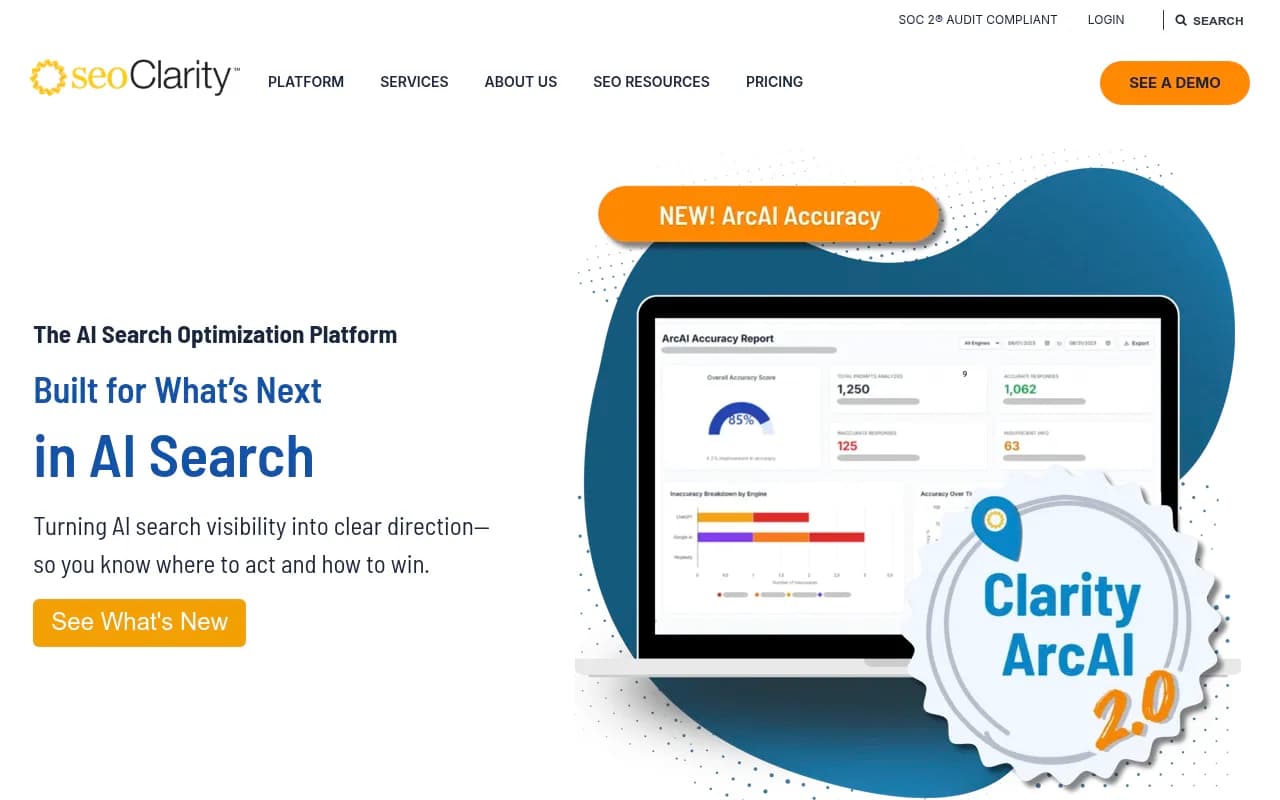
seoClarity has formalized hallucination detection as a named capability in its Clarity ArcAI product, surfacing alerts with the platform, query context and the specific false claim. If your organization already runs on seoClarity for classic SEO, this is a natural extension.
LLMClicks
LLMClicks pairs AI visibility tracking with hallucination detection and suits teams that want that function front and center.
Profound and Evertune
Both target large enterprises. Profound is strong on monitoring; Evertune positions itself for Fortune 500 GEO programs. Check whether either lets you move from a detected inaccuracy to a published fix without stitching together other tools.

PageCrawl.io
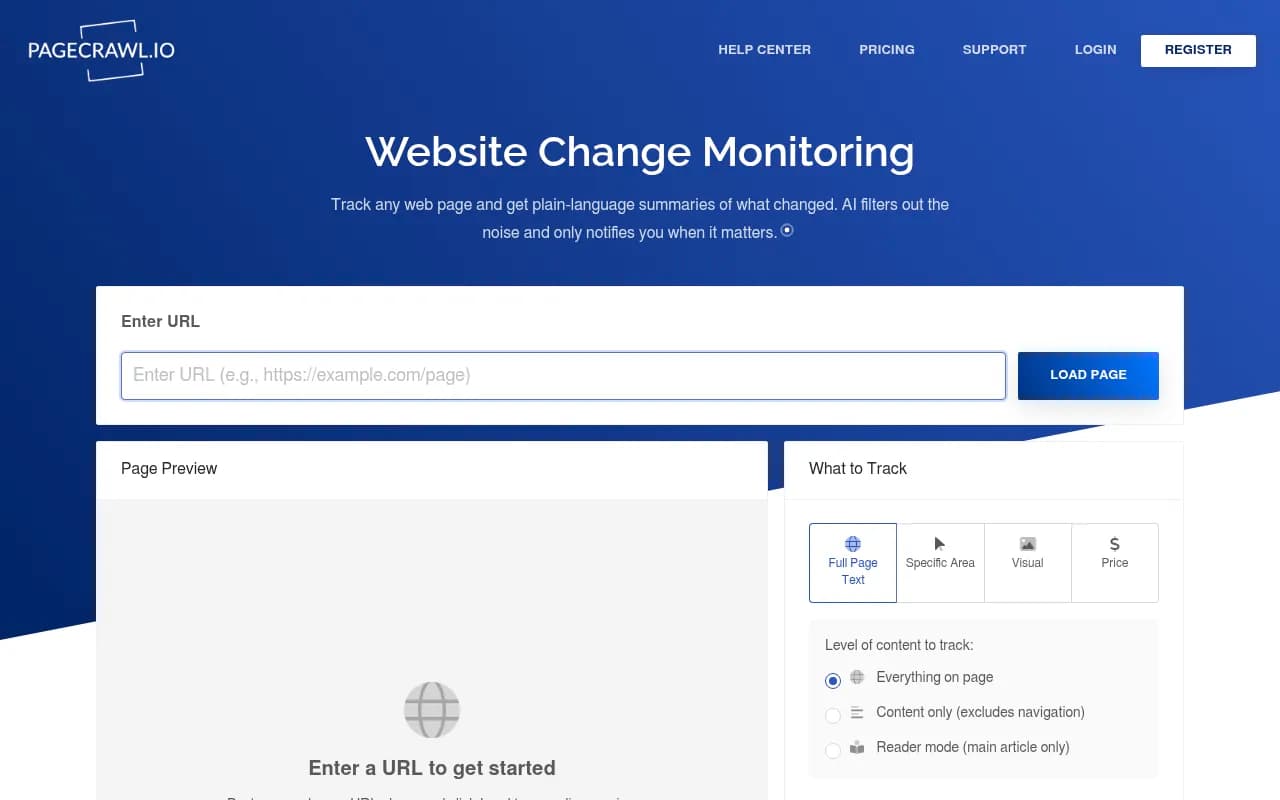
PageCrawl is not a GEO platform. It watches a URL for changes and flags substantive shifts, so you can paste in an AI answer page (for example a Perplexity search result about your brand) and get alerted when a claim changes. It is a cheap supplement, not a program.
For a wider survey of options, the directory at bestgeosoftware.com lists GEO platforms by category.
Governing your own AI-generated content
Monitoring outside AI is half the job. Enterprises scaling AI content production create a second risk: their own output feeds the web, and wrong claims in it end up in the sources AI engines retrieve from. Jasper's guidance makes this point about the feedback loop.
Practical controls:
- Ground generation in an approved knowledge base and brand book, not in the model's memory.
- Keep a human review step for anything touching pricing, compliance, medical or legal claims.
- Version and date your key facts pages so stale copies are easy to find.
- Audit generated content against the fact sheet before publishing.
Tools such as Writer and Jasper offer governed content workflows for this.
A simple severity framework
Not every wrong answer deserves the same response. Triage keeps the team sane.
| Severity | Example | Response time | Owner |
|---|---|---|---|
| Critical | Wrong compliance or safety claim, false "discontinued" statement | Same day | Legal, PR, comms |
| High | Wrong pricing or phantom feature in commercial prompts | Within a week | Product marketing, SEO |
| Medium | Outdated description or leadership info | Within a sprint | Content team |
| Low | Minor wording differences | Monthly review | SEO |
Track time-to-correct as a KPI. It is the closest thing to an honest measure of whether the program works.
Common mistakes
- Testing once. One prompt in one model on one day is an anecdote.
- Watching only visibility. A high mention rate with false claims is worse than a low one.
- Ignoring third-party sources. For branded prompts, reviews matter far more than their overall share suggests.
- Forgetting crawlers. If AI bots hit errors on your site, the model relies on whatever else it can find.
- No verification loop. Publishing a correction is not the same as the answer changing.
- Treating it as a PR problem only. Most fixes are content and technical changes.
Getting help from an agency
If your team lacks the capacity to run this, an agency can build the fact sheet, prompt set and remediation workflow. 1001 SEO Media runs GEO programs for brands and uses Promptwatch for AI visibility tracking, with no long-term contracts and transparent monthly reporting.
The bottom line
AI brand safety comes down to a loop: define the true facts, sample many prompts across models and markets, extract the claims, trace each wrong one to its source, correct that source, and re-test. The numbers from Promptwatch Data explain why the loop matters. Branded prompts rely on a short list of sources, and landing, docs and pricing pages stay cited for months. Start by asking ChatGPT, Gemini and Perplexity about your own pricing today. If any answer is wrong, you already know where the program begins.