Key takeaways
- In August 2026, sites with domain rank 46-75 earned 46% of ChatGPT citations, per Promptwatch Data. DR 91-100 averaged just 4.4% for the month.
- DR 91-100 slid from about 7% in week one to about 3% after August 14. Most of the lost share went to DR 61-75 and DR 46-60.
- You do not need a top-tier domain to get cited. You do need the right page types, a clear entity, and mentions on sites that sit around DR 61-90.
- Product pages, landing pages, and listicles earn the bulk of ChatGPT citations, so your commercial pages matter more than your blog.
- Treat the numbers as a snapshot. One month of data, one shift on August 14, and a DR source the report does not name.
What the data actually says
The headline is easy to repeat and easy to misread, so here are the numbers. Promptwatch's report covers August 1-31, 2026, and includes the 89.65% of ChatGPT citations whose domain has a known rank. The other 10.35% are excluded.
| Domain rank group | Average share of ChatGPT citations (Aug 2026) |
|---|---|
| DR 61-75 | 23.4% |
| DR 46-60 | 22.6% |
| DR 76-90 | 18.9% |
| DR 0-15 | 6.3% |
| DR 91-100 | 4.4% |
Add the two middle buckets and DR 46-75 comes to 46%. DR 61-90 held about 42% all month. DR 0-45 together took almost a third. Thibaud Guenneuguès pointed to the same figures in a LinkedIn post, and it matches the report.
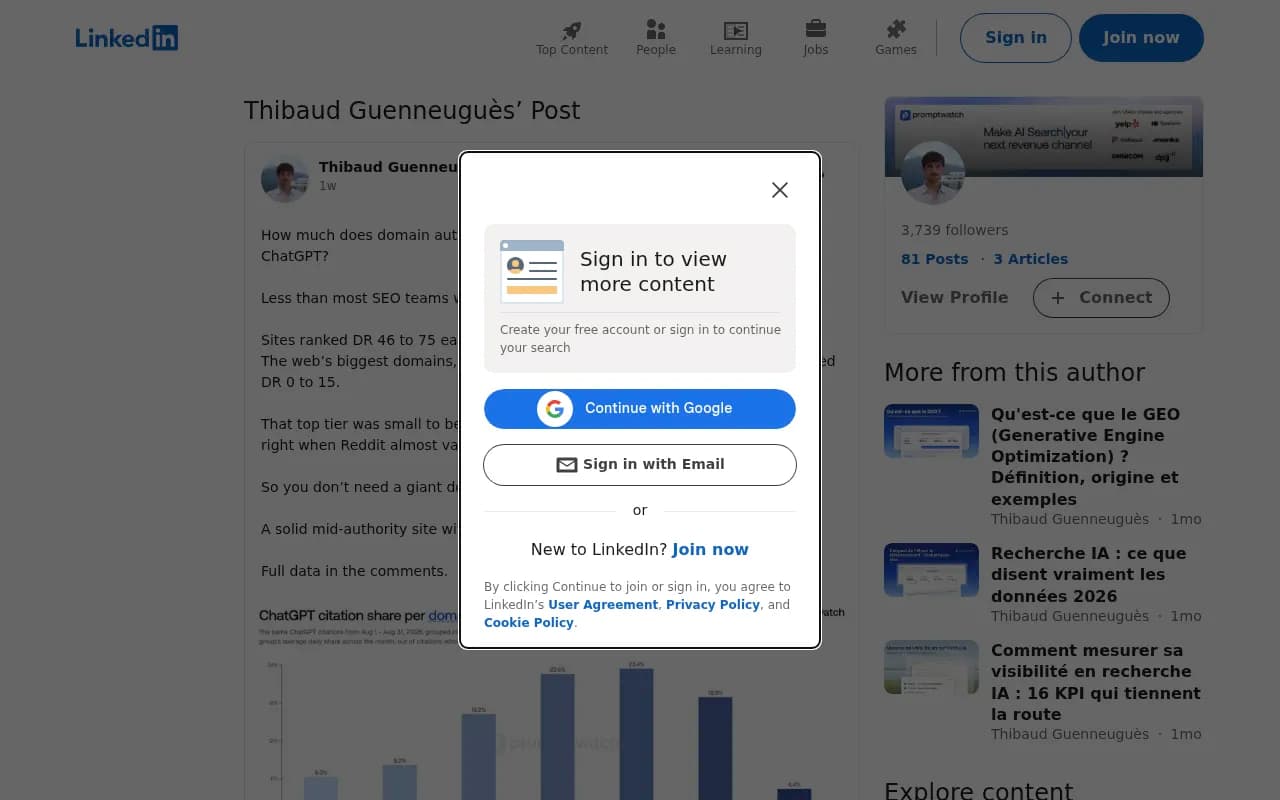
Two things I find worth sitting with. First, the biggest domains in the world, the ones every PR team chases, got less than DR 0-15 sites did on average. Second, that is partly a mid-month artifact. DR 91-100 started August near 7%, dropped to about 5% on August 8, and fell to about 3% on August 14, where it stayed.
The August 14 shift
August 14 is the same day reddit.com's share of ChatGPT citations collapsed from roughly 4% to 0.5%. Promptwatch's Reddit citation report covers that drop. Reddit is a very high-authority domain, so it is plausible that a chunk of the DR 91-100 decline is Reddit leaving. The report itself does not state that causal link, so I would treat it as a likely contributor rather than a proven cause.
There was also a behavior change on August 8, when ChatGPT began using the site: operator at scale. Promptwatch's fan-out data shows site: queries jumping from about 0.4% to about 17% of fan-out queries overnight. That is the same date DR 91-100 first stepped down. Again, correlation, not a confirmed explanation.
Why mid-authority sites win here
Domain authority still matters, just not the way it did in classic Google SEO. Third-party studies disagree on how much, which is a useful reminder to be careful:
- Profound is cited in a social post as finding 63.6% of ChatGPT citations going to domains between DR 20 and 80.
- A Reddit write-up of a 129K-citation analysis claimed sites with 32K+ referring domains were 3.5x more likely to be cited than small sites.
- Wellows' 20.5M-citation study concludes authority matters but no longer decides who gets cited.
I have not verified those studies, and they use different authority metrics, so they do not neatly reconcile. Read them as directional. The Promptwatch August data is the cleanest recent view of share by rank bucket, and it says the middle is where the volume is.
A simple explanation: there are far more mid-authority sites that publish specific, useful pages about products, tools, and services than there are giant domains. ChatGPT runs many searches per response, and almost half of its responses cite 10 or more unique domains. That is a lot of slots, and a big brand cannot fill all of them.
Winston Digital's playbook ranks the authority signals in this order: source domain authority, entity clarity, a named expert, and citation reciprocity. Their point that a strong domain with a buried answer loses to a smaller site that answers cleanly fits what the rank data implies.
Step 1: Find out where you sit
Before doing anything, check your own rank and your competitors'. Promptwatch's report does not name its rank source. It is most likely Ahrefs Domain Rating, but confirm before you benchmark against it.
Pull your DR (or the equivalent from Moz or Semrush, knowing the scales differ) and the DR of the five sites that actually get cited for your core prompts. If most of them sit between 46 and 75, you are competing in the range that earns the most citations. If you are below 45, you are not locked out. That group still took almost a third of citations in August.
Tools worth a look for this step:


For tracking which domains AI actually cites in your category, Promptwatch can show citation sources by prompt and where your pages land in the source list.

Step 2: Fix your page types before your authority
Authority is slow to move. Page type is something you can change this week. Promptwatch's content type report (Sep 28 to Oct 4, 2026) breaks down what ChatGPT cites:
| Content type | Share of ChatGPT citations |
|---|---|
| Product pages | 22.4% |
| Landing pages | 16.8% |
| Listicles | 13.6% |
| How-to guides | 8.7% |
| Documentation | 7.5% |
| General articles | 6.1% |
| Comparisons | 5.9% |
| News | 5.7% |
| FAQ | 3.3% |
| Reviews | 1.7% |
Product and landing pages together take 39%. For commercial prompts, product pages, landing pages, listicles, and comparisons make up almost 70% of citations. If your site is mostly blog posts, you are playing for a minority of the pie.
Practical changes:
- Make every product or service page answer a specific question in its first sentence. State what it is, who it is for, and what it costs or how it is priced.
- Build landing pages for each use case or segment you serve, not one generic page.
- Add an FAQ page. It is only 3.3% of citations, but it is cheap and hits branded prompts (4.8% there).
- Keep documentation public and crawlable. Docs take 7.5% overall and 8.5% for informational prompts.
- Write comparison pages honestly. They are 7.9% of commercial citations.
Content durability matters too. In Promptwatch's half-life data, landing pages and docs stayed cited longest while news lost half its pages within 36 days. For a mid-authority site, evergreen commercial pages are a better investment than news-style posts.
Step 3: Get into the roundups ChatGPT already cites
Listicles are 13.6% of all citations and 15% for commercial prompts. You rarely win those by publishing your own. You win by being listed on the ones other sites publish.
Promptwatch's recommendation is to aim PR and guest content at DR 61-90 sites rather than the very biggest publications. That is sensible. A placement on a DR 70 industry site is more likely to be a source ChatGPT pulls from than a DR 95 outlet that the model now cites far less often.
A workable process:
- List the prompts a buyer would ask in your category.
- Record which "best of" and comparison pages ChatGPT cites for each.
- Filter to DR 46-90 and see who publishes them.
- Pitch for inclusion, offer data or a product demo, and collect reviews on trusted review sites.
Tools that help find the cited sources and outreach targets:

Step 4: Make your entity easy to understand
Winston Digital lists entity clarity second after domain authority. In practice, that means ChatGPT should be able to tell who you are and what you do from multiple places. Consistent naming, an About page with real facts, schema markup, a named author with a verifiable profile, and third-party mentions that repeat the same description.
Structured data is the cheapest part of this. If you run WordPress, a plugin covers most of it:
Step 5: Check that AI can actually reach your pages
Mid-authority sites often lose citations to something dull: blocked crawlers, JavaScript-rendered content, or errors AI bots hit and nobody sees. Check robots.txt, server logs, and rendering before writing a single new page.
If you want to see which AI crawlers are visiting and which pages they read, Promptwatch's IP-verified crawler logs do that. Promptwatch's AI crawler traffic data gives a benchmark for what normal looks like by crawler.
Step 6: Track and adjust
Because the DR distribution moved inside a single month, a one-time audit will go stale. Track a fixed set of prompts daily, note your visibility and your citation rank, and watch for shifts around model updates. A platform that also writes and publishes content against your gaps shortens the loop, which is the main reason I would pick a tracker with an action layer over a monitoring-only one. The GEO software directory at bestgeosoftware.com lists the options if you want to compare.
| Job | What to use | Examples |
|---|---|---|
| Check your DR and competitors' | Backlink or SEO suite | Moz Pro, Semrush |
| Track AI citations by prompt | AI visibility platform | Promptwatch, Profound, Otterly.AI |
| Find cited source pages | Citation research | MentionBird, Promptwatch |
| Fix crawl and rendering | Technical SEO | Screaming Frog, Prerender.io |
| Add structured data | Schema tooling | Schema App, Yoast SEO |


What not to conclude from this data
A few cautions, because this is easy to oversell.
- It is one month. Share by rank group changed inside August. By the time you read this, the split may differ.
- It describes share of citations, not your odds. A DR 60 site with a thin page does not beat a DR 95 site with the best answer.
- DR 91-100 domains are few in number. Their 4.4% average is spread across a small group, so each individual large site may still outperform a typical mid-authority one.
- The 4.4% is a monthly average. The end-of-month level was about 3%.
- The rank source is not named, so your numbers may not map exactly.
Also, do not read this as a reason to stop link building. Promptwatch's own advice is more modest: do not wait for a top-tier DR before investing in AI search, put less weight on the biggest-site placements, and benchmark against the DR 46-75 range where most of your competition sits.
A 30-day plan
- Week 1: Record your DR and the DR of the sites cited for your top 20 prompts. Run a crawl check.
- Week 2: Rewrite your top five product or landing pages so the answer sits in the first sentence. Add FAQ and schema.
- Week 3: Build a target list of DR 61-90 sites that publish roundups in your category. Send pitches.
- Week 4: Re-check citations for your tracked prompts, note what moved, and repeat with the next five pages.
That is unglamorous work. It is also the work that fits a data set where the middle of the authority range, not the top, collected almost half of the citations.