MentionBird Review 2026
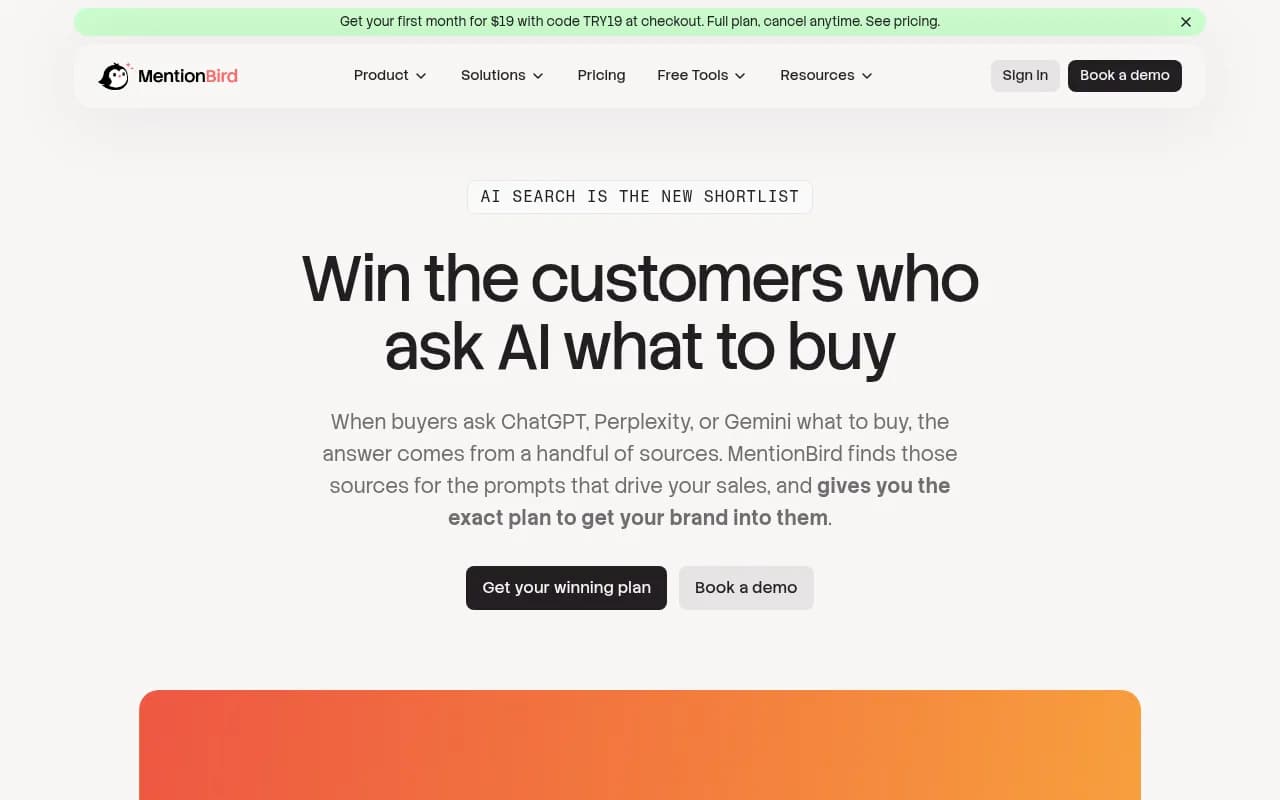
Shows which pages ChatGPT, Gemini, Perplexity, and Claude cite in your niche and explains why competitors get recommended instead of you.
Key takeaways
- MentionBird is a genuinely useful AI visibility tracker with a clear differentiator: it doesn't just chart your mentions, it gives you a per-prompt action plan ("get featured in trusted roundups," "add fit details to product pages") with effort and impact ratings.
- Pricing starts at $79/mo (Starter), but that plan only tracks ChatGPT and Gemini. Perplexity and Claude require the $299/mo Growth plan, and Grok, Google AI Overviews, Copilot, and DeepSeek are locked behind a custom-quote plan.
- There's no free trial or free tier. The $19 first month (code TRY19) is the closest thing to a test drive.
- It's a monitoring-and-advice tool, not an execution platform. Compared to Promptwatch, it lacks AI crawler logs, AI traffic attribution, content generation with CMS publishing, Reddit/YouTube citation tracking, ChatGPT Shopping insights, and query fan-out analysis.
- Best for: founders and small marketing teams who know they're invisible in AI answers and want a prioritized to-do list, not another dashboard.\n
What MentionBird actually does
MentionBird sits in the crowded AI visibility space, but it leads with a question most competitors dodge: not "are you mentioned?" but "what do I do to get mentioned?" You pick the prompts your buyers actually type ("best running shoes for daily use," "best ATS for small business"), and MentionBird checks AI answers daily, showing which sources get cited, whether you're in them, and where competitors are winning instead.
The core loop is three steps. First, you add prompts, either manually or via the built-in prompt research tool, which suggests questions buyers ask and scores each one for difficulty (1-10) and search volume (1-10). Second, the platform runs those prompts across its supported models and shows you the cited sources: domains, source types (news, forums, review sites), content formats (listicle, comparison, how-to), and even domain authority for cited sites. Third, and this is the selling point, the ranking-advice agent reviews the answers, named brands, and citations, then produces a concrete plan: get featured in trusted roundups (high impact, medium effort), publish a comparison guide, add product details AI can quote.
That last step is where MentionBird earns its keep. Most AI visibility tools hand you a chart and a shrug. This one hands you a to-do list.
Where it works well
The prompt-level granularity is good. You see, for a single prompt, exactly which pages AI trusts: a Runner's World roundup, a REI expert-advice article, a specific YouTube channel. That's actionable in a way aggregate visibility scores aren't. If you're cited in one source but missing from the three that matter most, you know precisely where to focus.
The metrics go deeper than a simple mentioned/not-mentioned flag. You get prominence score (how high in the answer you appear), average position, share of voice against named competitors, rank among brands, and 365-day history. You can read the actual AI answers, not just scores. Brand aliases and misspellings are grouped automatically, which sounds minor until you've watched a tool count "Nike" and "nike shoes" as different brands.
The testimonials ring true because they're specific. One founder realized he was winning category questions but losing comparison questions, which is backwards for a buying decision. Another found that when AI named his brand, it ranked near the top, but AI only named him in half the answers. Those are the kinds of diagnoses you can actually act on.
Pricing, and where it gets awkward
Starter is $79/mo ($66/mo annual) and includes 100 prompt runs per day, one brand, five competitors, ten team members, and 100 agent credits monthly. Growth is $299/mo ($249/mo annual) with 400 daily runs, three brands, ten competitors each, and 500 credits. Custom is quote-based.
Here's the catch, and it's a big one: Starter only tracks ChatGPT and Gemini. If your buyers use Perplexity or Claude, and many do, you need Growth. Want Grok, Google AI Overviews, Copilot, or DeepSeek? That's Custom, meaning a sales conversation. The platform-gating feels aggressive for a tool whose homepage advertises "daily checks across ChatGPT, Gemini, Perplexity, Claude, Grok, Google AI Overviews, Copilot, and DeepSeek" as a headline feature.
A "run" is one prompt on one platform once daily, with no rollover. Agent credits are a separate metered allowance: each ranking plan costs 5 credits, so Starter's 100 monthly credits cover roughly 20 plans. Extra credits run $99 per 500. You can stack +50 daily runs for $49/mo.
There's no free trial. The FAQ is blunt about why: every crawl costs them money. Fair enough, but it means you're paying to find out if the tool fits. The TRY19 code ($19 first month) softens this, and at that price it's worth a look before committing.
Strengths and limitations
Strengths:
- Per-prompt action plans with effort and impact ratings, not just dashboards
- Strong prompt research: AI-suggested questions, difficulty and volume scores, country-specific prompts
- Detailed citation analysis: source types, content formats, domain authority, page-level detail
- Daily tracking with 365-day history and readable AI answers
- Automatic competitor discovery and brand-alias grouping
- Reasonable entry price relative to competitors like Peec AI ($95/mo Starter)
Limitations:
- Platform gating: ChatGPT and Gemini only on Starter; four of the eight advertised platforms require a custom plan
- No free trial or free tier
- Runs reset daily with no rollover; agent credits are a separate, finite allowance
- No AI crawler logs, so you can't see when or how AI bots actually visit your site, or what errors they hit
- No AI traffic attribution: you see mentions, but not whether those mentions drive clicks or conversions
- No content generation or CMS publishing; the advice is a plan you execute manually
- No Reddit or YouTube citation tracking as dedicated reports, no ChatGPT Shopping insights, no query fan-outs
- Zero G2 reviews and a very recent launch mean you're betting on an unproven product
Who it's for
Founders and lean marketing teams at e-commerce, SaaS, and service businesses who suspect AI is recommending competitors and want a clear, prioritized fix list. If you're a solo operator or two-person team who will actually work through the ranking advice, the Starter plan at $19 for the first month is a low-risk experiment. Agencies managing many clients will chafe at the brand limits (one brand on Starter, three on Growth) and the credit metering.
If you need to understand why you're invisible, not just that you're invisible, and you want crawler logs, traffic attribution, and automated content execution, Promptwatch covers the full stack: it shows which of your pages AI crawls and cites, tracks actual visitors and conversions from AI platforms, and its content agents can write and publish GEO-optimized content to your CMS. MentionBird tells you what to do; Promptwatch helps you do it and proves the traffic impact.
Bottom line
MentionBird is a smart take on AI visibility that correctly identifies the gap in most competitors: charts don't fix anything, plans do. The ranking-advice agent is a real differentiator, and the prompt-level citation detail is genuinely useful. But the platform gating is frustrating, the credit system adds mental overhead, and the absence of crawler logs, traffic attribution, and any execution capability means you're still doing the hard part yourself. For teams that want monitoring plus advice and are happy to execute manually, it's worth the $19 first month. For teams that want to close the loop from insight to published content to measured traffic, Promptwatch is the stronger choice.
Frequently asked questions
What is MentionBird?
How does MentionBird work?
Which AI platforms does MentionBird track citations from?
Who is MentionBird for?
Why do AI chatbots recommend my competitors instead of me?
How much does MentionBird cost?
Does MentionBird offer a free plan?
What is AI visibility monitoring?
How is MentionBird different from traditional SEO tools?
Can MentionBird help me get cited by ChatGPT and other AI chatbots?
Similar and alternative tools to MentionBird